
How to Tailor Crisis Messages for Stakeholders
When a crisis hits, the way you communicate can make or break your organization’s trust and reputation. Different groups - employees, customers, investors, and regulators - have unique concerns, and addressing them effectively requires clear, targeted messaging. Here’s how to deliver the right information to the right audience:
- Act fast: Deliver an initial response within the first hour to prevent speculation and misinformation.
- Know your audience: Identify primary stakeholders (those directly affected, like employees and customers) and secondary stakeholders (influential parties, like regulators or media).
- Tailor your message: Employees need reassurance and direction, customers want updates on service impact, investors focus on financial risks, and regulators require factual compliance details.
- Stay consistent: Use a single core message across all communication channels, adjusting tone and content to suit each audience.
- Choose the right channels: Use internal platforms for employees, social media and websites for customers, and formal reports for investors and regulators.
- Balance speed and accuracy: Acknowledge the crisis quickly, share verified facts, and be transparent about uncertainties.
Clear, honest, and audience-specific communication builds trust and helps your organization navigate crises with confidence.
Understanding Stakeholder Perspectives in Crises | Exclusive Lesson
How to Identify Your Stakeholder Groups
Before crafting crisis communication, it's critical to identify all relevant stakeholder groups. This includes those directly impacted, those involved in resolving the issue, and those who can influence public or regulatory outcomes [1][7]. Overlooking a key group can leave an information gap - and if your organization doesn’t address it, someone else might [6]. Clear identification lays the groundwork for focused and effective communication.
Primary vs. Secondary Stakeholders
Primary stakeholders are individuals or groups directly affected by the crisis or essential to your operations. These include employees, customers, management, and others facing financial loss, illness, or property damage [1][6]. Employees play a dual role - they are both an internal audience and a channel for spreading information [6]. A case in point: after the January 2003 explosion at West Pharmaceuticals' Kinston, North Carolina facility, the company prioritized employees by sharing detailed updates on work schedules, temporary locations, and benefits to support them through the crisis and ensure business continuity [6].
Secondary stakeholders, on the other hand, are not directly impacted but hold significant influence. This group includes the news media, government officials, regulators, and suppliers [1]. Nearby communities may also need immediate safety updates during emergencies [6]. Research indicates that it takes three to four positive, credible sources to counteract the impact of one negative source during a crisis [7].
Once these groups are clearly defined, creating a visual map of stakeholders can help refine your communication strategy.
Using Stakeholder Mapping to Prioritize Communication
Stakeholder mapping is a key tool for prioritizing communication and efficiently allocating resources. This process evaluates each group's influence, the urgency of their information needs, and the legitimacy of their involvement [8]. One effective approach is the Power/Interest Grid, which categorizes stakeholders based on their level of influence and concern about the crisis [8].
Mapping can also segment audiences by location, demographics, and sentiment, enabling you to tailor messages with precision [8]. For example, after the 9/11 tragedy in September 2001, American Airlines used its corporate intranet to communicate directly with employees while relying on the media to handle broader public messaging [6]. Assigning specific internal teams - such as HR for employees or Legal for regulators - to manage communication with each stakeholder group ensures accountability and speeds up response times [1].
As Vincent T. Covello explains:
"The overarching goal of crisis communication is to enhance understanding while building trust and influencing the behavior of your target audience." [7]
Effective mapping also accounts for the fact that stress can lower people's ability to process information. To overcome this, messages should be simple, clear, and repeated across multiple channels to cut through the "mental noise" caused by anxiety [7]. These examples highlight how thorough stakeholder identification and mapping strengthen your crisis response strategy.
What Each Stakeholder Group Needs During a Crisis
When a crisis hits, it's critical to tailor your communication to meet the unique and immediate needs of each stakeholder group. Employees require timely updates about safety, policy changes, and guidance on remote work so they can understand the situation and communicate effectively with others [9]. Customers want clarity on how the crisis might affect service delivery or product availability, along with a clear outline of steps being taken to address the issue [1][9]. Meanwhile, investors and shareholders are focused on updates about the crisis's progression, its financial implications, and strategies to protect the company's reputation and long-term value [9].
Across all groups, communication must be clear, accurate, and honest. Acknowledge uncertainties while explaining the steps being taken to gather and verify information [1][10]. As Ready.gov emphasizes:
"The need to communicate is immediate when an emergency occurs. Many different audiences must be reached with information specific to their interests and needs." [1]
These varying needs shape the expectations that should guide your crisis communication strategy.
What Employees, Customers, and Investors Expect
Each stakeholder group has distinct expectations during a crisis, shaped by their relationship with your organization.
- Employees seek reassurance and operational clarity. They need to know they are safe and understand how to continue their work effectively.
- Customers value trust and expect timely updates on services, insights into how they may be impacted, and a clear timeline for resolution.
- Investors focus on stability and leadership. They expect detailed assessments of financial impact, proactive strategies to manage reputation, and regular progress updates.
Paul Kirvan, an independent consultant, highlights the risks of poor communication during a crisis:
"A lack of communication about the crisis can be almost as serious as the crisis itself." [9]
Maintaining a steady flow of information - even when there’s no new update - is essential. Pre-prepared templates that can be quickly customized and centralized information hubs with FAQs ensure consistent and accurate messaging across all audiences [1].
How to Address Common Questions and Concerns
Anticipating and addressing common concerns is key to building trust and maintaining confidence. Create targeted FAQs and scripts for your contact center staff to ensure consistent responses to inquiries from customers, suppliers, and the media [1].
Adopt a two-way communication approach: share updates while actively listening to stakeholder feedback and adjusting your messaging accordingly [1][10]. Clearly distinguish between confirmed facts and ongoing investigations to maintain credibility [11]. Transparency about ongoing inquiries, along with actionable advice for stakeholders, helps restore a sense of control [10]. FEMA underscores this point:
"Recognize the public's right to know the risks that it faces as well as protective actions that it can take, and plan for the prompt sharing of this information." [10]
Use clear, simple language and acknowledge the emotional toll a crisis can take. Studies show that people may need to hear health-risk messages 9 to 21 times to fully understand the risks involved [11]. Repeating critical information across multiple channels is vital, especially since stress often hampers the ability to process information during high-pressure situations.
sbb-itb-8feac72
How to Write Messages for Each Stakeholder Group
Crisis Communication Strategy by Stakeholder Group
Crafting messages for different stakeholder groups requires adjusting tone and content without compromising the core facts and values of your message. The objective is to address each group's specific concerns while ensuring consistency across all communication channels.
Adjusting Tone and Content for Different Audiences
Employees need messages that combine empathy with clear direction. Acknowledge the human impact first, then share operational details to maintain morale and reduce uncertainty [4][10]. For instance, in April 2018, Starbucks CEO Kevin Johnson used LinkedIn to address a racial bias incident at a Philadelphia store. He publicly apologized, announced immediate action, and closed over 8,000 U.S. stores for a day to provide racial bias training to 175,000 employees. This approach helped rebuild trust [14].
Customers value transparency, especially regarding how a crisis affects them directly. Use simple, actionable language and avoid technical jargon to ensure accessibility for all [4][10]. The tone should be honest and proactive, demonstrating that you understand their concerns and are actively working to address them.
Investors and shareholders prioritize financial clarity and risk management. Communicate professionally, using relevant data and a tone of decisive leadership [4][14]. Given that 97% of Fortune 500 CEOs use LinkedIn, it’s an effective platform for reaching high-level decision-makers during crises [14]. Share specific details about the crisis's financial impact and your strategy to safeguard long-term value.
Regulators require formal, fact-based communication that confirms compliance. Messages should be technical and precise, including clear documentation of events and the steps you’re taking to meet regulatory requirements [1][4].
Regardless of the audience, all tailored messages should align with a consistent core message to avoid confusion or mixed signals.
Building a Consistent Core Message
While you adapt tones for different audiences, the core message must remain consistent across all platforms. This consistency builds trust and ensures clarity, especially since only 49% of U.S. companies have a formal crisis communication plan [12][2][13].
Develop templates with placeholders for specific details to maintain alignment with your organization’s values and crisis response goals [1]. A centralized review process helps ensure tailored messages reflect the official stance before they’re released [1].
Follow the 5 Cs of Communication: Concern, Commitment, Competency, Clarity, and Confidence [5]. As Plante Moran puts it:
"Credibility is your currency." [3]
Designate a single spokesperson to deliver all external and internal communications. This ensures a unified voice and prevents mixed messages [12][2]. The spokesperson becomes the face of your crisis response, reinforcing the core message through repeated, coordinated communication.
Engage in two-way communication by listening to stakeholder feedback and refining your messaging accordingly [1][14]. For example, Starbucks demonstrated this approach in early 2024 by committing to town hall meetings and transparent third-party mediation during unionization efforts. By mid-2024, this strategy led to a signed agreement that included wage increases and improved scheduling, restoring public trust [5].
This framework of consistent messaging strengthens credibility and ensures stakeholders remain confident in your organization during challenging times.
Stakeholder Message Comparison
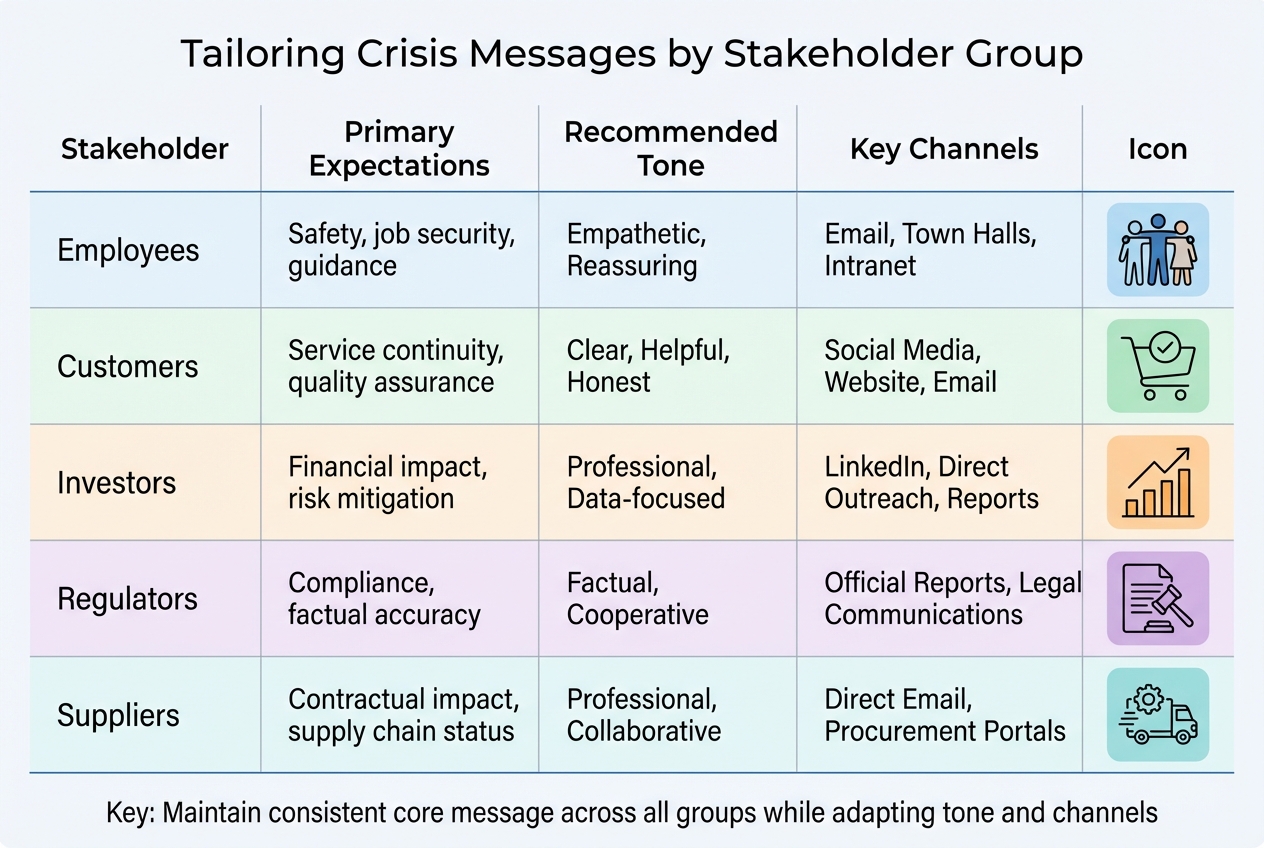
Each stakeholder group has unique expectations and requires a tailored communication strategy. Here’s a side-by-side comparison:
| Stakeholder | Primary Expectations | Recommended Tone | Key Channels |
|---|---|---|---|
| Employees | Safety, job security, guidance | Empathetic, Reassuring | Email, Town Halls, Intranet |
| Customers | Service continuity, quality assurance | Clear, Helpful, Honest | Social Media, Website, Email |
| Investors | Financial impact, risk mitigation | Professional, Data-focused | LinkedIn, Direct Outreach, Reports |
| Regulators | Compliance, factual accuracy | Factual, Cooperative | Official Reports, Legal Communications |
| Suppliers | Contractual impact, supply chain status | Professional, Collaborative | Direct Email, Procurement Portals |
Tailor your message delivery to suit the culture of each platform. For example, Reddit favors detailed, evidence-backed posts, Twitter works best for concise and empathetic updates, and LinkedIn is ideal for professional, long-form communications [13][14]. While the tone and format may change, the facts should remain consistent. LinkedIn’s professional tone makes it a strong platform for official statements, while Twitter’s immediacy is better suited for real-time updates and quick acknowledgments.
Choosing the Right Communication Channels
Selecting the right communication channels during a crisis is crucial for managing the narrative and maintaining trust. The key is to tailor each channel to the unique needs of your audience while ensuring a balance between speed and accuracy.
Matching Channels to Stakeholder Groups
For employees, rely on internal platforms like email, intranets, and bulletin boards to share clear safety updates and instructions. These channels serve as a single, reliable source of truth. In more urgent situations, using multiple internal channels at once ensures that critical information reaches everyone promptly.
Customers turn to digital platforms for updates during crises. Social media, your company website, and staffed call centers provide quick reassurance and enable two-way communication. To stay ahead, prepare "dark pages" - pre-designed, unpublished sections of your website that can be activated during emergencies. These pages help deliver accurate information while minimizing the risk of misinformation from unofficial sources.
Investors and the media expect formal and professional communication. Press releases, LinkedIn updates, and official reports are ideal for maintaining the tone these groups expect. A designated spokesperson is essential for ensuring consistent messaging, especially given the demands of a 24/7 news cycle.
Regulators require direct and documented communication. Secure email, official reports, and phone calls provide the traceability and formality needed to meet legal and compliance obligations during a crisis.
A strong crisis communication strategy also combines two key elements: "contact centers" (like staffed help desks and phone lines) for handling inquiries and "information centers" (such as websites and intranets) for distributing updates. Aligning these channels with stakeholder needs strengthens the overall effectiveness of your communication efforts.
How to Balance Speed with Accuracy
Once channels are chosen, timing and precision become critical. The 15-20-60-90 rule offers a clear guideline: acknowledge the situation within 15 minutes, share initial facts within 20 minutes, outline action steps within 60 minutes, and provide a detailed briefing within 90 minutes [15]. This framework allows for a rapid yet credible response.
However, speed should never compromise accuracy. When details are still emerging, it's better to acknowledge what is known and be transparent about what remains uncertain. As FEMA advises:
"Accept uncertainty and ambiguity, and acknowledge the potential need to act before all the facts are known." [10]
This openness reduces speculation and prevents misinformation from filling the void.
Pre-approved message templates with placeholders for specific details can further streamline communication across channels while maintaining consistency.
Additionally, keep stakeholder contact lists updated with accurate information, including phone numbers, email addresses, and preferred contact methods. With these in place, your team can quickly reach the right people when every second counts. Research shows that companies with structured crisis management protocols recover 30% faster from adverse events than those without [15].
Finally, monitoring real-time stakeholder sentiment through social media tools can help identify where misinformation might be spreading. This allows you to adjust your communication strategy swiftly and effectively.
Conclusion
Crafting crisis messages that resonate is essential for maintaining trust and steering outcomes effectively. During a crisis, heightened stress and emotions can cause people to process information at a level far below their usual capacity [7]. Using simple, direct language and tailoring messages to specific stakeholders can help break through these psychological barriers.
Once needs are identified and messaging is customized, a unified communication strategy becomes indispensable. Effective crisis communication relies on three key elements: understanding stakeholder needs, sticking to a consistent core narrative, and choosing communication channels that align with audience preferences. As crisis communication expert Covello explains:
"The overarching goal of crisis communication is to enhance understanding while building trust and influencing the behavior of your target audience." [7]
For technical leaders, these skills are particularly crucial. Translating complex technical issues into clear, relatable messages bridges the gap between technical knowledge and stakeholder expectations. With 86% of consumers now expecting companies to take actions beyond just their products and services [16], your crisis response must address operational concerns while also reflecting the priorities of your audience.
Preparation is key. Pre-approved message templates, up-to-date stakeholder contact lists, and well-trained spokespersons ensure your organization can respond quickly and accurately when a crisis arises.
It takes three to four positive credible sources to counteract the impact of one negative credible source during a crisis [7]. Your initial communication sets the stage, and maintaining consistent, accurate messaging across all groups safeguards your credibility in uncertain times.
FAQs
How does stakeholder mapping enhance crisis communication?
Stakeholder mapping is a crucial tool for organizations navigating a crisis. It helps identify and classify key individuals or groups based on their level of influence, interest, and the type of information they need. This approach allows for communication strategies that go beyond a generic, one-size-fits-all method.
By pinpointing each stakeholder's concerns, preferred communication platforms, and how often they need updates, organizations can ensure that the right messages reach the right people at the right moments. This not only strengthens trust but also improves understanding and enables quicker, more coordinated actions.
For tech-driven organizations like Tech Leaders, this process might involve categorizing stakeholders such as internal teams, investors, partners, and the developer community. For example, engineers might receive updates via Slack, while partners stay informed through newsletters. Using these tailored communication methods ensures everyone stays aligned and engaged, paving the way for more effective and collaborative crisis management.
What are the best ways to communicate with different stakeholders during a crisis?
To communicate effectively during a crisis, it's crucial to adapt your approach to meet the needs of each stakeholder group. Here's how you can ensure your message is clear and reaches the right people:
- Employees and internal teams: Keep your team informed with tools like email alerts, an intranet or crisis-response portal, and real-time platforms such as Slack or Teams. These channels not only deliver instant updates but also allow for two-way communication, so employees can ask questions or share concerns.
- Customers and the public: Use a variety of channels to share updates. This might include banners on your website, posts on social media, and SMS or phone alerts for urgent information. The goal is to make it easy for your audience to stay informed, no matter where they are.
- Media outlets: Formal press releases remain key for reaching journalists, but you can also host briefings or conference calls to provide deeper context. A dedicated media-relations webpage can serve as a hub for updates and resources.
- Investors and regulators: Share detailed updates through secure methods like email or investor portals. For more complex situations, live webcasts with Q&A sessions can help address specific concerns directly.
- Local communities and emergency partners: In areas with limited digital access, traditional channels like radio, TV, and printed materials are essential for spreading critical information.
By blending digital and traditional communication channels, you can ensure your message is delivered promptly and effectively, helping to maintain trust during challenging times.
How can you ensure both speed and accuracy in crisis communication?
Balancing speed and accuracy during a crisis is all about delivering clear, fact-checked updates as quickly as possible. This approach helps maintain trust and demonstrates that the situation is under control. However, even minor mistakes in communication can damage credibility and worsen the crisis.
One way to prepare is by creating a messaging playbook ahead of time. This playbook should include concise templates and a simplified fact-checking process. Designate a verification lead who can confirm critical details - like the scope of the issue or immediate next steps - within minutes. Start with a short acknowledgment message to let stakeholders know you're aware of the situation. Once the facts are verified, follow up with a more detailed update. Make sure to adapt the delivery method to fit the preferences of each audience, such as using internal channels for employees or secure portals for regulators.
When communicating with specific groups, address their unique concerns. For instance, partners like Tech Leaders may want to know how the crisis affects engineering timelines or product quality. By sharing accurate, timely updates in stages, you can keep everyone informed while preserving trust.