
Top Skills for Cross-Functional Team Leaders
Cross-functional teams combine expertise from different departments to tackle complex projects. Leading such teams requires specific skills to manage challenges like communication gaps, conflicting priorities, and diverse work styles. Here's a quick summary of the key skills every cross-functional leader needs:
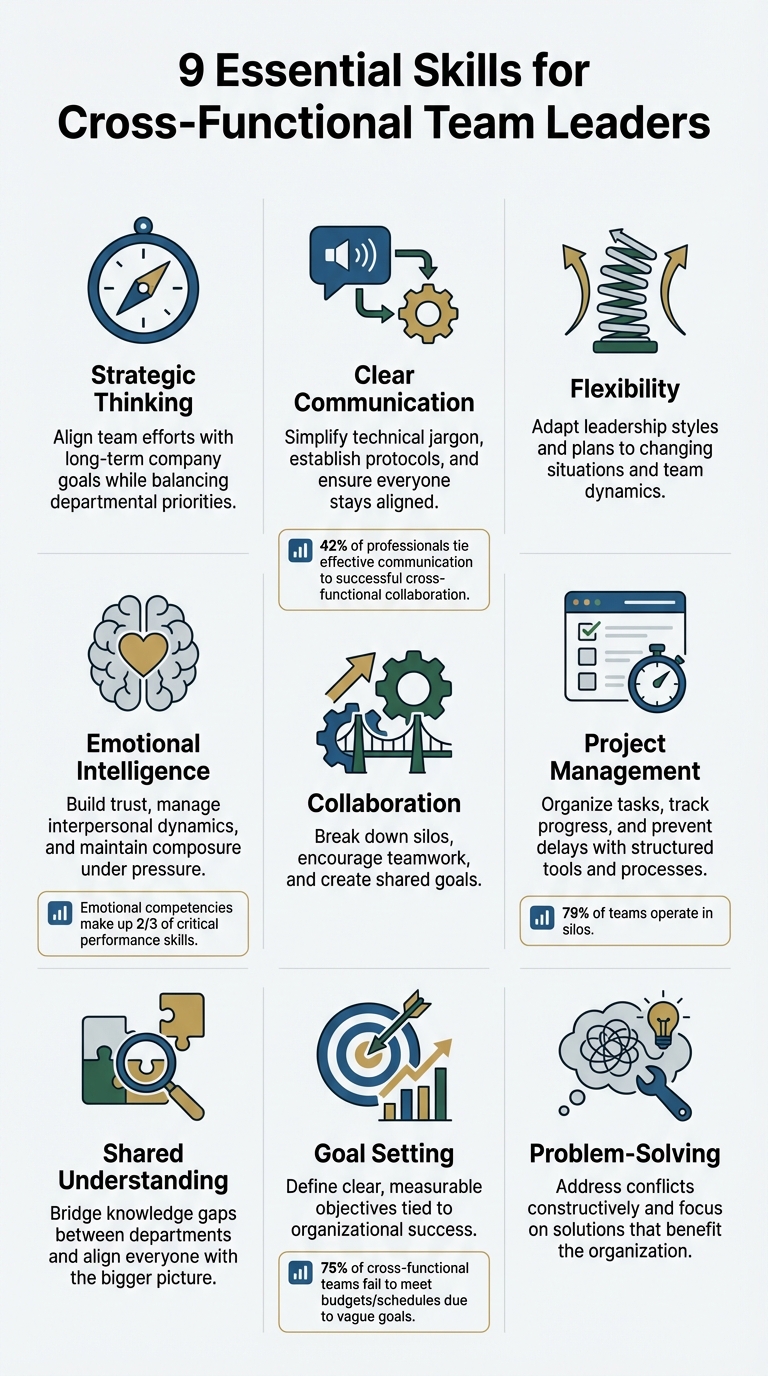
- Strategic Thinking: Align team efforts with long-term company goals while balancing departmental priorities.
- Clear Communication: Simplify technical jargon, establish protocols, and ensure everyone stays aligned.
- Flexibility: Adapt leadership styles and plans to changing situations and team dynamics.
- Emotional Intelligence: Build trust, manage interpersonal dynamics, and maintain composure under pressure.
- Collaboration: Break down silos, encourage teamwork, and create shared goals.
- Project Management: Organize tasks, track progress, and prevent delays with structured tools and processes.
- Shared Understanding: Bridge knowledge gaps between departments and align everyone with the bigger picture.
- Goal Setting: Define clear, measurable objectives tied to organizational success.
- Problem-Solving: Address conflicts constructively and focus on solutions that benefit the organization.
Mastering these skills can turn potential challenges into opportunities for success, ensuring your team works efficiently and achieves its goals.
9 Essential Skills for Cross-Functional Team Leaders
How to Manage a Cross-Functional Team
1. Strategic Thinking and Decision-Making
Cross-functional leaders need to think beyond their immediate responsibilities and connect their projects to the organization’s long-term goals. This means making decisions that align with the company’s broader objectives rather than just addressing short-term departmental needs. By doing so, leaders set the tone for clear and purposeful decision-making that drives progress in the right direction [3][5].
One of the toughest parts of this role is juggling competing priorities from various departments. Each team has its own objectives, and it’s up to the leader to balance these conflicting demands while keeping the organization’s shared vision front and center. A key to gaining departmental support is showing how a project benefits not just the company but also each specific team. When leaders clearly outline these benefits, departments are much more likely to provide their resources and backing [7][8].
This balancing act also helps optimize how resources are distributed. Leaders can pinpoint which tasks are critical for achieving organizational goals and allocate staff and budgets accordingly. To ensure alignment, it’s important to set clear deliverables at every stage that directly tie back to the company’s objectives. This keeps everyone focused on the mission [7].
Breaking down the organization’s vision into actionable steps with specific timelines is another crucial step. This ensures that every team member understands their role and how it contributes to the larger strategy. Tools like project management software can help maintain transparency, track progress, and ensure resources are allocated effectively [8]. Regular check-ins, such as alignment audits, are essential to confirm that the team’s efforts remain on track with the long-term vision and prevent any drift [3].
This strategic groundwork is the backbone of effective communication, collaboration, and problem-solving - key skills for any cross-functional leader.
2. Clear Communication
Leading a cross-functional team means navigating a maze of specialized languages. Engineers talk in terms of APIs and algorithms, marketers focus on conversion funnels and brand strategies, while legal teams zero in on compliance frameworks. With everyone operating in their own world, ensuring clear communication becomes critical. In fact, 42% of professionals tie effective communication to successful cross-functional collaboration, and nearly half believe it’s the main driver of productivity [3]. To overcome these challenges, you need deliberate strategies to bridge these departmental divides.
The first step? Break down the jargon. Organize sessions where team members from different departments explain their key terms and processes [11]. Miscommunication isn’t just frustrating - it’s expensive. For a company with 200 employees, siloed communication can cost up to $1.5 million annually, with teams spending roughly 15% of their workday untangling these issues [14]. To address this, appoint cross-team liaisons or "champions" who can act as translators between technical and non-technical groups [12].
"Communicate, communicate, communicate... science tells us that people need to hear a message at least six times before it truly sinks in." – Srima McQuillan, Transformation and Change Executive [13]
This highlights the importance of repeating messages, but not just for the sake of repetition - tailor them to resonate with each department. For example, during one digital transformation project, a senior leader created a short video demonstrating how the new system worked. This simple step eased fears among non-technical staff, making the transition smoother [13]. Similarly, Company XYZ, a consumer electronics giant, scheduled biweekly sync-ups between their R&D and marketing teams. These sessions allowed technical challenges to be discussed alongside consumer feedback, resulting in smoother product launches [12].
Finally, establish clear communication protocols. Use urgent email subject lines like "IMMEDIATE ACTION REQUIRED", tag team members with @mentions for quick context, and maintain a centralized digital hub to serve as your single source of truth [12][14]. These steps ensure that everyone stays on the same page, no matter how specialized their focus might be.
3. Flexibility in Approach
Cross-functional teams bring together individuals with a variety of work styles. Whether you're working with technical experts, creative thinkers, financial analysts, or sales professionals, each group requires a tailored leadership approach. A rigid, one-size-fits-all style simply doesn’t cut it. To lead effectively, you need to adjust your approach based on both the team members and the situation at hand. This kind of adaptability is key when navigating the diverse methods and mindsets within such teams.
Flexibility becomes even more critical when project requirements shift. In fast-moving environments, unexpected challenges often arise - market conditions can change, budgets might shrink, or emerging technologies may force a strategy overhaul. Leaders who stay composed and adjust their plans without losing sight of the ultimate goal help their teams remain focused and productive during these transitions [2]. As Matthew Johns from Thomas.co explains:
"Adaptability and flexibility are paramount for cross-functional leaders, to respond to market changes, technological advancements, new laws and government guidelines, and new trends" [5].
Interestingly, 75% of cross-functional teams are labeled dysfunctional due to unclear governance and lack of accountability [17]. This often happens when leaders lean too heavily on formal authority, especially when they lack direct control over team members from other departments. A better approach is to shift from commanding to influencing. Building trust-based relationships ensures that your priorities naturally align with the team’s goals [17]. As Birkman insightfully points out:
"Influence begins in the other person's perspective" [17].
To lead effectively, consider creating agile strategies that "zoom in and out" - translating broad, high-level visions into actionable steps that make sense to everyone involved [2][17]. This approach allows leaders to delegate responsibilities confidently without resorting to micromanagement.
Steer clear of micromanaging by trusting your team members to handle their core responsibilities. Focus on clearing obstacles, providing necessary resources, and staying adaptable. When circumstances change, evaluate the situation, consult your team, and pivot as needed to stay on track with your overarching goals [2][3][7].
4. Emotional Intelligence
Emotional intelligence (EI) plays a key role in leading cross-functional teams effectively. Managing a group of professionals from different departments - engineers, marketers, finance experts, and sales teams - means navigating a maze of priorities, workflows, and pressures. EI helps you recognize these challenges and handle the interpersonal dynamics that naturally arise in such collaborations. As Daniel Goleman puts it:
"EI is the ability to recognize our feelings and those of others, to motivate ourselves, and to handle our emotions well to have the best for ourselves and our relationships" [18].
In fact, emotional competencies make up two-thirds of the most critical performance skills worldwide [18]. When you lack formal authority over team members from different departments, building trust becomes essential. You can achieve this through honesty, transparency, and empathy [1]. Isabel Coronado-Maldonado from the University of Malaga emphasizes this point:
"Emotional intelligence involves understanding others in a social context in such a way that it enables one to detect nuances in emotional reactions and use this knowledge to influence others by controlling and regulating emotions" [18].
One of the most important aspects of EI is self-regulation, especially during high-pressure situations. Whether it’s a looming project deadline or unexpected budget cuts, maintaining your composure sets a tone of stability for the entire team. This steadiness helps foster a sense of psychological safety, ensuring that every team member feels heard and valued - even when tensions rise between departments with conflicting goals [19].
To improve your emotional intelligence, start by practicing active listening during team discussions to ensure all voices are included. Seek 360-degree feedback from peers and mentors to uncover blind spots in your emotional awareness. Additionally, schedule regular self-reflection sessions to fine-tune your leadership approach [19]. Establishing working agreements early on can also help address potential conflicts before they escalate into major issues [4]. These steps not only strengthen your leadership but also create a collaborative and respectful team environment.
5. Collaboration and Teamwork
After establishing clear communication, the next step in cross-functional leadership is fostering effective collaboration. This is essential for breaking down silos and uniting diverse teams.
Research underscores the importance of collaboration. A survey of over 3,500 managers by MIT Sloan Management Review and Deloitte revealed that companies excelling in digital transformation are far more likely to prioritize cross-functional teamwork [16]. However, McKinsey highlights a common obstacle: fragmented ownership of processes and information, which often stifles collaboration across departments [16]. As a leader, it’s your job to tackle these challenges head-on and encourage teamwork.
Start by identifying shared pain points across departments. According to Chad Dyar, Director of Enablement at OnDeck Capital:
"To make any cross-functional project work, you first have to get broad agreement around the core problem to solve" [16].
Gather input from all departments to pinpoint these challenges, then position your initiative as the solution. This approach not only addresses organizational goals but also demonstrates how the project benefits individual teams, making it easier to secure buy-in from department heads [1][16].
One way to bridge gaps between departments is by appointing "ambassadors" for each team. These representatives keep their departments informed and aligned. Before starting the project, establish clear working agreements that outline expectations for communication and conflict resolution. These agreements help the team stay on track and avoid unnecessary setbacks [4].
Don’t overlook the value of informal interactions. Hosting a social kickoff event - either in-person or virtual - can help team members connect on a personal level before diving into work [10]. Additionally, using tools like Slack or Asana can create a "virtual water cooler", promoting casual conversations and transparent data sharing [10]. Building trust through open and honest leadership is key, especially since cross-functional leaders often lack direct authority over team members. Instead of relying on control, lead with transparency and integrity [1][16]. Avoid micromanaging, as team members are likely balancing competing priorities from their own departments, and excessive oversight can harm morale [1].
sbb-itb-8feac72
6. Project Management Skills
Effective project management is the backbone of keeping cross-functional teams organized and on track. These teams often juggle different timelines, priorities, and deliverables, and without a clear structure, projects can easily lose momentum. Here's a striking fact: 79% of teams across organizations operate in silos, and 46% of professionals say poor business processes lead to manual errors and bad decisions [9]. Clearly, strong project management isn’t just helpful - it’s essential.
It all starts with proper planning and scoping. Defining your goals, success metrics, stakeholders, milestones, and deliverables upfront helps you stay focused and avoid scope creep. Tools like RACI charts are particularly useful here - they clarify who’s responsible for what, eliminate redundancies, and make handoffs seamless. As Sheryl Chopra, Project Manager at IPG Mediabrands, puts it:
"Having that visual representation in Asana makes it easier to move things around" [20].
Visual tools like Gantt charts are also game-changers. They connect task dependencies and highlight critical paths, making it easy to spot and address delays. Kanban boards and cross-functional flowcharts are equally effective for mapping out work stages and responsibilities, helping teams avoid bottlenecks and miscommunications. These visuals don’t just organize tasks - they set the foundation for clear, centralized communication.
Speaking of communication, consolidating everything into a single digital platform can make a world of difference. On average, employees toggle between 10 tools daily [9], which can slow collaboration. A unified platform streamlines this process. Features like @mentions and inline comments allow for quick problem-solving and transparent discussions. Jeana Abboud, COO at Social Factor, emphasizes the importance of this:
"Having executive oversight and insight into projects is key so we can quickly get up to speed on what is happening at any point" [20].
Another critical piece of the puzzle is managing team bandwidth. Workload management charts can help monitor resource allocation across departments, ensuring tasks are prioritized without overwhelming team members. This is vital because 75% of cross-functional teams struggle due to poor governance and accountability [21]. A structured approach to project management not only keeps your team productive but also prevents burnout.
7. Building Shared Understanding
Creating a shared understanding within a team goes hand in hand with effective communication and solid project management. It ensures that diverse groups stay aligned with the broader strategy.
Each team speaks its own language - engineers talk about sprints and APIs, marketers focus on funnels and conversion rates, while finance zeroes in on ROI and burn rates. Your job is to bridge these gaps, helping everyone grasp how their work fits into the bigger picture and how other teams contribute [1][6].
Start by identifying and discussing pain points across departments. Chad Dyar, Director of Enablement at OnDeck Capital, sheds light on this challenge:
"People who have spent years in silos may not be used to hearing about the challenges other departments face - or, even with good intentions, might not have the bandwidth to think much about them" [16].
Gather input from stakeholders about the hurdles their teams face and share these insights broadly. When team members understand why certain tasks take extra time or require additional steps, it reduces misunderstandings and friction. This mutual understanding lays the groundwork for clearly defined roles and agreed-upon communication practices.
Breaking down siloed practices also involves showing clear, team-specific benefits. When leaders see how initiatives directly benefit their department, they’re more likely to allocate resources and actively support the effort [1].
Another key step is setting up working agreements at the start of a project. Clearly outlining roles, responsibilities, and communication expectations can prevent confusion over accountability and minimize power struggles [4][6]. Visual tools, like flowcharts or process maps, can be particularly helpful in showing how various departments’ efforts connect, making the broader strategy easier to grasp. These tools, combined with clearly defined roles, help align everyone with the overall vision.
Additionally, using a "zoom in/zoom out" approach can be a game-changer [2]. Zoom in to dive into technical details when working with specialists, and zoom out to link those details to the larger strategy during executive discussions. This ability to shift perspectives ensures smooth information flow across teams and can help address the challenges faced by the 36% of workers who frequently encounter workplace conflict [9].
8. Setting Clear Goals and Metrics
Once you've got effective project management and team alignment in place, the next step is setting clear goals and metrics. Why? Because without specific, measurable objectives, cross-functional teams can lose focus. In fact, a study found that 75% of these teams fail to stick to budgets, schedules, or meet customer expectations - mostly due to vague goals and a lack of accountability systems [21].
To get it right, focus on outcomes instead of just outputs. Paula Cizek, Chief Research Officer at NOBL, puts it this way:
"When establishing metrics or signals of progress, teams should focus on desired outcomes (the thing that will be different, like increased market share), rather than outputs (the deliverables themselves, such as a new social campaign)" [22].
This approach shifts the team's attention to the bigger picture - what they're truly aiming to achieve - not just the tasks they're checking off.
Take WCF Insurance as an example. Between 2022 and 2024, their Small Business Assistance Team set a "Wildly Important Goal" to retain $3 million in premiums through outbound calls. By the first month, they had retained $200,000 and ended up exceeding their annual goal two months ahead of schedule. At the same time, their Finance Team applied a similar metrics-driven strategy to cut policy cancellations from 18% to just 10% [15].
But goals alone aren’t enough; the right infrastructure is critical. Start with a project charter that clearly outlines priorities, desired outcomes, timelines, and budgets [21]. Then, use tracking tools to monitor progress in real time. Without these systems, projects risk stalling out with unresolved tasks [22].
Lastly, make sure cross-functional goals are tied to performance reviews and even compensation structures [21]. This ensures that team members prioritize shared objectives. Also, establish decision-making authority early to avoid delays caused by endless debates over minor decisions [22]. Together, these steps keep everyone accountable and projects moving forward.
9. Problem-Solving and Conflict Resolution
Even with clear goals, disagreements are bound to arise when different departments have competing priorities. The trick isn’t to avoid conflict altogether - it’s learning how to handle it constructively. By building on clear communication and aligned objectives, resolving conflicts effectively can strengthen team cohesion.
Using shared values as a foundation, shift discussions from "who's right" to focusing on what best serves the organization [23][24]. As Ronke Majekodunmi, Director of Product Management, explains:
"The first thing to remember is that no one wakes up in the morning and says, I will make all the wrong decisions today, sabotage my teammates, and harm the organization. We all have the best intentions" [24].
When conversations are anchored around the organization's core mission, finding common ground becomes much easier.
As mentioned earlier, demonstrating the value of individual contributions can help align priorities. For instance, if a department leader sees how a project directly benefits their specific goals or KPIs, they’re more likely to allocate resources and resolve conflicts [1][7]. This requires understanding each stakeholder's challenges and framing the project’s benefits in terms that resonate with them. Mridula Kidiyur, Principal Product Manager at Walmart eCommerce, highlights this point:
"If you can understand where your team members are coming from, you can build stronger relationships and get everyone working together more harmoniously" [26].
Revisit the established working agreements [4][25]. These agreements, set early on, act as a guide to address conflicts promptly and prevent lingering resentment [25][4]. When discussing sensitive issues, use neutral, "I-focused" language (e.g., "I feel concerned when deadlines slip") to avoid defensiveness. Pair this with active listening - summarizing the other party’s perspective before responding - to ensure everyone feels heard [23][25].
Lastly, collaborate with stakeholders to create solutions together. Teams are more likely to implement and support solutions they’ve helped design [25]. Allowing a brief cooling-off period can also be helpful, giving everyone time to reflect and approach the situation thoughtfully rather than emotionally [23]. By combining these approaches with earlier collaboration strategies, constructive conflict resolution can significantly boost team performance.
Conclusion
Leading cross-functional teams successfully requires a blend of vision, structure, effective communication, and emotional intelligence. These elements, when combined, can significantly enhance team performance. As Benjamin Walker, a Leadership Development Coach, aptly states:
"A cross-functional team can be your company's greatest asset if it's managed properly" [4].
Cross-functional teams play a critical role in many organizations, and clear communication is often highlighted as a key factor for their success [3]. By fostering trust and delegating responsibilities effectively, you empower team members to take ownership of their roles, leading to higher morale and improved efficiency. Additionally, embracing adaptability and problem-solving equips leaders to handle unexpected challenges without derailing progress. These strategies provide a strong foundation for reflecting on and refining your leadership approach.
Take a moment to assess your leadership style. Tools like 360-degree feedback or psychometric assessments can help identify your strengths and pinpoint areas where improvement is needed. These methods can also uncover gaps in trust or understanding across departments. Conducting a relationship audit can shed light on the goals and constraints of leaders in other teams, while regular one-on-one meetings can help address potential friction before it escalates.
Focus on developing one skill that aligns with your current challenges. Consider integrating shared tools like Asana or Microsoft Planner to create a unified workflow for your team. Establishing clear working agreements at the start of a project can also prevent miscommunication and set the stage for smoother collaboration.
FAQs
What are the main challenges of leading cross-functional teams?
Leading cross-functional teams can be incredibly rewarding, but it doesn’t come without its challenges. One of the toughest obstacles is getting everyone on the same page when it comes to priorities. Departments like engineering, marketing, and finance often have their own goals that don’t always align, which can make it tricky to steer everyone toward a common objective. On top of that, communication styles can vary wildly - from the language each team uses to their workflows and decision-making approaches. These differences can easily lead to misunderstandings and slow everything down.
Another hurdle is breaking through siloed thinking. When teams are used to working independently, collaboration doesn’t always come naturally. This can lead to inefficiencies or even duplicated work. To tackle this, leaders need to encourage open communication and establish a shared vision that everyone can rally behind. And let’s not forget the challenge of balancing diverse viewpoints. Different teams often have contrasting risk appetites and performance metrics, which can complicate decision-making. This is where strong facilitation skills make all the difference, helping to align the group and keep projects moving forward.
What strategies can cross-functional leaders use to manage competing priorities effectively?
To handle competing priorities effectively, cross-functional leaders should begin by setting a clear, shared goal that unites all departments around the same business objective. This goal should then be broken down into measurable milestones for each team, with an emphasis on how their efforts contribute to the bigger picture. Transparent communication plays a crucial role in maintaining alignment and addressing potential conflicts before they escalate.
Practical tools can make a big difference. For instance, using a visual priority board helps track initiatives, deadlines, and responsibilities at a glance. Decision-making frameworks, such as weighted scoring, can also be used to objectively evaluate and prioritize tasks. Creating an environment where team members feel empowered to flag misalignments and suggest solutions encourages collaboration and reduces the risk of siloed thinking. Consistently reviewing progress against shared metrics and celebrating achievements as a team can help maintain focus and boost morale.
Strong communication, negotiation, and strategic alignment skills are essential for navigating these challenges. Programs like those from Tech Leaders are designed to help professionals shift from technical roles into effective cross-functional leadership, especially in the rapidly evolving, AI-driven world.
How can leaders improve communication in cross-functional teams?
Effective communication in cross-functional teams begins with setting clear expectations and protocols. Leaders should outline how information will be shared, establish consistent terminology, and hold regular check-ins to keep everyone on the same page. Tools like shared dashboards and brief status updates can help make progress visible and accessible to all team members.
Equally important is fostering a culture of active listening and constructive feedback. Leaders can encourage team members to recap key points or clarify any assumptions to prevent miscommunication. These practices not only enhance collaboration but also break down silos and ensure the team stays aligned with its shared objectives.
For technical professionals transitioning into leadership roles, developing these communication skills is crucial. Programs like those offered by Tech Leaders provide targeted training to help bridge the gap between technical know-how and leadership capabilities, equipping individuals to effectively lead cross-functional teams in today’s AI-driven landscape.