

Ultimate Guide to Gamification in Change Training
Gamification transforms corporate training by adding game elements like points, badges, and leaderboards, making learning more engaging and effective. It boosts engagement, speeds up behavioral changes, and improves knowledge retention. For instance, gamified training achieves over 90% completion rates, compared to just 25% for traditional eLearning. Companies like McDonald's UK and Deloitte have seen measurable results, such as increased revenue and employee satisfaction, by using gamification for training.
Key Takeaways:
- Engagement: Gamification increases employee participation by 60% and fosters collaboration with social elements like team challenges.
- Behavioral Change: Employees adapt faster, with a 50% reduction in time-to-proficiency in some cases.
- Retention: Knowledge retention improves by up to 80%, thanks to interactive and memorable training experiences.
- Examples: Companies like Cisco, Deloitte, and SAP have successfully used gamification for onboarding, compliance, and process improvements.
Gamification works because it provides real-time feedback, encourages collaboration, and aligns training with psychological principles like the Testing Effect and dopamine release. By tailoring game mechanics to business goals and employee needs, organizations can drive meaningful change while keeping training engaging and effective.
Avoiding the Dark Side of Gamification in Employee Training
sbb-itb-8feac72
Benefits of Gamification in Change Training
Gamification taps into basic human needs - autonomy, competence, and connection - which helps keep employees engaged during periods of change [5]. When people feel they’re progressing by choice, developing new skills, and working alongside others, they’re more likely to stay committed, even during tough transitions.
The numbers back this up. Gamification can increase employee engagement by 60%, and 95% of employees say they prefer a gamified work environment [4]. This is a big deal, especially when 35% of workers find traditional virtual training disengaging - making it one of the top reasons employees mentally check out [4]. Engaged teams don’t just stick around - they’re 37% more productive and 92% more likely to innovate [6]. The business case for gamification is hard to ignore.
Let’s explore how gamification boosts engagement, speeds up behavioral shifts, and helps employees retain content better.
Increasing Employee Engagement and Motivation
Gamification motivates employees by providing real-time feedback, which reinforces positive behaviors during change initiatives [5][6]. This approach taps into the flow state, where challenges are perfectly balanced with skill levels - keeping boredom and frustration at bay [3].
Take Arion Bank in Iceland, for instance. Alma Hannesdóttir, the bank’s Training Director, introduced gamified, simulation-based training using the Attensi platform. Employees voluntarily completed modules an average of 7.7 times each, leading to a 95% closure of knowledge gaps across the organization. Hannesdóttir remarked:
Introducing gamification truly changed everything... seeing the results in black and white was like winning the lottery [4].
Another example is Deloitte's Leadership Academy, which incorporated missions, badges, and leaderboards for executive training. This resulted in a 46% increase in daily returning users and double the average session time on the platform [3].
Social elements like leaderboards and team challenges also play a big role. These features create a mix of friendly competition and collaboration, fostering accountability and a sense of community [5][3]. Striking the right balance between individual achievements and team-based goals is key - personal leaderboards encourage individual excellence, while team competitions encourage cross-departmental collaboration [3].
Speeding Up Behavioral Change
Gamification doesn’t just engage employees - it also helps them change behaviors faster. Research shows gamified training improves behavioral change by 9% and skill assessments by 14% [3]. This is because gamified scenarios mirror real-world decisions, allowing employees to practice in a risk-free environment before applying what they’ve learned on the job.
For example, Webhelp, a European BPO company, used the Centrical platform to gamify performance and microlearning for frontline agents. The results? A 50% faster time-to-proficiency for new hires and a 6% drop in short-term absenteeism [4]. By turning abstract concepts into hands-on challenges with immediate feedback, gamification bridges the gap between theory and practice.
The Peak-End Rule helps explain why this approach works. People tend to evaluate experiences based on their most intense moments and how they end. Gamification creates exciting peaks and satisfying conclusions, making change initiatives feel rewarding instead of overwhelming [3]. When employees associate training with positive outcomes, they’re less likely to resist change.
Improving Training Content Retention
Gamification turns dry material into memorable experiences, significantly improving retention. Studies show gamified training can boost knowledge retention by up to 80%, with a 40% higher skill retention rate on average [6][4]. This happens because game mechanics enhance how the brain processes information.
For example, correctly answering questions in a competitive setting releases dopamine, which reinforces memory [3]. This aligns with the Testing Effect, where retrieving information during quizzes strengthens neural connections more effectively than simply reviewing material [3].
The difference compared to traditional training is striking. 75% of traditional training content is forgotten within a week [4][5]. In contrast, gamified learning achieves 90%+ completion rates, compared to just 25% for traditional eLearning [3]. Features like challenges and leaderboards encourage repeated participation, transforming one-off lessons into ongoing practice sessions that solidify knowledge. This kind of retention is crucial for making long-term changes stick.
Game Elements for Change Training
Using game mechanics in training can turn routine sessions into engaging, interactive experiences. These elements go beyond simply ensuring compliance - they encourage active participation and measurable progress. Studies suggest that combining tools like badges, progress tracking, and feedback loops leads to the most effective outcomes [10].
It's important to recognize that employees are motivated differently. For instance, achievers are drawn to levels and progress metrics, socializers enjoy team challenges and peer recognition, explorers gravitate toward discovering hidden content, and competitors thrive on leaderboards and exclusive rewards [13]. Below, we explore key game mechanics that can make change training more impactful.
Points and Levels
Points offer instant feedback, helping employees see their progress in real-time. But not all points work the same way. Experience Points (XP) measure engagement, while Skill Points reflect competency, rewarding both participation and mastery [13][15].
Levels break the process of change into smaller, achievable stages. Employees can advance from beginner to expert, with early levels designed to deliver quick wins that build confidence and momentum [13][15]. To keep the system meaningful, points should be earned through skill application, not just by clicking through content.
Badges and Achievements
Badges act as visual markers of accomplishment and are particularly effective in boosting confidence and demonstrating competence [9][10]. For example, earning a badge for mastering new software or completing a challenging module can serve as both a personal achievement and a way to inspire peers.
In digital environments, badges can foster camaraderie or even friendly competition, as employees see what their colleagues have achieved [8]. To make badges more impactful, link them to real-world recognition, such as career milestones, public shoutouts during team meetings, or small rewards. While badges focus on individual success, leaderboards tap into social dynamics to further drive engagement.
Leaderboards and Competition
Leaderboards use social comparison to encourage participation. However, global leaderboards can sometimes discourage those who fall behind. A better approach is to use relative leaderboards, which display only nearby competitors, keeping the focus on achievable goals. Regular resets - weekly or monthly - give everyone a fresh start and prevent long-term disengagement [8][9][13][14].
Balancing individual and team-based leaderboards can promote both personal achievement and collaboration across departments. For those who may find competition stressful, offering an opt-out option ensures the experience remains motivating rather than overwhelming [13].
Scenario-Based Challenges
Scenario-based challenges bring training to life by encouraging active decision-making. Employees can apply what they've learned in simulated situations, such as high-risk transactions or safety incidents [11][16]. These scenarios often include branching narratives, where choices lead to immediate consequences, reinforcing the connection between decisions and outcomes.
For example, a cybersecurity simulation might task employees with protecting company data from a potential threat. These exercises not only make abstract concepts tangible but also provide instant feedback, helping to correct mistakes before they turn into habits [11][16]. As Mindstamp explains:
Gamification turns mundane training tasks into compelling challenges by tapping into our innate desires for competition, achievement, and social recognition [16].
Scenario-based challenges transform training into missions, making learning both practical and engaging.
How to Implement Gamification in Change Training
Getting gamification right starts with a solid plan. To make it work, you need to connect game elements directly to your business goals. As Gabe Zichermann famously said:
Gamification is 75% psychology and 25% technology [17].
This process involves thoughtful planning, tailoring the experience to your team, and refining it based on results. When done well, it creates a training experience that’s both engaging and effective.
Set Clear Objectives and Understand Your Audience
To make gamification meaningful, start by setting specific goals and understanding who you’re designing for. The key is to integrate game mechanics into actual work tasks rather than using them as standalone entertainment. For example, if compliance is your focus, award points for completing real-world procedural walkthroughs. If you’re targeting sales improvement, link challenges to actions like closing deals or mastering objection-handling techniques. Autodesk saw a 15% boost in sales conversions by aligning gamified training with practical sales behaviors [12].
Knowing your audience is just as important. Younger employees may enjoy competitive features like leaderboards, while seasoned professionals might prefer progress trackers or certifications that reflect their expertise. A pre-launch needs assessment can help pinpoint learning goals and employee preferences, ensuring the game mechanics resonate with your team.
Design Tailored Learning Paths
A one-size-fits-all approach rarely works in training. Employees have different roles, skills, and learning speeds, so it’s essential to personalize the experience. Use performance data to adjust challenges and offer content that fits individual needs. For instance, a logistics worker might benefit from timed simulations, while a customer service representative could benefit from interactive scenarios mimicking real conversations.
Providing content in multiple formats also helps cater to varied learning styles. Companies that adopt adaptive learning paths have seen completion rates jump from 32% to 67% [12]. Additionally, incorporating “safe failure” opportunities - where employees can retry tasks without penalties - builds confidence and enhances memory retention, all while reducing the fear of mistakes during real-world change initiatives.
Personalized training keeps employees engaged and paves the way for steady, measurable improvement.
Leverage Feedback and Continuously Improve
Real-time feedback is a game-changer when it comes to driving behavior change. Notifications for successes and errors help employees make immediate adjustments, creating a constant cycle of learning and improvement. Instead of waiting until the end of a module, feedback becomes part of the entire training experience.
To measure success, track metrics like time to proficiency and error rates. Testing gamified content with small pilot groups before a full rollout can help identify areas for adjustment. Be cautious not to overdo the gamification - too many game elements can distract from the core learning objectives. Finally, integrating your gamified training system with existing tools like LMS, CRM, or HR platforms ensures that training data is seamlessly tied to everyday workflows, giving managers a complete view of employee progress and development.
Examples of Gamification in Change Training
Gamification has become a powerful tool for organizations aiming to create meaningful change in areas like onboarding, compliance, and process improvement. Here are some real-world examples showcasing its effectiveness.
Case 1: Gamified Onboarding for Digital Transformation
Cisco revamped its traditional onboarding process with an interactive game designed to help new hires navigate their roles. This approach led to an impressive 150% improvement in content retention [19].
Cleveland Clinic tackled the challenge of training staff on new electronic health record (EHR) systems by introducing simulations and role-playing exercises. This gamified method cut training time in half and boosted staff proficiency by 40% [19].
Microsoft took a creative route with its "Minecraft Challenge." This initiative immersed new employees in the company’s culture, values, and product knowledge through gameplay [20].
While onboarding is a common focus, gamification has also proven effective in compliance training.
Case 2: Compliance Training Using Scenarios
Deloitte turned its financial and compliance training into a digital game, complete with points, badges, and leaderboards. This approach led to a 47% increase in engagement and a 30% improvement in knowledge retention [19]. Similarly, the Deloitte Leadership Academy incorporated a badge system, achieving a 75% course completion rate and reducing training time by 50% [18].
Siemens transformed mandatory safety training into a competitive game. Employees earned points and badges for completing modules and demonstrating their knowledge, which resulted in a 48% increase in engagement [19].
But gamification doesn’t stop at compliance - it also plays a role in streamlining processes.
Case 3: Employee Engagement in Process Improvement
SAP introduced a game-based system for product development. This initiative encouraged participation and resulted in a 70% implementation rate of ideas generated by employees [19].
Microsoft's Language Quality Game engaged employees across 100 languages to review over 900,000 translation strings. By incorporating leaderboards and achievement badges, this effort improved product quality and reduced translation costs [1].
Even a logistics company saw results by gamifying its onboarding process, achieving a 22% reduction in supervisor escalations within the first 60 days [11].
These examples highlight how gamification can deliver measurable outcomes, offering a practical way to drive engagement and success in change training.
Measuring Success of Gamified Change Training
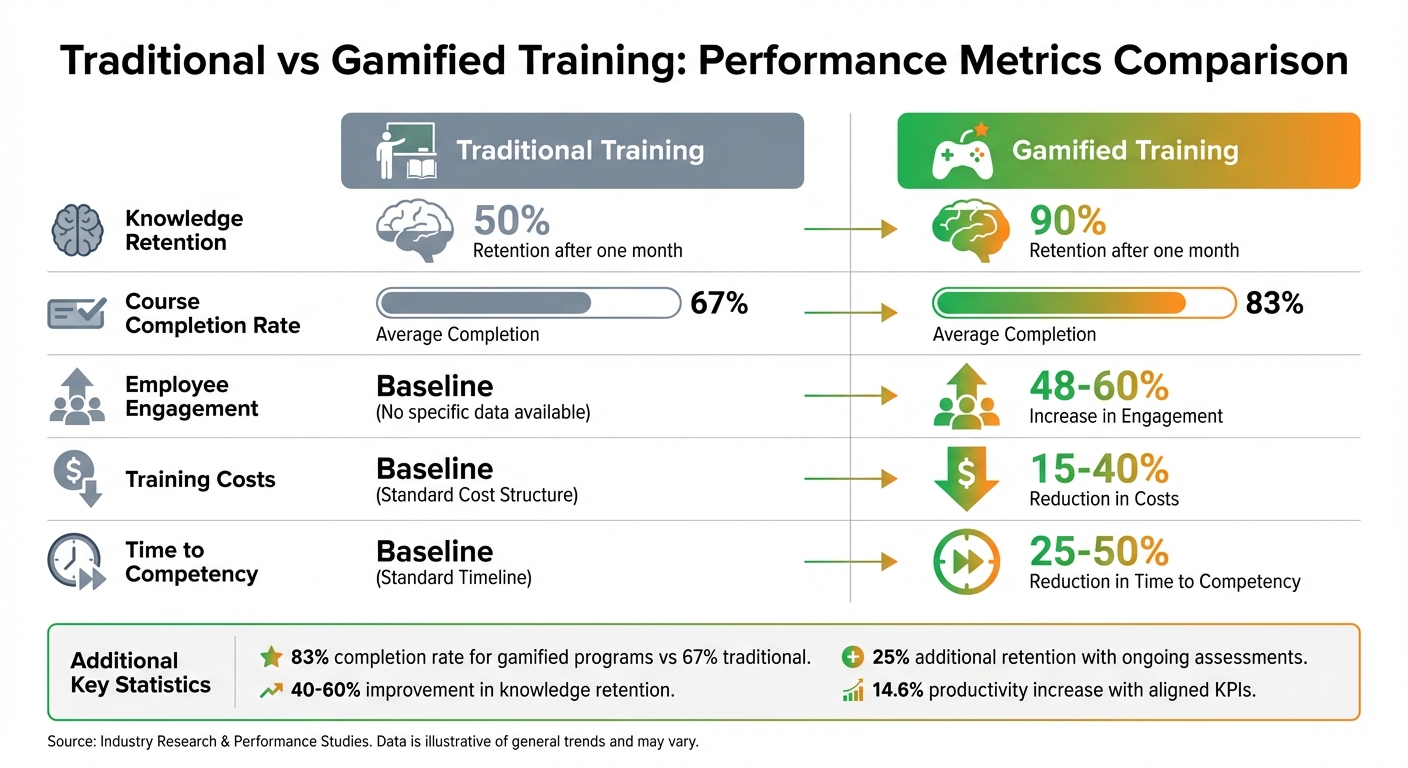
Traditional vs Gamified Training: Performance Metrics Comparison
To assess the effectiveness of gamified training programs, it's essential to track engagement and participation metrics. Key indicators include participation rates, course completion rates, and time spent on learning modules. These data points reveal how employees are interacting with the training content. For instance, gamified training programs boast an 83% completion rate, significantly higher than the 67% completion rate of traditional methods [22][23]. Additional insights can be gained by monitoring quiz participation, leaderboard activity, and forum contributions, which highlight how well game elements are resonating [22][23].
However, participation alone doesn’t tell the full story. The ultimate goal of training is behavioral change and skill application in real-world scenarios. To measure this, organizations should evaluate skill transfer, behavioral shifts, and productivity improvements. Research shows that gamified learning enhances knowledge retention by 40%–60% compared to traditional methods [24][21]. Moreover, incorporating ongoing assessments can increase retention rates by an additional 25% [23]. These metrics underline the importance of sustained behavioral change as the most meaningful indicator of success.
Another way to measure the impact is by comparing pre- and post-training results. Such comparisons validate improvements in engagement, retention, and overall performance. For example, gamified training has been shown to deliver a 48%–60% boost in engagement, reduce training costs by 15%–40%, shorten time to competency by 25%–50%, and improve employee retention by 34% [22][24][21]. TalentLMS highlights this sentiment with a compelling statistic:
83% of employees stated they would be more productive if their work included gamification [21].
Traditional vs. Gamified Training Metrics
| Metric | Traditional Training | Gamified Training |
|---|---|---|
| Knowledge Retention | ~50% [24] | 90% (after one month) [21] |
| Course Completion Rate | 67% [23] | 83% [23] |
| Employee Engagement | - | 48%–60% Increase [22][24] |
| Training Costs | - | 15%–40% Reduction [22][21] |
| Time to Competency | - | 25%–50% Reduction [24][23] |
The use of cloud-based LMS systems adds another layer of efficiency by enabling 24/7 monitoring and automatic certification [21][7]. These systems align key performance indicators (KPIs) - such as productivity levels and safety incident rates - with the goals of change initiatives. This alignment has been shown to drive a 14.6% productivity increase [21].
Conclusion
Gamification in change training taps into decades of psychological research to make learning both engaging and effective. By using principles like dopamine's role in memory, the Testing Effect, and Social Learning Theory, it turns complex organizational transitions into interactive experiences that encourage participation and continuous growth [3]. When designed carefully, gamification not only eases resistance but also delivers measurable improvements [2][1].
Take McDonald's UK, for example - their microlearning initiative achieved over 90% completion rates, significantly boosting revenue. Similarly, E.ON's interactive safety competition led to a 40% reduction in workplace incidents within a year. These examples highlight how gamified training can improve compliance, productivity, and onboarding efficiency [3][2].
For tech professionals navigating digital transformation, programs like those offered by Tech Leaders use gamification to drive meaningful change. The secret lies in avoiding surface-level rewards and instead linking recognition to genuine progress and mastery [3]. Incorporating team-based challenges, immediate feedback, and employee input into the design process can further enhance training success [2].
With the gamification market expected to hit $48.72 billion by 2029, growing at an annual rate of 25.85% [11], it’s clear this approach is reshaping how organizations handle change and employee development. Whether you're rolling out new tools, improving compliance, or revamping processes, gamification offers the psychological tools and practical strategies to turn resistance into engagement and create lasting behavioral shifts.
FAQs
How do I choose the right game mechanics for my change goals?
To pick the best game mechanics, hone in on methods that boost engagement and motivation. Features like progress and achievement systems can be particularly effective. Start by pinpointing what drives your audience - whether it's competition, collaboration, or the pursuit of mastery. Then, incorporate tools such as points, badges, or leaderboards to encourage desired behaviors. Make sure these mechanics align with your objectives, offer clear and measurable results, and include feedback loops to keep participants motivated and steadily moving forward.
How can we gamify training without it feeling childish or distracting?
To make training more engaging through gamification, it's crucial to focus on thoughtful design and functional mechanics that genuinely support learning. Incorporate elements like points, progress bars, and challenges that are directly connected to practical skills. Stay away from flashy but shallow features, and ensure rewards are both meaningful and motivating. By aligning gamification with your business objectives, you can create purpose-driven, interactive experiences that enhance learning without diluting the content or distracting participants.
What metrics best prove gamified training is working?
To measure how effective gamified training is, focus on these key metrics: engagement rates, knowledge retention, and learner satisfaction. Research highlights some impressive stats - gamification can increase engagement by 60% and improve retention by 40%. Plus, 90% of employees report they enjoy it more than traditional training approaches.
Beyond these, it’s also important to monitor behavioral changes and performance improvements. Use assessments and real-world scenarios to see how the training impacts employee growth and contributes to organizational goals. These insights can help you understand the full value of gamified learning.