

Understanding Emotional Intelligence in Workplace Politics
Emotional intelligence (EI) is the key to navigating workplace politics and improving your career. It’s about managing emotions - yours and others’ - to handle challenging interactions and foster better relationships. Research shows that EI accounts for 66% of the skills needed for professional success, often outweighing IQ and technical expertise.
Here’s the takeaway: EI isn’t fixed. You can build it by focusing on five areas: self-awareness, self-regulation, motivation, empathy, and social skills. These skills help you stay composed under pressure, resolve conflicts, and influence others effectively. For example, leaders like Satya Nadella and Indra Nooyi used empathy and emotional insight to transform their organizations, leading to significant growth and higher employee satisfaction.
In workplace politics, EI helps you read emotions, anticipate resistance, and address conflicts before they escalate. It also strengthens your influence and builds trust, creating a supportive environment. Companies that prioritize EI enjoy better performance, higher retention, and reduced toxicity.
To develop EI:
- Reflect on emotional triggers and patterns.
- Practice mindfulness to stay calm in tense situations.
- Use empathy to understand others’ perspectives.
- Build strong relationships by actively listening and offering support.
Emotional intelligence isn’t just a skill - it’s a powerful tool for thriving in complex workplaces.
Using Emotional Intelligence to Navigate Office Politics
What is Emotional Intelligence?
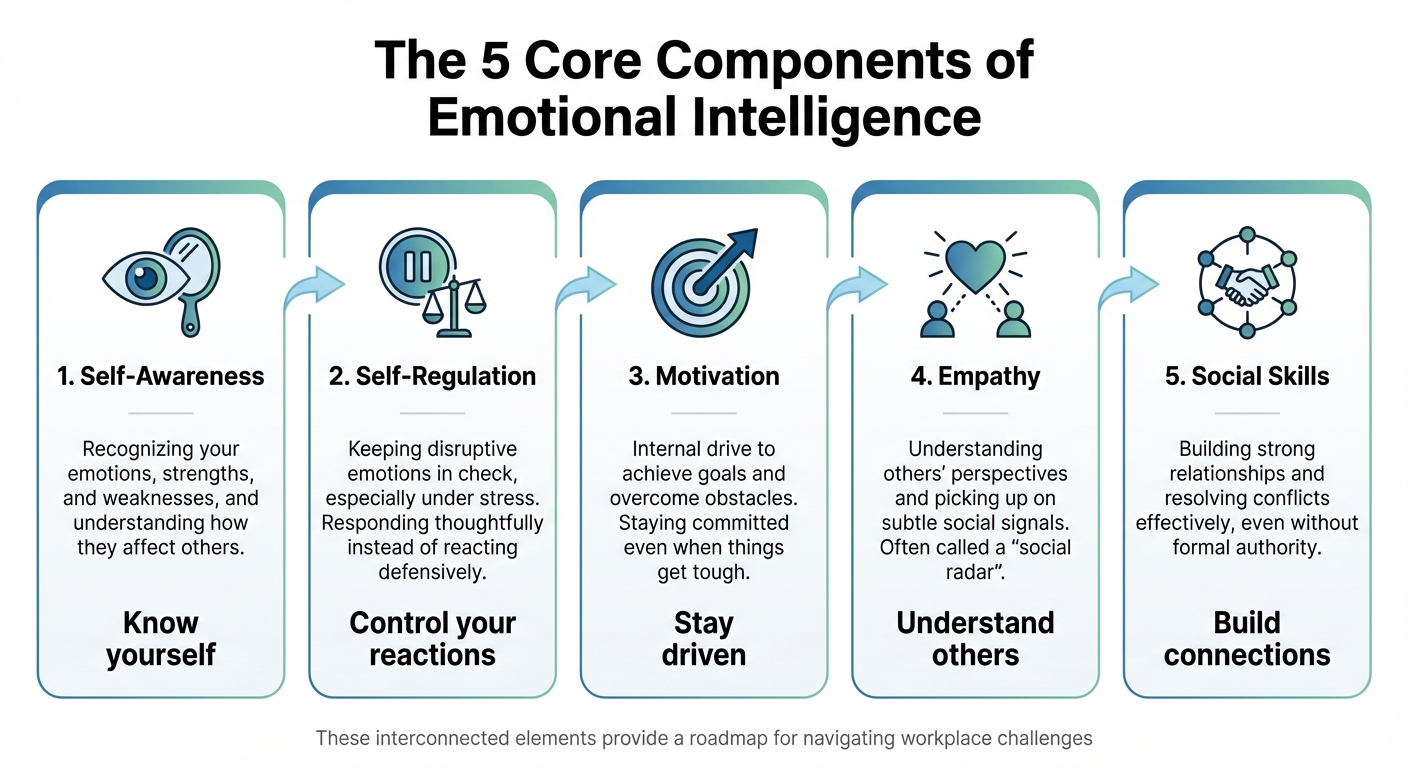
The 5 Core Components of Emotional Intelligence in the Workplace
Emotional intelligence (EI) is the ability to recognize and understand your own emotions, as well as those of others, and use that awareness to guide your thoughts and actions [1]. It's not about hiding emotions or always trying to please others - it’s about tuning into feelings and using that knowledge to make smarter decisions.
At its heart, EI blends logical thinking with emotional awareness [1]. In workplace dynamics, this means spotting emotional undercurrents that others might miss and addressing them effectively.
"Emotional intelligence is the subset of social intelligence that involves the ability to monitor one's own and others' feelings and emotions, to discriminate among them and to use this information to guide one's thinking and actions." – Salovey & Mayer [1]
Research highlights just how much EI matters. Emotional competencies account for 67% of what makes leaders effective [7]. In fact, EI is considered twice as important as IQ and technical skills when it comes to professional success [7]. A striking example is Satya Nadella's leadership at Microsoft. When he became CEO in 2014, he prioritized empathy and emotional intelligence within the company’s culture. The results? Microsoft’s market value soared from $300 billion to over $2 trillion by 2021, employee engagement rose by 145%, and the share price increased by 400% over six years [8].
Let’s dive into the five key elements of EI and understand how they shape workplace interactions.
The 5 Core Components of Emotional Intelligence
Daniel Goleman identified five interconnected elements of emotional intelligence, offering a roadmap for navigating workplace challenges with skill and understanding:
- Self-awareness: This is about recognizing your emotions, strengths, and weaknesses, and understanding how they affect others. Without self-awareness, managing your reactions becomes a challenge.
- Self-regulation: The ability to keep disruptive emotions in check, especially under stress. For example, instead of reacting defensively to criticism, you respond thoughtfully.
- Motivation: A deep, internal drive to achieve goals and overcome obstacles. This isn’t about external rewards but staying committed even when things get tough.
- Empathy: Often called a "social radar", empathy helps you understand others' perspectives and pick up on subtle social signals - an essential skill for navigating workplace dynamics [7].
- Social skills: Building strong relationships and resolving conflicts effectively, even without formal authority. Whether it’s mediating between departments or fostering team collaboration, social skills are key.
These components are backed by extensive research into how emotions influence behavior.
The Science Behind Emotional Intelligence
Emotions are not random - they are quick, organized responses designed to help us deal with challenges [1]. For instance, anger can drive us to confront unfair situations, while anxiety alerts us to potential risks.
Scientists break emotional intelligence into two types: "crystallized intelligence", which refers to knowledge about emotions, and "fluid intelligence", which involves solving emotional challenges in the moment [1]. Together, these skills help you navigate emotional dynamics effectively.
Mayer and Salovey’s research outlined four branches of emotional ability:
- Perceiving emotions: Recognizing emotions in facial expressions and vocal tones.
- Using emotions: Leveraging feelings to enhance problem-solving or creativity.
- Understanding emotions: Decoding how emotions evolve and their cause-and-effect relationships.
- Regulating emotions: Managing both your own and others' emotions to encourage growth, like calming a tense discussion [1].
Additional concepts further explain how EI works in practice:
- Emotional aperture: The skill of reading the overall emotional tone of a group, which helps in gauging collective reactions.
- Authenticity detection: Spotting the difference between genuine emotions and controlled displays, which builds trust during workplace interactions.
The impact of EI isn’t just theoretical - it’s measurable. Companies with high emotional intelligence see a 20% boost in performance metrics, and those with strong emotional competencies can generate up to 40% more revenue than their competitors [8]. A real-world example comes from PepsiCo under CEO Indra Nooyi. Between 2006 and 2018, her emotionally intelligent leadership style, rooted in empathy and collaboration, led to an 80% increase in net revenue (reaching $63 billion) and a 30% higher employee retention rate compared to industry peers [8].
How Emotional Intelligence Affects Workplace Politics
Navigating workplace politics is an unavoidable part of organizational life. Power struggles, competing priorities, and limited resources often create a challenging environment. In these scenarios, emotional intelligence (EI) can make all the difference between thriving and merely surviving. Research highlights that EI serves as a key buffer against the negative effects of toxic workplace politics, shaping how employees respond to such environments. For instance, a study involving 500 employees in IT and ITES sectors found that improving emotional intelligence significantly enhanced workplace dynamics in politically charged settings [9]. This demonstrates how EI not only reduces conflict but also helps individuals wield influence effectively in daily interactions.
Professionals with high EI tend to navigate workplace challenges with greater ease. They build personal power and foster social networks - valuable tools for mitigating role conflicts and resource limitations [9][10]. As Bhatia S. and colleagues explain:
"Emotional Intelligence has become a vital factor in individuals' capacity to successfully traverse the complexities of an organization" [9]
Understanding Political Behavior in Organizations
Workplace politics often stems from four key factors: the desire for power, interpersonal conflicts, limited resources, and role-related tensions [9]. These drivers create a competitive environment where employees vie for influence, recognition, and resources - often in ways that go beyond formal job descriptions or organizational hierarchies.
Emotional intelligence plays a pivotal role in navigating these dynamics. Instead of reacting impulsively, emotionally intelligent individuals assess the broader mood within their organization and anticipate potential resistance before it materializes. Here’s how the various branches of EI come into play in political situations:
| EI Branch | Application in Workplace Politics |
|---|---|
| Perceiving Emotions | Recognizing underlying beliefs and collective emotions within teams [1] |
| Understanding Emotions | Identifying how events and reactions are interconnected in political contexts [1] |
| Regulating Emotions | Applying strategies to maintain influence and resolve conflicts effectively [9][1] |
| Using Emotions | Leveraging emotions to fuel decision-making, creativity, and risk management [1] |
Emotionally intelligent individuals excel at analyzing why certain situations provoke specific emotional responses in others. This ability allows them to address conflicts early, preventing them from escalating into larger problems.
How EI Builds Relationships and Influence
Emotional intelligence also strengthens relationships and enhances influence in politically complex workplaces. By understanding the root causes of political behavior, emotionally intelligent professionals use empathy and emotional regulation to foster meaningful connections. Studies show that individuals with higher EI report greater satisfaction with workplace social support, contributing to a more positive and productive environment [10].
For example, a study of 319 working adults revealed notable gender differences in perceived power, with men reporting a higher mean score (36.83) compared to women (33.93) [10]. This highlights how perceptions of power can vary but also underscores the role of EI in creating a sense of empowerment and support.
A key skill in this context is empathic accuracy - the ability to discern unspoken beliefs, attitudes, and intentions by interpreting nonverbal cues. This allows emotionally intelligent individuals to align their actions with the unspoken needs and expectations of their colleagues. As Nicola S. Schutte aptly puts it:
"Individuals with higher emotional intelligence may have both a greater sense of power in their work environment and perceive their work environment as more supportive" [10]
sbb-itb-8feac72
How to Apply Emotional Intelligence in Political Situations
Understanding emotional intelligence (EI) is one thing - putting it into practice during tense workplace situations is another. Research highlights that employees who manage emotions effectively can boost their productivity by 20% to 30% compared to those who rely solely on time management techniques [5]. Below are practical strategies to help you handle politically charged scenarios at work with emotional intelligence.
Building Self-Awareness and Emotional Control
Self-awareness begins with identifying what triggers your emotions before they take control. For instance, if a colleague undermines your project in a meeting or your boss unexpectedly shifts priorities, your immediate reaction can shape the outcome. Recognizing what sparks frustration, defensiveness, or anxiety allows you to respond thoughtfully instead of impulsively.
Self-regulation, on the other hand, is about managing your emotions wisely - not suppressing them. Staying composed during heated moments is a skill that can set you apart. In fact, employees who regulate their emotions effectively are often more productive, and 92% of workers value organizations that prioritize emotional and psychological well-being [5]. Leaders who remain steady under pressure also create a calming ripple effect across their teams.
A simple way to build self-awareness is to spend 10 minutes daily reflecting on your emotional responses. Look for patterns in what triggers strong reactions. Mindfulness practices, such as focusing entirely on one conversation at a time (also known as single-tasking) [6], can help you stay clear-headed in high-pressure moments. Seeking feedback from trusted mentors can reveal emotional blind spots, while setting clear work-life boundaries helps prevent burnout.
"Emotional intelligence in the workplace is not about being emotional. It is about being smart with your emotions" [5].
Using Empathy to Resolve Conflicts
Empathy is not the same as sympathy. While sympathy involves pity, empathy requires stepping into someone else’s shoes to understand their perspective [12]. A study of 6,731 mid-to-upper-level managers across 38 countries found that empathetic leadership is strongly linked to higher job performance ratings from superiors [12].
To practice empathy, pay attention to more than just words - notice tone, pace, facial expressions, and body language to uncover what’s really going on beneath the surface. Validate the other person’s emotions without judgment before jumping to solutions. Reflecting on your own reactions during moments of stress also helps you approach conflict resolution with a clearer mind. Additionally, proactive empathy can alert you to signs of burnout or disengagement in your team.
"Empathetic leadership means having the ability to understand the needs of others, and being aware of their feelings and thoughts" [12].
Empathy isn’t about being overly emotional - it’s a practical tool to navigate workplace challenges. By making empathy a priority, you’ll also strengthen your ability to build meaningful connections.
Building Relationships to Navigate Politics
Strong relationships fueled by emotional intelligence can create the social capital you need to influence outcomes, even without formal authority. Developing social awareness allows you to read the emotional dynamics of a group, spot unspoken tensions, and adjust your approach accordingly. Tools like relationship mapping can help you identify key influencers, potential exclusions, and unwritten group norms.
Armed with this awareness, you can approach difficult conversations with strategic empathy, understanding the deeper motivations behind each stakeholder’s position. Simple but effective practices include active listening - focusing on the emotions behind colleagues’ words - and building frustration tolerance to avoid knee-jerk reactions during organizational changes. Showing genuine interest in your team members’ goals fosters trust and gradually builds political capital. Incorporating mindfulness or journaling into your routine can also enhance your ability to recognize how emotions shape your decisions [5][13].
"Emotional Intelligence in the workplace is the missing link that turns personality into effective performance" [5].
How Emotional Intelligence Benefits Organizations
When emotional intelligence (EI) becomes part of an organization’s DNA, the advantages go far beyond improving individual performance. Companies that prioritize EI create environments where collaboration, communication, and outcomes thrive because employees feel recognized and valued.
In everyday workplace interactions, EI enhances communication and fosters a sense of psychological safety. This not only encourages innovation but also minimizes misunderstandings. Daniel Goleman, a leading voice on emotional intelligence, underscores this idea:
"The single most important factor in maximizing the excellence of a group's product is the degree to which the members are able to create a state of internal harmony" [7].
This harmony often translates into tangible benefits like higher job satisfaction, stronger organizational commitment, and better employee retention.
Building an Emotionally Intelligent Culture
Creating a workplace culture rooted in emotional intelligence starts with leadership. When leaders model self-awareness, empathy, and emotional regulation, they set the tone for the entire organization. This behavior helps establish norms that guide how teams handle challenges and resolve conflicts [4].
To support this shift, many organizations are adopting tools like 360-degree feedback to help leaders uncover blind spots in their interpersonal skills [7]. Others use assessments like DISC profiles or Myers-Briggs to better understand the emotional dynamics within their teams [11]. Marc L. Goldberg, a Certified Mentor with SCORE Cape Cod & the Islands, highlights the importance of EI in business:
"Emotional intelligence (EI) is a secret weapon for small business success. It goes beyond technical skills and business strategies - it's about understanding people, managing relationships, and making smart, thoughtful decisions" [14].
In today’s unpredictable work environments, the need for EI is more pressing than ever. As organizations shift from navigating VUCA (Volatile, Uncertain, Complex, and Ambiguous) conditions to facing BANI (Brittle, Anxious, Non-linear, and Incomprehensible) challenges, emotional intelligence becomes a crucial tool. Companies that invest in EI training and build psychological safety empower employees to share ideas, own up to mistakes, and take thoughtful risks without fear of backlash.
Reducing Manipulation and Toxic Behavior
A workplace built on emotional intelligence doesn’t just perform better - it also discourages toxic behaviors. Employees with high EI can manage power dynamics effectively, avoiding manipulative tactics and focusing on resolving conflicts with mutually beneficial solutions [3]. On the other hand, low EI can lead to a blame culture, where accountability is deflected, and scapegoating becomes the norm.
Leaders with strong emotional regulation skills are less likely to engage in abusive behaviors, which are often linked to employee dissatisfaction, feelings of helplessness, and high turnover [4]. Joe Simonovich explains the broader impact of EI on workplace morale:
"Morale boosting is one of the many benefits of emotional intelligence in the workplace. When you have an office full of a staff that gets along and respects one another, the company culture is bound to be much stronger" [5].
Empathy is a cornerstone of reducing toxic patterns. By actively listening and understanding others’ perspectives, employees with high EI are less likely to engage in harmful behaviors like favoritism or exclusion [3]. This empathy encourages a shift away from defensive attitudes toward more open and respectful interactions. The result? A workplace where disagreements remain professional, and political savvy is about building connections rather than creating divisions. These changes lay the groundwork for a stronger, more resilient organization.
Conclusion
Emotional intelligence (EI) plays a central role in achieving long-term career success. It’s not just a "nice-to-have" skill - it’s a critical predictor of workplace effectiveness, especially in complex environments. In fact, emotional competencies account for 66% of key factors that contribute to workplace success [4]. As Vanessa Urch Druskat and Steven B. Wolff aptly state:
"Effectiveness in organizations is at least as much about EQ as IQ" [2].
As your career progresses, this becomes even more evident. While technical skills might land you the job, it’s EI that drives you toward impactful leadership [4]. Leaders with strong emotional intelligence inspire their teams, enhance morale, and achieve tangible results. They create environments where collaboration thrives and everyone feels empowered to share their best ideas.
To strengthen your EI, focus on its four core branches: recognizing emotions accurately, using emotional insights to guide decisions, understanding emotional patterns, and managing emotions effectively [1]. Developing self-awareness, empathy, and emotional regulation - key components of EI - can help you navigate workplace dynamics with confidence [1]. For instance, practicing mindfulness can improve your ability to stay composed during tense workplace situations. Similarly, cultivating empathy by actively listening to others’ perspectives can transform how you approach difficult conversations. Instead of preparing for conflict by building "ammunition", try focusing on managing the anxiety tied to the interaction [15].
In today’s unpredictable workplace - often described as a BANI environment (Brittle, Anxious, Non-linear, and Incomprehensible) - emotional resilience is more important than ever. Leaders who stay calm under pressure and make thoughtful decisions stand out. Start by seeking feedback to uncover blind spots, setting boundaries to protect your work-life balance, and regularly reflecting on your core values. These practices will help you make decisions that are intentional rather than reactive. By refining your EI, you’ll be better equipped to lead with clarity and resilience, no matter how challenging the workplace becomes.
FAQs
How can I improve my emotional intelligence to handle workplace dynamics better?
Improving emotional intelligence (EI) at work doesn’t require a massive overhaul of your behavior - it begins with small, intentional habits that make a big difference. Start by tuning into your emotions throughout the day. For example, before heading into a meeting, take a moment to check in with yourself. Are you feeling anxious? Excited? Irritated? Identifying these feelings and their triggers is the first step toward building self-awareness, a cornerstone of EI.
Once you’re aware of your emotions, the next step is to respond with intention rather than reacting on impulse. Let’s say a looming deadline has you feeling overwhelmed. Instead of letting frustration take over, pause, take a deep breath, and shift your perspective. Think of it as a chance to sharpen your ability to prioritize. At the same time, be mindful of others’ emotions. Pay close attention to nonverbal cues - like tone of voice or body language - and adjust how you communicate to better connect with them.
With practice, these habits can significantly enhance your emotional intelligence. And that’s not just a personal win - it’s a professional one, too. Strong EI helps you navigate workplace dynamics, resolve conflicts with ease, and build meaningful relationships with your colleagues.
How does emotional intelligence help reduce workplace toxicity?
Emotional intelligence (EI) plays a vital role in creating a healthier workplace by reducing conflicts and curbing toxic behaviors. When employees and leaders develop skills like self-awareness, self-management, social awareness, and relationship management, they gain the ability to understand their emotions, control their responses, and approach others with empathy. This not only helps in diffusing tensions but also allows disagreements to be handled in a constructive way.
Studies reveal that individuals with higher emotional intelligence are less likely to let workplace politics or misunderstandings spiral into stress or hostility. This can help avoid negative outcomes such as high turnover rates or absenteeism. Teams with strong emotional intelligence can better manage stress, work together more effectively, and maintain positive relationships, all of which contribute to a more productive and cooperative work environment.
Programs like Tech Leaders’ engineering leadership training incorporate emotional intelligence development, equipping technical professionals with the tools to strengthen their leadership abilities. This focus on emotional intelligence helps foster low-toxicity team dynamics and promotes a workplace culture that is both supportive and efficient.
How does emotional intelligence improve leadership in the workplace?
Emotional intelligence (EI) plays a key role in leadership by equipping leaders to understand and manage their own emotions while skillfully navigating the emotions of others. This level of self-awareness allows leaders to make thoughtful decisions, maintain composure during high-pressure situations, and earn the trust of their teams.
Leaders with strong EI excel at resolving conflicts, inspiring diverse groups, and promoting teamwork. These abilities contribute to better team performance, greater employee satisfaction, and a workplace environment that's more positive and collaborative. Programs like Tech Leaders incorporate emotional intelligence training into leadership development, preparing technical professionals to handle complex interpersonal challenges and achieve strategic goals.