

How Agile Mindset Drives Innovation
An agile mindset is about focusing on people, collaboration, and continuous learning rather than rigid processes. It helps organizations achieve better outcomes by solving real customer problems, improving team autonomy, and encouraging experimentation. Companies with this mindset experience faster revenue growth (37%) and higher profits (30%) compared to those without it. Key principles include:
- Four pillars: Respect for people, optimized flow, autonomy, and constant improvement.
- Common blockers: Fixed mindsets like avoiding risks, rigid hierarchies, and resource scarcity.
- Practical steps: Use short work cycles, fast feedback loops, and empower teams with ownership.
- Cultural shifts: Build trust through psychological safety and encourage learning from failure.
The agile mindset isn’t just for teams - it transforms leadership and consulting by helping individuals focus on solving real problems, adapting quickly, and aligning technical expertise with business goals. Start small by experimenting with iterative methods, tracking outcomes, and fostering collaboration.
The Agile Mindset - And Beyond • Linda Rising • GOTO 2012

Assess Your Current Mindset and Find What Blocks Innovation
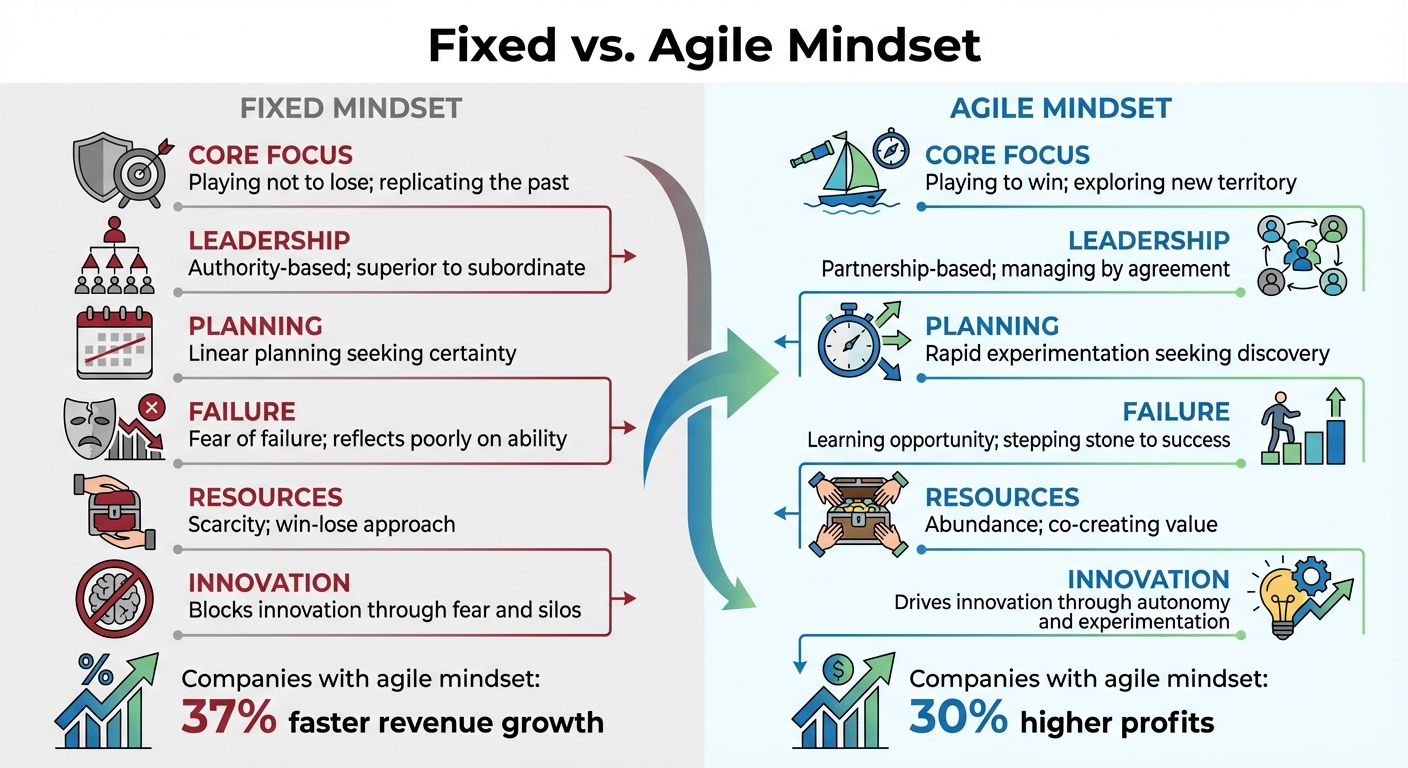
Fixed vs Agile Mindset: Key Differences in Leadership and Innovation
Spot Non-Agile Mindsets
Some common mindsets can quietly stifle innovation within teams. The mindset of certainty is one of them - it assumes the future is predictable and controllable through detailed, linear plans. This often leads teams to prioritize avoiding losses rather than chasing wins. Any deviation from the plan is seen as a risk to be avoided, rather than an opportunity to explore [5][6]. Then there’s the mindset of authority, which enforces rigid hierarchies where junior team members defer to seniors, cutting off the "creative collisions" that spark fresh ideas [5]. Lastly, the mindset of scarcity views resources and opportunities as limited. This fosters a win-lose mentality, where the focus shifts to capturing value from competitors instead of collaborating with stakeholders to create something bigger [5][6].
These mindsets often breed a fear of failure. Setbacks are treated as definitive failures instead of chances to learn, making risk-taking feel like an act of rebellion [5]. Teams caught in this cycle often measure success by output - how much they produce - rather than outcome, or whether their work actually solves customer problems [5]. Work silos become the norm, creating barriers to collaboration and eroding trust [5].
Assessment Frameworks for You and Your Team
To better understand and address these challenges, evaluate your team across three key dimensions. Start with certainty versus discovery: Does your team insist on complete certainty before moving forward, or are you comfortable making progress with 70% confidence? [2] Next, look at authority versus partnership: Are decisions made based on hierarchy, or do team members collaborate as equals with shared accountability? [5][6] Finally, consider scarcity versus abundance: Is your focus on competing for a slice of the pie, or on co-creating a larger opportunity? [6]
Use a simple 1–5 Likert scale to rate behaviors in these areas. For example, track decision-making speed by noting how often the team waits for perfect information versus acting on good-enough data [2]. Assess psychological safety by asking whether team members feel safe sharing ideas, questions, or mistakes without fear of backlash [1][2]. Check customer focus by reviewing how frequently the team gathers direct feedback from customers instead of waiting to unveil a "perfect" product [10]. Conduct these assessments quarterly to monitor progress and pinpoint areas for improvement.
The table below highlights the stark differences between fixed and agile mindsets, making it easier to identify where your team stands.
Comparison Table: Fixed vs. Agile Mindsets
| Dimension | Fixed Mindset | Agile Mindset |
|---|---|---|
| Core Focus | Playing not to lose; replicating the past | Playing to win; exploring new territory |
| Leadership | Authority-based; superior to subordinate | Partnership-based; managing by agreement |
| Planning | Linear planning seeking certainty | Rapid experimentation seeking discovery |
| Failure | Fear of failure; reflects poorly on ability | Learning opportunity; stepping stone to success |
| Resources | Scarcity; win-lose approach | Abundance; co-creating value |
| Innovation | Blocks innovation through fear and silos | Drives innovation through autonomy and experimentation |
Integrate Agile Principles into Your Daily Leadership
Use Iterative Work Cycles
Break large, complex projects into smaller, manageable chunks like 1–2 week sprints. Each sprint should deliver a single, testable outcome, such as a Minimum Viable Product (MVP). This way, your team can focus on making steady progress rather than waiting for everything to be perfect before moving forward. The idea is to aim for "good enough" to test and learn quickly, instead of getting bogged down in perfecting every detail [2][7].
Keep your team in sync with structured routines like daily stand-ups, sprint reviews, and retrospectives. These practices help streamline decision-making and align everyone’s efforts. For instance, a North American oil and gas company used agile methods to cut well design times by 50% to 75%. They achieved this by breaking down silos and focusing on iterative delivery [9][11][12]. This rhythm naturally creates faster feedback loops, which are key to staying agile.
Create Fast Feedback Loops
Use lightweight prototypes and gather direct customer feedback to uncover and address problems quickly [7]. Smaller batches and early testing help you spot issues sooner and refine ideas faster [1].
A great example comes from the 2020 COVID-19 pandemic. An Asian telecommunications provider faced a 36-hour message queue after its offshore call center shut down. By empowering cross-functional teams to reassign retail staff and launch digital prototypes, they reduced the queue to just a few minutes in under a month [9].
Give your teams access to unfiltered data - whether it’s about products, customers, or finances - so they can make informed decisions. Standard Bank in South Africa used this approach in 2017 to enhance its mobile apps. By identifying and fixing bugs early, they boosted trust among employees and customers alike [2][7].
Give Teams Autonomy and Ownership
Agile leadership thrives on empowering teams. Instead of assigning tasks, delegate outcomes and let teams decide how to achieve them. This approach shifts from a traditional hierarchy to a network of autonomous teams built on trust and shared goals [2][12].
"They knew their business objectives and had sophisticated reasoning for each of them. This allowed them to reprioritize their work within a few days."
Take Morning Star, the world’s largest tomato processor, as an example. They operate without formal leaders. Instead, employees negotiate a "Colleague Letter of Understanding" (CLOU) annually, committing to accountability and mutual support. This system replaces traditional authority with shared responsibility [6].
Make Experimentation and Learning from Failure Normal
Encourage small, low-risk experiments and treat failures as opportunities to learn rather than setbacks. Leaders should set the tone by admitting their own mistakes and fostering an environment where experimentation is celebrated [1][5]. This mindset not only reduces fear of failure but also drives continuous improvement.
"The best way to minimize risk and succeed is to embrace uncertainty and be the quickest and most productive in trying new things."
Regular retrospectives are a powerful tool for this. They give teams a chance to reflect on missteps and implement solutions right away. Since 60–80% of project failures stem from poor requirements gathering and change management [1], cultivating a culture that catches and corrects mistakes early is critical.
Track Metrics That Support Innovation
Focus on metrics that drive innovation rather than just measuring output. Key metrics include cycle time (how long it takes to complete work), customer satisfaction scores, and experiment throughput. These indicators help ensure your performance tracking aligns with your goals for growth and creativity [5].
Agile organizations are much more likely to rank in the top quartile for organizational health - a strong predictor of long-term success. To stay flexible and responsive, use outcome-based metrics and hold quarterly business reviews with rolling 12-month budgets. This allows you to reallocate resources efficiently as new insights emerge [2][9].
sbb-itb-8feac72
Build a Team Culture That Supports Agility and Innovation
Create Psychological Safety and Constructive Feedback
A two-year Google study found that psychological safety is the most critical factor in high-performing teams [13]. Yet, only a quarter of workers feel their opinions truly matter at work [16]. This gap between what teams need and what they experience stifles innovation.
Psychological safety means your team feels comfortable taking risks and speaking up without fear of punishment or embarrassment [14]. Despite executives estimating that only 2–5% of failures are genuinely blameworthy, 70–90% are still treated as such [15]. This fear of blame can shut down experimentation before it even begins.
To combat this, introduce blameless retrospectives that focus on improving processes instead of pointing fingers [15]. Use "premortems" before starting projects - encourage the team to discuss potential pitfalls to make risk-taking a normal part of the conversation [15]. As Paul Santagata, Google's Head of Industry, aptly puts it:
"There's no team without trust" [13].
End meetings with three simple questions: "What have we tried? What have we learned? What will we do next?" [17]. Ollie Bell, founder of ClutchCo, made this a regular practice to encourage reflection [17]. Leaders should also share their own setbacks to show that failure is just a stepping stone for growth, not a career-ending event [15][4]. When trust becomes the foundation, teams are better equipped for collaboration and innovation.
Enable Cross-Functional Collaboration
Once trust is established, diverse teams can collaborate more effectively. Cross-functional teams - bringing together engineering, design, and product experts - help eliminate blind spots and speed up innovation. However, siloed teams often struggle to stay aligned and maintain a shared understanding.
In 2025, Santander UK tackled this challenge by addressing organizational inefficiencies based on employee feedback. They eliminated 30% of recurring committees and consolidated 4,000 redundant phone and fax numbers into a single contact point. These changes cut product approval times from 12–18 months to just 3 months, while also boosting customer satisfaction by 10% [17].
To replicate this, create a central system of record where teams can access final decisions and relevant context [18]. Use RACI charts (Responsible, Accountable, Consulted, Informed) to clarify roles, especially when team members share similar levels of authority [18]. Align everyone’s efforts by defining a clear "North Star" - a goal that ties individual contributions to broader business objectives [18][5].
Consider structuring your organization as a network of autonomous teams instead of a rigid hierarchy [5][6]. Illinois Tool Works (ITW) exemplifies this by encouraging direct engineer-to-engineer discussions with customers. This approach has led to over 17,000 granted and pending patents [6].
Make Continuous Learning Part of Your Routine
Continuous learning thrives on deliberate habits. Start with "safe to fail" experiments - small, low-risk trials that let teams figure out what works in their unique context [19]. Shift the focus from output (how much work gets done) to outcomes (how well a feature addresses a market need) [4].
Create open digital spaces where teams can share knowledge freely [1]. This prevents valuable insights from being trapped with individuals and encourages collaboration. Celebrate every experiment, regardless of the result, to reinforce the idea that every effort is a chance to learn [19].
Track learning progress and process improvements. After all:
"What gets measured gets improved" [19].
Instead of overhauling everything at once, take small, manageable steps to help your team gradually adopt an agile mindset [4].
Align Incentives with Agile Behaviors
To solidify a learning-focused culture, your reward systems must match your values. If you only reward successful outcomes, you’ll end up with risk-averse teams. Instead, align rewards with behaviors like experimentation, collaboration, and learning.
Introduce peer-to-peer recognition through bonuses or real-time feedback tools to strengthen social bonds and emotional support within the team [15]. A 2014 study revealed that only 29% of workers could identify their colleagues' strengths and talents [16]. Recognition systems can help close this gap.
Shift from individual performance metrics to team-based outcomes that prioritize collaboration over competition. For example, Morning Star, the world’s largest tomato processor, operates without formal leaders. Employees annually negotiate a "Colleague Letter of Understanding", which emphasizes partnership, accountability, and mutual support [6]. While you may not go leaderless, you can adopt the principle by rewarding behaviors that benefit the entire team, not just individual achievements.
Apply Agile Mindset to Technical Leadership and Independent Consulting
By building on agile principles, technical leaders can combine their expertise with a forward-thinking approach to business, paving the way for success in independent consulting.
Connect Technical Expertise with Business Innovation
Technical leaders are known for their ability to tackle complex challenges, but to truly drive business value, they need to shift their mindset. Moving from a reactive, certainty-driven approach to a creative, discovery-focused one is essential [5][6]. This means embracing risk and welcoming diverse perspectives to foster innovation [5].
Take, for example, a global bank that transitioned from a rigid waterfall methodology to an approach centered around minimal viable products. The result? A 30% boost in productivity for product development and maintenance [2]. The key to this success was aligning technical decisions with a clear organizational purpose, ensuring that every innovation delivered measurable business impact [2]. This alignment between technical expertise and business goals forms the backbone of agile thinking.
For technical leaders, the shift isn’t just about methods - it’s about roles. Instead of focusing on planning and control, leaders must take on the roles of visionaries and coaches, empowering their teams to innovate [2]. As Aaron De Smet, Senior Partner at McKinsey, explains:
"The key to a successful agile transformation is for leaders, particularly senior leaders, to develop substantially new mind-sets and capabilities" [5].
This transition from traditional hierarchies to a partnership model - where teams operate as autonomous collaborators - unleashes new levels of creativity and innovation [5][6]. Such an approach not only transforms leadership in established organizations but also serves as a foundation for thriving as an independent consultant.
Use Agile Principles as an Independent Consultant
For independent consultants, agile principles are invaluable in reducing risk and delivering value faster. Instead of spending months crafting a complete offering, start with a Minimum Viable Product (MVP) [22]. This iterative process allows you to adapt quickly to market changes and avoid wasting time on unnecessary features.
The 80/20 rule is a great guide here - focus on the 20% of efforts that yield 80% of the results. Research shows that nearly 30% of functionality in traditional projects is rarely or never used [23]. As the Agile Manifesto wisely states:
"Simplicity–the art of maximizing the amount of work not done–is essential" [20].
Measuring progress through working solutions - not hours billed or documentation created - keeps the focus on delivering real value [20][21]. Regular client retrospectives further ensure that any issues are addressed early, making the final deliverable align with actual needs [20][23]. This collaborative, customer-first approach is key to consulting success.
Use Leadership Training to Develop Agile Skills
Adopting an agile mindset doesn’t happen overnight - it takes practice and the right guidance. Tech Leaders offers programs that blend engineering leadership training with entrepreneurship and AI business strategy. These courses help professionals transition from technical roles to independent consulting by teaching them how to package their expertise while applying agile principles to their work.
Effective training mirrors the agile process itself, focusing on quarterly cycles of skill-building with regular reviews and updates [5]. Programs often target four essential skills: communication, problem-solving, collaborative leadership, and strategic thinking [8]. Participants can choose between short, intensive workshops lasting 3-4 days or longer programs spanning several months [5]. These courses emphasize hands-on learning through "smart failures" - controlled experiments where unexpected outcomes become opportunities for growth [5][8]. Just as iterative feedback drives team success, this approach ensures that agile skills become second nature for long-term leadership.
As David Dabscheck, Co-CEO of GIANT Innovation, succinctly puts it:
"Agile is less about doing things right than doing the right thing" [8].
Conclusion: Key Takeaways on Driving Innovation with an Agile Mindset
An agile mindset is more than just a strategy - it's a transformative way of thinking and leading. Shifting from certainty to discovery, authority to partnership, and scarcity to abundance can unleash your team's creativity and position your organization to thrive in unpredictable markets.
To make this shift, focus on identifying fixed mindsets, integrating iterative cycles, establishing fast feedback loops, and empowering team autonomy. Creating an environment of psychological safety is crucial, allowing experimentation to become a natural part of your team's workflow. Instead of just tracking outputs like the number of features shipped, prioritize measuring outcomes such as reduced churn or improved customer lifetime value [3]. As Jon Ward, Transformation Lead at London Stock Exchange, puts it:
"The agile mindset focuses on trust and collaboration between team members, allowing them to work together to solve problems and achieve goals more effectively by harnessing the intelligence, creativity, energy and commitment to purpose of each member of the team" [8].
This approach not only strengthens team dynamics but also equips leaders to navigate rapidly changing markets. For technical leaders, agile principles translate into faster, customer-centric innovation. By embracing a "bet on ideas" approach - launching MVPs rather than fully polished products - you can accelerate progress while staying aligned with customer needs. Programs like those from Tech Leaders can help bridge the gap between technical expertise and leadership skills, ensuring a smoother transition.
Organizations that embrace agile principles gain the flexibility and resilience to turn challenges into opportunities. Whether you're leading a team or building your consulting practice, adopting an agile mindset offers a solid framework for achieving lasting success in uncertain times.
FAQs
What are the best ways to overcome challenges when adopting an agile mindset?
Overcoming hurdles in embracing an agile mindset begins with tackling leadership and workplace habits that resist change. Often, this resistance is rooted in fear of uncertainty or a preference for sticking to what’s familiar. Leaders have a key role here - they can set the tone by demonstrating agile behaviors themselves, clearly explaining why the shift is happening, and actively involving employees in shaping the new processes. When leaders communicate openly and show their commitment, it helps ease fears and build trust across the organization.
Taking practical steps can make the transition smoother. Setting clear goals, creating open feedback channels, and offering focused training give teams the tools and confidence they need to adapt. Celebrating small successes early on shows the tangible benefits of the new approach, and leaders who are self-aware can better guide their teams through this change. Together, these actions turn hesitation into enthusiasm, helping organizations tap into the creativity and flexibility that an agile mindset brings.
How can we measure the success of an agile transformation effectively?
To gauge the success of an agile transformation, it's essential to focus on three main areas: process metrics, business outcomes, and cultural health.
Start by leveraging agile maturity assessments to track progress over time. These assessments help evaluate how well teams are adopting practices like sprint planning, backlog refinement, and retrospectives. Alongside this, delivery metrics - such as lead time, cycle time, and deployment frequency - offer insights into how efficiently teams are delivering value.
Next, tie the transformation to measurable business results. Keep an eye on metrics like revenue growth, profitability, customer satisfaction (using tools like NPS or CSAT), and employee engagement. These indicators give a sense of how agility is influencing the broader organization.
Lastly, measure cultural shifts by conducting regular pulse surveys. These surveys can help you understand team autonomy, the level of support for innovation, and role clarity. When combined, these data points create a comprehensive and measurable view of how your agile transformation is progressing.
How does adopting an agile mindset enhance team autonomy and innovation?
Agility in the workplace thrives on three key principles: trust, collaboration, and continuous learning. These elements empower teams to operate independently, make confident decisions, and take ownership of their work. By creating an environment of psychological safety and stepping back from micromanagement, leaders pave the way for teams to fully engage with their goals and feel accountable for their outcomes. This sense of autonomy doesn't just improve morale - it creates the perfect conditions for fresh ideas and innovation to flourish.
Agile teams stand out by embracing short, iterative cycles. This method allows them to test ideas, tackle issues early, and fine-tune their processes along the way. It’s a system that rewards smart experimentation and quick learning, fostering adaptability and creative problem-solving. In fact, research indicates that organizations adopting agile practices often experience faster growth and higher profits, largely due to the continuous value delivered by motivated, empowered teams.
For those in tech leadership roles looking to cultivate this mindset, Tech Leaders offers targeted training programs. These sessions are designed to turn agile principles into actionable strategies, helping leaders build dynamic, high-achieving teams ready to innovate.