

How AI Enhances Fraud Risk Management in FinTech
AI is reshaping fraud detection in FinTech by moving from outdated, rule-based systems to smarter, real-time fraud prevention. Here's what you need to know:
- Fraud is evolving: Losses in the U.S. are projected to jump from $12 billion (2023) to $40 billion (2027), driven by AI-powered scams like synthetic identities and deepfakes.
- AI outperforms old methods: Machine learning, behavioral biometrics, and graph analytics detect fraud faster and more accurately, reducing false positives by 40–60%.
- Real-world success: Companies like PayPal and American Express have improved fraud detection by 6–10% using advanced AI models.
- Top tools: Platforms like Feedzai, Featurespace, and Kount offer scalable, precise fraud prevention solutions tailored to banks, e-commerce, and payment processors.
- Future trends: Quantum computing, multi-modal detection, and privacy-preserving AI are shaping the next generation of fraud prevention.
AI-powered fraud management not only detects threats in milliseconds but also reduces costs and improves customer trust. Let’s dive deeper into how these tools and strategies are transforming the financial industry.
The Smartest Way to Use AI for Fraud Prevention
AI Techniques for Fraud Detection
Modern AI fraud detection strategies combine multiple techniques to tackle fraud from various angles. These approaches help identify unusual activities, analyze user behavior, and uncover hidden criminal networks that traditional systems might overlook.
Machine Learning and Anomaly Detection
AI leverages machine learning models to identify fraud by detecting anomalies in data. These systems use two main approaches: supervised learning, which relies on historical data to recognize patterns, and unsupervised learning, which identifies outliers without prior labels. Supervised models like Random Forests and Support Vector Machines (SVM) classify transactions based on patterns seen in past fraud cases. On the other hand, unsupervised methods, such as K-means clustering and Isolation Forests, learn what constitutes normal behavior and flag deviations.
For instance, American Express improved its fraud detection accuracy by 6% using LSTM models, while PayPal saw a 10% increase in real-time fraud detection by implementing global AI systems [4]. These systems evaluate transactions in milliseconds, analyzing variables like spending habits, geographic location, and device fingerprints to decide whether to approve, flag, or reject a transaction.
Behavioral Biometrics and User Profiling
Behavioral biometrics focus on how users interact with their devices. This includes analyzing factors like typing speed, mouse movements, and navigation habits. Unlike traditional authentication methods that verify identity only at login, behavioral biometrics provide continuous authentication throughout the user session. AI creates a unique behavioral profile for each user, identifying what "normal" looks like for them.
For example, if a user's typing rhythm suddenly changes or they navigate checkout pages in an unusual way, the system raises an alert. This approach is especially effective against account takeover (ATO) fraud, which caused nearly $13 billion in losses in 2023 [6]. Importantly, these systems operate passively, ensuring a seamless experience for legitimate users while identifying suspicious activity.
Graph Analytics for Network Patterns
Graph Neural Networks (GNNs) analyze relationships between accounts, transactions, devices, and IP addresses by treating them as interconnected nodes. This allows these systems to uncover patterns that traditional methods might miss, such as fraud rings - coordinated groups reusing devices, addresses, or payment routes - or complex money laundering chains.
"Fraud rarely occurs in isolation. Fraudsters operate within complex networks, often using connections between accounts and transactions to hide their activities." - NVIDIA [7]
When one node is flagged as suspicious, graph-based systems reassess the risk across all connected nodes. This network-based perspective is crucial for identifying synthetic identity fraud, where real and fake personal information is combined across multiple accounts. By using automated machine learning with graph analytics, organizations can reduce false positives by 50% to 70%, enabling analysts to focus on more sophisticated cases instead of chasing false alarms [8].
Summary Table of AI Techniques
| AI Technique | Primary Function | Practical Application |
|---|---|---|
| Supervised Learning | Classification | Detecting known credit card fraud patterns |
| Unsupervised Learning | Anomaly Detection | Identifying emerging fraud tactics |
| Graph Analytics | Relationship Mapping | Exposing fraud rings and organized crime |
| Behavioral Biometrics | Identity Verification | Preventing account takeover through behavior |
These AI-driven methods are transforming fraud detection, offering faster, smarter, and more accurate ways to combat financial crimes.
AI Tools and Platforms for FinTech Fraud Prevention
Selecting the right AI platform can mean the difference between detecting fraud in an instant or facing massive financial losses. Among the top contenders in this field are Feedzai, Featurespace, and Kount. Each platform offers unique strengths tailored to different needs - whether you're safeguarding a major bank, a payment processor, or an e-commerce business.
Feedzai Platform Features
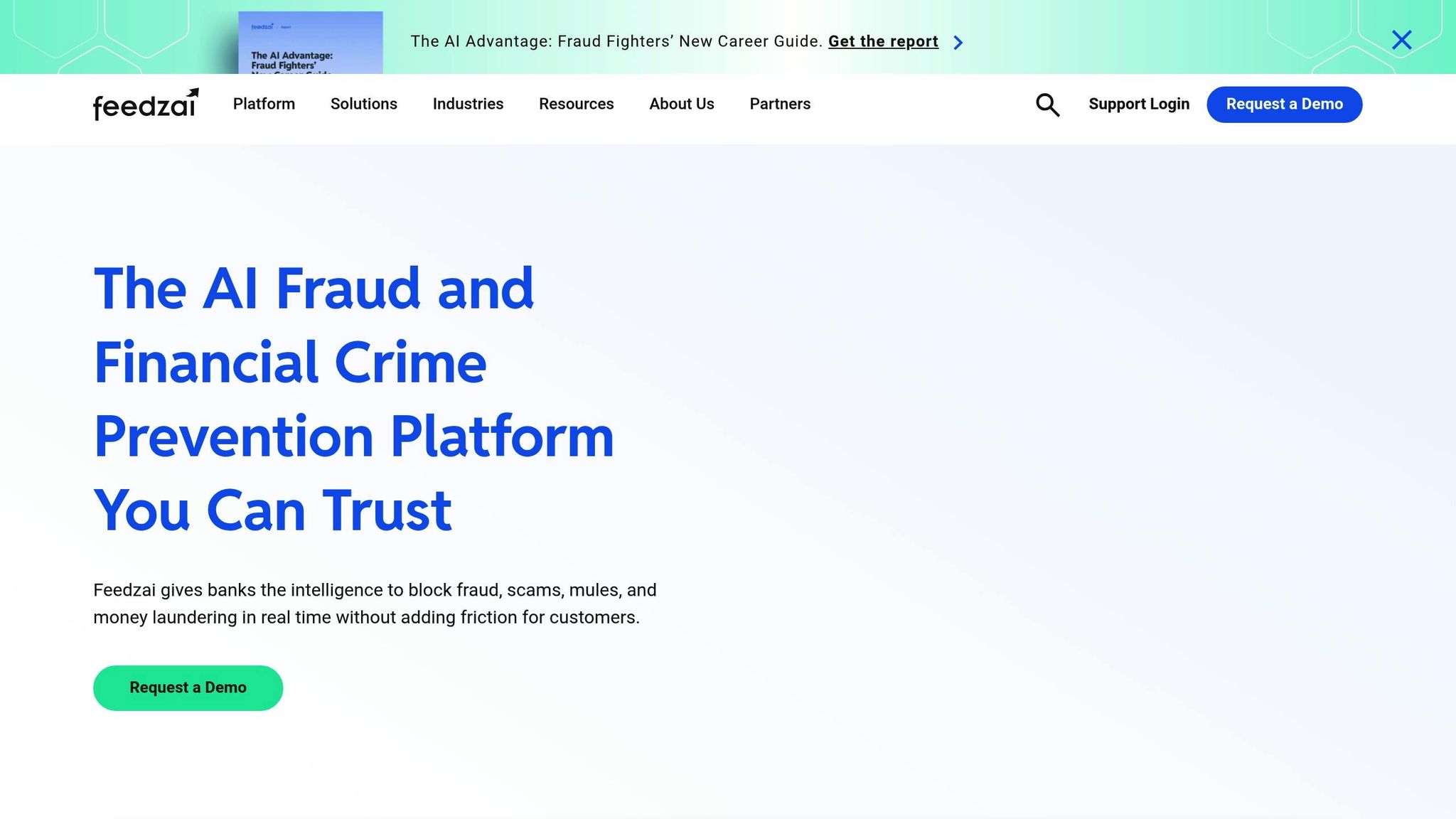
Feedzai protects nearly 1 billion consumers globally and secures transactions worth $6 trillion to $8 trillion annually [9][11]. It processes an astounding 70 billion events each year, making it one of the most scalable fraud prevention platforms available [9][11].
What sets Feedzai apart is its ability to create personalized 360° profiles using transactional, biometric, and device data. These profiles help detect anomalies by focusing on individual user behavior rather than applying one-size-fits-all rules. Its Pulse Risk Engine combines machine learning with customizable rules, enabling real-time risk scoring on a massive scale.
One Tier 1 bank reported a 62% increase in fraud detection and a 73% reduction in false positives after adopting Feedzai [11]. Additionally, Feedzai's models can be deployed within a week - much faster than the two-month timeline of some competitors [10].
Transparency is another key feature of Feedzai. Its Whitebox Explanations provide clear, plain-language insights into why a transaction was flagged, ensuring compliance teams can easily justify decisions. The platform also integrates GenAI through tools like ScamAlert, which helps consumers identify scams in real time - a critical feature for combating authorized push payment fraud [9].
Featurespace Adaptive Behavioral Analytics
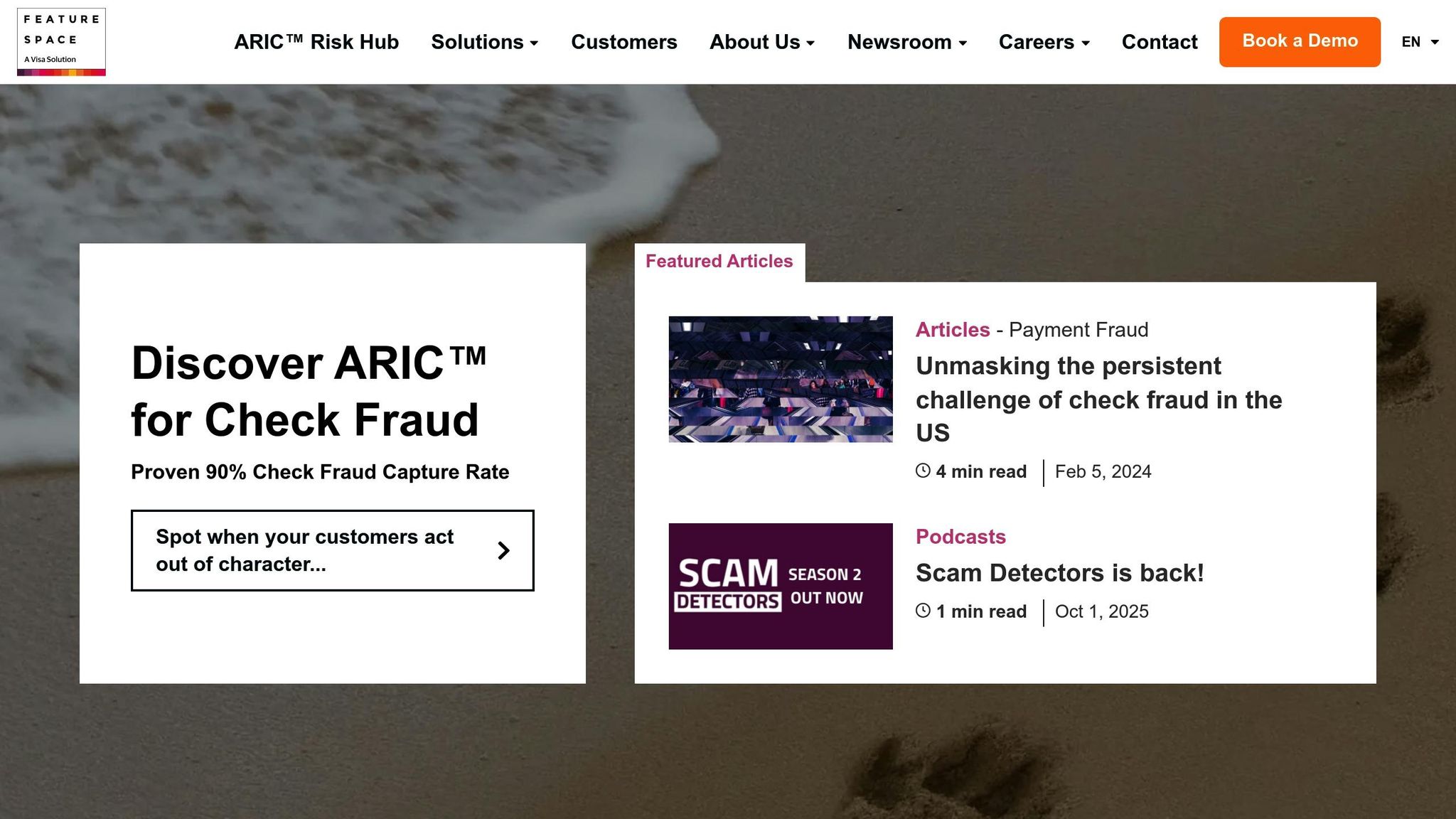
While Feedzai excels in rapid deployment, Featurespace focuses on deep behavioral insights. The platform protects 500 million consumers worldwide and handles over 100 billion payments annually [10]. In December 2024, Visa acquired Featurespace, incorporating it into its Risk and Identity Solutions division to enhance fraud detection capabilities [10].
At the heart of Featurespace's technology is Adaptive Behavioral Analytics, which powers its ARIC Risk Hub. This system learns what constitutes typical behavior for individual users, flagging unusual activity with precision. By doing so, it significantly reduces false positives - a critical factor, as 33% of consumers avoid businesses after experiencing a false decline [16].
Featurespace also employs Automated Deep Behavioral Networks, which use advanced neural networks to detect complex fraud patterns across various channels, including mobile apps, websites, and in-person transactions. While its model deployment takes up to two months, the deliberate approach still outpaces older systems [10].
Kount's Transaction Risk Scoring
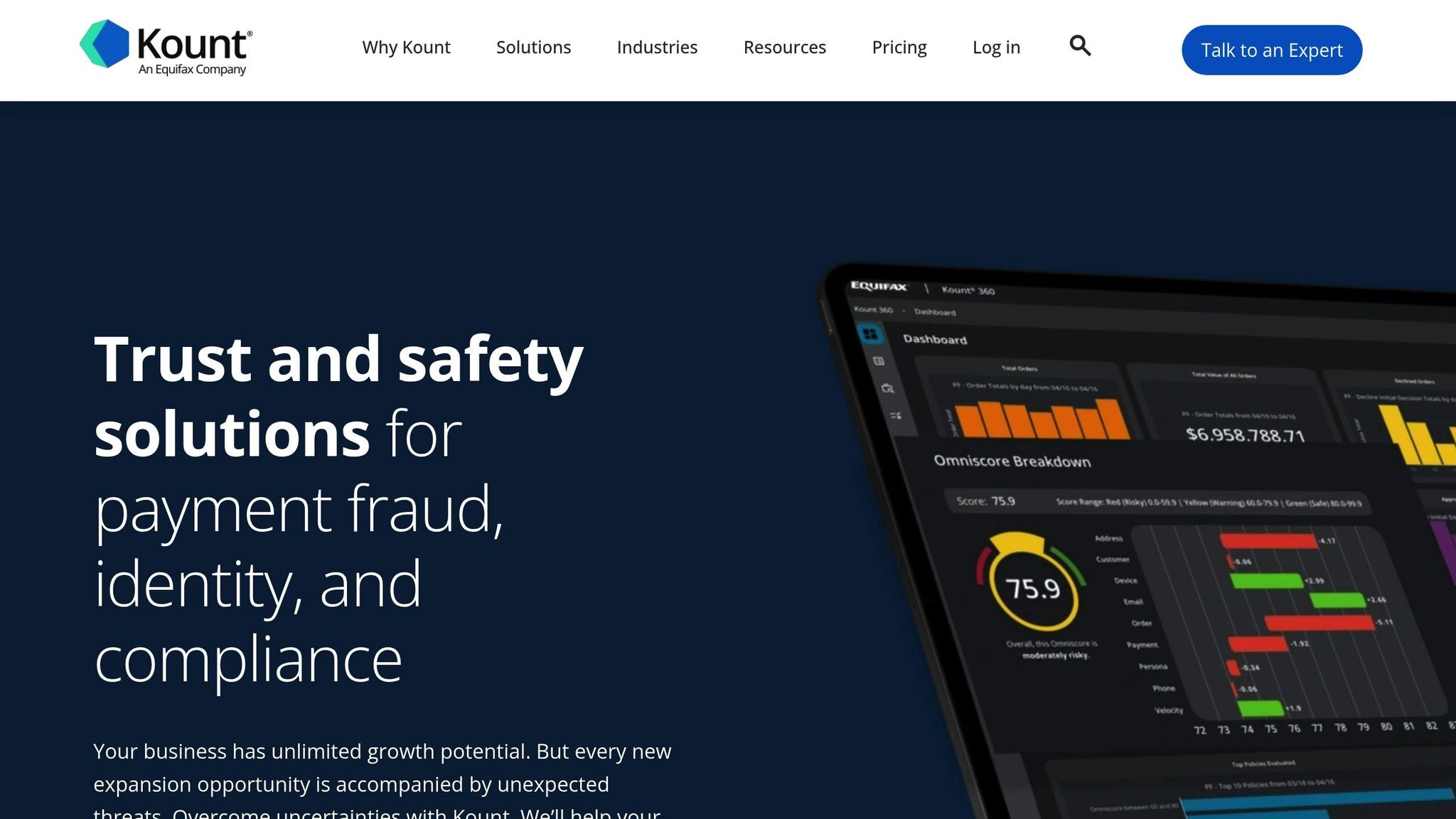
Kount, an Equifax company, specializes in Identity Trust Scoring for e-commerce and digital payments. The platform assigns real-time risk scores to users by analyzing data signals across a global network before transactions even occur. This pre-transaction evaluation is especially beneficial for online retailers that must approve or decline purchases within milliseconds.
Kount employs a hybrid approach to fraud detection, combining traditional methods with advanced analytics to identify both known and emerging fraud patterns. Its device analytics feature uses techniques like device fingerprinting and velocity monitoring to assess risk. For instance, if a single device initiates purchases from multiple accounts in different locations within minutes, Kount flags it instantly. This capability has been instrumental in combating account takeover fraud, which saw a 427% increase in blocked attempts in 2023 due to AI-driven solutions [14].
Kount's integration with the Equifax data network enhances its ability to verify customer identities, making it particularly valuable for businesses onboarding new users. The platform also supports rapid deployment through APIs and plug-ins for major e-commerce and payment platforms, allowing for quick implementation without extensive customization.
| Feature | Feedzai | Featurespace | Kount |
|---|---|---|---|
| Core Technology | Segment-of-One Profiling | Adaptive Behavioral Analytics | Identity Trust Scoring |
| Model Deployment | Less than 1 week [10] | Less than 2 months [10] | Rapid (via APIs/Plug-ins) [13] |
| Primary Focus | Unified Fraud & AML for Banks | Real-time Behavioral Analytics | E-commerce & Identity Trust |
| Data Network | 1,000+ unique integrations [10] | 80+ data feeds [10] | Equifax Data Network [12] |
AI Implementation Roadmap for Fraud Management
Creating an AI-driven fraud detection system isn’t just about deploying technology - it’s about thoughtful planning, quality data, and constant refinement. Rushing into implementation without a solid foundation often leads to systems that produce more noise than actionable insights. Here’s how to approach AI fraud management effectively, starting with building a strong data foundation.
Establish Data Baselines and Feature Engineering
The first step is setting up a real-time data ingestion layer that captures critical details like transaction logs, login attempts, device IDs, geolocation, and external blacklists [18]. Many FinTech organizations face challenges with fragmented data sources - separate systems for card processing, mobile apps, and online platforms operating in silos. Consolidating these into a unified data foundation is key to gaining a complete view of customer transactions and behavior [17].
Once your data pipeline is in place, focus on defining baselines and engineering features:
- Identify customer patterns, such as spending habits, preferred devices, login locations, and interaction methods [17].
- Develop advanced features like time-based aggregates (e.g., velocity spikes), behavioral biometrics (like keystroke patterns or touchscreen pressure), graph features (to detect fraud rings), and vector embeddings for email and IP addresses [18][19].
JPMorgan Chase showcased the importance of robust data engineering in 2024 by integrating real-time device, location, and chat log data to model customer behavior. This led to fraud alerts being 300 times faster and saved the company $1.5 billion across fraud, credit, and operational costs [18]. Tools like Feast can manage feature storage, while Redis or DynamoDB enable low-latency data retrieval [18]. For real-time data ingestion, platforms like Apache Kafka, Amazon Kinesis, or Google Pub/Sub are excellent choices [18].
Train and Deploy Machine Learning Models
Developing effective AI models means blending techniques. Use a hybrid approach that combines supervised learning (trained on labeled fraud data) with unsupervised methods like autoencoders or isolation forests to detect new, unseen patterns [4][3]. Graph Neural Networks (GNNs) are particularly effective for analyzing complex relationships within massive datasets, uncovering fraud rings that traditional systems might overlook [4][3].
For example, Mastercard’s "Decision Intelligence" system processes over 160 billion transactions annually, leveraging deep learning and behavioral signals to detect fraud with sub-50-millisecond latency. Between 2021 and 2024, this system prevented $35 billion in fraud losses [18]. Similarly, American Express improved fraud detection accuracy by 6% with advanced LSTM models, while PayPal achieved a 10% boost in real-time detection through continuous AI monitoring [4].
Before deploying models, establish a baseline for current fraud alert costs, including investigation time and tech expenses - this will help gauge the impact of your AI system [21]. Platforms like Amazon SageMaker can streamline workflows from data preparation to deployment, while serverless computing tools like AWS Lambda ensure scalability based on transaction volumes [20]. To address the "black box" nature of AI, implement explainability tools like SHAP to break down model decisions into understandable components for investigators and regulators [3].
Once deployed, the focus should shift to real-time monitoring and adapting to evolving fraud tactics.
Enable Real-Time Monitoring and Continuous Learning
Fraud tactics evolve quickly, so static models trained on outdated data won’t be effective. Build an event-driven architecture using stream processing frameworks to analyze events in real time and apply rules immediately [6]. Move beyond simple alerts to actionable AI that can trigger instant responses, such as freezing accounts, activating safe mode, or requiring additional verification for suspicious activities [15].
To keep models sharp, create a feedback loop where outcomes - both correct and incorrect - are fed back into the system. A "Human Plus Machine" approach allows analysts to review flagged cases and refine the model’s learning process [3]. For instance, PayPenny, a cross-border money transfer platform, implemented real-time AI safeguards and biometric KYC. By June 2025, they securely processed over $400 million for 120,000+ active users across multiple regions, with minimal fraud incidents [18].
Continuous training is essential. Stream live transaction data into learning pipelines instead of relying on batch updates [6]. Use tools like Elastic Stack to build real-time dashboards that help analysts monitor anomalies and model performance. Risk-based triggers can automatically enforce multi-factor authentication or biometric checks when activity deviates from a user’s normal behavior [6][15].
As Krishna Kandi, Senior Software Engineer at Convoke, explains:
"The trajectory points toward autonomous fraud defense - an ecosystem where AI agents monitor, learn, and coordinate defenses with minimal manual tuning, still guided by human oversight but operating at machine speed" [3].
sbb-itb-8feac72
Benefits of AI in Fraud Risk Management
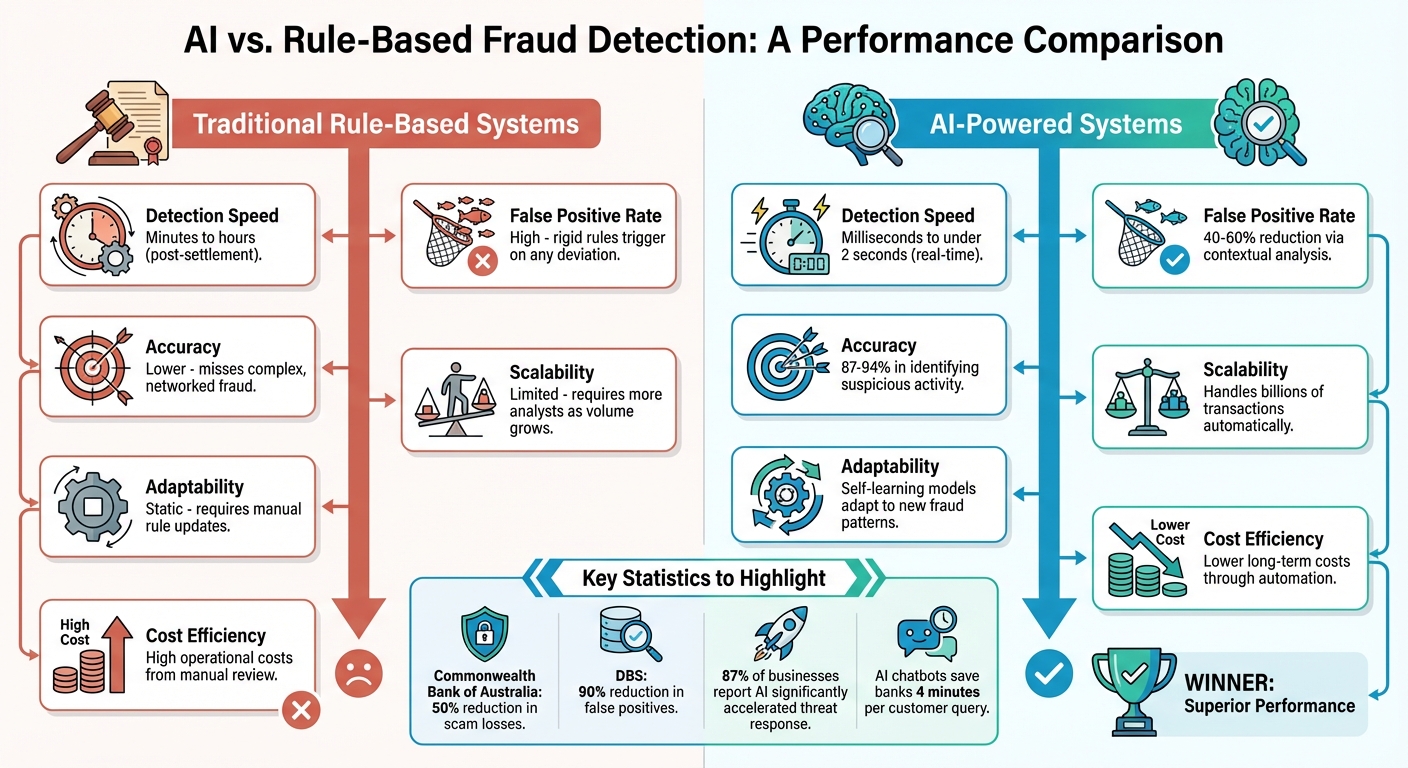
AI vs Traditional Fraud Detection Systems: Speed, Accuracy, and Cost Comparison
AI takes fraud detection to a whole new level, shifting it from being a reactive compliance measure to a proactive strategy. Instead of relying on rigid "if-then" rules, AI-powered systems adapt to context, identifying threats before they even surface. This shift enhances crucial metrics that FinTech companies depend on to operate effectively.
How effective are these systems? AI models achieve 87%–94% accuracy while slashing false positives by 40%–60%, far outperforming traditional rule-based approaches [22]. For instance, the Commonwealth Bank of Australia managed to cut scam-related losses by 50% with AI [19]. Similarly, DBS reduced false positives by an impressive 90% [19], enabling fraud analysts to focus on actual threats rather than wasting time investigating legitimate transactions.
Time is another area where AI excels. Fraud insights that used to take minutes - or even longer - are now generated in milliseconds [19]. Banks leveraging AI can detect suspicious activity in under two seconds, a stark contrast to older platforms that lag behind by several minutes [19]. This speed matters because 87% of businesses report that AI has significantly accelerated their ability to respond to threats [22]. These real-time capabilities highlight AI's transformative role in safeguarding financial systems.
"The automation of the data science process reduced time and costs. And time is money. So, you can do more with the same amount of time."
- Ruben Diaz, Data Scientist at Vision Banco [1]
AI vs. Rule-Based Systems Comparison
| Metric | Traditional Rule-Based Systems | AI-Powered Systems |
|---|---|---|
| Detection Speed | Minutes to hours; typically post-settlement | Milliseconds to under 2 seconds (real-time) [19] |
| False Positive Rate | High; rigid rules trigger on any deviation | 40–60% reduction via contextual analysis [22] |
| Accuracy | Lower; misses complex, networked fraud | 87–94% accuracy in identifying suspicious activity [22] |
| Scalability | Limited; requires more analysts as volume grows | Handles billions of transactions automatically [4] |
| Adaptability | Static; requires manual rule updates | Self-learning models adapt to new fraud patterns [3][4] |
| Cost Efficiency | High operational costs from manual review | Lower long-term costs through automation [4] |
This table underscores the clear advantages of AI over traditional systems. Whether it's faster detection, greater accuracy, or lower costs, AI is reshaping fraud risk management in FinTech. For example, AI-driven chatbots now save banks an average of 4 minutes per customer query [22], allowing human analysts to boost their productivity significantly [3]. These efficiency gains aren't just about saving time - they're about redefining how financial institutions operate in a world where fraud threats evolve constantly.
Future Trends in AI-Driven Fraud Management
Fraud prevention is entering a new era, with cutting-edge technologies transforming how financial crimes are detected and countered. Here’s a closer look at three transformative advancements shaping the future of fraud management.
Quantum-Enhanced Fraud Detection
Quantum computing is reshaping the way AI identifies fraudulent activities. By combining quantum pattern recognition with the reliability of classical systems, hybrid quantum-classical algorithms are speeding up fraud detection. Krishna Kandi notes that these algorithms can slash model-training times from hours to mere seconds [3].
"Since quantum systems produce complex patterns that classical systems struggle to produce, it is reasonable to postulate that quantum computers may outperform classical computers on machine learning tasks." - Jacob Biamonte, Peter Wittek, Nicola Pancotti, Patrick Rebentrost, Nathan Wiebe, and Seth Lloyd [23]
Quantum-enhanced AI is particularly effective in network analysis, uncovering connections among millions of nodes - such as accounts, IP addresses, and devices - to expose organized crime networks that might evade traditional systems [3]. While current hardware limitations remain a hurdle, researchers are working to overcome these challenges. As quantum computing evolves, its ability to handle diverse data types in multi-modal systems will further expand its potential.
Multi-Modal Threat Detection
With fraudsters deploying advanced tactics like AI-generated deepfakes and social engineering, FinTech companies are turning to multi-modal AI systems. These systems analyze multiple data types - text, images, audio, transaction logs, and behavioral patterns - simultaneously, catching inconsistencies that single-mode systems might overlook.
For example, a system could flag a transaction where the voice biometrics match the account holder, but the device fingerprint and geolocation suggest an unfamiliar device in another country. This layered approach helps distinguish between legitimate travel and fraudulent activity.
The stakes are high: payment fraud losses surged to €4.2 billion in 2024, up from €3.5 billion in 2023, while global scams cost consumers an estimated $442 billion [17]. The AI fraud detection market itself is forecasted to hit $39.1 billion by 2030 [17].
Rakuten France, which hosts 19 million monthly visitors, has already implemented AI tools to shield its platform from bot attacks [25].
"Not only are criminals rapidly inventing new AI-powered frauds, but they're also making familiar ones even more effective." - Dan Holmes, Vice President, Global Product Planning & Strategy, Feedzai [17]
However, deploying these advanced systems isn’t without challenges. High-performance infrastructure is critical to ensure real-time processing, and organizations must address privacy concerns and navigate legacy data silos [17] [24]. Despite these hurdles, multi-modal AI systems are proving to be a game-changer in fraud detection.
Privacy-Preserving AI Techniques
As fraud detection becomes more sophisticated, protecting sensitive data remains a top priority. Privacy-preserving AI techniques are helping FinTech companies strike a balance between effective fraud detection and compliance with stringent regulations like GDPR and CCPA.
Federated learning, for instance, enables institutions to train machine learning models locally on sensitive data while sharing only anonymized updates with a central model. This approach allows for collective intelligence without compromising privacy [3].
Other techniques include differential privacy, which adds statistical noise to datasets to prevent identifying individuals, and homomorphic encryption, which allows computations on encrypted data, ensuring sensitive information remains secure during processing [26] [3].
These methods are not just about compliance - they also improve accuracy. Privacy-preserving AI has been shown to reduce false positives by 50–60% compared to traditional rule-based systems [26].
| Technique | Primary Benefit | Compliance Alignment |
|---|---|---|
| Federated Learning | Enables industry-wide collaboration without data sharing | GDPR (Data Sovereignty) |
| Differential Privacy | Protects individual identities in datasets | CCPA/GDPR (Anonymization) |
| Homomorphic Encryption | Secures data during cloud processing | PCI-DSS/Data Security Laws |
| Explainable AI (SHAP/LIME) | Provides transparency in automated decisions | GDPR Article 22 (Right to Explanation) |
Explainable AI (XAI) tools like SHAP and LIME further enhance transparency by breaking down "black box" AI decisions into understandable components, addressing regulatory requirements for clarity [26] [3].
"Managing machine learning model risk is of the utmost importance in heavily regulated industries such as finance; in particular, to manage potential risks due to bias/fairness, conceptual soundness, implementation, and model change control." - Agus Sudjianto, EVP, Head of Corporate Model Risk, Wells Fargo [1]
The path forward is clear: autonomous fraud defense systems capable of monitoring, learning, and adapting with minimal manual intervention are becoming a necessity. With generative AI expected to drive U.S. fraud losses from $12.3 billion in 2023 to $40 billion by 2027 [2], privacy-preserving techniques are no longer optional - they’re essential for staying ahead in the fight against fraud.
Conclusion
AI has revolutionized fraud management, shifting it from rigid, rule-based systems to dynamic, real-time intelligence. Companies like American Express and PayPal have seen fraud detection rates improve by 6%–10%, processing millions of transactions in just milliseconds while cutting false declines by more than 30% [3][4]. These advancements allow AI-powered platforms to identify complex fraud patterns that traditional methods often overlook, marking a move toward proactive and adaptive fraud prevention.
Fraud incidents continue to rise, with U.S. banking losses projected to hit $40 billion by 2027 [5]. To counter increasingly sophisticated threats, tools like behavioral biometrics, graph analytics, and privacy-preserving federated learning have become critical components of modern fraud defense strategies.
"Artificial intelligence has moved fraud detection from static defense to dynamic intelligence. It is no longer about reacting to fraud but anticipating it."
However, technology alone isn't enough. Successful fraud prevention also requires strong leadership that combines technical expertise with strategic vision. Addressing challenges like AI model risk, bias, fairness, and regulatory compliance through explainable AI demands specialized knowledge [1].
If you're looking to develop the skills needed to lead AI-driven fraud prevention efforts, Tech Leaders offers tailored programs in engineering leadership and AI business strategy. Whether you're spearheading fraud prevention initiatives or exploring new opportunities in consulting, Tech Leaders equips professionals to navigate these challenges and drive impactful, AI-powered solutions.
FAQs
How does AI make fraud detection faster and more accurate in FinTech?
AI plays a powerful role in fraud detection by analyzing massive amounts of transaction data in real time. Using technologies like deep learning, it can spot unusual patterns or behaviors that might otherwise go unnoticed. This rapid analysis allows financial systems to flag suspicious activity almost immediately, cutting down response times and helping to limit potential losses.
What’s more, AI gets smarter over time. By learning from extensive datasets, it can identify even the most subtle or evolving fraud tactics. This not only reduces false alarms but also ensures that complex schemes are detected, making financial systems safer and more efficient overall.
What AI techniques are used to prevent fraud in FinTech?
AI-driven fraud prevention in FinTech leverages cutting-edge tools to identify and block fraudulent activities as they happen. Supervised machine learning models - like gradient-boosted trees and deep neural networks - are trained on past fraud incidents to recognize suspicious patterns. On the other hand, unsupervised techniques such as clustering and anomaly detection focus on defining typical behavior and flagging anything unusual, even without labeled data. Deep learning models, including recurrent and convolutional neural networks, excel at uncovering intricate patterns in payment data, while graph neural networks analyze transaction networks to spot coordinated fraud attempts.
Beyond these, other AI technologies strengthen fraud detection systems. For instance, predictive analytics forecasts high-risk transactions before they occur. Natural language processing (NLP) identifies phishing schemes or social engineering tactics hidden in text, and behavioral analytics creates tailored user profiles to detect anomalies while minimizing false positives. Together, these tools form a powerful and scalable defense against fraud for FinTech companies.
How can AI help financial companies meet privacy regulations like GDPR?
AI methods like synthetic data generation, differential privacy, and federated learning allow financial institutions to develop machine learning models without revealing sensitive personal data. These techniques align with critical GDPR principles, including data minimization, purpose limitation, and securing proper consent.
By adopting these privacy-focused strategies, businesses can strengthen fraud detection and improve risk management. At the same time, they ensure compliance with regulations, protect sensitive customer information, and uphold trust.