

AI Tools for Visionary Crisis Leadership
Handling crises today requires leaders to go beyond traditional methods. With crises becoming more complex and frequent, AI is now a critical tool for improving decision-making and response strategies. Here's what you need to know:
- AI as a Co-Pilot: AI helps leaders process vast amounts of data, predict risks, and optimize responses. For example, AI-driven platforms like SOAR cut response times by up to 80%.
- Predictive Power: Tools like IBM Watson and Google DeepMind forecast risks and outcomes, enabling leaders to act before issues escalate.
- Real-Time Insights: Platforms like Crisis24 provide threat intelligence tailored for decision-makers, helping them stay ahead of emerging challenges.
- Human + AI Collaboration: While AI enhances capabilities, human oversight ensures ethical, empathetic, and effective leadership.
Key Takeaways
- AI tools like Palantir Foundry, IBM Watson, and Crisis24 are transforming crisis management.
- Leaders who integrate AI gain better situational awareness and faster response times.
- Balancing AI insights with human judgment is essential for ethical and impactful decisions.
AI isn't replacing human leadership - it’s amplifying it. Leaders who embrace AI tools can navigate crises with greater precision and confidence.
How to Use AI for Strategic Leadership (Not Just Tasks) with Geoff Woods
What Defines Crisis Leadership with Vision
Visionary leaders in crisis situations don't just react to problems - they anticipate them. By leveraging AI predictive modeling and early warning systems, they move from simply putting out fires to proactively managing risks [3][8]. This shift requires a mindset that combines foresight with disciplined execution of core strategies. As the McChrystal Group explains:
Operating in crisis is challenging not because you need to develop new and complex processes but rather because your success will be determined by your ability to commit to the basics with rigorous discipline calibrated at the right speed [9].
The numbers paint a clear picture. Organizations that incorporate AI-specific roles are 60% more likely to meet their project goals compared to those that don’t [1]. Meanwhile, global insured losses from natural disasters are climbing at an annual rate of 5–7% and are expected to reach $145 billion by 2025 [10]. Leaders who embrace technology to analyze massive datasets gain what experts call "enhanced situational awareness" - the ability to identify anomalies and foresee risks that traditional methods might overlook [1].
Key Characteristics of Leaders with Vision
Leaders with vision don’t just rely on technology - they combine strategic thinking with emotional intelligence. These leaders understand that AI serves as a "co-pilot", complementing human judgment rather than replacing it [1][3]. For example, they make nuanced decisions that machines can’t, such as whether to allocate resources based on property damage or prioritize equity considerations [10].
Adaptability is another cornerstone of effective leadership, especially when crises evolve faster than pre-existing plans. Real-time feedback loops are essential, allowing leaders to adjust strategies as conditions shift [9]. A great example comes from November 2023, when the California Department of Forestry and Fire Protection used AI-driven image recognition to detect wildfires before humans could spot them. This early detection enabled emergency teams to contain fires before they spread [1]. Such foresight requires leaders to trust in technology while upholding transparency and ethical integrity in high-pressure scenarios [9].
The best leaders also challenge their own assumptions. Tools like AI-generated scenario modeling and "digital twins" - virtual replicas of physical environments - help them confront biases like overconfidence or groupthink during critical moments [5]. In March 2025, Marguerite Allen, assistant director of community development in Tarrant County, Texas, used generative AI to simulate how budget changes might impact local services. The tool revealed ways to restructure programs, boosting leadership confidence during financial uncertainties. As Allen put it:
There's some things you can't plan for, but in our work and what we do, it gives us flexibility to consider more possibilities and more responses [4].
The Role of Technology in Leadership
Technology, when used strategically, amplifies a leader's ability to predict and mitigate crises. Leaders must align AI tools directly with mission objectives to justify their value, especially in environments with tight budgets [1]. This is particularly relevant as the U.S. public health workforce has lost over 45,000 workers in the past decade, while an 80% increase in staffing is needed to meet current demands [1].
AI tools like Security Orchestration, Automation, and Response (SOAR) platforms can reduce cybersecurity incident response times by 80% [2]. Similarly, AI sentiment analysis systems can detect emerging crises up to 48 hours before they escalate into major disasters [6]. In 2024, the United Nations Development Programme used an AI-powered deployment platform to assign over 2,450 personnel to more than 150 offices worldwide [3]. These examples highlight how technology helps bridge the gap between limited resources and growing crisis demands.
However, human oversight remains critical. AI outputs must be verified for accuracy and ethical compliance [5][7]. Devanand Ramiah, Director of Crisis Readiness, Response and Recovery at UNDP, underscores this balance:
Ultimately, human oversight remains essential... we must establish guardrails to ensure ethical use and protect privacy [3].
The goal is to build what Michael Baskin, Chief Innovation Officer of Montgomery County, Maryland, calls "response muscles" - the decision-making skills of teams, strengthened through AI simulations [4]. Leaders who integrate technology effectively don’t just respond to crises faster; they transform how their organizations perceive and manage risk. This integration sets the stage for a deeper dive into AI tools specifically designed for crisis leadership.
AI Tools for Crisis Leadership
The right AI tools can reshape how leaders handle crises, shifting their approach from reactive problem-solving to proactive planning. These platforms don’t just crunch numbers - they offer practical insights that help leaders foresee disruptions and act before situations escalate. Below, we explore some key AI tools that are empowering leaders to integrate AI into their crisis management strategies.
Palantir Foundry for Crisis Scenario Simulation
Palantir Foundry leverages a "Decision Ontology" to map real-world entities, helping leaders visualize how their choices might impact their organizations [13][14]. This feature enables non-technical leaders to simulate the ripple effects of decisions before implementing them. With its Scenario Primitive tool, the platform creates "sandbox" environments where leaders can test actions - like adjusting supply chains, managing power outages, or reallocating resources - without disrupting live operations. This approach helps leaders make critical decisions with confidence, even under tight deadlines [13][15].
For example, in December 2022, California utility PG&E used Palantir's Ontology during wildfire emergencies to determine which grid assets to de-energize, minimizing disruptions for essential facilities like hospitals [14]. That same year, the platform played a pivotal role in the evacuation of 15,000 Afghan refugees within just 24 hours during the war in Ukraine [14].
IBM Watson for Predictive Analytics
IBM Watson is designed to sift through massive datasets to uncover patterns that signal potential crises. Its predictive analytics capabilities enable leaders to move beyond understanding current conditions to anticipating what’s likely to happen next. By analyzing historical data alongside real-time inputs, Watson can identify anomalies that traditional methods might overlook, giving leaders the critical lead time needed to adapt strategies or deploy resources effectively.
What sets Watson apart is its ability to simplify complex data into clear, actionable insights. Leaders can use it to evaluate the financial impact of potential disruptions, assess risk probabilities, and prioritize responses based on urgency and severity. This makes Watson especially valuable in industries like healthcare, finance, and manufacturing, where early detection of risks can avert major losses.
Crisis24 for Real-Time Threat Intelligence

Crisis24 AiiA, powered by Palantir, delivers high-level intelligence tailored for C-Suite executives [11][12]. Its standout feature, the President’s Brief, provides daily updates modeled after U.S. Presidential briefings. By synthesizing proprietary, operational, and open-source data, the platform delivers concise, strategic insights that cut through the noise [11][12].
In October 2025, a global manufacturer faced an unexpected military crisis and needed a rapid exposure report for its board. Crisis24 AiiA enabled the Chief Risk Officer to access hyper-localized supplier data and deliver a detailed briefing within hours [11]. With features like 12-month political outlooks and 2-month security forecasts, the platform helps leaders make informed decisions, such as diversifying suppliers or hedging against potential disruptions [11]. Sid Kosaraju, President of Crisis24, summed it up perfectly:
In today's volatile global environment, executives don't need more data - they need actionable foresight [12].
Google DeepMind for Scenario Forecasting

Google DeepMind stands out for its ability to model potential outcomes and visualize the long-term effects of leadership decisions. Using advanced machine learning, the platform forecasts how crises might unfold under various conditions, helping leaders grasp not just the immediate impacts but also the cascading effects across interconnected systems.
These forecasting capabilities are particularly effective for tackling complex challenges involving multiple variables - like climate-related events, supply chain fragility, or public health emergencies. By projecting how today’s decisions could influence outcomes months or even years down the line, DeepMind equips leaders to build resilience into their strategies rather than merely reacting to immediate threats. This forward-looking approach underscores the growing role of AI in crisis leadership frameworks.
sbb-itb-8feac72
Comparison of AI Tools for Crisis Leadership
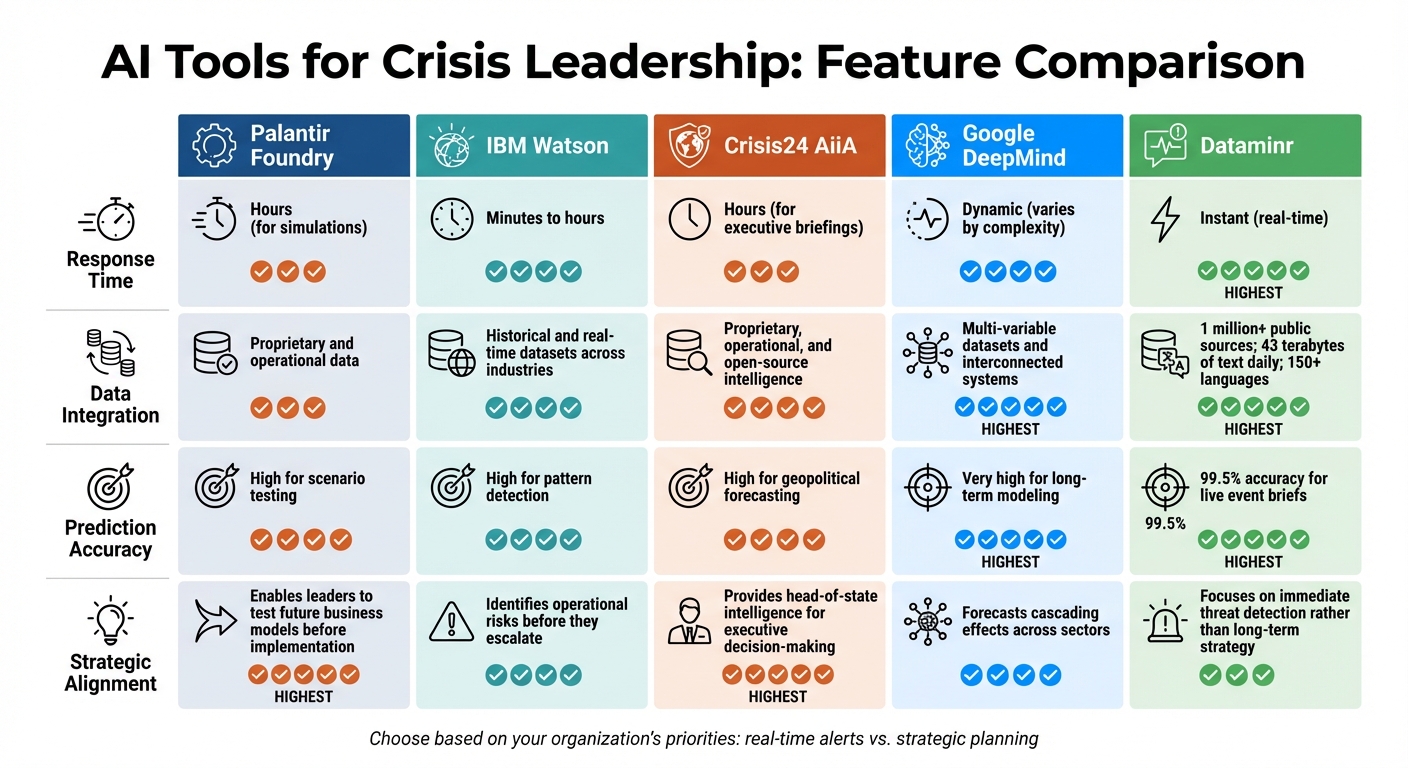
AI Crisis Management Tools Comparison: Response Time, Data Integration & Prediction Accuracy
Comparison Table
Choosing the right AI tool depends on factors like response time, data integration capabilities, prediction accuracy, and how well it aligns with your strategic goals. Here's a quick overview of some leading options:
| Tool | Response Time | Data Integration | Prediction Accuracy | Alignment with Vision |
|---|---|---|---|---|
| Palantir Foundry | Hours (for simulations) | Proprietary and operational data | High for scenario testing | Enables leaders to test future business models before implementation |
| IBM Watson | Minutes to hours | Historical and real-time datasets across industries | High for pattern detection | Identifies operational risks before they escalate |
| Crisis24 AiiA | Hours (for executive briefings) | Proprietary, operational, and open-source intelligence | High for geopolitical forecasting | Provides head-of-state intelligence for executive decision-making [11] |
| Google DeepMind | Dynamic (varies by complexity) | Multi-variable datasets and interconnected systems | Very high for long-term modeling | Forecasts cascading effects across sectors |
| Dataminr | Instant (real-time) | 1 million+ public sources; 43 terabytes of text daily; 150+ languages [16] | 99.5% accuracy for live event briefs [16] | Focuses on immediate threat detection rather than long-term strategy |
Take Dataminr as an example - it excels at real-time threat detection by processing over 43 terabytes of text daily, identifying nearly 500,000 events, risks, and threats [16]. According to the Chief Threat and Risk Analyst at Danske Bank:
Dataminr not only speeds up our identification of security risks but also enhances our ability to respond swiftly and effectively [16].
While Dataminr is ideal for immediate alerts, tools like Palantir Foundry and Crisis24 AiiA shine in proactive planning. These solutions provide rapid responses and facilitate simulations to anticipate future challenges [11].
For industries requiring precise long-term forecasting, Google DeepMind offers advanced neural networks to model complex relationships, making it particularly valuable in dynamic sectors like technology and energy [17]. Similarly, IBM Watson focuses on detecting operational risks and economic shifts early, which is crucial for businesses that depend on foresight to maintain stability.
Ultimately, selecting the right tool depends on your organization's priorities. If instant threat detection is paramount, Dataminr is a strong choice. For high-level strategic decision-making, Crisis24 AiiA might be more suitable. And for testing decisions in simulated environments, Palantir Foundry provides a robust solution. Align these tools with your mission-critical objectives to ensure a sound investment [1].
Integrating AI Tools into Leadership Practices
Building an AI-Enhanced Leadership Framework
Start by aligning AI capabilities directly with your organization's strategic goals. The idea isn't to adopt technology just because it's available but to ensure it helps secure funding and delivers better results, especially during crises. A well-designed framework can revolutionize how your organization anticipates and addresses threats.
Think of AI integration as building a toolkit of specialized models rather than relying on one massive system. For instance, machine learning can analyze patterns, natural language processing (NLP) can scan communications, and computer vision can evaluate damage using satellite imagery. This modular approach allows you to tailor solutions to specific crisis-related tasks. The key is to redesign processes so that humans and machines work together seamlessly[1].
The POP-DOC Loop framework provides a structured methodology for leaders. It includes steps like Information Gathering, Contextual Analysis, Predictive Modeling, Guided Decision-Making, Strategic Action, and Communication. By using this framework, leadership shifts from reactive damage control to proactive crisis prevention. It helps identify the "early tremors" of potential issues before they escalate into major emergencies[18].
At every stage, human oversight remains critical. As Devanand Ramiah, Director of Crisis Readiness at UNDP, explains:
We must establish guardrails to ensure ethical use and protect privacy. Challenges like bias, quality assurance, and insufficient data must be addressed. Ultimately, human oversight remains essential[8].
Governance should be embedded throughout the AI model lifecycle, from labeling training data to monitoring for model drift[1]. Once this AI-enhanced framework is established, leaders must also become proficient in using these tools to manage crises effectively.
Training Leaders to Use AI Effectively
Modern leadership training has moved beyond static, scripted exercises. Dynamic simulation training now allows leaders to engage in real-time scenarios, creating a more interactive and practical learning experience. For example, the Harvard National Preparedness Leadership Initiative offers a virtual "AI and Leadership" program. This 12-hour course, priced at $1,995, focuses on helping leaders understand the reasoning behind AI recommendations, fostering deeper mastery rather than just teaching how to generate outputs[20].
Studies reveal that emotionally regulated leaders make decisions 23% faster and require 32% fewer post-event corrections[21]. This highlights the importance of combining emotional intelligence with technical expertise, helping leaders maintain composure and clarity under pressure.
Real-world examples show the impact of effective AI integration. In 2025, UNDP utilized its EVA.ai-powered platform to deploy over 2,450 personnel globally. By automating application processing, the platform reduced individual application times to just 2.5 minutes, handling 25,000 applications worldwide[8]. Programs like those offered by Tech Leaders focus on bridging the gap between technical skills and leadership by teaching AI business strategies tailored for crisis management. Similarly, the UT Austin Post Graduate Program in AI for Leaders costs $3,100 for a four-month online course with live mentorship. It has achieved a 96% satisfaction rate among 2,231 participants[19].
Creating safe-to-fail environments is another crucial step. These environments allow leaders to experiment with high-risk decisions without real-world consequences. AI tools can provide real-time analysis and detailed post-simulation feedback, enabling leaders to fine-tune their strategies based on immediate insights[22].
Conclusion
Throughout this review of AI tools in crisis leadership, we've seen how platforms like Palantir Foundry, IBM Watson, Crisis24, Microsoft Copilot, and Google DeepMind are reshaping crisis management. These tools are helping organizations move from reactive responses to proactive, informed decision-making. With global insured losses from natural disasters projected to hit $145 billion by 2025, growing annually by 5–7% [10], the need for AI-driven insights has never been more pressing.
Take Palantir Foundry, for instance. Its "Ontology" framework turns raw data into actionable insights, enabling leaders to focus on decisions that drive measurable outcomes [13]. This kind of decision-centric architecture is becoming a cornerstone in modern crisis management.
Recent examples highlight the real-world impact of these tools. In 2024 and 2023, AI systems sped up aid distribution during Hurricanes Helene and Milton and helped contain wildfires in California more efficiently [1][10]. Organizations that embrace AI-specific roles are also 60% more likely to meet their project goals [1]. However, success with AI requires more than just technology. Leaders must prioritize governance, ensure accountability, and align AI systems with their organization's core values. As Devanand Ramiah from UNDP aptly puts it:
AI can become our co-pilot in building a resilient world... It is time to harness this tool safely and effectively or risk falling behind in our ability to help those who need it most [8].
The path forward is clear: leaders who incorporate these AI tools - leveraging predictive analytics, scenario simulations, and real-time threat intelligence - will be better equipped to safeguard their organizations and communities. The real challenge lies in how quickly organizations can adopt and integrate these advancements before the next crisis strikes.
For those ready to take the next step in merging technical expertise with strategic crisis management, additional resources are available at Tech Leaders.
FAQs
How can AI tools help leaders manage crises more effectively?
AI tools give leaders the ability to handle crises with a level of precision and insight that surpasses traditional methods. By processing massive amounts of real-time data - such as sensor outputs, satellite imagery, and activity on social media - AI systems can detect early warning signs of potential threats and send out timely alerts. This allows decision-makers to take proactive steps, often stopping problems from spiraling out of control.
These tools also leverage predictive analytics to model how different scenarios might unfold, covering areas like public health, economic stability, and security. This approach helps leaders focus their efforts on actions backed by clear, measurable risks, rather than relying on gut feelings or external pressures. On top of that, AI can handle repetitive tasks, tailor response plans to specific situations, and streamline communication, ensuring that resources are used effectively and everyone involved stays informed.
For leaders aiming to tap into these advantages, programs like those from Tech Leaders offer specialized training. These initiatives help bridge the gap between understanding AI technology and applying it strategically in crisis situations, empowering executives to make informed, compassionate decisions when it matters most.
What ethical challenges should leaders consider when using AI in crisis management?
When using AI in crisis management, leaders face several ethical challenges that must be addressed to ensure its responsible and effective application. One major issue is bias in AI systems. Since algorithms are trained on data, they can inadvertently reflect or even amplify existing biases, which might result in unfair outcomes or misidentification of at-risk groups. To tackle this, it's crucial to conduct fairness checks and make sure AI models are both auditable and transparent.
Another important concern is privacy protection, especially when dealing with sensitive or personal information. Safeguards like strict data-handling protocols and adherence to privacy regulations, such as GDPR or CCPA, are essential to uphold individuals' rights. Moreover, AI tools should prioritize transparency and explainability, ensuring decision-makers can understand and trust the system's recommendations.
Ethical governance also plays a central role. Leaders must establish clear guidelines on who can access AI tools, determine when automated decisions are appropriate, and define accountability for errors or unintended consequences. By carefully balancing AI's strengths with its limitations, leaders can use it effectively in crisis management while maintaining trust and reducing risks.
How can leaders balance AI insights with human judgment during a crisis?
To strike the right balance between AI insights and human judgment, leaders should view AI as a decision-support tool, not a decision-maker. This starts with ensuring the data feeding into AI systems is reliable - after all, AI’s recommendations are only as good as the information it processes. Leaders should also define specific use cases for AI and provide their teams with training on how these models work, including their strengths and where they might fall short. Adding human-in-the-loop checkpoints ensures AI complements rather than replaces critical thinking.
In a crisis, AI can excel at spotting patterns, forecasting possible outcomes, and delivering real-time metrics. But human leaders bring something AI cannot: context, ethical reasoning, and the ability to navigate conflicting priorities. Validating AI outputs for biases and maintaining human oversight, especially for high-stakes decisions, is essential. Asking questions like “What’s missing from the data?” encourages a broader, more thoughtful approach to decision-making.
Lastly, it’s crucial to enforce policies that prevent the use of unauthorized AI tools, which could bypass established governance protocols. By combining accurate data, well-defined use cases, and disciplined human oversight, leaders can harness AI’s speed and analytical capabilities while preserving the nuanced judgment necessary for effective crisis management.