

Best Practices for Analyzing 360 Feedback Data
Analyzing 360 feedback data is essential for turning raw feedback into actionable insights. This process helps leaders identify strengths, weaknesses, and gaps in perception, especially in areas like communication, delegation, and team dynamics. To make the most of 360 feedback, follow these key steps:
- Preserve Group Differences: Avoid averaging scores, as it can hide critical insights. Focus on group-specific feedback to uncover areas for improvement.
- Ensure Anonymity: Protect respondents' identities to encourage honest feedback. Use tools that aggregate data and enforce a minimum response threshold (e.g., 3 respondents per group).
- Clean the Data: Aim for an 80% response rate per rater category and flag unreliable data, such as overly consistent scores or biased responses.
- Focus on Competencies: Analyze feedback by leadership areas like task management and interpersonal skills, rather than overall averages.
- Use Visuals: Tools like bar graphs and radar charts can clarify findings and highlight patterns or gaps.
- Turn Feedback into Action: Develop a focused plan with 2–3 growth areas, set SMART goals, and track progress over time.
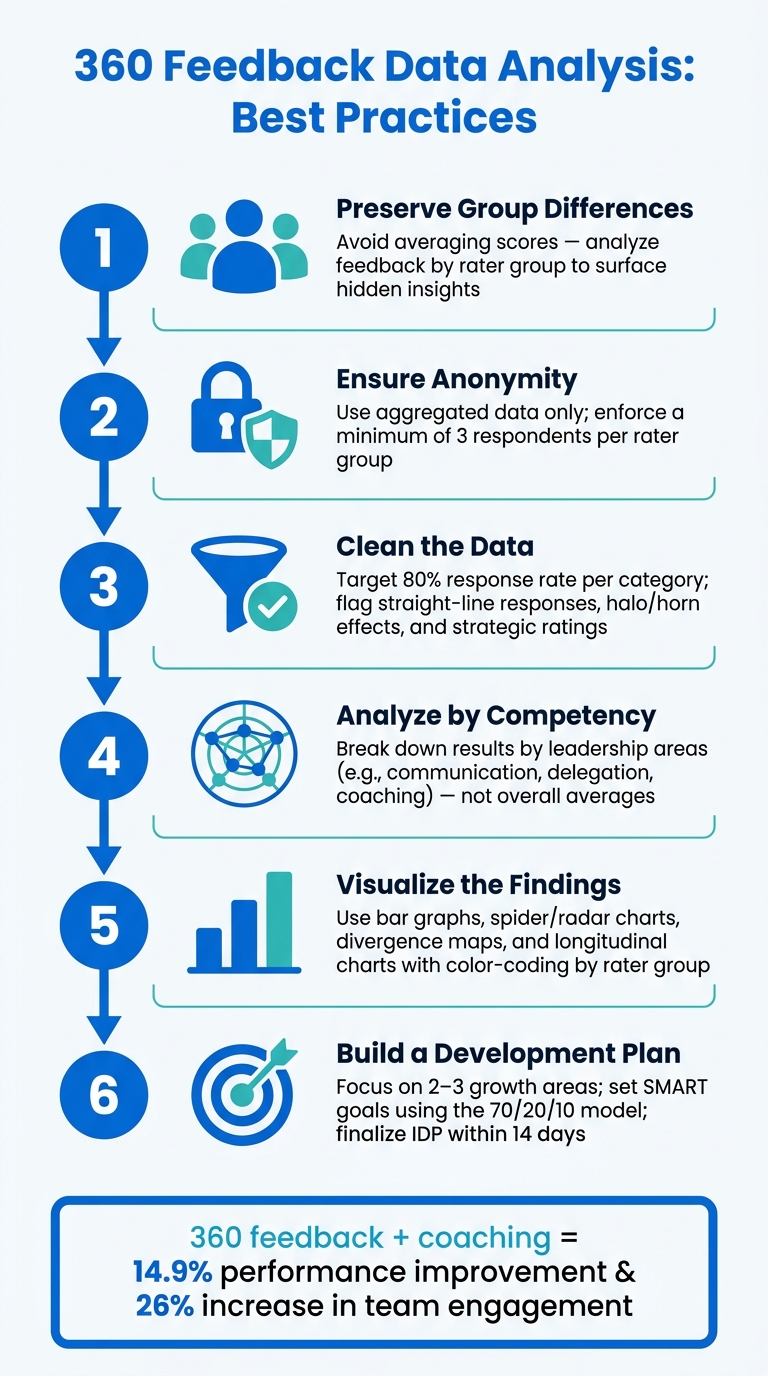
How to Analyze 360 Feedback Data: 6-Step Best Practices Guide
Webinar: 7 Steps to Running a Successful 360 Feedback Process
sbb-itb-8feac72
Preparing 360 Feedback Data for Analysis
Before diving into the analysis of 360 feedback data, it's crucial to ensure the data is properly prepared. Skipping this step can lead to misleading conclusions, which is a common pitfall for many leaders. A solid foundation is essential for accurate and meaningful insights.
Maintaining Confidentiality and Anonymity
The success of 360 feedback hinges on respondents' trust in the process. If participants believe their responses can be traced back to them, their feedback will likely be less honest, undermining the entire exercise.
"If there's even a hint that responses could be traced back, the process becomes polite and meaningless." - Pulsewise [6]
To address this, use systems that enforce anonymity rather than relying on verbal assurances. These platforms should only display aggregated group scores, not individual responses. Additionally, implement a minimum response threshold: feedback from any rater group (such as peers, direct reports, or external stakeholders) should only be included if at least 3 respondents from that group complete the survey [2][7]. If this threshold isn’t met, the data can either be combined with a similar group or flagged as "insufficient responses" rather than reported separately.
For open-ended comments, synthesize responses into broader themes to further protect anonymity [6][2].
Once anonymity is secured, focus on ensuring the data is complete. This step builds trust in the insights you’ll derive from the feedback.
Checking Data Completeness and Integrity
To ensure the reliability of your results, aim for an 80% response rate per rater category [10][3]. If response rates fall short, consider extending the survey window or sending automated reminders. Automated reminders are preferable because they maintain the anonymity of the process, unlike manual follow-ups [5][6].
Next, screen for response quality issues. Watch out for straight-line responses (where participants give the same score throughout) or biases like the halo or horn effect, where a rater scores someone uniformly high or low across all competencies regardless of their actual performance [9][3]. Such patterns can distort the data and should be flagged for review.
Identifying and Excluding Weak Data Sets
Once you've ensured data completeness, the next step is to filter out unreliable data. The table below outlines the most common criteria for exclusion:
| Criterion | Threshold | Why It Matters |
|---|---|---|
| Group size | Fewer than 3 respondents | Protects anonymity and prevents identification of individual raters [2] |
| Response rate | Below 80% | Ensures the data is representative of the group [10] |
| Rater tenure | Less than 6 months | Captures long-term behavior instead of first impressions [10] |
| Survey length | More than 40 items | Avoids response fatigue, which can degrade data quality [11] |
| Data consistency | High variance within a group | Flags inconsistent behavior or potential biases [2] |
Additionally, be mindful of strategic ratings - cases where a rater gives overly high scores to avoid conflict or overly low scores due to a competitive dynamic [12]. Such ratings often stand out when one rater’s scores sharply diverge from the group. Treat these as outliers and focus on patterns that multiple raters consistently highlight, as they provide the most reliable insights.
Techniques and Tools for Analyzing 360 Feedback Data
Once your data is cleaned and ready, the next step is to turn it into insights that can guide action.
Breaking Down Results by Competency
Avoid focusing on overall averages - they tend to hide the nuances that matter. Instead, analyze the data competency by competency. Think about areas like communication, delegation, strategic thinking, or coaching, and compare how different rater groups scored each competency.
Pay attention to the self-vs.-consensus gap. If someone rates themselves significantly higher than others, it might reveal a blind spot. On the other hand, if their self-rating is much lower, they could be overlooking a strength.
"The development direction lives where the largest gap sits, not where the average gap sits." - Unmesh Sheth, Founder, Sopact [2]
It’s helpful to categorize competencies into two main areas: task leadership (like setting goals, organizing, and driving results) and interpersonal leadership (such as mentoring, resolving conflicts, and building trust). Research from the Center for Creative Leadership highlights that peer ratings, especially in interpersonal areas, are often the best predictors of whether a leader might face career challenges [14]. Viewing competencies through this lens can show you where development efforts will make the biggest difference.
Once you’ve broken down the competencies, you can refine your analysis further by integrating qualitative feedback to provide context for the numbers.
Identifying Patterns and Themes in Feedback
After analyzing competencies, dive into the qualitative feedback to uncover recurring themes. Numbers can show you what people think, but open-ended comments often explain why. Look for patterns across multiple raters rather than focusing on isolated remarks.
For example, if several direct reports mention that you’re difficult to reach when they need decisions, that’s a pattern - not just a one-off issue. Themes that appear across different rater groups carry even more weight, as they point to consistent behaviors rather than isolated dynamics.
On the quantitative side, compare scores across different rater groups like managers, peers, and direct reports. Each group observes different aspects of leadership: managers focus on results and alignment with strategy, peers notice collaboration and influence, and direct reports emphasize coaching and communication [13]. If there’s a significant difference in how groups perceive you, it’s worth exploring. This could indicate that your behavior shifts depending on the group - a valuable insight for any leader.
Using Visual Tools to Clarify Findings
Visual tools can make it easier to interpret both the numerical data and the themes from qualitative feedback. They provide a clear way to communicate trends and insights. Here are some formats that work particularly well:
| Visual Tool | Best Used For |
|---|---|
| Bar Graph | Comparing scores across rater groups or competencies [16] |
| Spider/Radar Chart | Highlighting blind spots between self-ratings and others' ratings [17] |
| Divergence Map | Pinpointing the largest self-vs.-consensus gaps by competency [2] |
| Longitudinal Chart | Tracking progress in behavior over multiple review cycles [2] |
Adding color-coding by rater group can make comparisons even clearer. For instance, use one color for manager ratings, another for peers, and a third for direct reports [15]. This way, you can quickly spot discrepancies without combing through rows of data.
When presenting your findings, consider starting with areas of agreement and disagreement among rater groups, rather than jumping straight into a score summary. As Unmesh Sheth explains:
"A reader who opens to a score chart reads the report as a verdict. A reader who opens to a pattern reads the report as a development map." [2]
This shift in focus changes how feedback is perceived, turning it into a tool for growth rather than judgment.
Turning Feedback Insights into Development Plans
Once you've spotted patterns and drawn out the key findings, the next challenge is transforming those insights into a practical plan you’ll stick with.
Prioritizing Key Growth Areas
After analyzing the feedback, the goal is to create a focused development plan. Stick to 2–3 high-impact areas to avoid spreading yourself too thin. Research supports this approach, showing that focusing on just a few priorities prevents progress from stalling across the board [18][19].
A great way to decide what to tackle first is through intersection analysis. This means identifying where your biggest self-vs.-rater gaps align with recurring qualitative feedback. For instance, if "coaching direct reports" scores low and is frequently mentioned in open-ended comments, that’s a clear area to prioritize [2].
Remember, development plans shouldn’t just fix weaknesses. Include 1–2 core strengths that you can use more strategically. Balancing strengths with areas for improvement keeps the process encouraging rather than overly corrective [4].
Setting Specific Development Goals
General goals like "be a better communicator" don’t lead to real progress. Instead, break each growth area down into 3–5 specific, actionable steps you can integrate into your daily routine [18][5]. For example, instead of "improve communication", try "provide a concise written summary after every team meeting" or "ask one clarifying question during every 1:1."
To structure your skill-building, use the 70/20/10 model [19][20]:
| Development Type | Allocation | Example Action |
|---|---|---|
| Experiential (70%) | On-the-job practice | Leading a cross-functional project or delivering a major presentation |
| Relational (20%) | Coaching & mentoring | Regular 1:1 coaching sessions or collaborating with a peer mentor |
| Formal (10%) | Structured learning | Completing a certification course or attending a workshop |
When defining goals, stick to the SMART criteria - Specific, Measurable, Achievable, Relevant, and Time-bound [18][9]. And don’t wait too long: finalize your Individual Development Plan (IDP) within 14 days of reviewing your feedback. As Simon Carvi of Huneety Learning advises:
"A 360 report without a 70/20/10 plan within 14 days becomes a file nobody opens." [20]
Once your goals are set, create a system to monitor progress.
Planning Follow-Up and Tracking Progress
To keep your plan on track, set up a follow-up system. Schedule monthly or bi-weekly check-ins with an accountability partner - this might be your manager or a coach - and establish quarterly milestones to review your progress [20][21]. Regular follow-ups ensure that feedback doesn’t just sit on paper but drives meaningful growth.
For a longer-term view, plan a "Time 2" assessment 6–18 months after your initial review [1][8]. This could involve a pulse survey or a full 360-degree reassessment. Comparing results over time helps you see whether changes are sticking or if they’re just short-term efforts. As Dana Washington, Managing Consultant at DDI, emphasizes:
"360-degree feedback is a call to action, not a report to put away until the next assessment." [1]
Common Mistakes to Avoid in 360 Feedback Analysis
When analyzing 360 feedback, it’s easy to fall into traps that can undermine its effectiveness. Here are some frequent missteps and how to avoid them.
Overreacting to Isolated Comments
It’s natural to feel defensive or upset about a single negative remark, but one comment doesn’t usually signal a deeper issue. Andreas Pettersson, Executive Advisor and Keynote Speaker at LeadersAdapt, puts it this way:
"One low rating from one rater might reflect a single bad interaction or a personality conflict. Low ratings across multiple raters on the same dimension reflect a real pattern. Focus on patterns." [10]
Instead of zeroing in on one-off remarks, look for recurring themes across multiple responses. For example, if certain words or phrases keep popping up in open-ended feedback, they likely carry more significance. DecisionWise emphasizes this approach:
"Watch for one or more words or phrases that are repeated multiple times and give more weight to those messages than to other isolated comments that don't align with other themes from your report." [22]
Misusing Benchmark Comparisons
While benchmarks can offer useful context, they need to be interpreted carefully. A score that seems low compared to a norm group might actually be reasonable, depending on your team’s situation or recent challenges. Misinterpreting benchmarks can lead to unnecessary self-doubt or poor decisions.
Another major pitfall is using 360 feedback for high-stakes decisions like promotions or terminations. This not only creates legal risks but can also lead to less honest feedback, as raters may feel pressured to play it safe. Terri Baumgardner, Ph.D., of Assessments International, warns:
"The value and strategic impact of your 360 process is only as good as the capability of the people leading it." [8]
Also, keep an eye out for common rating biases that can skew results:
| Rating Bias | What It Looks Like |
|---|---|
| Halo Effect | A single strong trait inflates scores in unrelated areas. |
| Leniency Bias | Raters give overly high scores to avoid conflict or discomfort. |
| Recency Effect | Feedback reflects only recent events, ignoring the full evaluation period. |
| Central Tendency | Scores are clustered around the middle to avoid taking a strong stance. |
Treat these scores as tools for understanding perceptions, not as definitive judgments of your abilities. Use them as a guide to refine your leadership strategy. [10]
Disconnecting Feedback from Your Leadership Plan
Feedback is only as useful as the actions you take because of it. If the insights from your 360 report don’t directly influence your leadership development, their value is lost. As Unmesh Sheth of Sopact explains:
"The completeness of the report is what determines whether it drives development. A report that stops at element 1 [quantitative ratings] is a score chart, not a development document." [2]
To make the feedback meaningful, connect it to a concrete plan for growth. Share two or three specific changes you’re committing to with those who provided feedback. This not only builds accountability but also strengthens trust for future evaluations. Without this step, the report risks becoming just a collection of numbers instead of a roadmap for improvement.
Conclusion: Using 360 Feedback to Grow as a Leader
Key Takeaways for Technical Leaders
Shifting from being a technical expert to an effective leader is no small feat, but 360 feedback can serve as a guide. As Maximum Potential explains:
"A high performer is not always a strong people leader. Multi-rater feedback helps distinguish technical excellence from leadership readiness." [4]
To truly benefit from 360 feedback, it’s essential to go beyond the numbers. The data becomes meaningful when paired with five critical elements: quantitative ratings, qualitative themes, self-vs-consensus insights, clear development priorities, and long-term comparisons [2]. Without these, it’s just a collection of scores - not a plan for growth.
Peer feedback is especially important. According to the Center for Creative Leadership, peer ratings often provide the clearest indicator of whether a leader might struggle, particularly in areas like cross-functional teamwork and interpersonal skills - things that managers may not directly observe [14]. Leaders who consistently rate themselves higher than their peers do face a higher risk of career setbacks [14].
The numbers tell a compelling story about the value of acting on this feedback. Leaders who combine 360 feedback with coaching see a 14.9% improvement in performance, while their teams experience a 26% increase in engagement [25].
These findings lay the groundwork for actionable steps.
Next Steps for Applying These Best Practices
To turn feedback into measurable growth, consider these steps:
- Identify 1–2 key areas for improvement based on the largest perception gaps [10][23]. Use the 70/20/10 model mentioned earlier to structure your development efforts [20].
- Translate feedback into specific, time-bound actions. Share your plans with your team and commit to visible changes.
- Plan a follow-up 360 feedback session in 12–18 months to track progress and ensure your efforts are making a difference [2][25].
For technical professionals, programs like Tech Leaders offer tailored training to bridge the gap between technical expertise and the leadership skills that 360 feedback often highlights as areas for growth.
"360-degree feedback is a powerful growth resource; its true impact emerges when insights drive concrete actions." - Dana Washington, Managing Consultant, DDI [24]
FAQs
How do I interpret big differences between self-ratings and others’ ratings?
Gaps between how you rate yourself and how others rate you can uncover areas where you might be missing something important. If your self-ratings are higher than others’ assessments, it could point to overconfidence. On the other hand, lower self-ratings might reveal strengths you don’t fully recognize. The key is to look for patterns rather than getting caught up in one-off differences. Also, think about the context or specific relationships that might shape these perceptions. Working with a coach or mentor can be incredibly helpful - they can guide you in making sense of this feedback and help you develop a plan to better align how you see yourself with how others see you.
What should I do if a rater group has too few responses to stay anonymous?
If a rater group has too few responses to maintain anonymity, it's important to address this from the start. Clearly explain that only aggregated data will be reported. Being upfront about this ensures transparency and reassures participants that their individual ratings will stay confidential. By sharing data in a summarized format, you protect anonymity while still making the feedback useful for development.
How can I turn 360 feedback results into a simple development plan that sticks?
To turn 360 feedback into a meaningful development plan, collaborate with a coach or mentor to pinpoint recurring themes in the feedback. Zero in on 2–3 priority areas where growth is most needed, and create SMART goals - specific, measurable, achievable, relevant, and time-bound.
Outline actionable steps, such as enrolling in training programs or seeking mentorship opportunities. Share your plan with your manager to gain their support and align on expectations. Finally, set up regular check-ins with those who provided feedback to track your progress and strengthen trust over time.