

Best Practices for Stakeholder Engagement in AI Projects
When AI projects fail, it's often not because of technical issues but weak stakeholder engagement. Ignoring the needs of those impacted by AI systems - like students graded by algorithms or job seekers screened out by AI - can lead to bias, low adoption, legal risks, and reputational damage. Here’s how to avoid these pitfalls:
- Map all stakeholders: Include direct users, non-users, and marginalized groups.
- Set clear goals: Use the SMART framework to define measurable objectives.
- Communicate openly: Provide regular updates, tailor communication channels, and document feedback.
- Use AI tools wisely: Tools like sentiment analysis can track concerns, but human interaction is irreplaceable.
- Address resistance: Be transparent about benefits and limitations, and involve workers early on.
- Prioritize ethics: Maintain transparency, protect data, and follow frameworks like NIST’s AI RMF.
Early investment in stakeholder engagement - often a small fraction of project budgets - saves costs and builds trust. Success requires balancing technical expertise with social awareness and leadership skills.
Stakeholder Engagement in AI – ISO 42001
sbb-itb-8feac72
Understanding Stakeholder Needs and Defining Success Criteria
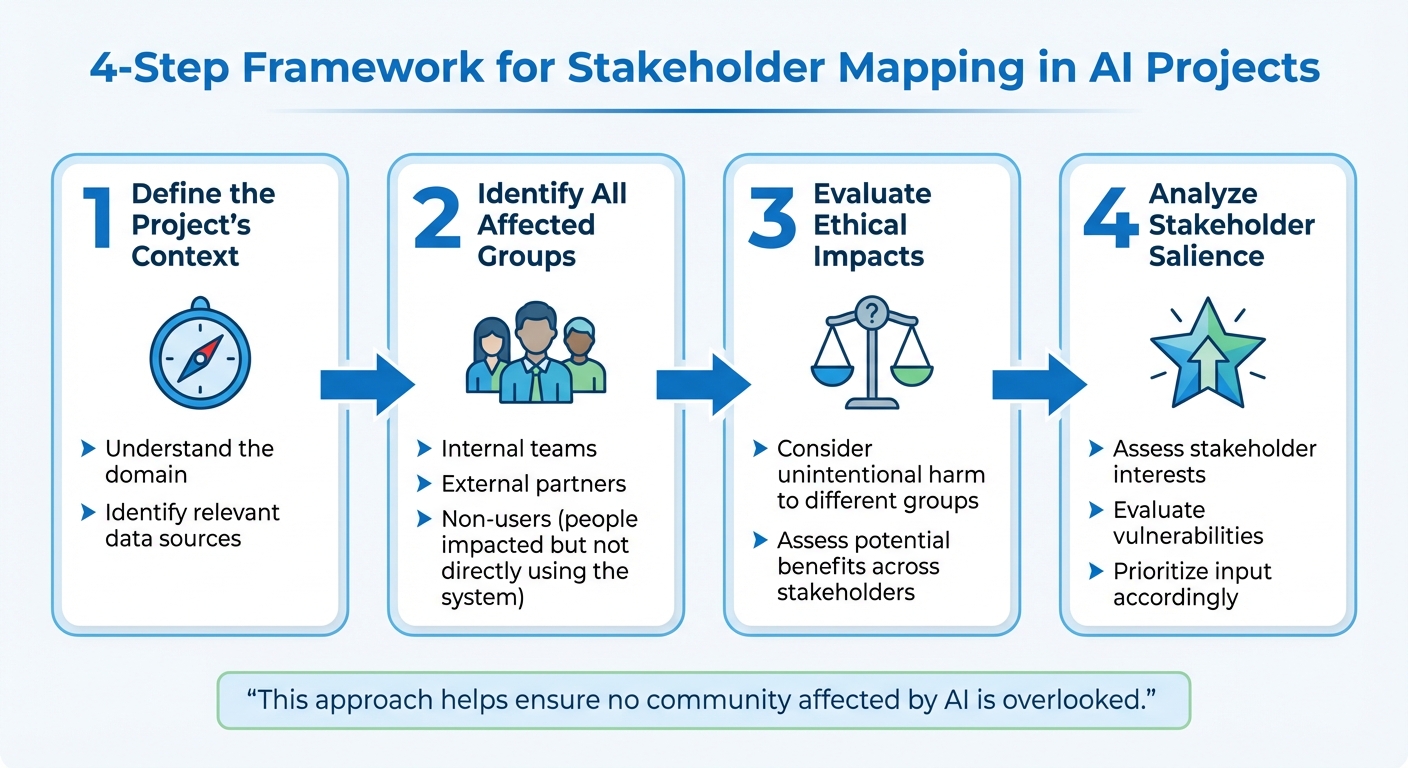
4-Step Framework for Stakeholder Mapping in AI Projects
Before diving into coding, take the time to map out how your system will impact all stakeholders. This goes beyond just identifying direct users. Consider everyone whose work or life may be influenced by the system - even those who may never interact with it. For example, AI-driven credit scoring systems can impact individuals without them ever seeing or using the algorithm. By taking this broader view, you ensure that the project reflects the needs and concerns of everyone it touches.
To guide this process, follow these four steps:
- Define the project's context: Understand the domain and identify relevant data sources.
- Identify all affected groups: Include internal teams, external partners, and even non-users.
- Evaluate ethical impacts: Consider how the system might unintentionally harm or benefit different groups.
- Analyze stakeholder salience: Assess their interests and vulnerabilities to prioritize their input [6].
This approach helps ensure no community affected by AI is overlooked.
Power imbalances between technical teams and impacted groups can make it harder to define success objectively. To address this, use positionality exercises to uncover biases and blind spots within your team [6]. These exercises can highlight marginalized stakeholders who might otherwise be ignored. As the Partnership on AI emphasizes:
"Inclusive AI/ML refers to algorithmic systems which are created with the active engagement of and input from people who are not on AI/ML development teams" [7].
Identifying Key Stakeholders
A Power-Interest Grid can help you organize stakeholders into four categories. For instance, stakeholders with high power and high interest should be closely involved, while those with high power but low interest may only need periodic updates [8]. Don’t stop there - broaden your scope to include experiential experts, particularly from marginalized communities [5].
It’s also essential to compensate stakeholders for their time and input [2]. This could mean monetary payments, travel reimbursements, or public acknowledgment. Such incentives ensure you gather insights from a diverse group, not just from those who can afford to volunteer. When working with marginalized communities, collaborate with local leaders who can help translate stakeholder feedback into actionable changes for your technical team [9].
Setting Measurable Goals
Once stakeholders are identified, work together to set clear, measurable objectives. Use the SMART framework - Specific, Measurable, Achievable, Relevant, and Time-bound - to define these goals. Be transparent about the extent of stakeholder influence on the project [8]. Conduct short, structured interviews to clarify expectations and uncover potential concerns early on. This can help avoid misunderstandings or conflicts later.
Pay particular attention to feedback from outlier users. These individuals often face the highest risk of harm, and their experiences can highlight critical system vulnerabilities that might later affect a broader audience. Success shouldn’t just be about performance metrics; it should also involve identifying and addressing potential failures through engagement with these "edge case" stakeholders [9].
Finally, document everything in a Project Summary (PS) report. This report should include your stakeholder analysis, reflections on positionality, and a governance workflow map [6]. Having this shared document keeps everyone aligned as the project progresses. While public engagement budgets are often in the hundreds of thousands rather than millions [2], investing in clarity upfront can save significant costs by avoiding major missteps later.
Communication Strategies for Stakeholder Engagement
Once you've clearly identified your stakeholders and set measurable goals, the next step is to adopt communication strategies that keep everyone engaged throughout the project. The key is to create structured communication channels that encourage trust and open dialogue at every stage of the AI project. Let’s take a closer look at how transparent communication builds the foundation for stakeholder trust.
Maintaining Transparency
Keeping stakeholders informed with regular, straightforward updates is essential for building trust. Weekly status reports that outline both progress and challenges can go a long way in ensuring everyone stays on the same page [10][11]. This level of openness minimizes misunderstandings and shows stakeholders that their involvement is valued. When stakeholders see their feedback making a tangible impact on project decisions, they’re more likely to stay engaged. Make it a point to document these outcomes - showing how input was considered not only builds accountability but also reinforces the importance of their participation [11]. This transparency becomes the backbone of effective communication channel selection.
Choosing the Right Communication Channels
Not all stakeholders are the same, so your communication methods shouldn’t be either. Use tools like the Power-Interest Grid to tailor your approach for each group. For example, high-power, high-interest stakeholders benefit from frequent face-to-face meetings, while low-interest groups may only require occasional email updates [12]. A mix of communication tools works best: platforms like JIRA, Asana, or Trello are ideal for internal teams, while broader audiences can be reached through newsletters or app notifications [10]. Don’t forget to include non-digital options for stakeholders who may not have regular online access [6].
Soliciting Feedback
Keeping feedback loops open throughout the project is crucial [3][6]. Offer anonymous channels for sensitive topics like privacy concerns or algorithmic bias - this encourages honest input that might otherwise go unheard [13]. When feedback is received, practice active listening: summarize what you’ve heard, explain how it will be used, and pay close attention to insights from marginalized groups or outlier users. These voices often highlight critical vulnerabilities that could impact a larger audience down the line [9]. To ensure nothing gets lost, archive all stakeholder interactions - whether they’re meeting notes, emails, or feedback forms - in a centralized platform like Confluence or Google Drive [10]. This approach not only keeps the project aligned with stakeholder needs but also strengthens trust and accountability.
Using AI Tools for Stakeholder Engagement
Building on the idea of transparent communication, AI tools offer practical ways to strengthen trust with stakeholders. By processing feedback, generating reports, and tracking sentiment, these tools allow you to focus on cultivating genuine relationships. The challenge lies in striking the right balance between automation and the irreplaceable value of human interaction.
Using Sentiment Analysis to Gauge Stakeholder Concerns
Sentiment analysis tools like IBM Watson Tone Analyzer and MonkeyLearn can quickly assess emails, surveys, and social media to uncover emotions such as frustration or enthusiasm [4][15]. Real-time insights from these tools can help you detect potential issues before they escalate. For instance, if a specific stakeholder group shows signs of frustration, you can prioritize a personal meeting to address their concerns directly.
These tools also help identify outliers or marginalized groups, enabling you to design solutions that address their unique challenges [9]. By providing actionable insights, sentiment analysis supports timely, informed decision-making while ensuring no group is overlooked.
Automating Updates and Reporting
AI simplifies the process of creating status reports, dashboards, and newsletters, saving time for more strategic tasks. Platforms like Borealis and Asana Intelligence can compile project data and draft reports complete with source references, ensuring stakeholders receive clear and accurate updates [14][15]. Many users find that these AI-generated summaries not only save time but also provide concise overviews that are perfect for stakeholder meetings [14]. Additionally, tools like app notifications and digital newsletters can efficiently reach large audiences without significant costs [6].
Balancing Automation with Personal Interaction
While AI excels at processing data, it cannot replace the empathy and understanding that only humans bring to the table. As Justin Lagac, Account Manager at Borealis, aptly states:
"AI is not a replacement for empathy, diplomacy, or cultural understanding - the skills that form the foundation of stakeholder engagement" [14].
AI insights can enhance human-led conversations - for example, by reviewing sentiment trends before a town hall meeting or using AI summaries to prep for individual calls. However, for sensitive negotiations, crisis communication, or high-stakes discussions, a human touch remains essential [4][14]. Transparency is also key: let stakeholders know when they're interacting with AI tools, like chatbots, or when their data is being analyzed. Always review AI-generated content for accuracy and tone before sharing it [4][14].
Addressing Challenges and Managing Change
Dealing with challenges head-on and navigating change effectively is essential for building and maintaining stakeholder trust. Resistance to new methods is natural - people often feel uneasy when their routines are disrupted. Even the best-designed AI projects will face hurdles, so it’s crucial to address concerns early and openly.
Communicating AI Benefits and Limitations
Transparency from the start can go a long way in reducing resistance. When stakeholders clearly understand what AI can - and cannot - do, they’re less likely to feel blindsided later. Be specific about the value the AI solution brings, like speeding up data analysis, improving accuracy, or cutting costs. At the same time, don’t shy away from discussing its limitations. For instance, if the AI requires a human to review final outputs, make that clear upfront. This honesty helps manage expectations while fostering trust.
The Partnership on AI emphasizes the importance of earning and maintaining public trust by ensuring the technology performs as promised and improves lives. Clearly communicating fixed technical decisions, rather than offering superficial consultations, sets the stage for smoother collaboration. Once clear boundaries are established, addressing resistance becomes more manageable.
Handling Resistance to Change
Concerns about job losses or disruptions to workflows are common. Address these fears by involving workers, unions, and labor organizations early in the process. This proactive engagement helps identify risks to workers’ rights, economic stability, and overall well-being. Structured frameworks like ADKAR (Awareness, Desire, Knowledge, Ability, Reinforcement) can guide individuals through the adjustment period. Additionally, using internal coaches or change agents to provide localized support - and starting with a small pilot group before a full rollout - can make the transition less daunting.
Acknowledging stakeholder contributions is another effective way to reduce resistance. Offering monetary incentives, public recognition, or exclusive insights can make participants feel valued, turning potential skeptics into active collaborators.
Establishing Ethical and Responsible AI Practices
As mentioned earlier, building ethical frameworks is essential to earning stakeholder trust. Transparent AI development - spanning everything from initial market research to ongoing monitoring - plays a central role in this process. When stakeholders feel their concerns are acknowledged and their interests safeguarded, they’re more likely to back your efforts, even when challenges arise. Below are strategies to maintain transparency and protect data throughout your AI initiatives.
Ensuring Transparency About AI Use
Always inform stakeholders when AI directly influences their experiences or outcomes. For example, if an AI tool like a chatbot escalates an issue or makes decisions, disclose this upfront [1].
Proactive measures, such as red-teaming exercises and bug bounty programs, can help identify risks early. These approaches not only address potential vulnerabilities but also encourage critics to become collaborators [1]. The Partnership on AI highlights this idea:
"Public engagement is an early stage investment to avert more significant costs that can arise from shipping a product that is harmful, doesn't meet people's needs, or fails in some other respect" [2].
By combining openness with strong data security measures, organizations can bolster stakeholder confidence and trust.
Implementing Data Privacy and Security Measures
Strong data governance is crucial for protecting sensitive information and preventing breaches. The NIST AI Risk Management Framework (AI RMF) offers a voluntary guide to embedding trust into AI systems from their design phase through evaluation [17]. Techniques like federated learning and differential privacy can further safeguard stakeholder data [16].
In industries where stakes are high, creating auditable data pipelines with human oversight is essential. This helps uncover biases and addresses privacy concerns before they escalate [16]. Engaging stakeholders in conversations about how their data is used and managed builds trust and strengthens relationships over time [3]. However, transparency must be balanced with caution - detailed explanations about AI systems can sometimes expose sensitive information. Collaborating with security teams ensures that transparency and privacy protection work hand in hand [16].
Conclusion
Building effective AI projects hinges on thoughtful stakeholder engagement at every stage of development. The strategies discussed here - from involving a diverse range of stakeholders to setting clear, measurable goals and prioritizing transparency - are essential for fostering trust. As the Partnership on AI aptly puts it:
"The question is no longer whether public engagement should be part of AI development but rather how we can make it a fundamental, non-negotiable step in shaping AI's future" [1].
Investing time and resources early on can prevent costly mistakes later. While robust stakeholder engagement might require an upfront investment in the hundreds of thousands, this is often just a small fraction of a project's overall R&D budget [2]. Early involvement can save organizations from the financial and reputational damage caused by releasing products that fail to meet user needs or cause harm. With AI revenue expected to soar to at least $1.5 trillion by 2040 [2], companies that prioritize inclusive engagement will be better equipped to seize market opportunities while maintaining public trust.
For technical leaders, success in AI development goes beyond technical expertise. It demands skills in facilitation, understanding social contexts, and qualitative analysis. The Partnership on AI highlights the importance of this broader skill set:
"Knowing how to build strong relationships with people from different walks of life is a skill set that can be honed both through experience and through formal training" [2].
As AI technology continues to evolve, leadership development must keep pace. Leaders who bridge the gap between technical know-how and non-technical skills - like stakeholder management, ethical decision-making, and strategic thinking - will be better prepared to handle the challenges of AI implementation. Programs such as those offered by Tech Leaders are designed to help technical professionals build these critical leadership capabilities for AI-driven projects.
FAQs
How can AI projects address the needs of underrepresented groups?
AI projects have the potential to better serve underrepresented groups when these communities are actively involved in every step of the development and deployment process. This means seeking their input to uncover potential biases, address social inequalities, and tackle unique challenges that might otherwise be overlooked. Engaging inclusively helps ensure that AI systems are fair, accessible, and tailored to meet the needs of diverse populations.
Achieving this requires creating spaces for meaningful participation, such as hosting workshops or consultations, and offering resources that support their involvement. It's also essential to address power imbalances, giving these groups a genuine voice in decision-making at every stage. When ethical engagement is prioritized, AI initiatives can foster trust and deliver solutions that truly reflect the needs of all stakeholders.
How can I address resistance to AI adoption in my projects?
Winning over stakeholders when introducing AI starts with transparency and clear communication. Make sure everyone understands the purpose behind the project, the benefits it aims to deliver, and how it could impact them directly. Being upfront about these details helps build trust and clears up any misconceptions. On top of that, keeping the conversation open and encouraging feedback throughout the process ensures that stakeholders feel valued and involved.
Another smart move is to start small. Launch a pilot project or focus on achieving quick, visible results. These small successes provide proof of concept and can help ease worries about uncertainty or major disruptions. People are much more likely to embrace change when they can see the upside early on.
It’s also a good idea to conduct a stakeholder analysis. This allows you to pinpoint specific concerns and tailor your communication and engagement strategies to address the unique needs of different groups. By combining these efforts, you create a more collaborative and supportive atmosphere, making the transition to AI smoother for everyone.
How can sentiment analysis improve stakeholder engagement in AI projects?
Sentiment analysis is an AI-driven tool that gives you real-time insights into how stakeholders feel about your AI projects. By examining data from platforms like social media, surveys, and feedback forms, it pinpoints emotions, opinions, and concerns. This helps technical leaders tackle issues early, clear up misunderstandings, and communicate more effectively.
What makes sentiment analysis so impactful is its ability to promote trust and transparency. By enabling data-driven and empathetic communication, it helps you connect with stakeholders on a deeper level. It also allows you to adjust your engagement strategies to better address their needs, ensuring ethical and inclusive practices throughout the project's journey. Understanding stakeholder sentiment strengthens relationships and ensures your AI efforts align with their expectations.