

Charismatic Leadership and Team Innovation
Charismatic leadership is about inspiring teams emotionally and ideologically, rather than relying on authority or rewards. This style of leadership is shown to significantly boost team innovation by creating environments where confidence, trust, and collaboration thrive. Key findings from research include:
- Team Confidence: Leaders who emphasize vision and empathy enhance team belief in their abilities, leading to better problem-solving and idea generation.
- Organizational Alignment: Charismatic leaders strengthen employees' connection to their organization, which translates into innovative actions.
- Sector-Specific Impact: The effectiveness of charismatic leadership varies by industry, with mechanisms like team trust, communication, and identity playing crucial roles.
Studies across banking, technology, and public sectors reveal that charismatic leaders use storytelling, emotional engagement, and symbolic gestures to inspire teams. For engineering leaders, adopting practical techniques such as metaphors, expressive gestures, and clear vision-setting can help replicate these results. Balancing charisma with operational focus is key to maintaining leadership effectiveness.
How to Become a Charismatic Leader
Research Findings on Charismatic Leadership and Team Innovation
Studies show that charismatic leadership plays a key role in sparking team innovation across various environments. These findings highlight three main pathways through which charismatic leadership drives innovation: team potency, organizational identification, and cultural transformation.
Le Blanc et al. (2011): Team Potency in Spanish Banking Teams
A study of Spanish banking teams by Le Blanc et al. (2011) found that team potency - essentially, a shared belief in the team’s ability to succeed - serves as the link between charismatic leadership and innovation. The researchers used a two-stage model to demonstrate how early charismatic leadership fosters team potency, which in turn leads to higher innovation ratings by managers [2]. When teams feel confident in their abilities, they’re more likely to embrace creative problem-solving and generate fresh ideas.
Moon (2025): Organizational Identification and Innovation
Between October and November 2024, Kuk-Kyoung Moon and Jaeyoung Lim explored the impact of charismatic leadership on 1,012 South Korean public officials, evenly split between national and local government roles. Using data from the Korea Institute of Public Administration (KIPA), their research revealed that organizational identification - the sense of belonging and alignment with an organization - requires charismatic leadership to fully translate into innovative behavior.
Regression analysis showed that leaders who used visionary messaging and symbolic gestures amplified the innovative potential of employees with strong organizational identification. Moon and Lim explained:
"Charismatic leadership acts as a contextual force that determines whether identification remains symbolic or evolves into innovative action."
Interestingly, the study also highlighted how charismatic leaders encourage selective rule-breaking to achieve broader institutional goals, creating a psychologically safe space for risk-taking. This is especially impactful in hierarchical settings with high power distance [5].
Ali Asgari (2023): Creativity and Cultural Transformation
Ali Asgari’s 2023 research adds another dimension, focusing on how charismatic leadership influences team creativity and reshapes organizational culture. By presenting a clear and inspiring vision and demonstrating unwavering commitment to change, charismatic leaders foster environments where creative experimentation thrives. Over time, this approach not only enhances immediate team performance but also shifts cultural norms to support continuous innovation.
Together, these studies underscore the transformative potential of charismatic leadership in driving both team-level creativity and broader organizational change.
How Charismatic Leadership Drives Innovation
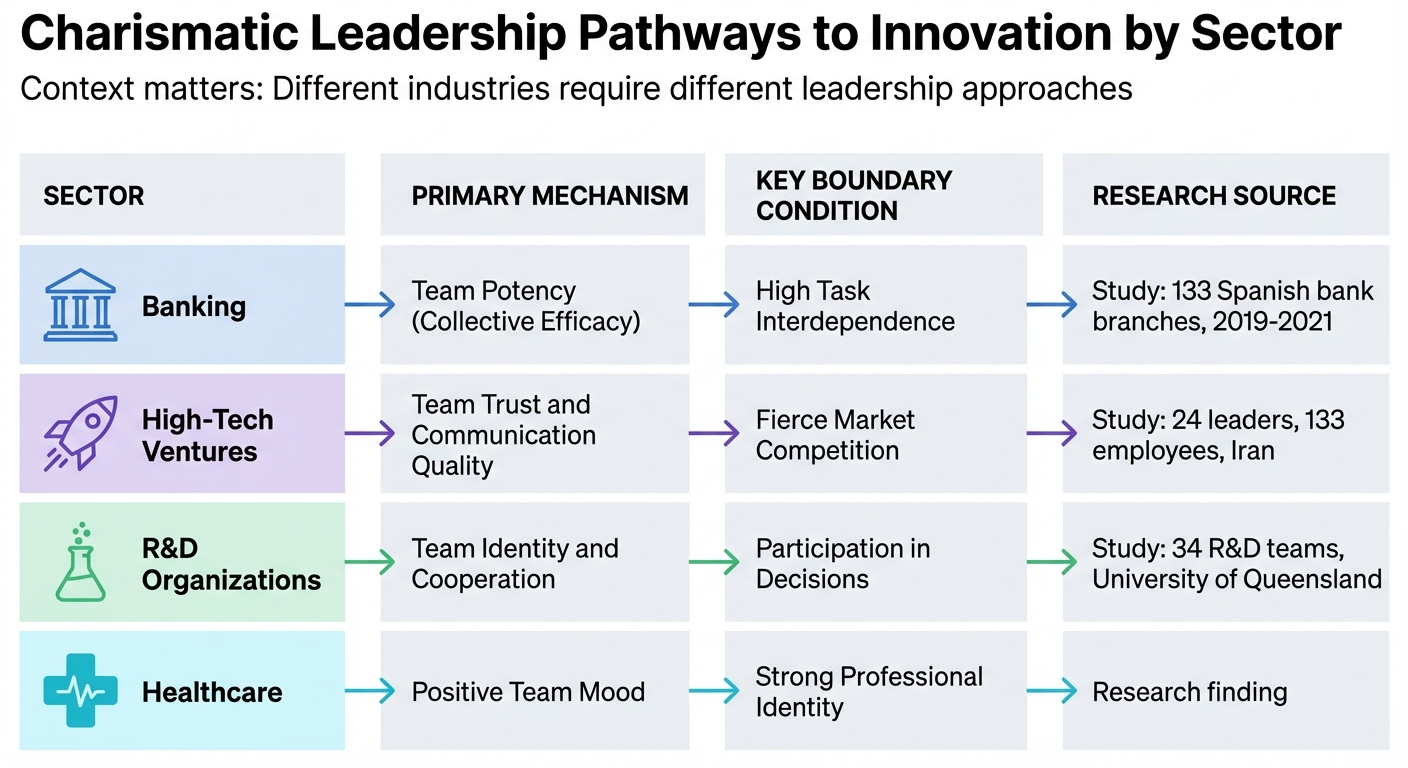
How Charismatic Leadership Drives Innovation Across Different Industries
Charismatic leadership plays a pivotal role in driving innovation by influencing key psychological and social dynamics within teams. One of the most impactful ways this happens is through the development of team potency, which we’ll explore below.
Team Potency as a Key Link
Team potency - the shared belief among team members that they can successfully handle a variety of tasks - serves as a bridge between charismatic leadership and innovation. A longitudinal study conducted across 133 Spanish bank branches from 2019 to 2021 revealed that in workplaces where tasks required high levels of collaboration, charismatic leadership significantly boosted both team potency and innovation ratings [2].
Similarly, research involving 34 R&D teams at the University of Queensland highlighted how charismatic leaders foster innovation by cultivating a strong sense of team identity. This shared identity encouraged cooperative behaviors, such as active involvement in decision-making and the open sharing of new ideas. As Neil Paulsen explained:
"Charismatic leaders promote team innovation by supporting a sense of team identity and commitment, and encourage team members to cooperate through the expression of ideas and participation in decisions" [3].
This ability to enhance team potency sets charismatic leadership apart from transactional leadership styles, which primarily depend on rewards and formal authority [1].
Organizational Identification as a Crucial Factor
Research suggests that the effectiveness of charismatic leadership is amplified when there’s alignment between leaders’ and followers’ identification with the organization [6]. For example, a study involving 33 leaders and 142 followers during a corporate restructuring found that leaders who removed obstacles and clearly communicated a forward-looking vision were perceived as more charismatic. This perception strengthened team members’ commitment to change, fueling innovative initiatives [1].
Industry and Sector Variations
The influence of charismatic leadership on innovation isn’t uniform - it varies across industries, with each sector benefiting from distinct mechanisms. The table below outlines how innovation is driven in different sectors and the conditions that shape these outcomes:
| Sector | Primary Mechanism to Innovation | Key Boundary Condition |
|---|---|---|
| Banking | Team Potency (Collective Efficacy) | High Task Interdependence [2] |
| High-Tech Ventures | Team Trust and Communication Quality | Fierce Market Competition [4] |
| R&D Organizations | Team Identity and Cooperation | Participation in Decisions [3] |
| Healthcare | Positive Team Mood | Strong Professional Identity [7] |
For instance, in high-tech ventures, a study involving 24 team leaders and 133 employees in Iran found that charismatic leadership indirectly spurred innovation by building trust and improving communication - both critical in highly competitive markets [4]. Meanwhile, in healthcare settings, charismatic leaders enhanced innovation by creating a positive team mood, which was especially effective when team members identified strongly with their profession [7].
These findings highlight that the pathway from charismatic leadership to innovation depends heavily on the context. In some industries, collective confidence is the driving force, while in others, trust, communication, or a unified team identity take center stage. Leaders need to adapt their approach to these nuances to unlock their teams’ full creative potential.
sbb-itb-8feac72
Examples from Tech Organizations
In technology-focused companies, the dynamics of leadership and collaboration often play a critical role in shaping research, development, and innovation.
R&D Teams and Product Development
Research involving 34 R&D teams highlighted the influence of charismatic leadership on fostering innovation in tech environments. Leaders who cultivated a strong sense of team identity saw a boost in cooperative behaviors, as team members felt encouraged to share new ideas and actively participate in decision-making processes [3].
Another study, which included 24 team leaders and 133 employees from high-tech ventures, found that charismatic leadership indirectly drove innovation by building trust within the team and enhancing communication. These factors created an environment where innovation could thrive [4]. Together, these findings show how leadership styles tailored to the tech industry can lead to measurable outcomes, particularly when trust and communication are prioritized.
In R&D settings, charismatic leaders often excel by promoting collaborative problem-solving. Instead of working in isolation, team members feel empowered to openly discuss technical challenges and brainstorm solutions collectively. These examples provide a foundation for comparing findings from various related studies, as outlined below.
Study Comparison Table
Here’s a summary of key findings from studies conducted in tech-related contexts:
| Study | Sample Size | Key Mediating Factor | Key Moderating Factor | Primary Outcome |
|---|---|---|---|---|
| Le Blanc et al. | 133 teams | Team Potency | Task Interdependence | Innovative Behavior [2] |
| Paulsen et al. | 34 R&D teams | Team Identity & Cooperation | N/A | Team Innovation [3] |
| Jahanshahi et al. | 24 leaders / 133 employees | Team Trust & Communication | N/A | Team Innovation [4] |
| Eisenbeiß & Boerner | 52 R&D teams | N/A | Curvilinear (U-shaped) | R&D Innovation [8] |
| Walter & Bruch | 33 leaders / 142 followers | Commitment to Change | Organizational Change | Team Performance [1] |
How Engineering Leaders Can Apply These Findings
Building Charismatic Leadership Skills
Engineering leaders can develop charisma by adopting practical, learnable techniques. Researchers at the University of Lausanne have identified 12 Charismatic Leadership Tactics (CLTs) - nine verbal and three nonverbal - that leaders in technical fields can practice systematically [10].
Verbal tactics include using metaphors, storytelling, and rhetorical questions to break down complex technical ideas and encourage critical thinking. A great example is Steve Jobs's Stanford commencement speech in June 2005. In that speech, Jobs shared personal stories, contrasted unconventional choices with traditional paths, and inspired his audience with high moral aspirations [10]. On the nonverbal side, tactics like using an animated voice, expressive facial expressions, and purposeful gestures can help leaders convey energy and enthusiasm that resonate with their teams [10][13].
Engineering leaders can approach leadership development much like they would an engineering challenge: by hypothesizing, testing, and refining their methods [12]. Tools like 360-degree feedback and personality assessments (such as DISC, MBTI, or True Colors) can help leaders gain self-awareness and fine-tune their approach [12].
"High-performing engineering teams are not the smartest... It's less about brain-power and more about heart-power." - Zachary White, CEO, Oasis of Courage [12]
Interestingly, research shows that charisma’s effectiveness peaks at about the 60th percentile. A study involving 800 business leaders and 7,500 coworkers revealed that leadership effectiveness starts to decline when charisma scores exceed this threshold [14]. Leaders who are highly charismatic may risk being seen as less effective in daily operations. To strike the right balance, they should seek regular feedback to ensure their visionary ideas don’t overshadow operational needs [14][15].
These techniques provide a foundation for formal training programs that help refine leadership skills even further.
Tech Leaders Training Programs

Building on these research-backed methods, Tech Leaders offers specialized programs for engineering leadership and entrepreneurship. These programs are designed to help technical professionals blend their expertise with essential leadership and AI business strategy skills. They emphasize communication, emotional intelligence, and vision-building - qualities research has shown to be key for fostering team effectiveness and innovation.
Through leadership peer masterminds, personalized learning plans, and private coaching, participants can practice and apply charismatic tactics in real-world scenarios. For instance, they learn to craft compelling visions that serve as rallying points for their teams [9][11] and to create a strong sense of team identity and collaboration, which are critical for driving innovation in R&D environments [3]. These programs empower technical professionals to step confidently into leadership roles and mobilize their teams effectively using proven principles. By immediately applying these tactics, leaders can reinforce the research findings and make a tangible impact on their teams and organizations.
Conclusion
Research highlights that the emotional and symbolic influence of charismatic leadership plays a key role in driving team innovation, especially in environments that encourage collaboration and calculated risk-taking [1].
Studies also point out that strengthening team confidence and fostering a sense of shared identity through charismatic leadership can lead to noticeable increases in innovative behavior [2][3]. These findings emphasize the importance for engineering leaders to incorporate charismatic leadership techniques into their approach.
FAQs
How does charismatic leadership drive team innovation?
Charismatic leaders have a knack for sparking innovation within teams by crafting a shared vision that excites and motivates. They present change as a thrilling opportunity and communicate their vision with confidence and energy. This infectious enthusiasm gives team members a sense of purpose, encouraging them to step out of their comfort zones, take risks, and come up with creative solutions. The result? Stronger team confidence and better collaboration, as diverse skills and perspectives come together seamlessly.
Studies highlight that charismatic leaders also play a pivotal role in driving change. They encourage experimentation, celebrate small wins early on, and create an atmosphere where fresh ideas are not just accepted but actively encouraged. This leadership style doesn’t just inspire effort - it speeds up how quickly teams can turn innovative ideas into reality.
For engineers looking to build these skills, Tech Leaders provides targeted training. Their programs blend technical know-how with critical leadership skills like setting a clear vision, inspiring through communication, and empowering teams - essential qualities for thriving in today’s fast-moving tech world.
Which industries see the greatest innovation benefits from charismatic leadership?
Charismatic leadership plays a crucial role in industries that depend on rapid knowledge generation and tackling intricate challenges. Take high-tech sectors, for instance - these industries often experience noticeable benefits, such as increased patent filings, improved R&D performance, and more robust innovation pipelines. These advantages tend to shine in environments where creativity and charisma are highly valued.
Beyond tech, other fields like financial services and public administration also reap rewards from charismatic leaders. In banking, for example, such leaders have been shown to inspire greater team innovation, particularly during digital transformation initiatives. Similarly, in government agencies, charismatic leadership has the potential to spark reform and encourage innovation by fostering a strong sense of organizational identity.
In R&D settings, where discovering new solutions is essential, charismatic leaders can guide teams through change and inspire groundbreaking ideas. This is especially true in the tech world, where innovation fuels both product development and market competitiveness. Leaders who embrace charisma can help teams channel their technical expertise into impactful, AI-driven projects, accelerating progress and delivering meaningful results.
How can engineering leaders develop charismatic leadership skills to inspire team innovation?
Charismatic leadership blends personal charm with a strong vision, enabling engineering leaders to inspire their teams and spark creativity. In tech environments, this approach encourages out-of-the-box thinking by giving team members the confidence to challenge norms and align their efforts with a greater purpose.
Here’s how to cultivate charismatic leadership:
- Create an inspiring vision: Tie technical objectives to a meaningful story that energizes and motivates your team.
- Communicate with clarity and confidence: Whether in meetings or updates, a confident delivery builds trust and encourages action.
- Practice genuine empathy: Listen attentively, address concerns, and provide thoughtful feedback to strengthen emotional connections.
Engineering leaders can also sharpen their skills through training programs that merge technical knowledge with leadership techniques like storytelling and influence. By applying these strategies consistently, leaders can build a team culture that thrives on collaboration and fresh ideas.