
Checklist for Building Cross-Functional Agile Teams
Want to make your Agile teams more effective? Cross-functional teams are the way to go. They combine diverse roles like developers, testers, and designers into a single group that shares responsibility for delivering a product. Here’s how you can build one:
- Pick the right people: Look for "T-shaped" professionals - experts in one area but capable of contributing across others. Prioritize collaboration skills.
- Define roles clearly: Use tools like a RACI matrix to assign responsibilities and prevent confusion.
- Set shared goals: Align everyone with SMART objectives and use tools like OKRs to track progress.
- Streamline communication: Use platforms like Slack, Jira, or Notion to keep everyone connected and informed.
- Encourage trust and learning: Create a safe environment for feedback and use retrospectives to improve teamwork.
Key Insight: Google’s research shows psychological safety is the top factor for team success. When people feel safe to take risks, they perform better.
Ready to start? Follow these steps to build a team that delivers results and avoids delays.
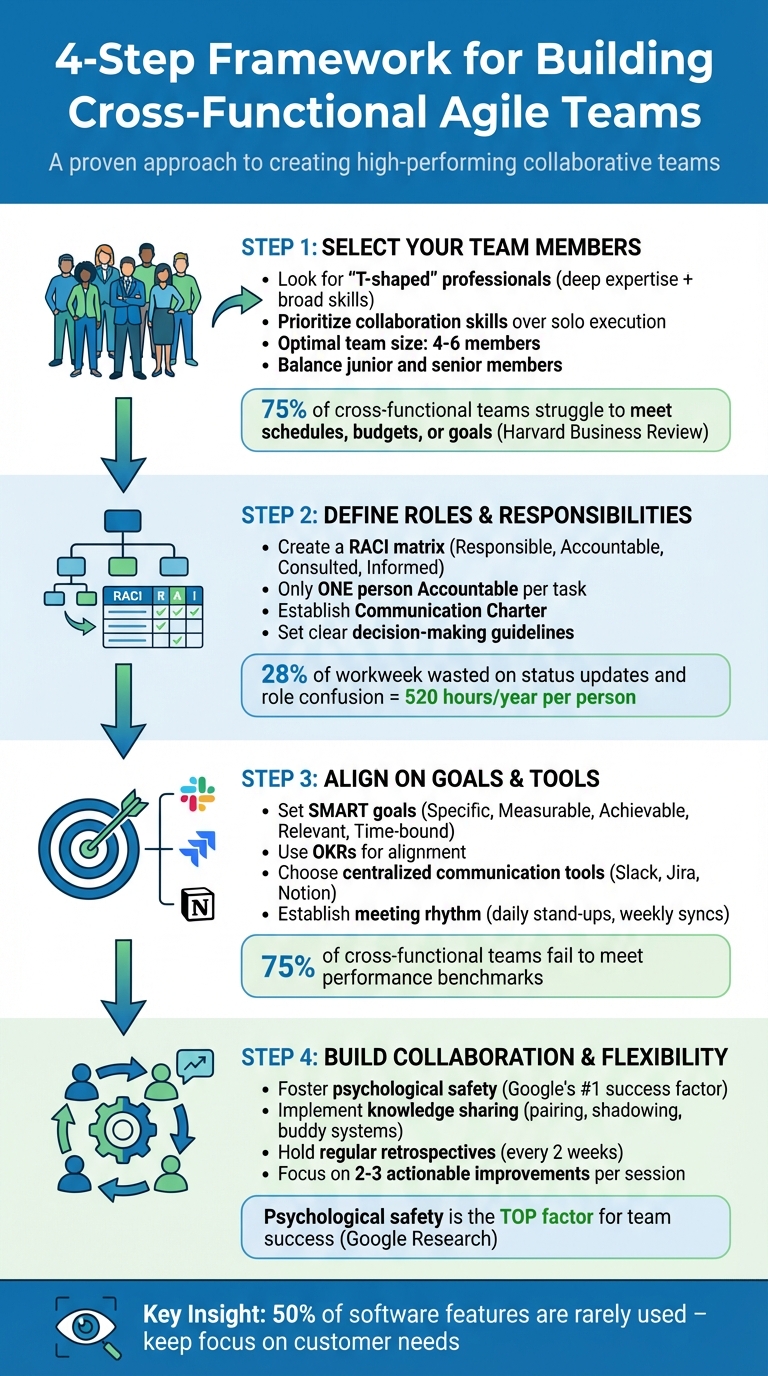
4-Step Framework for Building Cross-Functional Agile Teams
Building a CROSS-FUNCTIONAL Agile Team: 10 Step Process | HOW TO BUILD A CROSS FUNCTIONAL AGILE TEAM
sbb-itb-8feac72
Step 1: Select Your Team Members
Building an effective team isn’t just about technical expertise - it’s also about finding individuals who thrive in collaboration. According to Harvard Business Review, 75% of cross-functional teams struggle to meet schedules, budgets, or goals [7]. The key to avoiding these pitfalls often lies in choosing people who can work well together, not just execute tasks independently.
Look for "T-shaped" professionals - those with deep expertise in one area but enough versatility to contribute across other domains. As Bernie Maloney from Scrum Alliance puts it, "The goal is not for everyone to do everything but for the team to have all the skills needed to achieve their goals without relying on external groups" [2]. For instance, if a QA specialist is unavailable, a T-shaped developer could step in to handle testing, ensuring the project keeps moving forward.
Collaboration skills should be a top priority. Traits like agreeableness, clear and respectful communication, and a "yes, and" mindset can significantly enhance team dynamics [6]. Emotional stability is equally important - team members need to stay composed under pressure, whether it’s dealing with bugs or managing challenging customer feedback [6].
Identify Required Roles and Functions
Start by outlining the core roles needed to deliver a complete product increment. These typically include back-end and front-end developers, UI/UX designers, product managers, and QA specialists. Each role brings something essential to the table: developers create features, designers focus on usability, product managers align work with customer priorities, and QA specialists ensure quality before launch.
Before finalizing your team, conduct a skill inventory to identify gaps. Compare the skills required for your project with those available in your talent pool [4]. For example, a mobile app project might call for iOS and Android developers, a designer experienced in mobile interfaces, and someone familiar with app store submission processes [4][6]. During interviews, ask candidates about their passions and long-term goals - it’s a great way to gauge whether they’re motivated by solving complex challenges rather than just routine tasks [6].
Determine Team Size and Mix
Smaller teams, typically 4–6 members, tend to communicate more effectively and make decisions faster. Strive for a balance between junior and senior team members to blend hands-on execution with strategic insight [3][5].
Keep the focus on customer needs. Research shows that 50% of software features are rarely used [6], so it’s critical to have team members who prioritize end-user value. During the selection process, ask candidates how they define “customer service” to ensure they understand its importance [6]. Additionally, evaluate their ability to adapt to the uncertainty of agile environments, where priorities can shift quickly [6].
Once your team is in place, establish clear roles and collaboration practices to unlock their full potential.
Step 2: Define Roles, Responsibilities, and How People Work Together
Unclear roles can drag a team down. Research indicates that 28% of the workweek gets wasted on status updates and confusion about roles - that’s about 520 hours per person, per year [8]. By clearly defining roles, you can avoid unnecessary delays, missed tasks, and the blame game when things go wrong.
When everyone knows their responsibilities, feedback flows more freely, and you cut down on duplicated efforts or arbitrary decision reversals. This clarity lays the groundwork for effective teamwork as your project progresses.
Create a RACI Matrix
One way to ensure clear roles in an agile environment is by using a RACI matrix. This framework breaks down involvement into four categories: Responsible (the person doing the work), Accountable (the one with final decision-making authority), Consulted (those who provide input), and Informed (stakeholders who need updates). For instance, a developer might be Responsible for coding a feature, the Product Owner is Accountable for approving it, the Scrum Master is Consulted on process improvements, and the Sales Manager is Informed when the feature is ready to launch.
The golden rule? Only one person should be Accountable for each task. As Amit Kothari, CEO of Tallyfy, explains:
"Responsible executes the task; Accountable owns the outcome" [8].
Too many people sharing accountability slows progress, while involving too many Consulted roles can bog down decision-making [9].
Focus on documenting tasks that frequently cause delays or confusion. Use the matrix to spot workload imbalances or gaps in responsibilities. Instead of letting this document gather dust, integrate it into your project management tools so tasks automatically go to the right person. Research shows that people forget 90% of documented processes within a week [8], so make the RACI matrix a living part of your workflow, not just a static reference.
Set Rules for Collaboration and Decision-Making
In addition to defining roles, establish clear collaboration and decision-making guidelines. A Communication Charter can help by specifying which tools to use for different purposes - like Slack for updates, Jira for task tracking, and Notion for documentation [10][3]. Define response time expectations, set up daily stand-ups, and schedule weekly syncs. For disagreements, focus on finding solutions instead of assigning blame, and consider bringing in neutral mediators for tough situations [10].
Make your team’s principles actionable. Instead of vague values like "we value transparency", use practical statements like, "I share updates proactively, even if the work isn’t finished" [3]. After each milestone, hold retrospectives to assess what’s working and adjust your rules accordingly [11][3].
If your team is small enough - think Amazon’s "Two-Pizza Rule", where a team should be small enough to be fed by two pizzas - roles often become naturally clear without the need for heavy documentation [8].
Step 3: Align on Goals, Metrics, and Communication Tools
Once you’ve clarified roles and responsibilities, the next step is to align your team around shared goals and establish effective communication channels. Why is this so important? Because about 75% of cross-functional teams struggle to meet basic performance benchmarks, like staying within budget, hitting deadlines, or aligning with organizational objectives [12]. A common culprit is the lack of a unified vision for success or a clear way to measure progress. When team members from different departments don’t share the same priorities or speak the same “language,” they often focus on their own departmental goals rather than the project’s overall success [12]. On the flip side, when everyone is on the same page with clear goals and easy access to updates, teams can adapt quickly to changing priorities [11].
Well-defined goals are the foundation for measurable progress.
Set Measurable Objectives
Start by crafting SMART goals - those that are Specific, Measurable, Achievable, Relevant, and Time-bound [11]. For instance, instead of vaguely aiming to "improve customer onboarding", you could set a clear target like: "Reduce onboarding time from 10 minutes to 5 minutes by March 15, 2026, as tracked through analytics." This eliminates ambiguity and gives the team a clear direction.
Another effective framework is using OKRs (Objectives and Key Results) to drive alignment and accountability [12]. For example, your objective might be, "Launch a seamless mobile checkout experience", with measurable key results like "achieve a 95% success rate on first-time transactions" and "reduce cart abandonment by 20% within the first month." It’s also critical to ensure that individual or departmental KPIs don’t clash with cross-functional goals. For example, if a developer’s performance is assessed based on speed rather than quality, they might skip thorough testing, which could jeopardize a smooth launch.
Use Agile Tools for Communication
Once goals are locked in, the next step is to streamline communication. This starts with choosing tools that centralize all project information. Platforms like Confluence or Notion can serve as a single source of truth, documenting everything from goals and decisions to timelines and blockers [12]. This ensures both technical and non-technical team members have access to updated information at all times.
For daily coordination, tools like Slack or Microsoft Teams work well for quick updates and urgent questions [14]. Pair these with visual task management tools like Jira or Asana, which allow teams to track workflows, manage backlogs, and monitor dependencies using Kanban boards or Gantt charts. For example, if a designer notices a developer is stuck on an API integration, they can immediately adjust their timeline.
Establish a structured meeting rhythm to keep everyone aligned. This might include daily 15-minute stand-ups, weekly progress reviews, and milestone retrospectives to evaluate and refine the team’s approach [3]. Clearly separate information-sharing meetings from decision-making ones to keep discussions focused. And most importantly, avoid using jargon that could confuse team members from other departments. For instance, if your marketing lead mentions "CTR optimization" or your engineer talks about "API rate limiting", make sure these terms are explained so everyone stays on the same page [13].
"What actually creates innovation is bringing together people with diverse knowledge and experiences. Nobody has all the answers anymore, but smart collaboration sparks those answers" [12].
The secret to seamless collaboration lies in clear goals and a solid communication framework. When these pieces are in place, teams can work together effortlessly and adapt to challenges with ease.
Step 4: Build Collaboration and Flexibility
To drive continuous improvement, start by cultivating trust. Back in 2012, Google’s research highlighted that psychological safety - a team environment where members feel safe to take risks, admit mistakes, and ask for help without fear of judgment - is the cornerstone of high-performing teams [5]. Even the most advanced tools and streamlined processes can’t compensate for a lack of trust.
Breaking down silos and encouraging ongoing learning are essential steps to building trust. Satendra Singh from Edstellar puts it succinctly: "Every team member should bring mutual respect to the table, fostering positivity and adaptability." [3]. Below are practical ways to create this kind of culture.
Encourage Knowledge Sharing
Facilitate knowledge sharing through methods like pairing, shadowing, and buddy systems. For instance, pair programming - where two developers code together - or job shadowing - like having a marketer spend a day with a designer - can help team members gain insight into each other's challenges and workflows [5][14]. This kind of collaboration nurtures "T-shaped" professionals: individuals with deep expertise in one area and a broad understanding of others [5].
A buddy system can also be highly effective. Pair people from different departments for short-term mentoring. For example, a developer working alongside a product manager for a month can develop a better grasp of the other’s decision-making process. To extend this learning further, organize cross-functional workshops or shared learning sessions. Document key takeaways in a centralized platform like Confluence or Notion to ensure this knowledge remains accessible and actionable [3].
Adjust Team Dynamics Based on Feedback
Regular reflection is crucial for improvement. The Agile Manifesto emphasizes the importance of teams reviewing their processes to enhance effectiveness [15]. Retrospectives - usually held every two weeks to align with sprint cycles - are a great way to catch issues early and implement small, meaningful changes [15]. A helpful rule of thumb: dedicate about 30 minutes for every week of work being reviewed [15][16].
Start retrospectives with the "Prime Directive" to create a blame-free zone [15][16]. Use both quantitative metrics (like velocity, cycle time, and error rates) and qualitative feedback (such as team mood and signs of burnout) to identify areas for improvement. Rather than tackling everything at once, focus on two or three actionable items per session, assigning clear owners and deadlines for each [15][16]. To keep things fresh and engaging, try different formats like "Start Stop Continue" or "Mad Sad Glad" exercises [15][16].
Resources for Leadership Development
As teams refine how they work together, building leadership that complements technical expertise becomes increasingly important.
High-performing cross-functional agile teams thrive not just on technical know-how but also on leadership that drives collaboration and progress. Agile leadership moves away from the traditional command-and-control style, focusing instead on enabling teamwork and fostering collaboration. Joseph Wabwile Wanyama from Edstellar puts it this way: agile leadership is about orchestrating progress rather than dictating tasks.[3] For technical professionals, this means developing skills like emotional intelligence, conflict resolution, strategic thinking, and business judgment - skills that directly improve teamwork and operational success.
The gap between technical expertise and leadership is significant. For instance, only 15% of employees are aware of their organization’s primary goals, highlighting a critical need to align strategy with execution.[17] A great example of bridging this gap comes from WCF Insurance. Between 2021 and 2024, they implemented structured leadership frameworks to better align their cross-functional teams. The results were impressive: their Small Business Assistance Team retained $200,000 in premiums in just one month and exceeded their $3 million annual goal two months early. Meanwhile, their Finance Team reduced policy cancellations from 18% to 10% by adopting leadership-driven behavioral standards.[17]
For those looking to develop leadership skills tailored to technical professionals, Tech Leaders offers programs that transform technical expertise into leadership capabilities. These include peer masterminds, personalized learning plans, and one-on-one coaching.
Building "T-shaped" skills - deep expertise combined with a broad understanding of other functions - helps leaders make informed and flexible decisions.[2] In cross-functional teams, leaders must juggle competing priorities, resolve interdepartmental tensions, and create a culture where team members feel safe to express ideas and concerns.
Investing in leadership development is a game-changer for agile teams. As Chris McChesney aptly puts it:
"Nothing is more motivating than belonging to a team of people who know the goal and align themselves to get there."[17]
Formal training, peer masterminds, and coaching can transform how teams handle collaboration and conflict, equipping leaders to guide their teams through today’s dynamic and fast-paced environments.
Conclusion
Creating cross-functional agile teams takes thoughtful planning across four essential areas: blending the right skills, defining roles and responsibilities, aligning on shared objectives, and fostering an environment that encourages ongoing adaptation.
The advantages are undeniable. When teams have all the necessary expertise in-house, they avoid the delays caused by external handoffs. Diverse perspectives mean problems are identified and resolved faster, and teams stay flexible by managing trade-offs internally as priorities evolve.
To set your team up for success, start with a clear framework. Use a RACI matrix to define responsibilities and establish a communication charter at the project kickoff to decide which tools to use and when. Above all, cultivate an atmosphere where team members feel safe to take risks - psychological safety is a cornerstone of high-performing teams.[1] If you're shifting from traditional structures, consider a gradual transition to ease resistance and support learning.
Leaders play a crucial role here. Instead of simply assigning tasks, they should focus on enabling collaboration. Encouraging mutual respect and being attuned to the diverse needs of team members are key to building a supportive environment where teams can excel.[3]
Approach this process step by step, refining with each sprint. Keep an eye on team health and delivery metrics, and adjust your methods based on retrospective insights. The goal isn’t to achieve perfection immediately - it’s to build a team that grows stronger over time, continuously improving its ability to deliver value and adapt to change.
FAQs
What role do 'T-shaped' professionals play in cross-functional agile teams?
T-shaped professionals excel by combining deep expertise in one specific area with a broad understanding of related disciplines. This blend allows them to contribute beyond their core responsibilities, making cross-functional agile teams more efficient and self-sufficient. Picture a backend developer who also has a working knowledge of testing, UI design, or DevOps. If a team member is unavailable, they can step in to keep the workflow on track, minimizing delays and boosting overall productivity.
Beyond just filling gaps, these professionals encourage knowledge-sharing and foster a sense of shared responsibility within teams. This dynamic leads to quicker decision-making and helps maintain a steady, predictable pace of work. Companies that prioritize developing T-shaped talent create teams that are not only stronger but also more flexible, capable of tackling a variety of challenges without heavily depending on outside specialists. Programs like Tech Leaders focus on training in areas like engineering leadership and AI business strategy, equipping technical professionals with the skills to thrive in this versatile role.
Why is psychological safety important for cross-functional agile teams?
Psychological safety plays a key role in building trust and encouraging collaboration within cross-functional agile teams. When team members feel comfortable sharing ideas, admitting mistakes, or questioning assumptions without the fear of criticism, communication becomes more open, and conflicts are addressed in a constructive way. This kind of environment paves the way for creativity and fresh thinking to flourish.
Fostering psychological safety also promotes inclusivity by valuing every team member's input. By embracing diverse perspectives, teams can leverage a wide range of skills, adapt more effectively, and stay focused on common objectives - essential ingredients for achieving success in an agile framework.
How does a RACI matrix help streamline team collaboration?
A RACI matrix is a straightforward tool designed to improve teamwork by assigning clear roles for every task or decision: Responsible, Accountable, Consulted, and Informed. This clarity eliminates confusion, minimizes miscommunication, and avoids delays caused by overlapping duties.
By outlining specific responsibilities, the RACI matrix helps teams operate more effectively, accelerates decision-making, and ensures that every important task gets the attention it needs. It’s a practical way to keep projects on track and ensure everyone knows their part.