
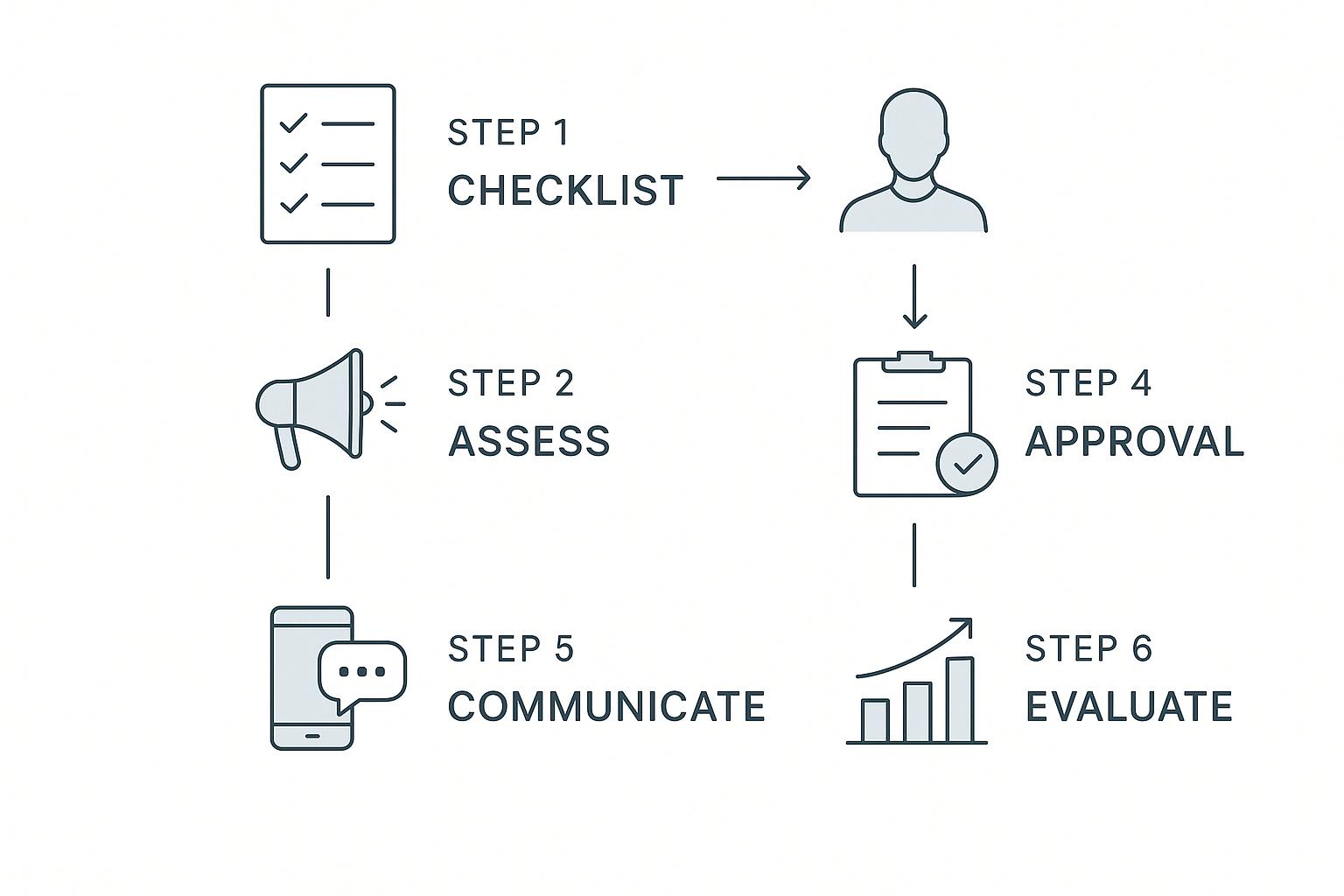
Checklist for Evaluating Crisis Communication
When a crisis hits, how you communicate can make or break trust. Here's the bottom line: evaluating your crisis communication ensures clarity, speed, and trustworthiness. This guide focuses on how to assess and improve your strategies, from setting measurable goals to refining messages and channels.
Key Takeaways:
- Set Clear Goals: Define objectives like notifying employees within 30 minutes or meeting regulatory deadlines.
- Track Metrics: Measure timeliness, reach, comprehension, and behavior using tools like email open rates and surveys.
- Review Stakeholders: Map out groups (employees, customers, regulators) and ensure their unique needs are met.
- Check Message Quality: Use simple, consistent language that’s empathetic and transparent.
- Evaluate Channels: Ensure tools like email, SMS, and websites functioned properly and misinformation was addressed quickly.
- Learn and Improve: Conduct post-crisis reviews, document lessons, and update plans and training regularly.
By focusing on these steps, you’ll build a reliable system that keeps people informed and strengthens your organization’s response during high-pressure situations.
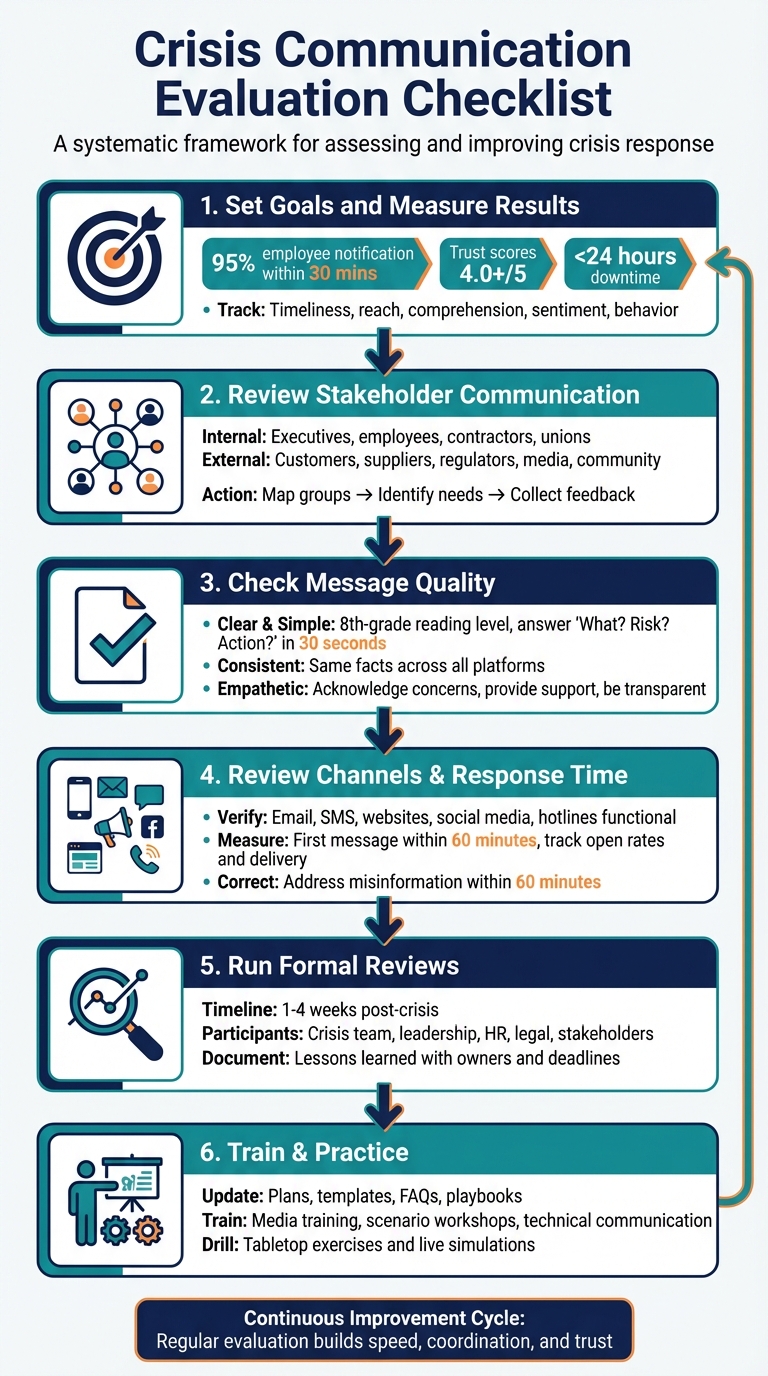
6-Step Crisis Communication Evaluation Framework
Set Goals and Measure Results
Define Clear Goals
Before a crisis hits, it’s crucial to set specific, measurable objectives that align with your organization’s continuity plan. Instead of vague goals like "keep people informed", aim for precise targets. For example, ensure 95% of employees receive safety instructions within 30 minutes of an incident, maintain employee trust scores of 4.0 or higher out of 5 in post-crisis surveys, and keep unplanned operational downtime under 24 hours [1][3][6].
Customize these objectives based on your audience. For instance, notify customers of service disruptions within two hours, meet U.S. regulatory deadlines, and inform investors about financial impacts within one business day. Pay extra attention to vulnerable groups - such as shift workers, non-English speakers, or those medically at risk - by ensuring your messages are both accessible and actionable [1][4][8].
Once these goals are established, keep a close eye on performance to measure how well your communication efforts succeed.
Track Performance Indicators
To evaluate communication effectiveness, focus on key metrics like timeliness, reach, comprehension, sentiment, and behavior. Measure how quickly you issue your first public statement, send internal alerts, or brief stakeholders after an incident. Use tools like email open rates, intranet view counts, SMS delivery reports, call volumes, and social media impressions to confirm your messages are reaching the right people.
Assess comprehension by conducting quick pulse surveys, short safety quizzes, or tracking inquiries for clarification. Monitor sentiment through media tone analysis or social listening tools. Finally, review behavioral outcomes - such as whether employees followed evacuation instructions or customers adopted alternative solutions - to gauge the real-world impact of your communication [1][4][5][6][8].
Compare Expected vs. Actual Results
After the crisis, compare your predefined goals to the actual outcomes to evaluate success. Use a straightforward scorecard to document each goal, the target, the actual result, and any gaps. For example, if your goal was to alert employees within 30 minutes but the alert took 1 hour and 45 minutes, note the 75-minute delay and its impact, such as a postponed evacuation.
Dig into the root causes of these gaps - whether it’s slow approval processes, poorly integrated alert systems, missing pre-approved templates, or insufficient spokesperson training. Validate your findings through stakeholder surveys, interviews, or complaints. Then, document lessons learned and set corrective actions with deadlines. For instance, you might update pre-approved templates by March 31, 2026, with the Communications Director leading the effort [1][4][5][7].
Review Stakeholder Communication
Identify Stakeholders and Their Requirements
Start by mapping out all the groups that require communication during a crisis. Internal stakeholders include executives, managers, employees (across all shifts), contractors, and union representatives. On the external side, consider customers, suppliers, regulators, local authorities, media, community organizations, and vulnerable populations, such as those with limited English proficiency or disabilities.
Each group has unique needs. Employees may need updates on reporting locations, safety protocols, work schedule changes, and compensation details. Customers will want clear information about service disruptions, timelines, and alternative options. Regulators and partners might have legal or contractual notification requirements you must address. Additionally, it’s crucial to identify the primary and backup communication channels for each group. For example, office staff may rely on email or an intranet, while field workers might need SMS updates. Community members could depend on local radio or TV, and those offline may require phone hotlines.
After the crisis, revisit your stakeholder map to evaluate communication effectiveness. Were all groups reached in a timely manner? Did anyone receive incomplete or delayed messaging? For instance, if frontline employees learned about a facility closure through the media instead of internal channels, that gap should be documented and corrected.
Collect Stakeholder Feedback
To understand how well your communication worked, gather direct feedback from stakeholders. Use short, post-crisis surveys (3–5 questions) to assess whether updates were received, which channels were used, message clarity, and trust levels. Pair survey results with metrics like email open rates, SMS confirmations, intranet views, and hotline call data.
Beyond numbers, qualitative feedback from interviews, focus groups, or town halls with employees, key customers, and community partners can reveal deeper insights. Pay close attention to recurring questions or complaints - if the same issue comes up repeatedly, it’s likely the original message wasn’t clear enough. Also, analyze whether stakeholders first learned about the crisis through your official channels or from external sources like media or social media. If the latter, it could mean your response was too slow or relied on the wrong channels. Use these findings to fine-tune your approach, especially for high-risk groups.
Support High-Risk Groups
Feedback often highlights the challenges faced by vulnerable populations during a crisis. These groups - such as seniors, individuals with disabilities, people with limited English proficiency, and low-income communities - are at greater risk and can be easily overlooked. Use HR data, demographics, and post-crisis assessments to ensure communications were accessible. This includes translating messages, using plain language, and providing alternative formats like large print, audio, captioned videos, or ASL.
Make sure accessible communication channels were activated, such as those managed by community organizations, faith-based groups, local health clinics, or dedicated hotlines. Evaluate whether these groups received timely updates, frequent communications, and had opportunities for two-way interaction to ask questions and get help. If you find that a vulnerable group experienced delays, confusion, or missed critical actions, it’s a clear sign that your communication and support strategies need improvement. Address these gaps to better serve high-risk groups in the future.
What Are The Best Metrics For Post-crisis Evaluation? - Crisis Response Coach
Check Message Quality and Consistency
Once you've evaluated message reach and feedback, it's time to focus on the content itself. The clarity of your language, the tone you use, and consistency across platforms are critical in building trust and ensuring your audience understands your message. This part of the checklist zeroes in on crafting crisis communication that is clear, consistent, and empathetic - essential elements for effective engagement.
Use Clear and Simple Language
In a crisis, simplicity is key. Stress can make it harder for people to process information, so stick to short sentences and plain, everyday language [1][4]. Avoid technical jargon and acronyms unless absolutely necessary. If you do need to include technical terms, explain them in straightforward terms. For example, instead of saying, "implement social distancing protocols", say, "stay at least 6 feet away from others." Aim for an 8th-grade reading level or lower, which you can check using tools like Flesch-Kincaid scores.
Your message should answer three crucial questions within the first 30 seconds: What happened? Am I at risk? What do I need to do now? If you lead with legal disclaimers or background details instead of addressing these basics, your audience may lose focus. Use familiar U.S. units and culturally relevant examples to make your message relatable. After the crisis, surveys and interviews - especially with groups like non-native English speakers or older adults - can help gauge whether your language was accessible and effective.
Keep Messages Consistent Across Platforms
Clarity is important, but consistency is just as critical. Conflicting information across emails, social media, press briefings, and internal communications can erode trust and confuse your audience. Mixed messages can lead to misunderstandings and lower compliance [1]. To maintain consistency, review all crisis communications to ensure the facts align across every platform. Create an inventory of key details like what happened, who is affected, recommended actions, timelines, and contact information, and compare them across channels [1][4].
Using a centralized "single source of truth", such as a message map, can help ensure uniformity. Establish a formal approval process where a designated communication lead reviews and signs off on all external messages. This process helps keep critical details - like safety instructions, dates, and updates - consistent [4]. If departments are issuing unofficial clarifications or staff are unsure what to communicate, that’s a sign your consistency controls need improvement.
Communicate with Empathy and Honesty
Even the most accurate information needs to be delivered with empathy and transparency. Review your messages to ensure they acknowledge people’s fears, frustrations, or losses. Show solidarity with statements like, "We understand many of you are worried about your safety and your families." Avoid bureaucratic language or technical jargon, and instead, use a conversational tone that feels human. Point people toward practical support resources, such as hotlines, counseling services, or employee assistance programs [1][2].
Honesty is equally important. Clearly separate confirmed facts from preliminary information, avoid speculation, and don’t make promises you can’t keep [1][2]. Let your audience know what’s still unknown, explain what steps are being taken to find answers, and provide realistic timelines for updates. Transparency also means correcting errors quickly, explaining changes in guidance, and addressing tough questions openly [1][6]. Gathering feedback - through surveys, interviews, or social sentiment analysis - can reveal whether your audience felt respected, supported, and heard, or if your messages came across as defensive or indifferent [1][5].
For organizations with technical expertise, specialized training can help improve these communication skills. Programs like those offered by Tech Leaders can bridge the gap between technical knowledge and empathetic, effective crisis messaging tailored for U.S. audiences.
sbb-itb-8feac72
Review Communication Channels and Response Time
After assessing the content of your messages, it's time to evaluate how well your communication channels performed and how quickly messages were delivered. Even the most well-crafted message loses its impact if it’s delayed or doesn’t reach its audience. This section focuses on the functionality of your communication tools, the speed at which messages were delivered, and how effectively false information was managed.
Verify Channel Functionality
Ensure all communication systems - email, SMS, websites, social media platforms, internal tools, and phone hotlines - were fully operational during the crisis. Review system logs to identify any outages, delivery errors, or spikes in issues. This should also include checks for compliance with U.S. emergency alert systems, 911 coordination, and ADA accessibility requirements. If any channel failed or underperformed, document the time, cause, and nature of the issue to guide future technical improvements.
Measure Reach and Response
Evaluate whether your messages reached the intended audience and how quickly they were delivered. Track the time between recognizing the crisis and sending the first message - many organizations aim to issue an initial update within 60 minutes [1][5]. Analyze metrics like email open rates, SMS delivery success, website traffic, social media impressions, and call center activity. Make sure these are recorded in local time zones for accuracy. Compare your findings against the goals outlined in your crisis plan and stakeholder maps. It’s also essential to confirm that all groups - such as remote workers, contractors, and non-English-speaking audiences - received the information effectively. This data is invaluable for addressing misinformation and improving future responses.
Correct False Information
Assess how effectively misinformation was identified and corrected during the crisis. Monitor platforms like social media, news outlets, call center logs, and emails to spot rumors or confusion. Keep a detailed log of misinformation incidents, noting their source (e.g., TikTok, local radio, internal chat) and how long it took to respond. The CDC’s crisis communication tools emphasize the importance of determining "what misinformation needs to be corrected" as a top priority [4].
Create a clear correction message and distribute it across all channels, ensuring it’s prominently displayed, such as pinning it on social media. After the crisis, review your misinformation log to evaluate whether corrections were issued within the recommended timeframe - often within 60 minutes of identifying significant false information. Use these findings to refine your approach for future incidents. Just like measuring message clarity and gathering stakeholder feedback, assessing channel performance is crucial for a smooth crisis response. Efficient communication tools play a key role in managing crises and contribute to the ongoing cycle of improvement discussed earlier.
Learn and Improve After the Crisis
Once you've assessed your communication channels and the quality of your messaging, the next step is to put the lessons learned into action. Skipping this critical reflection phase can lead to repeating mistakes, while taking the time to evaluate and adapt strengthens your future crisis response. Organizations that prioritize this process tend to develop faster, more reliable, and trusted communication systems over time.
Run Formal Review Sessions
Plan a structured after-action review within one to four weeks of the crisis, while the events are still fresh in everyone's memory. Gather your crisis communication team, senior leadership, legal and HR representatives, operational managers, and anyone who played a significant role in the response. Don't forget to include key stakeholders, such as representatives from customer support, unions, or community relations.
Your review should focus on important questions: What happened, and when? What were the communication goals at each stage? Which channels, messages, and spokespeople were effective? Where did issues like delays, confusion, or inconsistent messaging arise? What feedback came in from employees, customers, media, and regulators? Use hard data to guide your discussion - media coverage summaries, social media analytics, website traffic reports, call center logs, and stakeholder surveys can all provide valuable insights. The American Hotel & Lodging Association's crisis communication checklist emphasizes the importance of this step, noting that feedback collection and post-crisis analysis are essential parts of the process, not optional extras [5].
Record and Prioritize Changes
Capture every lesson and suggested improvement in a shared repository, such as a crisis log, knowledge base, or incident management tool. Each lesson should be documented as a clear action item with an assigned owner, deadline, and expected outcome. For instance, if social media approvals caused delays, your action item might state: "Simplify the approval chain to include only the Crisis Lead and Legal", assigned to the Chief Communications Officer with a 30-day deadline.
Focus on changes that are both impactful and easy to implement. This could include updating contact lists, refining templates, or simplifying approval processes. Revise all related materials, such as your crisis communication plan, message templates, FAQs, social media playbooks, and operational checklists. Make sure the updated plan is version-controlled, easy to find, and shared with all stakeholders. Use the MM/DD/YYYY format for clear version tracking. Regular check-ins, such as monthly meetings, can help monitor progress and keep improvement goals visible to leadership. These updates should also feed into your training and practice sessions.
Schedule Training and Practice Drills
The final step in your crisis evaluation process is reinforcing improvements through targeted training and practice drills. Identify any skill gaps that became apparent during the crisis and design training sessions to address them. For example, media training for executives and spokespeople can focus on improving empathy, clarity, and honesty under pressure. Scenario-based workshops can help cross-functional teams practice decision-making and crafting messages under tight deadlines, boosting their confidence for future events.
For crises involving technical issues, such as cybersecurity breaches or system outages, it's crucial for technical leaders to communicate complex problems in simple, actionable terms. These leaders should receive training on how to collaborate effectively with PR and legal teams while sticking to approved messaging. Programs like Tech Leaders offer courses tailored to help technical professionals build the communication skills needed for high-pressure situations, especially in the fast-paced world of AI.
Regular drills, whether tabletop exercises or live simulations, can test your team's readiness for scenarios like data breaches, product safety concerns, or severe weather events. These drills should evaluate your team's ability to detect and escalate issues quickly, initiate internal and external communications promptly, maintain consistent messaging across channels, and handle tough questions from stakeholders. After each drill, conduct a mini after-action review and update your plans as needed. This creates an ongoing cycle of learning and improvement, ensuring your organization is always better prepared for the next challenge.
Conclusion
Effective crisis communication isn't just about checking boxes; it's about creating a repeatable process that ensures speed, coordination, and trust during challenging moments. By consistently evaluating your goals, stakeholder communication, message clarity, channel effectiveness, and post-crisis insights, you can build an institutional memory that turns hard-earned lessons into actionable improvements. Organizations that see evaluation as a continuous cycle - rather than a one-off task - develop the agility to respond with clarity, empathy, and speed when it matters most.
This systematic approach also cultivates stronger leadership. For technical and operational leaders, reflecting on how you navigated complex communication challenges, coordinated teams, and demonstrated leadership enhances critical skills. These include decision-making under pressure, understanding stakeholder needs, and delivering transparent messages - skills that directly boost your leadership presence and your ability to influence non-technical audiences in high-stakes situations.
The next step? Make it practical. Set a deadline to review your crisis communication plan using this framework and schedule a drill as part of an ongoing cycle. Assign clear ownership within your communications, risk, or operations team, and commit to revisiting and updating your plan every year. In the U.S., where legal, regulatory, and media scrutiny can be intense, this structured approach safeguards people, protects your reputation, and ensures business continuity - something that ad hoc responses simply cannot achieve.
For technical professionals looking to enhance their ability to communicate complex ideas clearly during crises, specialized training can make a big difference. Tech Leaders offers targeted programs designed to help bridge technical expertise with effective crisis messaging. These programs focus on building the confidence and skills needed to lead decisively, especially in AI-driven or data-heavy scenarios.
Make regular evaluations part of your strategy to stay prepared and lead with confidence.
FAQs
What steps can I take to make my crisis communication goals measurable?
To ensure your crisis communication efforts can be measured effectively, begin by setting clear and specific goals that align with your broader strategy. Pinpoint key performance indicators (KPIs) such as stakeholder feedback, media coverage, and social media engagement to gauge your progress.
Incorporate measurable data points like sentiment analysis, media reach, and response times to assess how well you're meeting your objectives. Use tools like media tracking software or stakeholder surveys to keep a close eye on these metrics. Make adjustments as needed based on the data to refine your approach and keep improving.
How can you ensure consistent messaging across different platforms during a crisis?
When managing communication during a crisis, it's crucial to maintain a unified message. Start by establishing clear, centralized guidelines that define the tone, key points, and approved responses. Pre-approved templates can help simplify the process and keep everyone on the same page. Regular check-ins with your communication team are essential to address updates or adjust messaging as needed. Lastly, keep a close eye on all platforms to ensure your messaging stays consistent and effectively addresses any concerns from stakeholders.
What’s the best way to handle misinformation during a crisis?
To address misinformation during a crisis, it’s essential to have a well-thought-out communication plan in place. This should prioritize quick fact-checking, honest messaging, and regular updates to build and maintain trust.
Keep a close eye on media outlets and social platforms to identify false information as it emerges. When misinformation surfaces, respond swiftly with verified facts and straightforward corrections. Partnering with trusted voices can also help spread accurate information and push back against false narratives.
Leverage media monitoring tools to track misinformation trends. These tools can help you respond faster and stay ahead of potential challenges.