
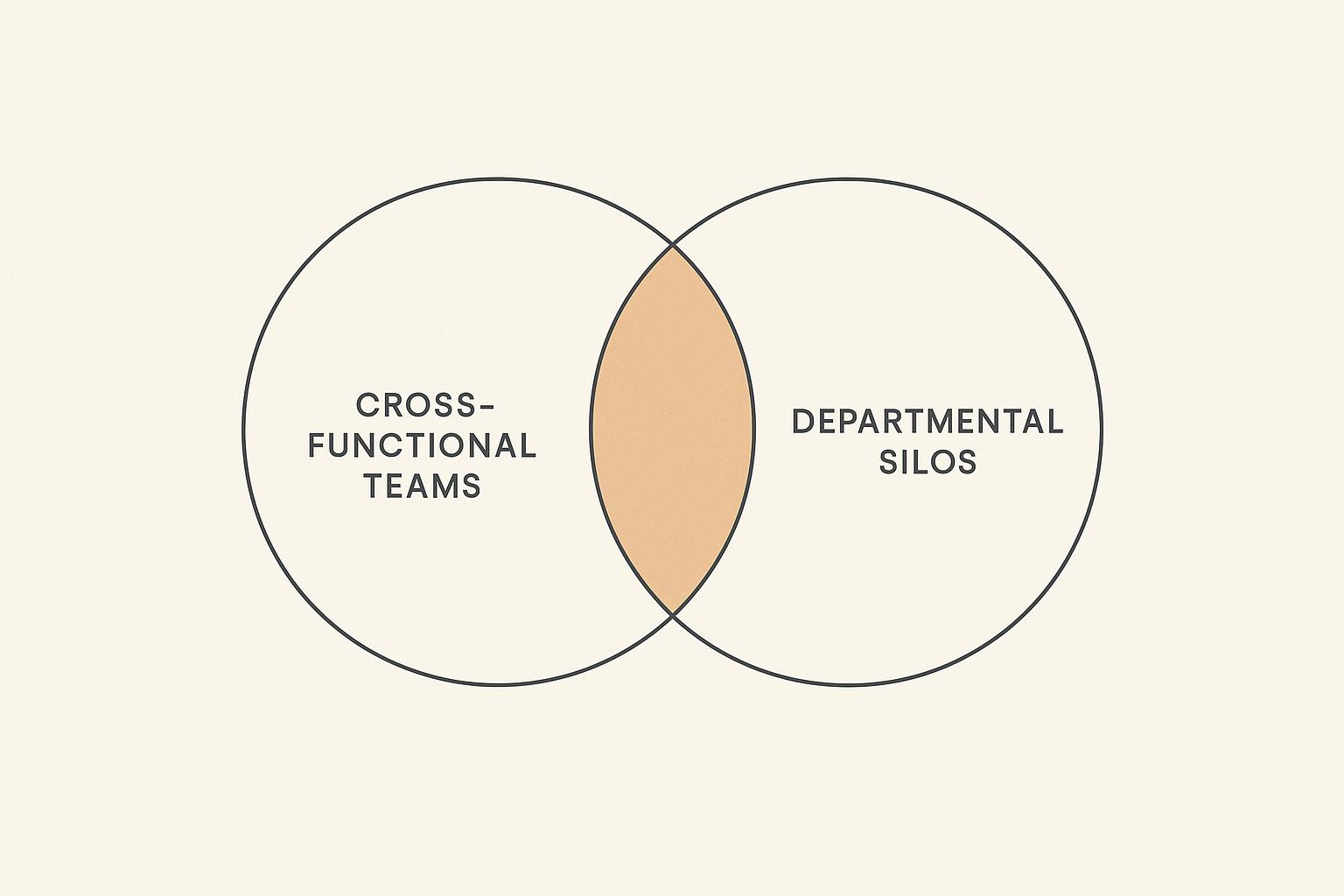
Cross-Functional Teams vs. Departmental Silos
Cross-functional teams and departmental silos represent two distinct ways to structure organizations, each with its own strengths and weaknesses. Here's the key takeaway: Cross-functional teams bring together diverse expertise to focus on shared goals, while departmental silos specialize in functional efficiency but often struggle with collaboration. Choosing the right approach depends on the type of work, organizational goals, and leadership capacity.
Key Differences:
- Cross-Functional Teams: Combine specialists from different departments (e.g., engineering, design, product) to work on a shared objective, like improving user activation. They boost collaboration and accountability but require strong leadership to manage diverse perspectives and avoid role confusion.
- Departmental Silos: Group employees by function (e.g., engineering, marketing) for deep expertise and efficiency. They excel in standardized, repeatable tasks but often face misaligned priorities and slower cross-department communication.
Quick Insights:
- Cross-Functional Teams: Best for complex, interdisciplinary projects like product development or customer-focused initiatives.
- Departmental Silos: Ideal for routine, regulated tasks like compliance or financial reporting.
- Hybrid Models: Combine both approaches to balance collaboration and specialization.
A hybrid approach, with shared goals and leadership development, often works best for organizations aiming to align efforts across teams while maintaining functional depth. The key is not the structure itself but ensuring goals and metrics are shared across teams to drive collective success.
Breaking Down Silos: How Leaders Can Drive Cross-Team Collaboration
Cross-Functional Teams: Benefits and Challenges
Cross-functional teams can drive creativity and speed, but they also require thoughtful management to navigate their inherent complexities.
Benefits of Cross-Functional Teams
Collaboration sparks creativity. When engineers, designers, product managers, and customer-facing specialists work together, they challenge assumptions and uncover blind spots that single-function teams might miss. For example, a technical solution that seems perfect to an engineer might create usability issues - a concern that a designer or customer success expert can flag early. This blend of perspectives often leads to solutions that balance technical practicality with user needs.
Organizations that embrace cross-functional collaboration see real results: project timelines shrink by up to 30%, and companies are 21% more likely to outperform their industry peers in profitability [3]. According to Harvard Business Review, businesses with strong cross-functional collaboration are five times more likely to achieve high performance [3]. When product managers, tech leads, and designers work closely, they can address tradeoffs around scope, quality, and timelines in real time.
Accountability becomes a shared responsibility. In cross-functional teams, the same group that designs and builds a feature also monitors its performance, handles incidents, and gathers customer feedback. This shared ownership eliminates finger-pointing between departments and fosters a culture of problem-solving. This approach is especially effective in DevOps and SaaS environments, where teams oversee both development and operations.
Cross-functional setups also promote engagement and skill-sharing. Engineers gain insights into customer needs, product managers learn about technical limitations, and designers become familiar with data pipelines. This exchange of knowledge builds empathy and creates well-rounded professionals. Pamela Johnston, a Senior Business Strategy Consultant, highlights this dynamic:
Half of the group is technical, the other half is nontechnical. This is the perfect blended approach for anyone who wants to learn AI. [2]
By participating in shared activities like daily standups and sprint reviews, team members break down "us vs. them" barriers, build trust, and improve collaboration on future projects.
While cross-functional teams offer these advantages, they also come with challenges that require careful attention.
Challenges of Cross-Functional Teams
The diversity that fuels innovation can also lead to communication hurdles. Specialists often speak different "languages" - engineers focus on systems, designers prioritize user experience, and product managers consider market dynamics. Bridging these gaps requires constant effort to translate and align perspectives.
Ambiguity around roles and decision-making can also slow progress. Without clear authority and decision rights, teams can get bogged down in debates or power struggles, wasting valuable time.
The challenges are significant: Harvard Business Review reports that 75% of cross-functional teams struggle to meet key criteria like staying on schedule, staying on budget, meeting customer expectations, aligning with company goals, and maintaining morale [1]. Common issues include weak governance, lack of executive support, and misalignment with broader organizational priorities.
Resource allocation can add further strain. Shared experts - like data engineers or security specialists - often juggle competing demands from multiple teams, leading to delays and burnout. Even when team objectives are clear, functional managers may push their own agendas, causing team members to prioritize department-specific goals over collective outcomes.
Additionally, managing a cross-functional team requires more upfront planning, frequent communication, and active conflict resolution than a single-function team. This can slow decision-making, especially when consensus is needed from everyone involved.
When to Use Cross-Functional Teams
Deciding whether to use a cross-functional team depends on the complexity and interdependence of the work. These teams shine in situations requiring tight collaboration and adaptability.
One classic example is end-to-end product development. Building an AI-powered feature, for instance, demands input from engineering, product, design, QA, data, and even marketing or customer success. A cross-functional team can quickly adapt to technical constraints, user feedback, and business priorities.
Customer-focused initiatives also benefit from this approach. Projects like improving onboarding, reducing churn, or entering new markets require collaboration across sales, support, marketing, engineering, and product to fully understand the customer journey and implement changes effectively.
Cross-functional teams are particularly effective for tackling complex and ambiguous problems - whether it’s building a personalization engine, migrating a legacy platform, or meeting new compliance standards. Their diverse perspectives help avoid blind spots and allow for real-time adjustments as challenges arise.
DevOps-style service ownership is another area where cross-functional teams excel. When the same group that builds a service also runs it in production, monitors reliability, and handles incidents, the feedback loop is faster, and accountability is clearer. This approach aligns well with the emphasis on shared outcomes over departmental goals.
However, these teams may not be the best fit for highly standardized or transactional tasks that rely on specialized expertise and established processes. Small organizations with limited resources may also find it difficult to implement a cross-functional model effectively.
For technical leaders transitioning from hands-on roles to advisory or consulting positions, knowing when to recommend cross-functional teams versus functional specialization is key. Programs like Tech Leaders provide training in leadership, communication, and strategies for navigating the AI-driven business landscape. These insights can help leaders design team structures that balance collaboration and productivity.
Departmental Silos: Benefits and Challenges
Cross-functional teams may dominate discussions about modern organizational design, but departmental silos remain a cornerstone for many successful U.S. companies. This is particularly true for organizations operating at scale or in heavily regulated industries. For technical leaders, understanding the advantages and downsides of silos is key to navigating and optimizing organizational structures. Let’s explore how silos contribute to expertise and efficiency, as well as the challenges they present.
Benefits of Departmental Silos
Silos drive deep expertise and operational efficiency. Teams focused on specific functions - like tax accounting, FDA compliance, or database optimization - develop unmatched depth in their domains. For instance, a finance team that consistently closes the books in USD every month builds efficiency through repetition. Similarly, a pharmaceutical quality assurance team enforcing strict protocols ensures compliance and avoids costly regulatory missteps.
This level of specialization directly improves efficiency. Standardized workflows reduce errors and speed up processes, while predictable systems make it easier to train staff and monitor performance. Metrics like calls handled per hour or time to close tickets become reliable benchmarks for evaluating success.
Clear roles and responsibilities are another strength of silos. Defined ownership of functions, budgets, and risks eliminates ambiguity. Leaders know exactly who to hold accountable when problems arise - or who to credit when success is achieved. This clarity is especially critical in industries like healthcare, financial services, government, and manufacturing, where compliance and risk management are non-negotiable. Dedicated teams ensure proper regulatory oversight, documentation, and audits, providing a safety net for the organization.
Drawbacks of Departmental Silos
However, the same features that make silos effective can also lead to problems. Silos often create misaligned priorities and inefficiencies. Departments tend to focus on their own KPIs, which can conflict with broader company goals. For example, marketing might prioritize lead generation without considering whether product teams or customer support can handle the resulting demand. This misalignment can lead to overpromising, missed deadlines, and dissatisfied customers.
Research from Deloitte highlights the financial impact of these inefficiencies, estimating that companies lose 20–30% of revenue annually due to poor cross-team alignment [3]. These losses aren’t just theoretical - they represent real dollars left on the table because departments fail to work in sync.
Another issue is delayed decision-making and fragmented customer insights. Decisions that span multiple departments often require lengthy negotiations, slowing implementation. Monthly reports within silos can obscure cross-departmental bottlenecks until they’ve already caused customer dissatisfaction. Meanwhile, each department only sees a narrow slice of the customer experience. Marketing focuses on acquisition, sales on closing deals, and support on complaints. Without a shared view, customers may receive conflicting messages or face unresolved issues.
Common examples of silo-related failures include IT deploying systems without consulting end-users, resulting in low adoption, or departments optimizing for their own success at the expense of the larger organization. In government settings, siloed departments can delay information sharing, causing frustrating delays for citizens [5].
The contrast is striking: companies with strong cross-department collaboration are 21% more likely to outperform their industry peers in profitability, while siloed organizations often see drops in productivity and customer satisfaction [3]. McKinsey research further shows that better alignment can boost customer satisfaction scores by up to 20%, underscoring the real-world harm silos can cause [3].
Where Silos Work Best
Despite their challenges, silos shine in environments where consistency and control are more important than rapid innovation. They are ideal for highly repeatable tasks, tightly regulated processes, and scenarios where cross-functional collaboration is less critical. Think routine claims processing, payroll, standardized manufacturing, or compliance-driven reporting [6].
Regulated industries, in particular, depend on silos to maintain strict control over processes and documentation. In these settings, even minor mistakes can lead to regulatory investigations or jeopardize safety. The expertise and predictability silos provide act as essential safeguards.
Large enterprises often adopt a hybrid approach, keeping silos for back-office functions while encouraging cross-functional collaboration for customer-facing initiatives. This balance ensures efficiency where it’s needed while fostering teamwork where it impacts customer outcomes.
For technical leaders - especially those transitioning from hands-on roles to advisory or consulting positions - knowing when to maintain silos and when to break them down is a critical skill. Effective leaders align departmental goals with broader organizational objectives, ensuring KPIs and incentives promote collaboration rather than isolated success [5][6]. They focus on shared metrics like net revenue retention, customer satisfaction, or end-to-end cycle times to drive cooperation across teams [3][5].
Programs like Tech Leaders help engineering professionals develop the skills to navigate siloed environments effectively. By learning how to bridge gaps between departments, technical leaders can turn functional expertise into broader organizational impact - a crucial ability in today’s rapidly evolving technological landscape.
sbb-itb-8feac72
Direct Comparison: Cross-Functional Teams vs. Departmental Silos
When deciding between cross-functional teams and departmental silos, it’s essential to weigh the pros and cons of each structure. The best choice often depends on your organization’s specific needs - whether it’s the type of work, organizational maturity, or strategic goals. Below, we break down the key differences in structure, strengths, weaknesses, and goal alignment, followed by guidance on how to select or blend these models effectively.
Comparison Table: Key Attributes
| Attribute | Cross-Functional Teams | Departmental Silos |
|---|---|---|
| Structure | Teams with mixed expertise, focused on specific products or projects (e.g., product squads). | Employees grouped by function (e.g., engineering, marketing, finance), with work moving across departments via requests and handoffs. |
| Primary Strengths | Encourage faster collaboration, minimize handoffs, and align teams around shared outcomes, driving innovation. | Utilize deep functional expertise with standardized processes and clear accountability, delivering efficiency for routine tasks. |
| Key Weaknesses | May face high coordination costs, unclear roles, and conflicting priorities. | Prone to communication breakdowns, misaligned goals, duplicated efforts, and slow decision-making across departments. |
| Impact on Goal Alignment | Focus on shared goals and integrated metrics (e.g., product adoption, customer satisfaction, revenue) to optimize the organization as a whole. | Rely on function-specific KPIs (e.g., engineering velocity, marketing leads), which can create competing priorities. |
| Best-Suited Work Types | Ideal for complex, interdisciplinary, and time-sensitive projects like product development or digital transformation. | Better for stable, repetitive, and function-specific tasks like financial reporting or compliance operations. |
| Decision-Making Speed | Generally faster with clear authority, though seeking consensus can sometimes slow progress. | Efficient within functions but slower for decisions requiring cross-departmental coordination. |
| Resource Efficiency | Reduces delays and rework, potentially lowering labor costs by 8–12% by eliminating handoffs [5]. | Optimizes internal function efficiency but may create bottlenecks and redundant efforts organization-wide. |
Choosing the Right Model for Your Organization
Technical leaders must consider several factors when choosing between these organizational structures - or opting for a hybrid approach:
- Nature of Work: Cross-functional teams excel in innovation-driven projects, such as launching AI-powered products, where collaboration across disciplines is crucial. Conversely, silos are better suited for stable, high-volume tasks like security operations or financial reporting, where deep specialization is key.
- Need for Speed and Innovation: If quick adaptation to market changes is essential, cross-functional teams can eliminate delays caused by handoffs, enabling real-time adjustments based on customer feedback.
- Regulatory and Quality Constraints: Industries like healthcare, financial services, or government often require centralized functions to enforce strict policies, such as compliance rules or audit trails.
- Organization Size and Maturity: If silos are causing inefficiencies like misaligned goals or duplicated efforts, shifting to cross-functional teams or a hybrid structure can help address these issues.
- Leadership Capacity: Managing cross-functional teams demands strong leadership skills to balance conflicting priorities and handle diverse stakeholder expectations. Without capable leaders, these teams may struggle to deliver results.
Hybrid Models: Combining Both Approaches
For organizations needing both deep expertise and agility, hybrid models offer a balanced solution. Here are three common hybrid approaches:
- Matrix Structures: Employees report to both a functional manager (for career development and resource planning) and a product or project leader (for daily priorities). Clear decision-making authority is critical for this structure to work effectively.
- Product or Feature Teams with Centralized Functional Chapters: Cross-functional squads handle product-level goals, while functional leaders oversee standards, hiring, and training. This model maintains alignment on product outcomes while preserving specialized expertise.
- Communities of Practice: Informal networks connect individuals with similar skills across teams, allowing them to share tools, best practices, and lessons learned. This prevents fragmented methods without slowing cross-functional delivery.
To implement a hybrid model successfully, technical leaders should focus on the following:
- Define decision rights to clarify responsibilities between product leaders and functional managers.
- Set shared metrics to measure cross-functional outcomes while tracking functional health indicators.
- Adopt lightweight governance with regular reviews to assess progress and resolve conflicts.
- Document agreements in concise playbooks outlining escalation procedures, prioritization rules, and conflict resolution methods.
Investing in leadership development is critical for success. Both product leads and functional managers benefit from training in areas like conflict resolution, systems thinking, and managing competing priorities. Programs such as Tech Leaders equip professionals with the skills needed to thrive in these complex, hybrid structures - an essential step for technical experts moving into advisory or consulting roles.
How to Align Goals Across Different Structures
No matter how your organization is structured - whether it’s based on cross-functional teams, departmental silos, or a mix of both - goal alignment is the glue that holds everything together. Without clear, shared objectives, even the most well-organized company can struggle to move forward. But here’s the thing: alignment doesn’t mean forcing everyone into the same mold. It’s about creating systems that connect different teams to the same overarching business outcomes.
Setting Shared Goals and Metrics
Start by translating your organization’s mission into a handful of measurable, company-wide outcomes. Think about goals like revenue growth, customer satisfaction (measured by NPS), reducing cycle times, or improving operating margins. These aren’t just lofty aspirations - they’re concrete objectives that drive real results.
One effective strategy? Host quarterly summits where leaders from every department and cross-functional team come together to co-create objectives. These sessions are an opportunity to map out dependencies - like how marketing’s lead generation efforts align with sales’ conversion goals or product’s release schedule. Frameworks like OKRs (Objectives and Key Results) help ensure that each team’s goals are measurable, time-sensitive, and tied to the company’s top priorities. This prevents teams from focusing solely on their own KPIs at the expense of broader goals.
For example, a U.S.-based company might use net revenue retention as its guiding metric. This could link product teams (focused on feature adoption rates), sales teams (driving annual recurring revenue), and support teams (improving customer satisfaction scores) to a shared outcome. By displaying these KPIs on a unified dashboard, success becomes a collective effort rather than a competition between departments.
A "stacked metrics" approach works well here. In this model, a few shared "north star" metrics appear on every senior leader’s scorecard alongside their department-specific KPIs. This method naturally encourages collaboration. A transparent dashboard makes it easy to see how each team’s work contributes to the bigger picture, reducing finger-pointing and boosting accountability. To reinforce this, tie compensation and recognition to cross-functional achievements. For instance, a portion of a department head’s bonus could depend on the success of collaborative projects. Regular reviews - whether monthly or quarterly - help keep everyone aligned as strategies and market conditions shift.
Building Effective Decision-Making Processes
Shared goals are a great start, but alignment can fall apart without clear, efficient decision-making processes. Even when teams agree on objectives, they may still clash over priorities or resources. What sets thriving organizations apart is their ability to make decisions quickly and fairly.
A tiered operating rhythm can help keep everyone on the same page. Weekly cross-functional meetings are ideal for discussing current projects, resolving blockers, and making decisions that require input from multiple teams - think marketing, engineering, and customer success. These meetings should have clear agendas and time limits to stay productive. Meanwhile, biweekly or monthly cross-department reviews provide a chance to assess shared metrics, address dependencies, and plan for any resource constraints. Quarterly reviews can be used to reset goals, reallocate resources, and decide whether certain efforts should remain siloed or shift to cross-functional teams.
Defining decision rights is equally important. Frameworks like RACI or RAPID clarify roles: who’s accountable, who makes the final call, who needs to be consulted, and who should simply be informed. For example, a cross-functional product team might handle prioritizing backlog items, while the engineering head oversees technical standards. A decision-rights matrix, shared on an internal wiki and reviewed regularly, can prevent confusion, speed up decision-making, and minimize territorial disputes.
When conflicts arise, a structured two-step process can help. First, teams negotiate using clear criteria, such as the impact on shared metrics, regulatory requirements, or customer needs. If they can’t reach a consensus, the issue is escalated to a neutral decision-making body - like a portfolio review board or steering committee - where senior leaders make the final call based on overall business priorities.
Developing Leadership Skills for Better Collaboration
At the heart of effective decision-making are leaders who can bridge the gap between different departments. Aligning goals across teams isn’t just about metrics and processes - it also depends on leaders who can connect diverse priorities and perspectives. Key skills for this include systems thinking (understanding how decisions in one area affect others), strong stakeholder management, and the ability to influence without formal authority. Leaders also need to translate technical issues into business terms that resonate across the organization.
Technical leaders, in particular, can benefit from expanding their skill sets beyond their core expertise. By mastering communication, negotiation, and strategic thinking, they can better align their goals with those of marketing, finance, and operations. Organizations can nurture these abilities through targeted leadership development programs that combine workshops, coaching, and cross-functional assignments. For instance, promising engineers could be assigned as technical leads on cross-functional projects, paired with mentors from other business areas, and evaluated on outcomes like stakeholder satisfaction and on-time delivery - not just technical performance.
External programs can also accelerate this growth. For example, Tech Leaders offers engineering leadership training tailored to help technical professionals thrive in cross-functional settings. Their programs emphasize the blend of technical expertise with essential skills like communication and business strategy, preparing participants to align their work with broader organizational goals - or even transition into consulting roles where collaboration is key. With over 300 individuals trained and more than 200 organizations impacted globally, Tech Leaders has shown how investing in leadership development can transform siloed experts into enterprise-minded collaborators.
"The Tech Leaders environment is supportive, practical, and encouraging, with no judgement, pressure, or intimidation." - Pamela Johnston, Senior Business Strategy Consultant for IT software projects
"If you are an advanced AI resource Tech Leaders have been where you want to go. They have the experience, knowledge, and community that can address every challenge you face." - Pamela Johnston, Senior Business Strategy Consultant for IT software projects
Integrating such programs into internal talent pipelines can accelerate the transition from individual contributors to leaders capable of aligning goals across any organizational structure.
These strategies deliver tangible results. For example, a U.S. city government implemented cross-departmental teams for projects like downtown revitalization and digital permitting. By tying each team’s success to shared metrics - such as project completion time, citizen satisfaction, and budget compliance - they saw faster execution, improved service quality, and an estimated 8–12% reduction in labor costs [5]. Research shows that organizations with unified goals and shared KPIs are up to twice as likely to outperform their competitors [5].
Alignment isn’t a one-and-done effort. It’s an ongoing process that requires tracking outcome metrics (like revenue growth and customer satisfaction), process metrics (such as decision cycle time and reduction in duplicated work), and perception metrics from employee surveys about collaboration and goal clarity. By keeping these elements in focus, organizations can create a culture where alignment drives success.
Conclusion
Effective goal alignment serves as the bridge between cross-functional teams and departmental silos, driving better outcomes across the board. But choosing between these structures isn’t a simple either-or decision - it’s about knowing what each brings to the table and when to use them. Cross-functional teams thrive on collaboration, innovation, and tackling complex projects by pooling diverse expertise. When managed effectively, they can significantly boost performance [3][4]. However, they come with challenges: higher coordination demands, role ambiguity, and complex decision-making that can slow progress without strong leadership.
On the other hand, departmental silos excel at specialization. They provide clarity, efficiency, and focus within specific functions - key advantages for tasks like compliance, standardized workflows, or areas requiring deep expertise such as finance or legal. The issue arises when these silos operate in isolation, leading to misaligned goals, inefficient handoffs, and duplicated efforts.
The real key isn’t the structure itself but the alignment of goals. Organizations that prioritize cross-functional goal alignment consistently outperform those that focus solely on departmental KPIs [3][6]. In fast-paced U.S. markets, companies don’t obsess over whether teams are structured as cross-functional units or traditional departments. Instead, they zero in on shared outcomes, transparent metrics, and coordinated incentives that tie everyone to the same business objectives - whether that’s driving revenue, improving customer satisfaction, or speeding up time-to-market.
For many U.S.-based organizations, a hybrid model strikes the right balance. Functional departments can remain focused on talent development and operational expertise, while cross-functional teams tackle high-impact initiatives [4][7]. Regularly reviewing these initiatives based on measurable outcomes - like customer lifetime value, conversion rates, or delivery speed - helps determine where cross-functional collaboration is most effective.
Leadership plays a critical role in making this work. Executives and managers must set a clear direction, resolve cross-functional tradeoffs, and facilitate collaboration across boundaries. Many technical leaders, in particular, need to develop soft skills like communication, stakeholder management, and strategic thinking to lead cross-functional efforts successfully. Programs like Tech Leaders offer valuable support, helping technical experts bridge their deep knowledge with broader organizational and client-facing goals.
Moving forward, focus on alignment over structure. Start by crafting a unified, customer-focused vision. Choose the right mix of cross-functional teams and silos based on your strategic needs. Implement shared metrics that connect departments - like net revenue retention or lead-to-revenue conversion - so success becomes a collective effort. And invest in leadership development to strengthen collaboration across functions.
Finally, take stock of your organization. Identify areas where siloed operations create friction or where cross-functional opportunities are being overlooked. Then make small but meaningful changes - introduce shared OKRs, host joint planning sessions, or create transparent dashboards - to improve alignment and drive stronger performance. The structure is just the starting point; alignment is what ultimately determines success.
FAQs
What’s the best way for organizations to balance the advantages of cross-functional teams and departmental silos?
Organizations can find harmony by combining the strengths of both approaches. Cross-functional teams promote collaboration across various departments, sparking creativity and enabling quicker solutions to challenges. Meanwhile, departmental silos allow teams to concentrate on their specific areas of expertise, which can improve efficiency in focused tasks.
To get the best of both setups, businesses should define clear scenarios for each. Cross-functional collaboration works well for strategic initiatives or product development, while siloed efforts are better suited for operational or highly specialized tasks. By fostering open communication and aligning team goals, companies can ensure everyone is moving toward shared objectives while still benefiting from specialized focus.
How can communication challenges in cross-functional teams be addressed effectively?
To tackle communication hurdles in cross-functional teams, start by setting clear goals and expectations right from the beginning. When everyone knows their responsibilities and how their efforts contribute to the bigger picture, collaboration becomes much smoother.
Make sure to promote open communication channels by leveraging collaborative tools and holding regular check-ins. These practices keep team members from various departments on the same page and help resolve misunderstandings before they escalate.
Creating an environment rooted in empathy and respect also goes a long way in strengthening team relationships. When people feel understood and valued, it's easier to bridge differences in viewpoints or priorities. Providing training in soft skills - like active listening and conflict resolution - can further enhance how team members communicate and work together.
When is a hybrid approach better than relying solely on cross-functional teams or departmental silos?
A hybrid approach shines in organizations that require both specialized expertise and strong collaboration across departments. Imagine a complex project that demands deep technical knowledge - departmental teams can zero in on their specific areas, while cross-functional teams ensure everything aligns and integrates seamlessly across the board.
This method is especially effective in fast-moving industries like technology or healthcare. These fields thrive on breakthroughs and flexibility but also depend heavily on maintaining strong expertise in specialized areas. By blending the strengths of focused expertise with collaborative innovation, companies can strike a balance between efficiency, creativity, and depth.