

Cybersecurity Ethics: Balancing Privacy And Security
Balancing privacy and security is one of the biggest challenges in cybersecurity today. Organizations often face tough decisions: how much data should they collect to ensure safety without overstepping individual privacy rights? Here’s the key takeaway:
- Security protects systems and data from breaches or disruptions.
- Privacy ensures individuals control their personal information.
- A system can be secure but still violate privacy if data is misused.
With over 20 U.S. states rolling out privacy laws by 2026 and the rise of AI-driven tools, businesses must rethink their approach. Common mistakes include collecting excessive data, siloed privacy and security teams, and relying on opaque AI systems. Ethical practices like data minimization, transparency, and proportionality can help organizations navigate these conflicts.
The solution lies in combining governance, privacy-enhancing technologies, and a culture of ethical awareness. Leadership plays a critical role in shaping strategies that respect both security and privacy. By aligning technical measures with ethical principles, organizations can build trust and reduce risks.
Data Privacy and Cybersecurity: A Symbiotic Relationship
sbb-itb-8feac72
Why Privacy and Security Conflict
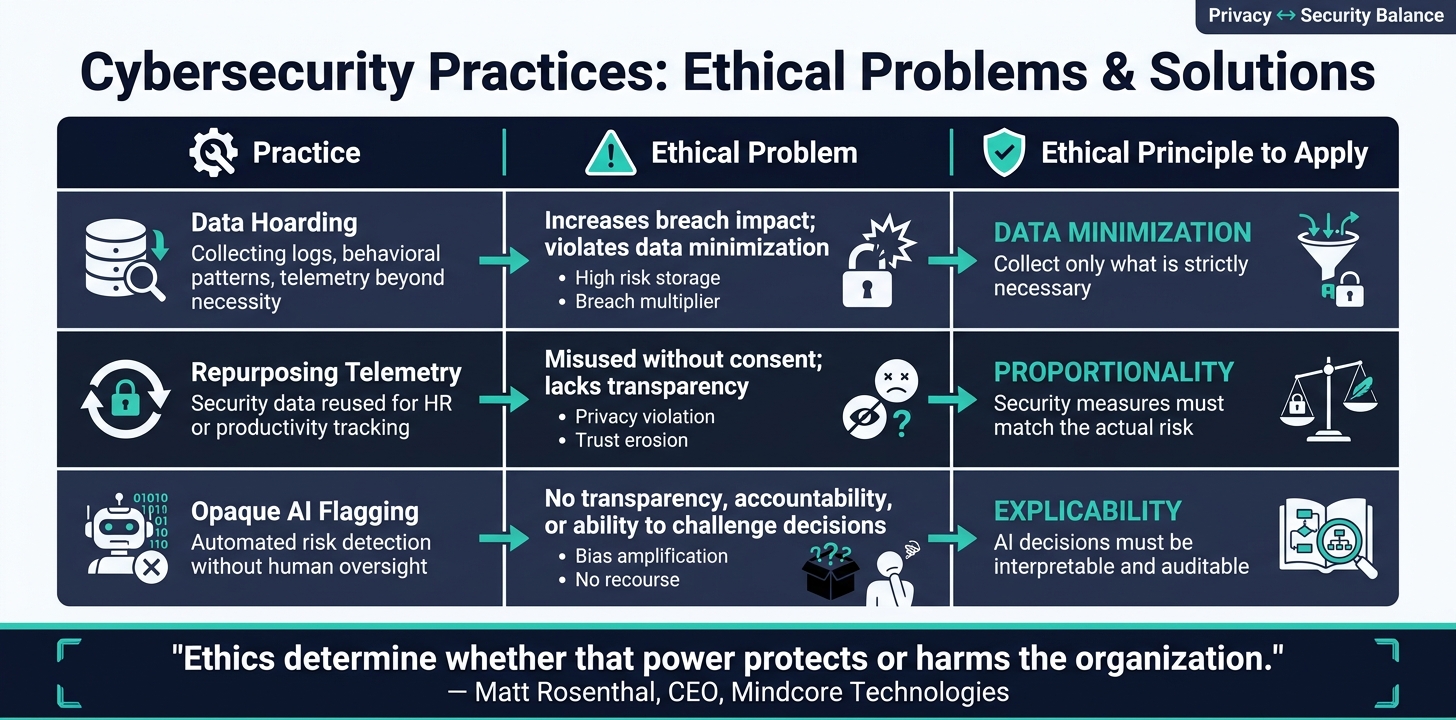
Cybersecurity Ethics: Privacy vs. Security Practices Compared
Privacy and security often find themselves at odds, primarily because their goals inherently pull in different directions. Security teams require broad visibility to detect and respond to threats effectively, while privacy principles emphasize limiting data collection and safeguarding personal information. It’s not that these objectives can’t coexist, but without careful governance, they can lead organizations down conflicting paths.
Common Mistakes Organizations Make
One of the biggest missteps organizations make is treating privacy and security as entirely separate concerns. Often, Chief Information Security Officers (CISOs) and Chief Privacy Officers (CPOs) operate in silos, each with their own budgets, priorities, and metrics. This fragmented approach weakens risk management efforts. Security metrics, such as how quickly vulnerabilities are patched, tend to dominate conversations because they’re easier to measure. Meanwhile, privacy metrics, like limiting data collection, are harder to quantify and often take a back seat.
Another frequent error is the "collect everything" mindset. Many organizations assume that gathering more data automatically leads to better security. However, this approach increases the potential attack surface, making breaches more damaging. Holding onto unnecessary data - like dormant records or outdated archives - also heightens risk. As Aaron K. Tantleff, Partner at Foley & Lardner LLP, explains:
"Deletion - letting go of unnecessary data - is often one of the strongest indicators of organizational maturity." [4]
Organizations also tend to focus on how they protect data rather than questioning why they collect it in the first place. Jennifer L. Urban, another Partner at Foley & Lardner LLP, highlights this issue:
"The hardest conversations are often around why data is collected - not how it's secured." [4]
Cybersecurity Practices That Create Ethical Problems
Some cybersecurity practices, while aimed at improving protection, can lead to ethical challenges. These include data hoarding, excessive monitoring, and opaque AI decision-making.
- Data hoarding: Collecting vast amounts of data, such as logs, behavioral patterns, and telemetry, is often justified as necessary for threat detection. However, this violates the principle of data minimization and amplifies the damage from breaches.
- Excessive monitoring: Data collected for security purposes, like login patterns or activity logs, can be repurposed for other uses - such as evaluating employee performance or productivity - without proper consent. This creates ethical concerns around transparency and misuse.
- Opaque AI decision-making: AI tools used for security analyze behavior to flag "risky" users or activities. When these flags lead to actions like restricting access or initiating disciplinary measures without human oversight, it raises accountability issues. Individuals affected by these automated decisions often have no clear way to challenge them. As Matt Rosenthal, CEO and President of Mindcore Technologies, emphasizes:
"AI gives cybersecurity teams immense power. Ethics determine whether that power protects or harms the organization." [3]
The table below outlines how these practices can lead to ethical dilemmas:
| Practice | Intended Purpose | Ethical Problem |
|---|---|---|
| Data hoarding | Improve threat detection | Increases breach impact; conflicts with minimization |
| Repurposing telemetry | Security monitoring | Misused for HR or productivity tracking without consent |
| Opaque AI flagging | Automated risk detection | Lacks transparency and human oversight, risking bias |
These challenges highlight the need for ethical principles to guide cybersecurity practices, which will be explored further in the next section.
Ethical Principles for Cybersecurity Decisions
When facing ethical challenges in cybersecurity, organizations need clear guidelines to navigate decisions involving data, monitoring, and security tools.
Core Principles to Apply
Ethical cybersecurity practices rest on four key principles: proportionality, data minimization, explicability, and justice.
Proportionality ensures that security measures are appropriately scaled to the risks they address. For instance, implementing invasive monitoring across an entire workforce to prevent a rare insider threat would be excessive. Data minimization, on the other hand, focuses on collecting only the information that is strictly necessary, as storing unnecessary data increases the potential damage in the event of a breach.
Explicability becomes crucial as AI tools play a growing role in security. Automated systems labeling individuals as "risky" must provide clear and understandable reasoning for their decisions. Without transparency, accountability falters. Finally, justice emphasizes fairness in security practices. Tools like biometric access systems or behavioral analytics should be designed to prevent discrimination and promote equitable outcomes.
As Christen et al. explain:
"Excessive focus on cybersecurity can violate values such as equality, fairness, freedom, or privacy. However, neglecting cybersecurity could undermine citizens' trust and confidence in the digital infrastructure." [6]
Frameworks for Making Ethical Decisions
To apply these principles effectively, organizations can rely on established frameworks. Three are particularly helpful.
Contextual integrity focuses on maintaining privacy by ensuring that information use aligns with the social norms of the context in which it was shared. For example, health records shared within a hospital should not be repurposed for an employer’s analytics, even if both systems are secure.
A rights-based approach evaluates security measures through the lens of human rights. Known as the "triple test", this method requires that any action infringing on rights like privacy must meet three criteria: it must follow the law, be necessary in a democratic society, and serve a legitimate purpose [6].
Lastly, structured risk-benefit analysis helps weigh tradeoffs systematically. In April 2026, ISC2 introduced its Ethical Decision-Making Guide, which outlines a nine-step process for evaluating ethical dilemmas - from identifying the issue to reflecting on the outcomes [5]. As ISC2 emphasized:
"As cybersecurity professionals are asked to balance business objectives, legal requirements and societal impacts, having a shared ethical framework helps strengthen decision-making and supports the profession's overall advancement." [5]
These frameworks provide a structured way for security teams to balance competing priorities, ensuring they avoid both excessive surveillance and overly rigid approaches to privacy. They are essential for fostering ethical practices in a fast-changing digital world.
How to Build an Ethical Cybersecurity Practice
Turning ethical principles into everyday practices strengthens an organization’s dedication to balancing privacy with security. The challenge lies in embedding these principles into policies, technologies, and the people who implement them.
Governance and Policy Changes
Ethical cybersecurity starts with governance that unites ethics, law, and policy into a clear, unified approach - treating transparency as an advantage rather than a risk. As the NeGD Integrated Playbook explains:
"Ethics supplies direction, law provides enforceable guardrails and remedies, and policy operationalises both through roles, processes, and technical controls." [7]
Going beyond basic compliance is key. Two practical tools stand out in this effort: Data Protection Impact Assessments (DPIAs), which identify and address privacy risks before a project begins, and Software Bills of Materials (SBOMs), which document software components to uncover hidden vulnerabilities [7].
Additionally, ethics reviews that involve multiple departments are critical. Policies should avoid the "technocratic fallacy," where only technical teams make decisions on ethical trade-offs [6]. Including voices from legal, HR, and business teams fosters shared accountability and leads to better, more balanced decisions.
Technical Tools That Support Privacy and Security
Certain technologies can bridge the gap between privacy and security. Privacy-Enhancing Technologies (PETs) are a great example. For instance, federated learning enables AI models to train on decentralized devices without transferring raw data, while differential privacy introduces statistical noise to datasets, making individual identification nearly impossible [8]. Organizations managing sensitive computations can turn to homomorphic encryption, which processes data while it remains encrypted, ensuring sensitive information stays protected during analysis [8]. Similarly, AI-driven tools supported by Explainable AI (XAI) frameworks make automated decisions easier to interpret, helping to identify and address biases before they cause harm [8].
| Technology | Function | Benefit |
|---|---|---|
| Federated Learning | Trains models on local devices | Raw data stays on the source device [8] |
| Differential Privacy | Adds noise to datasets | Protects against re-identification of individuals [8] |
| Homomorphic Encryption | Computes on encrypted data | Eliminates the need for decryption during processing [8] |
| Explainable AI (XAI) | Makes AI decisions interpretable | Helps audit and detect bias [8] |
| Pseudonymization | Replaces identifiers with pseudonyms | Limits data linkability while maintaining usability [2] |
While these tools help maintain compliance, fostering a proactive culture ensures these measures are fully effective.
Training and Culture
Policies and technology alone won’t create an ethical cybersecurity practice without a culture that prioritizes ethical awareness. The goal is to shift employees from simply following rules to actively understanding the importance of those rules - and the risks of ignoring them.
Training programs should focus on real-world scenarios rather than relying on generic compliance videos. Case-based training helps employees navigate complex dilemmas, building the judgment needed for situations not covered by standard policies. Ethics should be integrated into onboarding and woven into the organization’s core values - not relegated to an IT handbook. This approach ties the theoretical frameworks discussed earlier to practical, everyday actions. As the NeGD Integrated Playbook emphasizes:
"Culture binds the system." [7]
When leadership visibly supports ethical behavior and rewards responsible actions, it sends a clear message: privacy and security are shared responsibilities, not just IT’s job.
The Role of Leadership in Cybersecurity Ethics
How Leaders Shape Ethical Cybersecurity
Leadership plays a critical role in setting the ethical foundation of an organization, especially in cybersecurity. Decisions made by CISOs, CTOs, and engineering leaders - whether about budgets, strategies, or how to handle incidents - directly influence not just technical outcomes but also the ethical direction of the organization. For instance, prioritizing investment in privacy-enhancing technologies over invasive monitoring tools is a choice that reveals an organization's values.
Leaders also wield considerable authority. They can approve monitoring, revoke access privileges, and lead investigations. Without clear ethical boundaries, these powers can easily undermine trust within the organization. A stewardship mindset encourages leaders to think beyond the immediate question of "Is this system secure?" and instead ask, "What are the broader implications of our decisions?" This approach requires leaders to develop the ability to balance the often-conflicting demands of privacy and security.
Building the Skills Leaders Need
Many cybersecurity leaders rise from technical roles, but navigating the complex overlap of privacy, security, and ethics requires more than technical knowledge. Ethical reasoning, governance expertise, and an understanding of AI-related risks are becoming critical skills. Training programs like those offered by Tech Leaders help bridge this gap, equipping professionals with the tools to manage these challenges effectively. These programs focus on areas such as AI business strategy and governance, which are essential for leaders transitioning from technical positions to roles that shape organizational policies.
As noted by MIT xPRO:
"Cybersecurity is no longer just a technical issue - it's a strategic imperative as threats grow more complex and persistent." - MIT xPRO [9]
Conclusion: Finding the Right Balance
Striking the right balance between privacy and security is no easy feat, but it's a challenge that organizations must confront head-on. By treating these priorities as distinct yet interconnected, the path forward becomes clearer and more actionable.
"Security without privacy is a fortress around data the organization shouldn't have collected, retained, or shared the way it did." - netguardia.com [1]
A practical approach begins with data minimization. Reducing the amount of data collected and stored not only shrinks the potential attack surface but also demonstrates a commitment to protecting individual privacy. Prioritizing the deletion of unnecessary data goes beyond mere compliance - it signals true accountability. As Aaron K. Tantleff from Foley & Lardner LLP pointed out, shedding unneeded data is a hallmark of organizational maturity [4].
Achieving this balance requires more than technical know-how. Leaders must embody ethical responsibility, blending legal awareness, operational insight, and moral clarity to navigate the complex intersection of privacy, security, and AI governance. Ethical leadership isn't just about implementing policies - it's about fostering trust and accountability at every level.
"Trust is the foundation of privacy and security preservation. A violation of privacy constitutes a risk, and thus, a threat to security." - ISACA [10]
FAQs
How can we reduce data collection without weakening security?
Reducing data collection while keeping security intact means embracing privacy-by-design and data-minimization principles. This involves collecting only the data that’s absolutely required and using methods like anonymization or pseudonymization to protect sensitive information. Implementing role-based access controls (RBAC) ensures that only authorized personnel can access specific data. For added protection, advanced techniques like homomorphic encryption allow secure data analysis without revealing the raw information. Additionally, strict data retention policies - like deleting unneeded files - help safeguard privacy while maintaining robust security measures.
When does security monitoring become unethical surveillance?
Security monitoring crosses an ethical line when it moves from safeguarding security to unnecessarily intruding on privacy. This happens when data collection lacks a clear purpose, gathers more information than needed, or involves sensitive personal details. Warning signs include a lack of transparency, collecting unrelated data, and failing to establish clear policies for how long data is kept. Ethical monitoring demands striking a balance between ensuring security and respecting individual privacy rights.
How do we make AI security decisions explainable and fair?
To make AI security decisions more understandable and equitable, systems need to offer clear, evidence-backed explanations for their results - like pinpointing specific patterns or anomalies. Ensuring fairness involves rigorous bias testing, taking diverse work habits into account to prevent discrimination, and incorporating human oversight for crucial decisions. Tech Leaders provides training designed to help organizations adopt these ethical practices, connecting the dots between AI technology and responsible leadership.