

Ultimate Guide to Emotional Regulation for Tech Leaders
Emotional regulation is a must-have skill for tech leaders. Why? Because your reactions under pressure directly impact your team’s productivity, morale, and communication. Whether it’s handling a critical system failure or managing team conflicts, staying composed can make or break outcomes.
Here’s what you need to know:
- Emotions are contagious: Your emotional state influences your team’s behavior through mirror neurons.
- Stress can hijack logic: During high-pressure moments, your brain’s amygdala can override rational thinking, leading to impulsive decisions.
- Tech leaders face unique challenges: Constant innovation, remote teams, and high-stakes decisions create emotional stressors unlike other industries.
This guide outlines practical strategies like the PAUSE Framework for conflict resolution, the STOP Technique for immediate emotional resets, and daily mindfulness practices. Learn how to identify triggers, manage emotions effectively, and create a supportive team environment.
Mastering emotional regulation isn’t just about managing stress - it’s about leading with clarity and intention, even in the toughest moments.
How Emotions Work: The Science Behind Emotional Regulation
How Your Brain Processes Emotions
Your brain is a complex network of regions working together, especially when you're under stress. At the center of this process is the amygdala, often referred to as the brain's alarm system. It works incredibly fast, scanning for potential threats. However, because it processes minimal sensory input, it can sometimes misinterpret symbolic threats - like a stern email from your boss or a critical comment - as physical danger [9].
When the amygdala perceives a threat, it can override your prefrontal cortex (PFC) - the part of the brain responsible for logical thinking, planning, and empathy. This "hijacking" limits your ability to think creatively, adapt, or see things from others' perspectives. Instead, you're left with reactive, often impulsive responses [9].
Another critical region, the anterior cingulate cortex (ACC), helps you manage conflicts and recognize when your actions don't align with your intentions [8]. Under stress, elevated cortisol levels can impair memory and cognitive function, making problem-solving even harder [8]. To navigate these challenges, it's essential to stay within your window of tolerance - that sweet spot where you're able to think clearly despite pressure. When you exceed this window, you might find yourself in hyperarousal (fight-or-flight mode, like snapping at a colleague) or hypoarousal (feeling frozen or emotionally numb) [2].
Understanding how these brain processes work also explains why certain strategies can help you regain control when emotions threaten to take over.
Interestingly, as you gain more authority, your ability to read emotional cues from others - powered by mirror neurons - can decrease. This phenomenon, known as the "power paradox", means that the higher you rise, the harder it becomes to stay emotionally connected unless you make a conscious effort [7]. Take Jamie Dimon, CEO of JPMorgan Chase, as an example. After his daughter overheard him angrily berating a colleague on the phone and asked, "Dad, why are you so angry?" he realized he needed to adjust his emotional approach. He began conducting "Heartland Tours" to connect with employees and avoid becoming isolated in an executive bubble [7].
Common Emotional Triggers for Tech Leaders

Tech leaders face unique emotional stressors. Tight deadlines and high-stakes decisions - like finding a critical bug just hours before a product launch or managing a massive system failure - can test your emotional limits. Likewise, interpersonal conflicts, such as mediating team disputes or dealing with resistance to change, can push you out of your window of tolerance [1].
Sometimes, emotional triggers come from unexpected places. For example, one CEO in April 2022 realized his recurring anger during financial reviews stemmed from insecurities about his math skills dating back to school. By recognizing this, he decided to review financial data privately before meetings, reducing the pressure and expanding his emotional bandwidth [6]. Similarly, Travis Stice, now CEO of Diamondback Energy, faced a pivotal moment in 1993 when he was passed over for a promotion. Feedback that he prioritized personal gain over team success led to a profound shift in his leadership style. This change eventually played a role in Diamondback Energy’s impressive 940% total shareholder return [7].
Your body often gives you early warning signs before emotions spiral out of control. Physical symptoms like a racing heart, shallow breathing, muscle tension, or a churning stomach are cues that you’re nearing an emotional tipping point [1]. Recognizing these signals allows you to intervene before emotions take over. As Marc Brackett, Founding Director of the Yale Center for Emotional Intelligence, puts it:
"Emotion regulation is about choice. It's about deciding how to use our emotions wisely so they fuel action rather than hijack it." [11]
Emotional Regulation For Leaders: Staying Calm Under Pressure
Emotional Regulation Techniques for Tech Leaders
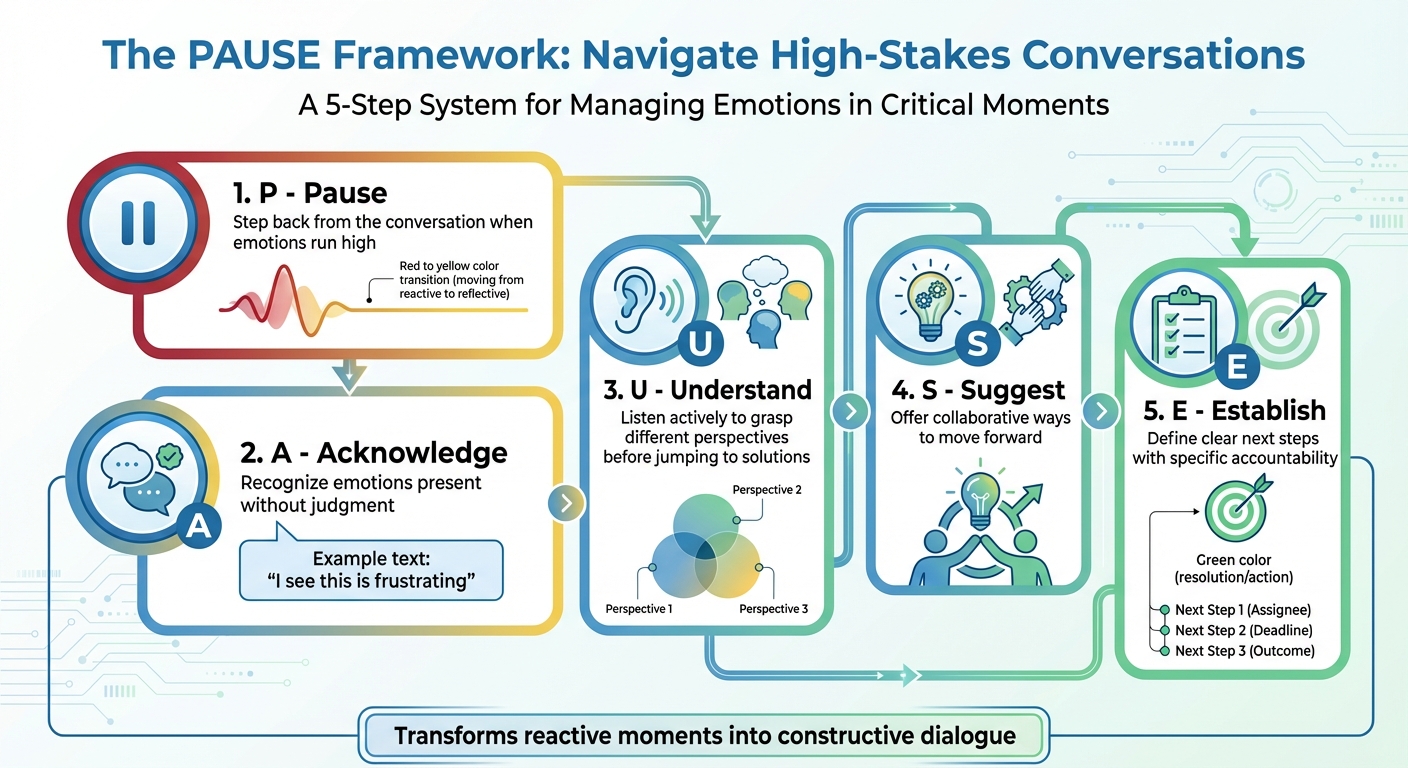
PAUSE Framework: 5-Step Emotional Regulation System for Tech Leaders
Understanding how your brain processes emotions and identifying your triggers is a crucial first step. The techniques below take theoretical insights and turn them into actionable strategies. These methods are designed to help you navigate the unique challenges of tech leadership by providing quick and effective ways to manage your emotions in critical moments.
The PAUSE Framework: A 5-Step System
The PAUSE Framework is a structured tool for managing high-stakes conversations. It helps create a moment of reflection between your initial emotional reaction and a more measured response. Here’s how it works:
- Pause: Step back from the conversation as soon as you notice emotions running high.
- Acknowledge: Recognize the emotions present without judgment (e.g., “I see this is frustrating”).
- Understand: Listen actively to grasp different perspectives before jumping to solutions.
- Suggest: Offer collaborative ways to move forward.
- Establish: Define clear next steps with specific accountability [1].
By using the PAUSE Framework, you can turn reactive moments into opportunities for constructive dialogue, allowing your rational side to take the lead.
The STOP Technique for High-Pressure Moments
For situations that demand an immediate reset - like before sending a heated email - the STOP Technique offers a quick way to regain control [1][5]. Follow these steps:
- Stop: Halt whatever you’re doing immediately.
- Take: Take a deep breath to calm your system.
- Observe: Check in with yourself. Notice physical sensations, such as a racing heart or clenched jaw, without judgment.
- Proceed: Choose your next action thoughtfully, ensuring it aligns with your long-term goals.
This brief pause can help you shift from acting on impulse to responding with intention.
Daily Mindfulness Practices
Regulating emotions isn’t just about handling crises - it’s also about building habits that strengthen your emotional resilience over time. Incorporate these practices into your daily routine:
- Start each morning with 5–10 minutes of intention-setting to prepare for potential challenges.
- Take 1–2 minute breaks between meetings to practice deep breathing and release tension.
- Dedicate 5 minutes at the end of the day to reflect on what went well and identify areas for improvement.
- Try the RAIN method: Recognize the emotion, Allow it to exist without judgment, Investigate it with curiosity, and Nurture yourself with kindness [1][13].
Even small moments can become opportunities for mindfulness. For example, Dr. Patti Johnson, a psychologist, suggests:
"Take a few diaphragmatic breaths whenever you are stopped at intersections. Focus on breathing in slowly through your nose so that your stomach moves outward with each inhale" [14].
Consistently practicing these techniques helps expand your emotional tolerance and strengthens your ability to handle stressful situations. Over time, these habits not only enhance your personal well-being but also foster a more emotionally supportive environment for your team.
sbb-itb-8feac72
Creating Emotionally Supportive Team Environments
While managing your own emotions is essential, creating an emotionally supportive environment for your team is just as important. As a tech leader, your emotional state sets the tone for your team. Many team members face their own emotional struggles, and your ability to create a nurturing atmosphere can make a significant difference.
The idea of emotional contagion explains how your mood can influence your team through mirror neurons. For instance, if you remain calm during a project setback, your team is more likely to mirror that steadiness, focusing on problem-solving rather than succumbing to panic [1]. Robin Stern, Ph.D., from the Yale Center for Emotional Intelligence, emphasizes this beautifully:
"Emotions are social and contagious components of life. When you prioritize your own emotional well-being... it shows and it rubs off on others" [16].
This ripple effect highlights how your emotional regulation directly impacts your team's ability to stay focused, communicate effectively, and perform at their peak. Understanding this dynamic naturally leads to exploring how different methods of managing emotions can influence your team.
Suppression vs. Acceptance: Which Strategy Works Better
It’s common for tech leaders to suppress emotions, thinking it maintains professionalism. However, research suggests this approach often backfires. Margaret Cullen, M.A., M.F.T., sheds light on this:
"Suppression doesn't make the emotion go away, it just stays inside you causing more pain" [15].
Encouraging your team to "suck it up" might seem practical, but it can lead to increased anxiety, depression, and decreased job performance. Here’s a closer look at how suppression compares to acceptance:
| Strategy | Description | Disadvantages/Costs | Evidence-Based Outcomes |
|---|---|---|---|
| Suppression | Hiding or holding back emotions [15]. | Leads to rumination, anxiety, depression, and even physical discomfort. Lowers overall job performance [15][4]. | Emotions linger and contribute to long-term psychological distress [15]. |
| Acceptance / Reappraisal | Recognizing emotions as they arise or reframing situations to shift perspective [10][4]. | Requires vulnerability and self-awareness, which can be challenging at first [3]. | Results in better sleep, improved job satisfaction, stronger team connections, and higher performance [15]. |
Choosing acceptance over suppression fosters a healthier work environment. Teams that process emotions in real-time - rather than burying them - enjoy benefits like better sleep, enhanced job performance, and stronger relationships [15]. This doesn’t mean letting emotions spiral out of control; it means acknowledging and addressing them so they naturally subside, like waves ebbing away.
Team Support Strategies That Work
One way to create a supportive environment is by normalizing emotional check-ins during team meetings. A simple tool like the HALT acronym helps team members identify when they’re Hungry, Angry, Lonely, or Tired before making critical decisions [3]. This practice builds self-awareness and reduces reactive decision-making.
Encourage "micro-breaks" of just 1–2 minutes between meetings. During these moments, team members can practice quick breathing techniques like box breathing (4-4-4-4) or the 4-7-8 method to reset their nervous systems [3][16]. These short pauses prevent emotional carryover from one task to the next, keeping everyone in a balanced state.
When conflict arises, active listening protocols can transform how your team navigates emotional tension. This involves maintaining a calm posture, letting others speak without interruption, and repeating back what you’ve heard to confirm understanding [1]. This approach fosters psychological safety, which is essential for creativity and innovation. When team members feel secure sharing ideas without fear of criticism, they’re more likely to take the risks that lead to breakthrough solutions.
Consistency is key. By openly acknowledging your own emotions during high-pressure moments or maintaining confidence during setbacks, you set an example for your team. This authenticity builds trust and encourages a culture where emotional regulation becomes a shared practice rather than an individual challenge [1].
Conclusion: Mastering Emotional Regulation as a Tech Leader
Emotional regulation is all about staying steady and effective when it matters most. Debra Roberts, an expert in interpersonal communications, highlights this as one of the most important leadership skills to develop [2]. The techniques outlined in this guide - from the STOP Technique to acceptance-based strategies - gain strength with regular practice.
Key Points to Remember
At the heart of emotional regulation lies the Window of Tolerance - the mental state where you can process information calmly without being overwhelmed or shutting down [2]. If you feel triggered, take a moment to pause, following the advice of Bethany Klynn, PhD:
"The number one skill in regulating difficult emotions... is to pause. Take a breath. Slow down the moment between trigger and response" [4].
This brief pause can help you think clearly and make better decisions. When you stay composed, your team is likely to reflect that calmness [1]. Also, remember that choosing acceptance over suppression is key. Research shows that acknowledging emotions instead of pushing them away leads to better sleep, higher job satisfaction, and stronger team relationships [15]. Supporting your emotional regulation also means prioritizing basics like getting 7–8 hours of sleep and staying active for at least 30 minutes five times a week [12].
These insights are tools you can use daily to improve your emotional resilience.
Next Steps for Tech Leaders
Start small. Pick one technique and practice it consistently for 30 days. Use tools like an Emotional Awareness Chart to track your reactions to common triggers [1]. Spend five minutes each day reflecting on your wins and identifying areas for growth [1].
Consider professional development opportunities. Tech Leaders offers training programs tailored to engineering leaders, helping bridge the gap between technical expertise and skills like emotional intelligence. Programs like Mindfulness-Based Emotional Balance (MBEB) or coaching focused on resilience can also be valuable [4][15]. Remember, emotional regulation is a skill that can be developed, and believing in your ability to improve makes a big difference [17].
The goal isn't perfection - it’s progress. Learning to pause and acknowledge emotions rather than suppressing them will not only strengthen your leadership but also help create a healthier, more connected team environment.
FAQs
What is the PAUSE Framework, and how can it support conflict resolution?
At the moment, detailed information about the PAUSE Framework and its application in conflict resolution isn't readily available. Without a clear explanation of its principles or a reliable source to reference, it's difficult to provide a thorough description. If you can share more context or point to a credible resource, we'd be glad to dive deeper and offer further insights.
How does emotional regulation enhance team performance for tech leaders?
Emotional regulation is all about understanding and managing your emotions so you can respond thoughtfully instead of reacting impulsively. For tech leaders, this skill is a game-changer. When you're juggling tight deadlines, high-stakes decisions, and constant change, staying emotionally steady can make all the difference. It helps you think clearly, handle conflicts calmly, and build trust with your team.
Studies back this up: leaders who manage their emotions well create work environments where teams make smarter decisions, experience lower turnover, and feel psychologically safe. This sense of safety fuels productivity in fast-moving tech settings. When leaders stay composed, they set the tone for open communication, faster problem-solving, and resilience in tough situations. The result? Better collaboration and stronger outcomes.
To support this, Tech Leaders integrates emotional-regulation techniques into its leadership training programs. These include practices like reflection exercises, active listening, and stress-management strategies. By mastering these tools, tech leaders can keep their teams performing at their best while staying adaptable in today’s rapidly evolving, AI-driven landscape.
What are some simple mindfulness practices tech leaders can use daily?
Mindfulness doesn’t have to take up a huge chunk of your day - it can easily be woven into even the busiest schedules. For tech leaders constantly on the move, small, intentional moments of awareness can make a big difference. For instance, take a few deep breaths while you’re stopped at a red light, savor a meal without scrolling through your phone to truly enjoy the taste, or spend the first five minutes at your desk tuning into how your body feels before tackling your to-do list.
If you’re feeling overwhelmed, grounding exercises can offer quick relief. One popular method is the 5-4-3-2-1 technique: notice five things you can see, four you can touch, three you can hear, two you can smell, and one you can taste. Another go-to strategy is the STOP technique: Stop, Take a breath, Observe, Proceed. This simple pause can help you respond thoughtfully to challenges instead of reacting on autopilot. These easy practices not only boost focus and emotional stability but also contribute to a more balanced and positive work environment.