
Equity and Retained Earnings: Basics for Tech Leaders
Understanding equity and retained earnings is essential for tech leaders transitioning into decision-making roles. These financial concepts go beyond accounting - they influence how companies grow, fund operations, and stay financially healthy.
Here’s what you need to know:
- Equity represents a company’s net worth, calculated as total assets minus total liabilities. It’s the foundation for attracting investors and managing financial risks.
- Retained earnings are profits kept within the company instead of being paid out as dividends. These funds fuel growth initiatives like R&D, hiring, and market expansion.
- Key metrics to watch: Retention ratio (reinvested profits) vs. dividend payout ratio (profits paid to shareholders). Balancing these ensures long-term stability.
For example, companies like Apple and Amazon have historically reinvested retained earnings to drive innovation and expand market share. On the balance sheet, retained earnings indicate growth potential, while negative balances may reflect losses or heavy reinvestment.
Mastering these concepts helps tech leaders make informed decisions, balance growth with financial discipline, and reduce reliance on external funding.
Retained Earnings Explained with Examples
sbb-itb-8feac72
What is Shareholders' Equity?
Shareholders' equity is essentially your company's net worth. It’s the value left after subtracting total liabilities from total assets - what shareholders would receive if the company sold all its assets and paid off its debts [5][6]. The formula is simple:
Shareholders' Equity = Total Assets – Total Liabilities [6][8].
This figure highlights the balance between owner investments and debt. A Shareholders' Equity Ratio (calculated as Total Equity / Total Assets) below 50% often points to a company with heavy debt, while a ratio of 100% means nearly all assets are funded by equity [7]. Equity also acts as a cushion during tough times, helping businesses weather financial losses [9].
For instance, Apple reported shareholders' equity of $60.27 billion, based on assets of $335.03 billion and liabilities of $274.76 billion [8]. On the flip side, negative shareholders' equity - when liabilities exceed assets - signals financial trouble and warns of potential risks for investors [5][8].
Parts of Equity
Shareholders' equity consists of several components that collectively reflect a company’s financial history and strategy:
- Common Stock: Represents the base value of shares issued, granting ownership and voting rights [9][11].
- Additional Paid-In Capital (APIC): The extra amount investors pay beyond the par value of shares, often significant during initial public offerings (IPOs) [7][9].
- Retained Earnings: Accumulated profits reinvested into the business instead of being paid out as dividends. For established companies, this often becomes the largest part of equity [7][8][10].
- Treasury Stock: Shares repurchased by the company, which reduce total equity as a contra-equity account [7][8].
- Accumulated Other Comprehensive Income (AOCI): Includes unrealized gains or losses, such as currency translation adjustments [9][11].
In startups, APIC often dominates equity due to high valuations during funding rounds. As companies mature, retained earnings typically take center stage, signaling a shift from external funding to self-sustained growth.
Understanding these elements provides valuable insight into a company’s financial health and funding strategy.
How Equity Shows Financial Health
Shareholders' equity offers a snapshot of whether a company’s assets can cover its liabilities. Positive equity reflects financial stability, while prolonged negative equity could signal insolvency [5][8]. As Investopedia puts it:
"A positive stockholders' equity is a sign of a company's financial soundness, whereas a negative balance can be a sign of insolvency" [8].
The structure of equity also reveals a company’s approach to financing. For example, Tesla reinvests retained earnings to fund production, research, and global expansion [10]. Similarly, Amazon’s strategy of reinvesting nearly all its profits into its platform and new technologies has boosted both its market share and shareholder equity [10].
For investors, tracking Return on Equity (ROE) - calculated as net income divided by shareholders' equity - provides a clear measure of how efficiently management is using investor funds to generate profits [5]. Additionally, strong retained earnings signal a company’s ability to finance growth and innovation internally, reducing reliance on costly debt [10].
What are Retained Earnings?
Retained earnings represent the total net profits a company keeps after distributing dividends, which are then reinvested to drive future growth.
Unlike net income, which reflects a single period, retained earnings accumulate over time. They provide a snapshot of how much profit has been reinvested back into the business. For instance, if a tech startup earns $100,000 in net income during a year and pays out $30,000 as dividends, the remaining $70,000 gets added to its retained earnings from previous years.
These earnings are crucial for tech companies, as they often use them to fund research, innovation, or market expansion. Early-stage firms, however, might show a negative retained earnings balance - known as an accumulated deficit - because they often prioritize reinvestment over immediate profitability.
Take Apple Inc. as an example. In September 2024, the company reported a $19.1 billion accumulated deficit. Yet, its retained earnings of $15.50 per share contributed to an $84 per share increase in stock price. This suggests that every dollar retained translated into approximately $5.42 in market value [12].
Calculating Retained Earnings
The formula for retained earnings is straightforward:
Ending Retained Earnings = Beginning Retained Earnings + Net Income – Dividends
For example, in February 2025, a SaaS startup reported a net profit of $100,000 in its first year. After distributing $30,000 in dividends, the company reinvested $70,000 into product development and marketing. That $70,000 became its ending retained earnings.
It’s important to note that retained earnings are an accounting figure recorded under equity - they don’t represent cash on hand. Before making large investments, always check the cash flow statement to ensure liquidity. This calculation is then summarized in the Statement of Retained Earnings, which outlines how profits are allocated.
Statement of Retained Earnings
The Statement of Retained Earnings connects the income statement and the balance sheet by detailing how net income is either distributed to shareholders or reinvested in the business. This document sheds light on a company’s strategic direction. For example, a high retention ratio - indicating a large percentage of net income is reinvested - often reflects confidence in internal projects yielding strong returns compared to paying dividends.
For tech leaders, this statement is a valuable tool. It tracks how profits are reinvested and highlights strategic priorities. Companies may also designate specific portions of retained earnings for significant future plans, such as acquisitions or debt repayment. By earmarking these funds, management ensures they are allocated to key initiatives rather than immediate dividend payouts.
Retention Ratio vs. Dividend Payout Ratio
Company Lifecycle Stages: Dividend Payout vs Retention Ratios for Tech Leaders
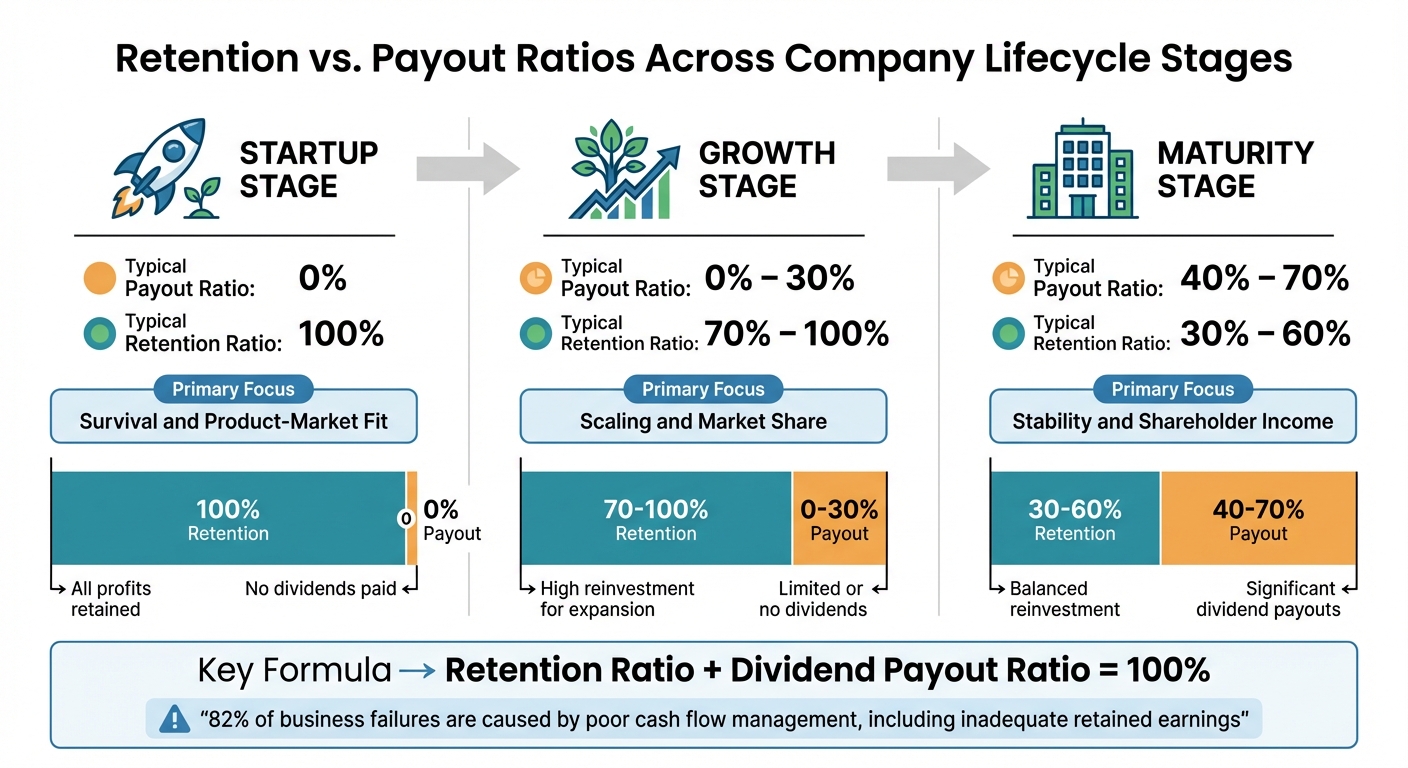
When it comes to retained earnings, tech leaders face a critical decision: reinvest profits or issue dividends. These choices are reflected in two key metrics - the retention ratio and the dividend payout ratio - which together always add up to 100% [14]. For example, if 25% of profits are paid out as dividends, the remaining 75% is retained for reinvestment.
The retention ratio, also known as the "plowback ratio", shows the percentage of net income kept for operations. It’s calculated using the formula: (Net Income – Dividends Paid) ÷ Net Income [13]. A high retention ratio often indicates a company is prioritizing growth, R&D, or reducing debt - common strategies in the tech industry. For instance, small businesses generally reinvest 50% to 90% of their profits into operations [3], while many tech startups reinvest nearly all their earnings. A notable example is Microsoft, which reinvested 100% of its profits for decades before issuing its first dividend, allowing it to expand its asset base and achieve high returns on capital [16].
On the other hand, the dividend payout ratio measures the percentage of net income distributed to shareholders as dividends. It’s calculated as: Total Dividends Paid ÷ Net Income [14]. Mature industries, like utilities, often have payout ratios between 60% and 70% [17], while high-growth tech companies typically keep their payout ratios low - between 0% and 30% - to preserve funds for innovation. A payout ratio exceeding 100% signals potential financial issues, as the company may be using reserves or taking on debt to maintain dividend payments [14]. For cyclical tech sectors like semiconductors, evaluating dividend sustainability based on recession-level earnings, rather than peak earnings, is a more prudent approach [14].
These metrics help align financial strategies with a company’s lifecycle stage, as outlined below:
| Lifecycle Stage | Typical Payout Ratio | Typical Retention Ratio | Primary Focus |
|---|---|---|---|
| Startup | 0% | 100% | Survival and Product-Market Fit |
| Growth | 0% – 30% | 70% – 100% | Scaling and Market Share |
| Maturity | 40% – 70% | 30% – 60% | Stability and Shareholder Income |
For startups, nearly all earnings are reinvested (0% payout ratio). Growth-stage companies may distribute up to 30%, while mature firms often balance payouts with reinvestment, maintaining payout ratios between 40% and 70% [14]. Poor cash flow management, including inadequate retained earnings, is a leading cause of business failure, accounting for 82% of such cases [3].
Striking the right balance between reinvestment and distribution is essential for long-term success and ties directly to broader financial strategies.
Retention Ratio
The retention ratio reveals how much profit is being reinvested into the business. To calculate it, use the formula: (Net Income – Dividends) ÷ Net Income [15]. For example, if a SaaS company earns $500,000 in net income and pays $50,000 in dividends, the retention ratio is 90%, meaning $450,000 is retained for reinvestment.
Reinvesting today’s earnings can lead to substantial future gains through compounding [18]. That’s why growth-phase tech firms often reinvest 70% to 100% of their profits into R&D and market expansion. However, retention alone isn’t enough - companies must track their Return on Equity (ROE) to ensure reinvested funds yield strong returns [13][17]. Reinvesting without delivering competitive returns may not justify withholding dividends [14].
Tech leaders should also consider the Free Cash Flow (FCF) Payout Ratio, calculated as Dividends ÷ FCF. This metric provides a clearer picture of dividend sustainability, as net income can be skewed by non-cash items or large capital expenditures. If a company shows positive net income but negative FCF, it could be funding dividends through borrowing rather than actual operational success [14].
Dividend Payout Ratio
The dividend payout ratio shows the portion of net income distributed to shareholders. It can be calculated as Total Dividends Paid ÷ Net Income or Dividends Per Share ÷ Earnings Per Share [14]. Together with the retention ratio, it provides a full view of how profits are allocated. Mature industries, like utilities, typically maintain payout ratios between 60% and 70% [17]. In contrast, high-growth tech firms usually keep this ratio low - between 0% and 30% - to prioritize innovation and expansion.
A payout ratio above 100% is a red flag, indicating the company may be depleting reserves or taking on debt to pay dividends. For tech companies in cyclical industries, evaluating dividend sustainability against recession-level earnings offers a more realistic measure of financial health [14].
How Retained Earnings Shape Tech Company Decisions
Retained earnings play a crucial role in guiding how tech companies make strategic choices, especially when it comes to growth and innovation.
Reinvesting in Technology and Growth
With retained earnings, tech companies can fund their ambitions without issuing new shares or taking on debt that comes with interest payments [20]. This internal funding allows leaders to directly channel profits into areas like hiring skilled engineers, purchasing advanced tools, and setting up research labs [19]. It also gives companies the flexibility to launch new products, explore untapped markets, or even acquire competitors - all without relying on external financing or approvals [4][21].
This reinvestment creates a cycle of growth. Profits invested in product improvements drive more sales, which in turn generate more profits for future projects. Apple is a prime example of this approach. Between the early 2000s and 2007, the company used retained earnings to maintain a strong balance sheet while pouring resources into research and development. This strategy laid the groundwork for the iPhone, launched in June 2007, which transformed the industry and became a cornerstone of Apple’s success [19]. Similarly, Amazon used its retained earnings to evolve from an online bookstore into a tech powerhouse, launching services like Amazon Web Services (AWS) and Amazon Prime Video. These moves diversified its revenue streams and cemented its dominance across multiple sectors [19].
Retained earnings also support critical tasks like securing intellectual property through patents, trademarks, and copyrights [19]. They act as a safety net during economic downturns, ensuring that innovation doesn’t stall even when external funding dries up [19][21]. To stay competitive, tech leaders might allocate a fixed percentage - say, 20% - of their retained earnings to R&D projects. However, it’s important to track the returns on these investments and adjust course if they don’t lead to market growth [19].
For tech leaders, understanding how these reinvestments impact the balance sheet is key to crafting a sound financial strategy.
Reading Retained Earnings on a Balance Sheet
You’ll find retained earnings listed in the shareholders' equity section of a balance sheet, usually below paid-in capital [1][23]. Reviewing this figure monthly can help leaders track profitability and identify trends early on [1].
The state of a company’s retained earnings provides valuable insights into its financial health and growth potential:
| Retained Earnings Status | Strategic Meaning for Tech Leaders |
|---|---|
| Positive | Indicates profitability and the ability to self-fund operations or expansion [4]. |
| Growing | Reflects sustainable growth and effective long-term planning [4]. |
| High | Suggests financial stability, making the company more appealing to lenders [4]. |
| Negative | Known as an "accumulated deficit", it can signal past losses or heavy reinvestment [4][2]. |
For tech startups, negative retained earnings (or accumulated deficits) are common in the early stages, as they often prioritize scaling fast over immediate profitability [1][2]. This isn’t necessarily a red flag - it’s often a calculated risk to secure market share. However, leaders need to balance this strategy with financial discipline. High revenue paired with low retained earnings could point to unchecked expenses or overly generous dividend payouts [4].
It’s also worth noting that retained earnings represent cumulative profits, not liquid cash [4][2][22]. A company might report high retained earnings but have limited cash on hand if those profits are tied up in assets or receivables. This makes it crucial to maintain a balance between reinvestment and liquidity to stay agile [4][2][22][1][21]. Investors often look at retained earnings alongside metrics like Return on Equity (ROE) and Return on Assets (ROA) to assess whether a company is effectively turning its profits into long-term value [4].
Conclusion
For tech professionals transitioning into leadership roles, understanding equity and retained earnings is a key part of making informed, strategic decisions. These financial concepts shed light on how a company creates value, allocates profits, and funds growth without taking on excessive debt or losing ownership control.
Retained earnings, in particular, offer flexibility. They allow you to reinvest profits into areas like hiring top talent, developing new products, or entering new markets - all without needing approval from investors or negotiating loan terms. This approach avoids equity dilution and keeps decision-making firmly within your control. Reading retained earnings on the balance sheet can also provide early insights into financial health. Increasing retained earnings often signal confidence in the company’s future and a commitment to reinvestment for sustained growth, rather than prioritizing short-term shareholder payouts. On the flip side, knowing when negative retained earnings indicate strategic investments versus unsustainable losses helps leaders make smarter calls on risk and resource management.
Effectively using retained earnings is at the heart of every major decision a tech leader faces. As covered earlier, understanding these financial fundamentals not only strengthens your balance sheet but also enhances your ability to make sound strategic choices. With this knowledge, leaders can strike the right balance between maintaining liquidity for immediate needs and investing in long-term growth - deciding when to double down on R&D and when to build reserves for tougher times.
At Tech Leaders, we aim to bridge the gap between technical expertise and critical business skills like financial strategy. Mastering equity and retained earnings equips you to lead with technical insight and financial confidence, driving growth in an increasingly AI-driven world.
FAQs
How is retained earnings different from cash?
Retained earnings reflect the total profits a company has saved over time for reinvestment in the business. On the other hand, cash refers to the liquid funds a company has on hand and can use immediately. While retained earnings are recorded on the balance sheet under equity, they are not the same as cash. These two concepts are connected but serve distinct roles in evaluating a company's financial standing.
When is negative retained earnings OK for a startup?
Negative retained earnings are often a normal occurrence for startups during their early growth phases or when dealing with short-term losses. This happens because many startups focus on scaling and expanding rather than turning a quick profit. In such cases, raising additional equity capital can play a key role in balancing out the negative earnings, providing the financial cushion needed to support their growth strategy.
How do I choose retention vs dividends?
When deciding between retaining earnings or distributing dividends, it all boils down to your company’s objectives and financial situation. Retained earnings can be reinvested into growth initiatives, daily operations, or even serve as a financial cushion, helping to fuel long-term progress. On the other hand, dividends offer immediate returns to shareholders, which can enhance investor satisfaction but leave less capital available for reinvestment.
The key is finding a balance that aligns with your company’s growth ambitions while meeting shareholder expectations. This decision should reflect your strategic goals and future vision.