
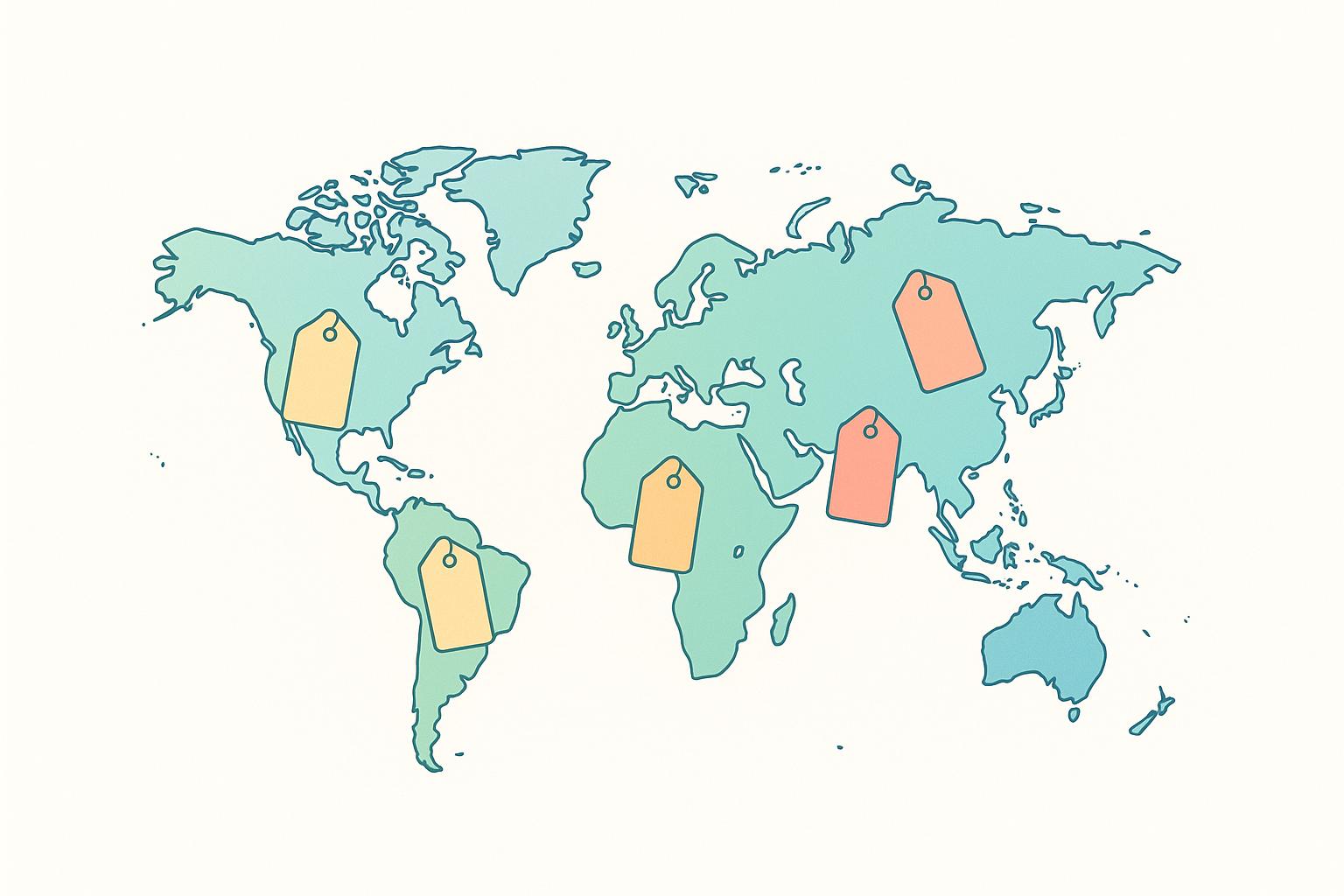
Geographic Pricing: Basics for Tech Leaders
Want to grow your SaaS or consulting business by up to 50%? Geographic pricing might be your answer. This strategy customizes prices based on location, helping you boost revenue, break into new markets, and align with local purchasing power. Here’s what you need to know:
- What is it? Pricing adjusted for factors like local demand, competition, and economic conditions - not just currency conversion.
- Why use it? It opens doors to new markets, maximizes revenue, and builds trust by aligning with local realities.
- How to implement it: Conduct market research, segment by location and economic factors, test your pricing, and adjust regularly.
For example, Netflix charges $15.49 in the U.S. but only $6 in India, reflecting local purchasing power. Even small adjustments can lead to 20–50% revenue growth. Ready to learn how? Let’s dive in.
Geographical Pricing: Definition, How Strategy Works, and Example
Factors That Affect Geographic Pricing
When it comes to setting prices across different regions, several factors play a critical role. For tech companies offering consulting services or SaaS products, these considerations directly influence profitability and market reach. Let’s explore the key elements shaping geographic pricing strategies.
Shipping, Logistics, and Operating Costs
Even though SaaS businesses don’t deal with physical shipping, regional operating costs still weigh heavily on pricing decisions. These can include expenses like data center hosting, customer support infrastructure, and compliance requirements - each of which can vary significantly by location.
Take cloud infrastructure as an example: Amazon Web Services adjusts its pricing depending on the data center’s location. Similarly, operational costs vary for consulting services, where travel expenses and local partnerships can create additional pricing pressures. For instance, a consultant working out of San Francisco faces considerably higher operating expenses than one based in Austin, Texas.
Technology infrastructure costs also play a role. A 2023 Gartner survey found that 85% of supply chain executives are prioritizing cloud-based logistics solutions. Meanwhile, shipment brokerage has surged by 45%, and rates for specialized transportation have climbed by 25% [3][4]. These operational variances naturally lead to differences in pricing across regions.
Local Market Demand and Competition
Pricing strategies must also reflect the unique dynamics of local markets. Understanding regional demand patterns helps businesses position their services more effectively.
For instance, in Australia, e-commerce sales hit AUD 50 billion in 2023, highlighting the importance of competitive pricing to capture market share [7]. Additionally, electric vehicle sales in the country saw a 50% increase that same year, signaling new opportunities for strategic pricing [7]. Competitive markets may require lower prices to attract customers, while less crowded ones might allow for premium pricing. Differences in business practices and cultural norms also mean that what works in New York may not succeed in smaller cities.
As market demand evolves, aligning prices with regional economic realities becomes a must for maintaining relevance and competitiveness.
Purchasing Power and Economic Conditions
Economic conditions and purchasing power are among the most influential factors in geographic pricing. Tailoring prices to local income levels ensures services remain both accessible and profitable.
For example, Spotify Premium costs $10.99 in the U.S. but only $1.07 in Pakistan [9]. This stark difference underscores how purchasing power parity shapes pricing decisions. A SaaS tool priced at $99 per month might be reasonable for a Silicon Valley startup but could be too expensive for businesses in smaller or less affluent markets. Similarly, a consultant charging $200 per hour in Manhattan operates under different market conditions than one in Cleveland.
Economic stability adds another layer of complexity. In regions facing financial uncertainty, flexible pricing models - such as extended payment plans or scalable options based on company size - can help businesses better align with local realities. Striking the right balance prevents pricing that’s either too high, leading to lost sales, or too low, which risks undervaluing the service [6].
Common Geographic Pricing Strategies
Tech leaders have several geographic pricing strategies at their disposal, each designed to fit specific market conditions and business models. Let’s explore three practical approaches to geographic pricing.
Zone Pricing
Zone pricing involves dividing your market into separate geographic regions, each with its own pricing structure. For consulting services, these zones might be based on travel distance or local market dynamics, ensuring customers in the same area are charged consistently. This approach promotes fairness within each zone.
Take the example of a RELEX customer in Estonia. They initially used a uniform pricing model that didn’t account for differences in regional purchasing power. By shifting to a zone-based pricing strategy that aligned with local purchasing power, they saw improved customer satisfaction and healthier profit margins across their regions [10].
Local Market Pricing for Digital Services
Local market pricing adjusts rates to reflect factors like local purchasing power, competition, and demand. Implementing this strategy requires detailed market research and ongoing adjustments.
Dropbox provides a great example: they tailor subscription fees in countries with lower GDP to better match local economic conditions [8].
For tech consulting, this means understanding local competitor pricing and regional business budgets to set rates that align with the economic reality of each market. SaaS companies often take this a step further by conducting price sensitivity studies. These studies test different price points to measure customer reactions, conversion rates, and long-term value. When done right, geographic pricing can significantly boost growth, with some companies achieving 25–50% higher growth rates [1].
FOB Origin and Delivered Pricing
Originally used for physical goods, FOB (Free on Board) origin pricing and delivered pricing can also be adapted for tech consulting services.
- FOB Origin Pricing: In this model, the consultant delivers the core service, while the client takes on additional costs like travel, accommodations, or extended support. This approach keeps initial quotes lower and shifts certain financial responsibilities to the client.
- Delivered Pricing: This model provides an all-inclusive rate, bundling everything - consulting fees, travel expenses, training materials, and post-implementation support - into a single, predictable price. Enterprise clients often prefer this for its simplicity, as it eliminates the risk of unexpected costs.
Here’s a quick comparison of these models:
| Pricing Model | Best For | Advantages | Considerations |
|---|---|---|---|
| FOB Origin | Cost-conscious consultants, flexible projects | Lower initial quotes, better cost control | Clients handle additional expenses |
| Delivered | Premium services, enterprise clients | Simplified budgeting, predictable pricing | Higher upfront costs, risk of cost overruns |
The choice between these models depends on your target audience and competitive strategy. Enterprise clients often lean toward delivered pricing for its convenience, while smaller businesses may prefer the flexibility and lower upfront costs of FOB Origin pricing. Regardless of your choice, clear communication about what’s included - and what isn’t - is crucial to building trust with your clients.
"When considering your price, it's important to remember that it's not for yourself, but for your target customers." - Eric Dolansky, Associate Professor of Marketing, Brock University [11]
How to Set Up Geographic Pricing: Step-by-Step Guide
Setting up geographic pricing involves a structured approach that combines market research, segmentation, and ongoing adjustments. Here’s how tech leaders can implement this strategy effectively.
Conducting Market Research
Market research is the backbone of any geographic pricing strategy. Without understanding regional specifics, pricing becomes little more than guesswork.
Start by setting clear goals, like defining pricing tiers for enterprise consulting in specific regions within a set timeframe, such as 90 days [12].
Use a mix of research methods to gather a full picture. Primary research might include surveys, interviews, or focus groups with potential customers in target regions. Secondary research could involve studying government reports, industry analyses, or competitor data. Together, these methods provide both numbers and nuanced insights [12].
Pay close attention to market demand by analyzing consumer behavior in each region. Factors like cost of living, average income, local climate, and competitor activity all come into play. For example, a cybersecurity consultant might notice that financial firms in New York City allocate budgets differently than manufacturing companies in the Midwest [2].
A good example of this in action is Adobe. They adjust Creative Cloud pricing in markets like the United States and India, reflecting differences in purchasing power, tax structures, and market conditions [8].
Market research isn’t a one-and-done task. Plan to revisit your findings every six months to stay ahead of economic shifts, market changes, and evolving customer needs [1].
Use this data to effectively segment your markets.
Dividing Markets by Geographic and Economic Factors
Once you’ve collected your research, the next step is to divide markets based on meaningful criteria. This allows you to tailor offerings and optimize revenue across regions [5].
Start by considering geographic factors and then refine your segmentation with economic data. For instance, a cloud migration consultant might focus on large metropolitan hubs like New York, San Francisco, or Chicago for enterprise clients, while targeting smaller cities for mid-market businesses. Each group will have different budgets, decision-making processes, and expectations [13].
Evaluate local income levels, purchasing power, and economic conditions in each area. Also, consider how factors like production costs, regulations, and competition vary by region. These directly impact what customers are willing and able to pay [6].
Customize service packages to align with local business practices and norms.
Dynamic pricing models can be particularly effective, allowing you to adjust rates based on real-time factors like location, seasonal demand, or competitive shifts [6].
Don’t forget to stay informed about local laws and tax regulations that may influence pricing. For example, a data privacy consultant working across state lines needs to account for varying compliance requirements, which could affect service complexity and pricing.
"When considering your price, it's important to remember that it's not for yourself, but for your target customers." - Eric Dolansky, Associate Professor of Marketing, Brock University [11]
Testing and Adjusting Pricing Models
After segmenting your markets, it’s time to validate your pricing strategy through testing. Even the best-researched plans need real-world feedback.
Begin with pilot programs in select markets before a full rollout. This minimizes risk and allows you to refine your approach based on customer responses. Choose test markets that represent different segments of your target audience [2].
Use A/B testing to explore different pricing strategies in similar geographic regions. For example, test one pricing model in Denver and another in Nashville. Measure metrics like conversion rates and deal size to determine what works best [15].
Nike provides a great example with their Court Legacy sneaker strategy in 2023. They launched at a premium price to attract early adopters, then gradually introduced discounts to appeal to price-sensitive shoppers. This strategy helped manage inventory while catering to a broad audience [15].
Collect feedback from your sales team, customer service reps, and clients. Sales teams, in particular, often have valuable insights into customer reactions, objections, and competitive pressures [14].
Regularly review your pricing performance. Plan to reassess your geographic pricing strategy every six months, looking at both data and customer feedback. Markets evolve quickly, and your pricing should keep up [1].
"After the initial localization, you test out your new geographical pricing and adapt if it does not bring the results you were looking for. Additionally, you should re-evaluate all of your pricing, not just the localization, every 6 months to ensure you're continuously accounting for changing market dynamics." - SBI Growth [1]
Invest in flexible pricing tools that allow for quick adjustments. The goal is to create a system that’s adaptable while maintaining consistency within each segment.
sbb-itb-8feac72
Benefits and Drawbacks of Geographic Pricing
Geographic pricing has the potential to increase growth rates by 25–50% [1] while broadening market reach and building customer trust. However, it also brings operational hurdles that businesses must navigate carefully.
Benefits of Geographic Pricing
Adjusting prices based on local purchasing power can significantly boost revenue and open up new markets. For instance, a cybersecurity consultant might charge higher rates for enterprises in Silicon Valley while offering more affordable pricing in smaller markets. This approach allows them to capture business from both high-end and cost-sensitive clients.
Market entry becomes more feasible when pricing reflects local conditions. Instead of sticking to a uniform pricing model that might alienate certain regions, businesses can confidently enter new markets. By offering competitive prices in lower-cost areas and maintaining premium rates where the market supports it, geographic pricing enables a more inclusive market strategy [16].
Aligning prices with local expectations can also strengthen customer relationships. When clients see that your pricing reflects their economic realities, it fosters trust and long-term loyalty [16]. This localized approach demonstrates an understanding of their needs, boosting satisfaction and credibility.
Another advantage lies in the flexibility to respond to local market dynamics. While competitors may stick to rigid pricing models, geographic pricing allows businesses to adjust to seasonal trends, economic changes, or regional competition [2].
"Pricing is one of the most important growth levers and utilizing geographic pricing correctly can be a relatively easy way to gain 25-50% higher growth rates, quickly." - SBI Growth [1]
Additionally, geographic pricing diversifies revenue streams across multiple markets [2]. This reduces reliance on any one region, creating more stable income. If one market faces economic challenges, strong performance in other areas can help offset the impact.
While these benefits are compelling, implementing geographic pricing comes with its own set of challenges that businesses must address.
Problems and Risks
Managing different price points across regions requires advanced systems and processes [5]. Billing, sales, and customer support teams must handle these tiers without errors or confusion, which can complicate operations.
Transparency issues can arise if customers discover they are paying more than others in different regions. In an age where pricing information spreads quickly online, this can lead to perceptions of unfairness [5].
Another concern is the risk of gray market activities. Customers may exploit regional price differences by using VPNs to access lower-priced services or by purchasing through resellers in cheaper regions. This can undermine your entire pricing strategy [17].
Regulatory challenges also come into play. For example, in the EU, antitrust regulations have led to fines for companies that failed to comply with differential pricing rules [5]. This adds another layer of complexity to implementation.
Channel conflicts can occur when distribution partners operate in overlapping regions with different price structures. These discrepancies may strain relationships with resellers and require clear operational controls to prevent tension [5].
Ethical concerns may arise if price differences between regions seem excessive. While adjustments based on economic conditions are generally accepted, extreme disparities could be seen as exploitative [17].
| Benefits of Geographic Pricing | Geographic Pricing Challenges |
|---|---|
| Potential for 25-50% higher growth rates | Complex management of regional pricing |
| Increased profit margins in local markets | Risk of perceived unfairness among customers |
| Strengthened customer trust and loyalty | Threat of gray market activities |
| Flexibility to adapt to local conditions | Regulatory compliance hurdles |
| Easier market expansion | Channel conflicts with distributors |
| Diversified revenue streams | Ethical concerns over significant price gaps |
To mitigate these risks, businesses should focus on transparent communication about the value they provide in each market [18]. Highlighting the unique benefits delivered to specific regions can help minimize perceptions of unfairness.
Using clear geographic boundaries and implementing IP-based access restrictions can also reduce gray market activities [18]. However, maintaining these systems requires ongoing effort and resources, which can be particularly challenging for smaller businesses or consulting practices.
Conclusion
Implementing a localized pricing strategy ensures prices reflect local market realities while protecting margins across regions. Geographic pricing moves away from a one-size-fits-all approach, embracing location-specific strategies that can drive growth by 25–50% while fostering stronger connections with customers in varied markets [1].
For tech leaders transitioning into independent consulting, mastering geographic pricing is a game-changer. It allows you to tailor pricing to local market dynamics rather than relying on uniform rates that may not align with every region's realities [2]. Factors like taxes, economic conditions, and competition vary widely, making it essential to adapt pricing strategies to fit each unique market [2].
Thorough market research and flexible pricing approaches are at the heart of this strategy. Incorporating elements like region-specific visuals and locally relevant campaigns can enhance its effectiveness [2]. By testing pricing models on a smaller scale before rolling them out broadly, you can reduce risks and fine-tune your approach based on actual market feedback.
The benefits? Diversified revenue streams, stronger local credibility, better profit margins, and lower logistical costs [2]. These gains are particularly crucial for tech leaders venturing into consulting or entrepreneurial projects, where adaptable pricing can make or break market entry.
That said, implementing geographic pricing successfully requires careful management of operational complexities, clear communication of the value provided, and strict adherence to regulations. Companies excelling in this space invest in reliable systems, maintain transparency, and continually refine their strategies to keep up with changing market demands.
By applying a structured approach, geographic pricing turns technical expertise into responsive business solutions. It equips leaders to compete effectively across diverse markets and build sustainable, diversified revenue streams.
At Tech Leaders, we know how vital it is to combine technical expertise with business strategies like geographic pricing to thrive in the competitive shift from technical roles to independent consulting. Let us help you navigate this journey with confidence.
FAQs
How can tech leaders create a geographic pricing strategy that reflects local economic conditions and purchasing power?
Crafting a Geographic Pricing Strategy
To create a pricing strategy that resonates with local economic realities, tech leaders need to adapt prices based on regional factors like income levels, market demand, and the cost of living. This approach not only aligns with customer expectations but also helps balance fairness with profitability.
Start by diving into local economic data - look at average income, spending patterns, and how competitors are pricing similar products or services in the area. Regularly revisit and adjust your pricing to stay in tune with shifts in the economy or market trends. By tailoring prices to reflect regional differences, you can remain competitive while addressing the unique needs of diverse customer groups.
What challenges can arise with geographic pricing, and how can tech leaders address them effectively?
Geographic pricing comes with its own set of hurdles. Businesses often struggle with managing differences across regional markets, maintaining consistent pricing, and avoiding clashes with distribution partners. On top of that, keeping track of and enforcing pricing across various locations can be tricky, potentially leading to profit losses or even harming how the brand is perceived.
To tackle these issues, companies can start with in-depth market research to better grasp regional differences. Establishing clear pricing policies is another key step, as is leveraging technology to keep an eye on pricing compliance. Strategic planning and running scenario analyses can also play a big role in reducing risks and ensuring pricing strategies stay competitive while aligning with overall business objectives.
How do companies like Netflix and Spotify decide on pricing for different regions, and what factors influence these decisions?
Companies like Netflix and Spotify use regional pricing strategies by carefully examining factors such as local economic conditions, purchasing power, and market demand. Take Netflix, for example - it adjusts subscription costs to strike a balance between affordability for users and profitability for the company in different regions. Similarly, Spotify tailors its pricing based on income levels and consumer behavior in each market.
To set regional prices effectively, businesses typically consider:
- Income levels and the average purchasing power within a specific region
- Currency exchange rates and how they impact pricing
- Local competition and the availability of alternative options
- Consumer preferences, which can influence how appealing a product is
By aligning their pricing strategies with these factors, companies can better connect with local audiences while optimizing their revenue on a global scale.