

5 Steps to Implement 360 Feedback
360 feedback is a method where managers, peers, direct reports, and stakeholders provide confidential input on someone's performance. For technical leaders like engineering managers or tech leads, it helps identify blind spots and bridges the gap between technical skills and leadership abilities.
To implement 360 feedback effectively, follow these steps:
- Define Purpose and Participants: Decide if the feedback is for development or evaluation, select participants carefully, and ensure anonymity.
- Design the Survey: Focus on clear, behavior-based questions tied to leadership competencies relevant to technical roles.
- Communicate the Process: Explain the purpose, train participants, and use tools that ensure anonymity and ease of use.
- Analyze and Deliver Results: Highlight patterns, not outliers, and organize feedback into actionable themes.
- Create Development Plans: Set specific, measurable goals and follow up with coaching and support.
Key Stat: 82% of organizations using 360 feedback report improved leadership performance. Start small, focus on development, and ensure follow-through for meaningful growth.
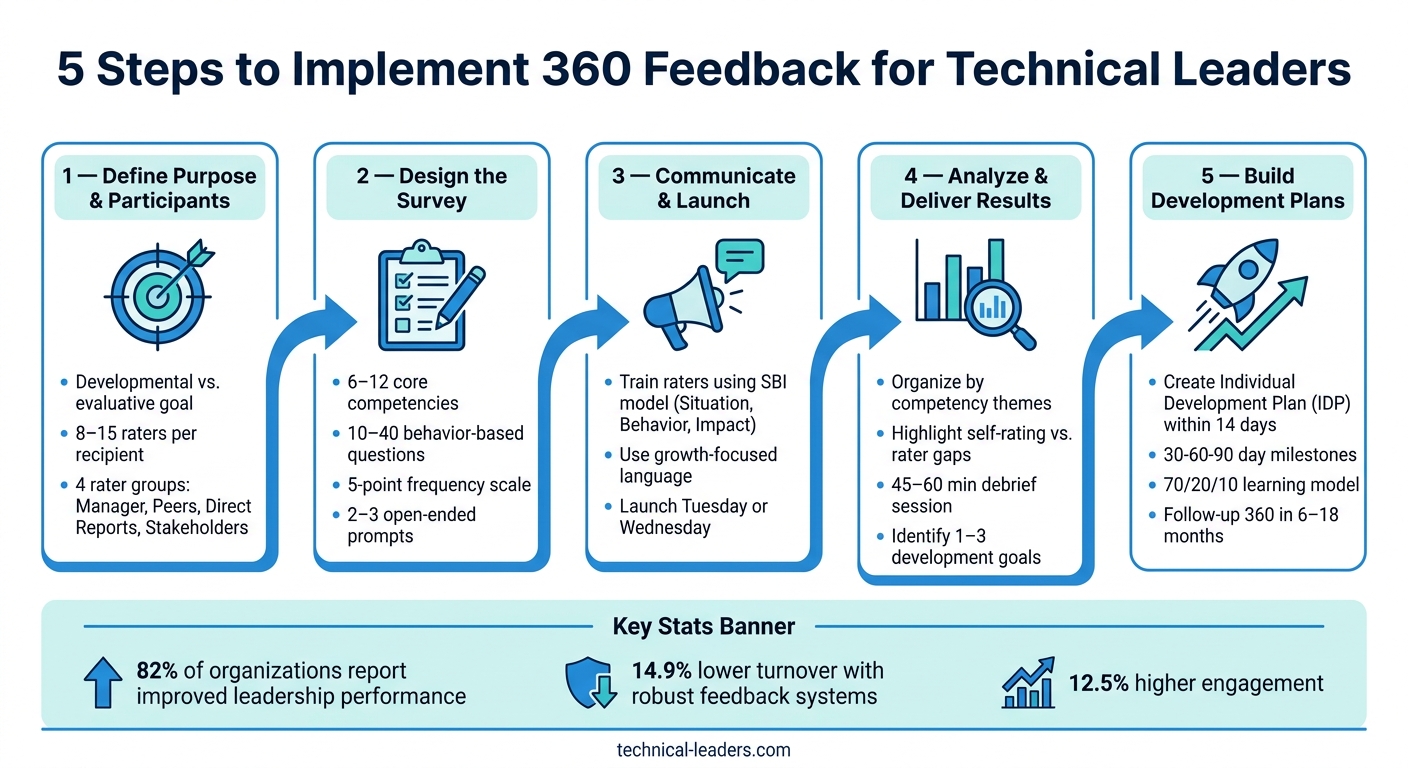
5 Steps to Implement 360 Feedback for Technical Leaders
6 Key Steps To Success With 360 Degree Feedback Implementation
sbb-itb-8feac72
Step 1: Define Purpose, Scope, and Participants
Before launching a feedback survey, it's crucial to define its purpose clearly. Skipping this foundational step can undermine trust in the process. Here's how to set clear goals, identify the right participants, and establish confidentiality guidelines.
Set Clear Goals and Outcomes
The first question to address is whether the feedback program will be developmental (focused on personal growth) or evaluative (used for performance reviews or compensation decisions). Experts often recommend starting with a developmental approach. As one expert explains:
"When employees know that peer feedback will influence their colleagues' ratings or compensation, they will not give honest negative feedback." - Harmny [3]
When targeting technical leaders, focus on addressing specific gaps rather than generic leadership traits. For instance, narrowing the perception gap - the difference between how a leader thinks they are perceived versus how their team actually experiences them - can lead to actionable insights. Measurable goals are key. Instead of setting a vague objective like "improve communication", aim for something more concrete, such as "proactively share project context with stakeholders before decisions are finalized." Specific, measurable targets make it easier to track progress over a set period, such as 6 or 12 months.
Choose Feedback Recipients and Raters
Determine who will receive feedback (e.g., engineering managers, tech leads, product managers) and select raters from these four groups:
| Rater Group | Primary Focus |
|---|---|
| Direct Manager | Strategic alignment, goal achievement, resource management |
| Peers | Daily collaboration, communication style, reliability |
| Direct Reports | Leadership style, delegation, psychological safety |
| Internal Stakeholders | Cross-functional responsiveness, professionalism |
Aim for 8–15 raters per feedback recipient. To ensure meaningful input, an administrator should review nominations and confirm that all raters have worked closely with the recipient for at least six months [9]. This ensures feedback is grounded in real experience.
"People don't appreciate being reviewed by peers who have little context and they are likely to reject feedback as a result." - Philip Arkcoll, CEO, Worklytics [4]
Set Rules for Anonymity and Confidentiality
Anonymity is a cornerstone of effective feedback. To maintain trust, require at least three responses per category before sharing aggregated results. If fewer responses are collected, withhold that group's data entirely to protect individual identities [5][7].
For smaller teams (fewer than 20 people), anonymity can be harder to maintain. In these cases, consider using open-ended qualitative questions or involving an external facilitator to gather and present feedback. From the outset, make it clear that 360 feedback is strictly for development purposes and will not influence salary, bonuses, or promotions. Communicating this in writing from senior leadership helps create the psychological safety needed for honest, constructive input [10].
Step 2: Design the Survey and Feedback Framework
Now that you've established your goals, identified participants, and set confidentiality rules, it's time to create a survey framework that delivers meaningful insights. A well-structured survey transforms your intentions into actionable feedback.
Define the Leadership Competencies to Measure
Start by pinpointing the leadership behaviors that are most relevant in your engineering environment. Tie these competencies to your organization's values and the specific demands of each role. For technical leaders, this could mean focusing on tasks like managing post-mortems, ensuring transparency in cross-functional projects, or conducting detailed code reviews - rather than vague traits like "being a good leader."
Stick to 6–12 core competencies per role. This range helps avoid overwhelming respondents while still gathering useful data [2][12]. Here's an example of how common competency categories apply to technical leadership:
| Competency Category | Example Observable Behavior | Technical Leadership Context |
|---|---|---|
| Accountability | Takes ownership of failures; resolves root causes | Managing post-mortems and incident responses |
| Coaching/Development | Provides actionable feedback | Mentoring junior engineers; conducting code reviews |
| Information Sharing | Proactively shares updates before decisions | Ensuring transparency in cross-functional projects |
| Decision-Making | Explains the reasoning behind decisions | Choosing a tech stack or architectural approach |
| Strategic Thinking | Links daily tasks to long-term goals | Balancing technical debt with feature delivery |
"If leadership was only about results, we'd just promote the busiest person. 360 feedback reminds us - it's how you get results that actually scales." - Paul Keijzer, CEO, Engage Consulting [6]
Write Clear, Behavior-Based Questions
With your competencies defined, craft questions that focus on observable actions rather than personality traits. For instance, instead of asking, "Is this person a good communicator?", try, "Does this person proactively share project updates with stakeholders before decisions are made?" [3]
Here are some practical tips for creating effective survey questions:
- Use a 5-point frequency scale ("Always" to "Never") rather than agree/disagree options. Frequency scales better capture consistency in behavior [13].
- Keep questions focused on one specific behavior. Avoid combining multiple behaviors into one question, like "Provides feedback and promotes the right people", as this can confuse respondents and skew results [15].
- Limit the survey to 10–15 high-priority questions for a focused review, or up to 30–40 questions for a more thorough evaluation [3][13]. Surveys with more than 60 items often see a sharp drop in completion rates [7].
- Include 2–3 open-ended prompts, such as "What should this person start, stop, or continue doing?" These questions provide additional context to support the numerical data [7].
Pilot Test and Refine the Survey
Before rolling out the survey, test it with a small group, such as senior leaders or a diverse cross-functional sample. This pilot phase helps identify unclear wording or other issues that could confuse respondents.
"When participants and raters are confused by the content or find providing ratings difficult, the feedback will also be confusing, inaccurate, and not very useful." - Oliver Lee Bateman, Ph.D., Perceptyx [15]
During this stage, refine vague or overly broad language. For example, replace "Strong leader" with "Sets expectations and holds the team accountable for results." Similarly, change "Decisive" to "Makes decisions promptly even when information is incomplete" [5]. Use the pilot to verify that your anonymity thresholds - such as requiring at least three responses per rater group - are realistic for your team sizes [5][14]. Allow about two weeks for piloting and fine-tuning before launching the survey.
Taking these steps ensures your survey is clear, effective, and ready to deliver meaningful feedback, setting the stage for the analysis and development work in Step 4.
Step 3: Communicate and Launch the 360 Feedback Process
Once your survey is polished and ready, the next step is making sure everyone understands the process before it goes live. Even the best-designed survey can fall flat without clear communication.
Explain the Purpose and Process to Participants
Building trust is essential for honest feedback. Before launching the survey, be upfront about its purpose and how the results will be used. For instance, if the feedback won’t impact salaries, bonuses, or promotions, make that clear. Research indicates that only 9% of highly developed organizations use 360-degree feedback for salary decisions, with the majority focusing solely on development [16].
Use growth-focused language instead of terms like "evaluation" or "review", which can make participants defensive. Phrases like "development review" or "competency mirror" emphasize growth and improvement rather than judgment.
"Language shapes reality; if you frame it as a potential-seeking process, people will be more open to it." – Nais [16]
Having senior leaders visibly support and participate in the process can further build trust. When leadership is involved, it helps create a sense of psychological safety throughout the organization. Also, be transparent about who will see the results. Typically, only the individual receiving feedback and a trained coach or manager should have access to the final report.
Train Raters and Feedback Recipients
Training is crucial for both those giving feedback (raters) and those receiving it. For raters, the focus should be on providing specific, behavior-based feedback rather than vague impressions. The SBI model - Situation, Behavior, Impact - is an effective framework for this:
| Component | Description | Example |
|---|---|---|
| Situation | Describe the specific context | "During the sprint planning meeting on Tuesday..." |
| Behavior | State the observable action | "...you asked each engineer to flag their top blocker before assigning tasks." |
| Impact | Explain the effect of the action | "...This surfaced a dependency issue early and saved the team two days of rework." |
During training, address common biases like affinity and recency bias. Even a 30-minute session on these biases can significantly improve the quality of feedback. This is especially important since 43% of organizations fail to provide enough training on delivering meaningful feedback [8].
For feedback recipients, encourage a mindset of curiosity. Suggest they look for patterns or recurring themes across multiple feedback sources instead of dwelling on isolated comments. Frame feedback as a "gift of perspective" to help them approach it with an open mind [10].
Once everyone is aligned on expectations, the next step is selecting the right survey tool.
Choose and Set Up Survey Tools
With trust established, it’s time to pick a tool that ensures anonymity and produces accurate results. The tool should streamline the process with features like automated distribution, reminder emails, anonymity thresholds, and clear, actionable reports. Mobile-friendly access and auto-save functionality are also helpful, allowing participants to complete the survey at their convenience without losing progress [18].
Here’s a simple roadmap for setting up your survey:
- Define your competency framework.
- Nominate raters (with manager approval to ensure balance).
- Set a clear data-collection window.
- Personalize communication using your organization’s branding.
- Configure a real-time dashboard with auto-save enabled [18][20].
Many mid-tier platforms like Lattice, 15Five, or Humareso Lead360 can be set up and launched in as little as 48 hours [19]. For larger organizations, enterprise tools like DDI or Korn Ferry offer robust benchmarking options but can cost between $500 and $2,000 per participant and may take 3 to 6 months to implement [19].
A quick tip: avoid launching surveys on Fridays. Sending an automated email late in the week can create unnecessary stress and lead to lower response rates. Instead, aim for a Tuesday or Wednesday morning launch to encourage better engagement.
Step 4: Analyze and Deliver Feedback Results
Once your survey is live and responses start rolling in, the next step is all about digging into the data and turning it into actionable insights.
Build Clear Feedback Reports
Organizing your report by leadership competencies - such as communication, strategic thinking, or technical decision-making - can make it much easier to identify trends. This approach highlights broader patterns instead of overwhelming recipients with a question-by-question breakdown.
Pay special attention to the gap between self-ratings and rater feedback. These gaps can reveal blind spots (where you think you're doing better than others perceive) or hidden strengths (where others see more potential than you do). Research shows that self-ratings in 360 assessments are often inflated by about half a proficiency level compared to rater scores [2].
For open-ended feedback, avoid simply dumping raw comments into the report. Instead, group the responses into themes using frameworks like "Start, Stop, Continue." This method helps recipients focus on recurring patterns rather than getting bogged down in individual opinions. Additionally, only display group averages if you have responses from at least three or four raters per category to maintain anonymity [5][3].
Once your reports are clear and concise, the next challenge is turning these insights into meaningful conversations.
Run Effective Feedback Conversations
Schedule a dedicated debrief session lasting 45–60 minutes, and share the report with participants 24–48 hours in advance. This gives them time to process any initial emotional reactions before diving into the discussion [2][17].
During the debrief, focus on patterns rather than individual comments. For example, compare how different groups perceive the leader. A technical lead might be viewed as highly strategic by their manager but seen as unavailable by their direct reports. These comparisons across groups often hold the most valuable insights.
"The greatest value of 360-degree feedback is that it helps leaders see the gap between their intentions and how they actually show up." - Dana Washington, Managing Consultant, DDI [1]
Wrap up each session by identifying 1 to 3 specific, time-bound development goals. Avoid vague objectives like "be more collaborative." Instead, opt for actionable steps such as "schedule a 30-minute check-in with each direct report before finalizing sprint decisions." Keep the list short - too many goals can dilute focus and lead to inaction [9][3].
After the debrief, be cautious about how you interpret the data to avoid common pitfalls.
Avoid Common Mistakes in Reading Results
One of the biggest mistakes when analyzing 360 feedback is overreacting to outliers. A single critical comment from one rater does not indicate a trend - it’s just noise. On the other hand, a theme that appears in three out of five responses is a signal worth addressing [3].
Another crucial point: never link 360 feedback data to compensation or promotion decisions. If raters believe their feedback could impact someone’s pay or career, they may sanitize their responses, which undermines the trust and value of the program.
"The moment raters suspect their answers feed into compensation, responses sanitize... and the program loses the trust it needs to work." - Simon Carvi, Huneety Learning [2]
Be aware of biases that can skew your data. The table below outlines four common rating biases and their potential effects:
| Bias Type | What It Looks Like | Effect on Data |
|---|---|---|
| Halo/Horns Effect | One strong trait influences all other ratings | Skews the true profile of specific competencies [11] |
| Leniency/Severity Bias | Rater is consistently too easy or too harsh | Makes it harder to identify real strengths or weaknesses [11] |
| Central Tendency | Rater chooses midpoint scores for everything | Results in flat data with little developmental value [11] |
| Recency Effect | Ratings reflect only recent events | Overlooks consistent behavior over time [5][11] |
Use the report as a foundation, but remember that without a follow-up development plan, the insights won’t lead to meaningful change.
Step 5: Build Development Plans and Drive Improvement
Feedback reports and debriefs only matter if they lead to actionable steps.
"The connection between 360 feedback and the IDP is what makes the data worth collecting. If the insights disappear into a PDF that neither party looks at again, the process has produced no value." - Harmny [3]
Create Personalized Growth Plans
Feedback becomes impactful when it's translated into an Individual Development Plan (IDP). Focus on 1–2 key areas that both the leader and manager identify as priorities, based on recurring themes in the feedback [3][7].
Here’s how you can turn broad feedback into clear, measurable goals:
| Vague Concept | Specific Behavioral Goal |
|---|---|
| Good Communicator | Share project context with stakeholders proactively, before finalizing decisions [3]. |
| Strong Leader | Define clear expectations and ensure the team is accountable for technical outcomes [5]. |
| Collaborative | Address disagreements constructively and commit to group decisions once made [3]. |
| Supportive | Publicly acknowledge and celebrate team technical achievements [5]. |
Break these goals into 30-60-90 day milestones to make progress manageable and trackable. Draft the IDP within 14 days of the feedback session to keep the process moving forward [2][7].
Provide Coaching and Support
Creating a plan is just the starting point - success lies in execution. To ensure progress, schedule 2–3 coaching sessions over the next six months. These sessions help address challenges and maintain focus on the goals [7][6].
The 70/20/10 development model is a useful guide for growth: 70% of learning comes from hands-on experience (e.g., leading a critical technical project), 20% from learning through relationships (e.g., mentorship or coaching), and 10% from formal training [2]. For instance, a technical leader could take charge of a high-stakes architectural decision while receiving mentorship from a senior engineering leader.
To build trust and accountability, close the feedback loop by thanking raters, sharing key takeaways, and outlining the changes you plan to make [21].
Beyond individual development, aggregated feedback can shine a light on broader organizational needs.
Use Feedback to Improve the Organization
When anonymized 360 feedback is analyzed at a team or departmental level, patterns emerge that highlight systemic challenges rather than isolated individual issues [7][6].
For example, if feedback consistently shows low scores in areas like strategic communication or leading change, it suggests gaps that require organizational attention. Simon Carvi explains:
"Used across a management layer, 360 data surfaces which competencies the organisation is weakest on, not just which individuals need development." [2]
This kind of analysis helps guide decisions about leadership training, development budgets, and succession planning. It also distinguishes technical expertise from true leadership readiness. To measure the effectiveness of these efforts, conduct a follow-up 360 assessment 6–18 months later. The progress between cycles will provide the clearest evidence of improvement [2][11].
Conclusion: Key Takeaways for Implementing 360 Feedback
Running a successful 360 feedback program requires careful planning and execution. Each of the five steps - defining the purpose and participants, designing the survey, communicating the process, delivering results, and creating development plans - builds upon the previous one. Skipping any of these steps can weaken the entire process.
What makes 360 feedback especially impactful for technical leaders is the clarity it offers. 82% of organizations using 360-degree feedback report improved leadership performance [23]. Additionally, companies with robust feedback systems experience 14.9% lower turnover rates and 12.5% higher engagement [22]. These numbers represent real outcomes - engineers and technical leads gain honest insights into how their actions are perceived by others, leading to meaningful growth.
One common pitfall is viewing 360 feedback as a one-time exercise. Paul Keijzer, CEO of Engage Consulting, emphasizes this shift in perspective:
"If leadership was only about results, we’d just promote the busiest person. 360 feedback reminds us - it’s how you get results that actually scales." [6]
This shift - from focusing solely on what is delivered to how one leads - defines the transition from being a skilled technical contributor to becoming an effective engineering leader. For those navigating this journey, Tech Leaders provides training programs tailored to help bridge the gap between technical expertise and scalable leadership skills.
The key to success lies in treating the process as developmental rather than evaluative. Use behavior-focused questions, ensure anonymity, and turn results into actionable plans with clear milestones. Start small, build trust, and commit to follow-through - that's where the true value of 360 feedback emerges.
FAQs
How often should we run 360 feedback for engineering leaders?
For engineering leaders, it’s a good idea to schedule a 360-degree feedback reassessment every 12 to 18 months. This helps monitor progress and ensures development stays on track. After the initial debrief, aim to put a 70/20/10 development plan into action within 14 days. Instead of relying on frequent large-scale surveys, focus on smaller, regular check-ins - like reviewing goal progress every few months. These shorter follow-ups are much better for fostering long-term growth.
What should we do if our team is too small to keep 360 feedback anonymous?
If protecting anonymity is a concern, ensure feedback groups have at least three reviewers. If responses fall short, consider merging smaller groups - like peers and direct reports - to maintain confidentiality. Should anonymity remain unachievable, it’s better to pause the program. Instead, concentrate on fostering a culture of feedback through manager-led conversations until the team is prepared for 360 feedback. Tech Leaders provides programs designed to cultivate these leadership practices.
How can we turn 360 results into measurable behavior change?
To make 360-degree feedback lead to real behavior change, treat the results as a guide for improvement rather than just an evaluation tool. Look for recurring themes, compare how you see yourself with how others see you, and identify areas you might not have noticed. Work with a coach or manager to build a clear, time-bound Individual Development Plan that focuses on 1–2 concrete actions. Check in on your progress frequently and stay accountable by updating your team or coach along the way.