
Key Stakeholders For AI Projects
AI projects involve a broader and more complex group of stakeholders compared to traditional tech initiatives. Here's what you need to know:
- Expanded Stakeholder Roles: Beyond developers and business analysts, AI projects require input from data scientists, MLOps engineers, legal teams, ethics officers, domain experts, and even external regulators.
- Continuous Collaboration: Unlike traditional projects with fixed milestones, AI projects demand ongoing involvement for tasks like model training, validation, and monitoring.
- Regulatory and Ethical Challenges: AI systems intersect with laws on privacy, discrimination, and fairness, requiring legal and compliance teams to stay engaged throughout the project lifecycle.
- Decision-Making Dynamics: Decision authority is distributed across diverse roles, including product owners, data scientists, and ethics officers, often requiring governance committees for oversight.
- Trade-Offs: Broader involvement improves accountability and reduces risks but can slow down decisions and create alignment challenges.
Key takeaway: Managing AI projects requires balancing technical execution with effective stakeholder coordination, ethical considerations, and regulatory compliance. Success hinges on structured governance and clear communication among all involved parties.
Why engage stakeholders in AI?
Stakeholder Roles and Responsibilities
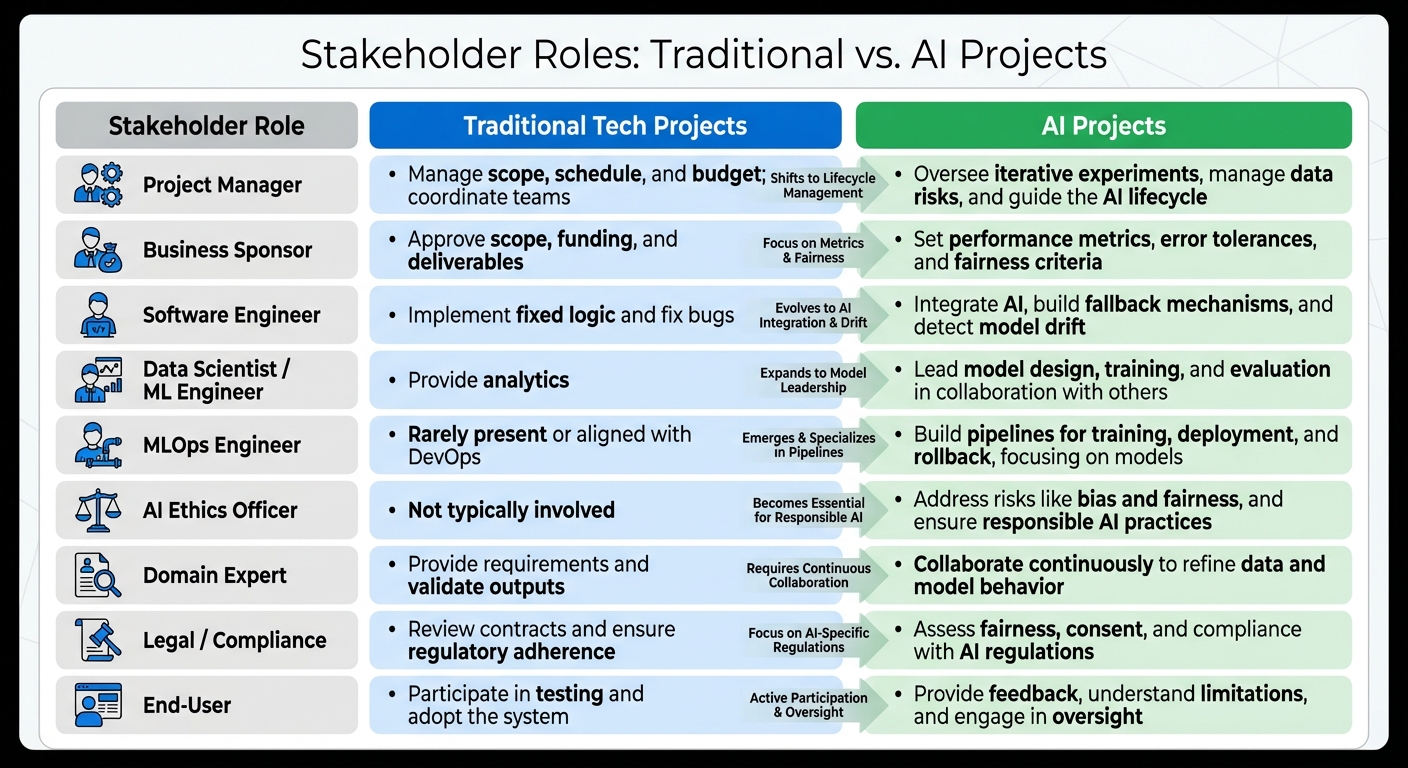
AI vs Traditional Tech Projects: Stakeholder Roles and Responsibilities Comparison
AI initiatives bring a whole new level of complexity compared to traditional tech projects. In the past, project managers orchestrated a relatively predictable process involving developers, business analysts, and QA testers. Business sponsors signed off on funding and scope, engineers wrote straightforward code, and end-users tested the system to ensure it met their needs.
But AI projects? They rewrite the playbook entirely. Instead of moving through linear phases, project managers now juggle iterative experiments, manage risks tied to data and models, and lead cross-functional teams that include data scientists, MLOps engineers, domain experts, legal advisors, and even AI ethics officers. Their job isn’t just about tracking tasks anymore - it’s about navigating the unpredictability of models and ensuring ethical standards are met throughout the model's lifecycle. Business sponsors, too, have an expanded role. They’re not just approving budgets; they’re setting performance benchmarks like precision rates, determining acceptable error margins, and making critical go/no-go calls based on fairness and compliance.
Data scientists and ML engineers are at the heart of AI projects, designing, training, and evaluating models while aligning technical metrics with business goals. MLOps engineers, on the other hand, focus on building and maintaining pipelines for everything from data ingestion to model deployment and rollback. Unlike traditional DevOps, their work emphasizes continuous experimentation and managing multiple model versions. AI ethics officers play a pivotal role by identifying risks related to bias, fairness, and transparency, conducting impact assessments, and ensuring responsible AI use. Meanwhile, domain experts go beyond providing initial requirements - they’re actively involved throughout the process, co-designing data labels, validating outputs, and defining acceptable error rates.
Even software engineers see their responsibilities evolve. Instead of just coding deterministic logic, they now integrate AI services, create fallback mechanisms for when models fail, and incorporate drift detection into their systems. Legal and compliance teams also take on a more dynamic role, moving from periodic reviews to ongoing evaluations of algorithmic fairness, data consent, and explainability. And let’s not forget end-users - they’re no longer just passive testers. In AI workflows, they provide feedback, understand model limitations, and sometimes retain the authority to override automated decisions in human-in-the-loop systems.
Here’s a quick comparison of how responsibilities shift across key roles:
| Stakeholder Role | Traditional Tech Projects | AI Projects |
|---|---|---|
| Project Manager | Manage scope, schedule, and budget; coordinate teams. | Oversee iterative experiments, manage data risks, and guide the AI lifecycle. |
| Business Sponsor | Approve scope, funding, and deliverables. | Set performance metrics, error tolerances, and fairness criteria. |
| Software Engineer | Implement fixed logic and fix bugs. | Integrate AI, build fallback mechanisms, and detect model drift. |
| Data Scientist / ML Engineer | Provide analytics. | Lead model design, training, and evaluation in collaboration with others. |
| MLOps Engineer | Rarely present or aligned with DevOps. | Build pipelines for training, deployment, and rollback, focusing on models. |
| AI Ethics Officer | Not typically involved. | Address risks like bias and fairness, and ensure responsible AI practices. |
| Domain Expert | Provide requirements and validate outputs. | Collaborate continuously to refine data and model behavior. |
| Legal / Compliance | Review contracts and ensure regulatory adherence. | Assess fairness, consent, and compliance with AI regulations. |
| End-User | Participate in testing and adopt the system. | Provide feedback, understand limitations, and engage in oversight. |
For U.S.-based technical leaders, managing these expanded roles means bridging technical AI knowledge with effective communication. Programs like Tech Leaders help professionals develop the skills they need to translate complex AI trade-offs into terms executives and clients can easily grasp. Without clearly defined roles and accountability, AI projects can stumble over issues like poor data quality, unsponsored models, ethical oversights, or unnoticed performance declines. And more often than not, these failures stem from weak stakeholder governance rather than technical missteps. This reshaped stakeholder landscape is also tightly linked to regulatory and ethical considerations, which we’ll explore further in the next section.
Regulatory and Ethical Considerations
When it comes to traditional tech projects, the focus often rests on basic legal and security requirements. However, AI projects bring a whole new set of challenges to the table. Since AI systems frequently automate decisions - like those involving hiring, credit approvals, housing qualifications, or even medical prioritization - they intersect directly with U.S. regulations on civil rights, consumer protection, employment, lending, and healthcare. This dynamic and evolving regulatory landscape demands early and ongoing collaboration with legal and compliance experts.
In the U.S., federal agencies are stepping up their efforts to enforce existing laws on AI systems. For instance, the Federal Trade Commission (FTC) targets unfair or deceptive practices as well as discriminatory outcomes, while the Equal Employment Opportunity Commission (EEOC) focuses on AI's role in hiring, promotions, and layoffs. Other agencies, like the Consumer Financial Protection Bureau (CFPB), the Department of Housing and Urban Development (HUD), and the Food and Drug Administration (FDA), are similarly involved in holding companies accountable for the outcomes of their automated systems - even when those outcomes stem from algorithms.
This increased regulatory scrutiny has changed how organizations approach AI projects. Legal, compliance, and risk teams are now integrated into the entire AI development lifecycle. Their responsibilities include ensuring lawful data usage, identifying and mitigating proxy discrimination, and maintaining human oversight in critical decisions. To manage these complexities, many companies have established AI governance frameworks. These frameworks typically include formal policies, risk management procedures, and review checkpoints. Some organizations have also formed ethics boards or responsible AI councils, which bring together data scientists, product managers, legal experts, and external advisors. These groups review high-risk applications - like credit scoring, fraud detection, or clinical decision-making tools - before they are deployed, much like how medical review boards operate.
Two of the most pressing issues in AI today are algorithmic bias and explainability. Even when AI outputs are technically accurate, they can perpetuate historical biases if those biases are embedded in the training data. Tackling this requires a collaborative effort among data scientists, domain experts, and compliance teams. Together, they conduct fairness tests, establish meaningful metrics, document trade-offs between accuracy and fairness, and monitor for bias over time. Meanwhile, as expectations for transparency grow - from regulators, customers, courts, and internal risk teams alike - product teams must simplify complex technical details into clear, user-friendly explanations. Compliance teams also play a key role in setting standards for these explanations to ensure accountability.
For technical leaders in the U.S. managing AI initiatives, balancing technical expertise with a strong understanding of regulatory and ethical considerations has become essential. Programs like those offered by Tech Leaders can help engineering managers and independent consultants develop the skills needed to create effective governance structures and engage stakeholders. Without embedding ethics reviews, bias testing, impact assessments, and ongoing monitoring into everyday workflows, AI projects face serious risks, including regulatory fines, lawsuits, and damage to reputation. Strong governance practices not only mitigate these risks but also set the foundation for long-term project success and accountability.
sbb-itb-8feac72
Collaboration and Decision-Making Processes
AI projects demand ongoing, flexible decision-making rather than sticking to rigid milestone approvals. Factors like model performance, data quality, and ethical risks must be reassessed regularly, which often leads to shifting project scopes and success criteria based on experimental outcomes[3][6]. This dynamic approach redistributes decision-making authority across a broader group of technical and ethical experts.
Unlike traditional tech projects - where project managers, business owners, and senior IT leaders typically hold most of the decision-making power - AI initiatives rely on a more diverse set of stakeholders. These include data scientists, machine learning engineers, domain experts, risk and compliance officers, and AI ethicists[3][6]. Any of these contributors can pause deployment if issues like bias, compliance failures, or underperformance arise. To manage these evolving dynamics, structured governance frameworks are essential, ensuring that technical, ethical, and regulatory considerations are balanced effectively.
Cross-functional AI governance committees play a key role in responsible decision-making. These committees consist of product owners, data scientists, legal experts, compliance officers, risk managers, and security professionals. Together, they review use cases, approve models, and set acceptable risk thresholds[4][6]. For instance, a manufacturing company used AI tools to analyze 315 stakeholder questionnaires, leading to measurable improvements in stakeholder engagement and decision efficiency. These tools helped map out critical factors like top management support and teamwork[4]. Such governance structures often work alongside traditional project management offices (PMOs), adding oversight layers for tasks like data source validation, algorithm selection, model interpretability, and bias assessments. This integrated approach aligns AI projects with broader accountability and risk management strategies.
| Dimension | Traditional Tech Projects | AI Projects |
|---|---|---|
| Decision cadence | Periodic, milestone-based (e.g., requirements, design, UAT, go-live)[3][6] | Continuously updated based on evolving data and performance[3][6] |
| Key decision-makers | Project manager, business owner, architects, senior IT leadership[3] | Product owner, data scientists/ML engineers, domain experts, AI ethicists, risk/compliance[3][6] |
| Governance bodies | PMO, change control boards | Cross-functional AI governance committees plus PMO; formal risk/ethics reviews[4][6] |
| Stakeholder engagement | Strong at the start and major approvals, less in between[3] | Continuous involvement with validation and monitoring feedback loops[3][6] |
| External influence | Customers, vendors, some regulators | AI-focused regulators, affected communities, NGOs, industry bodies |
For technical leaders navigating these complex collaboration structures, it’s crucial to develop skills that blend technical expertise with AI business strategy and effective stakeholder communication. Programs like Tech Leaders are designed to help engineering managers and consultants build the leadership skills needed to create robust governance frameworks and manage diverse stakeholder groups in AI projects. Strong collaboration and iterative decision-making are the cornerstones of successful AI initiatives.
Pros and Cons
Building on the earlier discussion about stakeholder roles and ethical governance, it's time to weigh the upsides and downsides of the broader stakeholder involvement in AI projects. Expanding the range of participants - such as data scientists, domain experts, ethicists, legal teams, and end-user representatives - brings both benefits and challenges.
On the plus side, this diverse group enriches the way problems are approached. By addressing issues like bias, discrimination, and privacy concerns early on, teams can improve the overall reliability and trustworthiness of AI models[1][2]. Another advantage is experiment-based alignment, where teams use methods like A/B testing or pilot projects to make informed decisions about trade-offs, such as balancing accuracy with explainability, rather than relying on abstract debates[2].
However, this broader involvement also has its drawbacks. Coordination overhead and slower decision-making are common challenges. Managing input from executives, data scientists, legal teams, HR, and external auditors often means more meetings and formal reviews. This can delay design, deployment, and iteration timelines[1][2]. Additionally, business leaders may prioritize aggressive revenue goals, which can clash with the stricter guidelines advocated by legal and ethics teams, leading to tension and shifting project scopes[1]. Interestingly, a PMI-related study found that AI-powered project management improved time-estimate accuracy by roughly 25% compared to traditional methods[7].
Below is a table summarizing the trade-offs between AI and traditional technology projects:
| Aspect | AI Projects – Pros | AI Projects – Cons | Traditional Tech Projects – Pros | Traditional Tech Projects – Cons |
|---|---|---|---|---|
| Stakeholder breadth | Diverse experts (data, domain, ethics, legal) enhance relevance and risk coverage[3][5][6] | More voices make alignment complex and slow decision-making[3][5][6] | Familiar IT/business stakeholders simplify coordination[5][6] | Narrower input may overlook ethical, data, and user-impact concerns[3][5][6] |
| Engagement style | Continuous feedback loops improve performance and fit[3][4][5] | Higher communication demands risk stakeholder fatigue[3][5][6] | Milestone-based engagement is easier to plan and manage[5][6] | Limited feedback risks locking in early assumptions[5][6] |
| Uncertainty & expectations | Iterative experimentation drives innovation and learning[5][6] | Managing shifting expectations can frustrate stakeholders[5][6] | Clearer requirements simplify expectation-setting[5][6] | Less adaptable to mid-project changes in business needs[5][6] |
| Ethics, regulation, and trust | Dedicated ethics and compliance roles can build trust over time[3][5][6] | Oversight slows timelines; missteps can harm reputations[3][5][6] | Fewer regulatory and ethical constraints for many systems[5][6] | Ethical oversights can become problematic when systems interact with sensitive data or AI later on[3][5][6] |
For technical leaders stepping into more stakeholder-facing roles, balancing technical execution with business strategy and communication is critical. Programs like Tech Leaders are designed to help engineering managers develop the leadership skills needed to navigate these complexities. By bridging technical expertise with organizational, ethical, and regulatory considerations, leaders can better manage the diverse group of participants in AI projects. This sets the stage for exploring strategies to enhance stakeholder engagement in future initiatives.
Conclusion
AI projects require a distinct approach to stakeholder management compared to traditional tech initiatives. The AI landscape is complex, blending technical and societal elements, and involves a wide array of participants - data scientists, domain experts, ethicists, legal professionals, and even the communities impacted by AI decisions. Engaging with these groups isn’t a one-time task; it’s an ongoing process. Since AI models evolve with data, potentially introducing bias or creating unclear decision-making pathways, organizations must prioritize stakeholder strategy as a key component of success, alongside data quality and model performance. This highlights the importance of sustained governance throughout the AI lifecycle.
The foundation of effective engagement lies in structured governance and clear accountability. It starts with mapping out all relevant stakeholders and setting up formal feedback loops for every stage of the project, from sourcing data to post-launch monitoring. Transparent documentation of processes is equally critical, as it helps clarify how the AI operates and where its limitations lie. Establishing these structured feedback systems ensures ongoing alignment and identifies key factors that drive success throughout the lifecycle of an AI initiative.
Beyond governance, strong AI leadership is essential. Leaders must combine technical knowledge, business insight, and effective communication to translate AI capabilities into actionable outcomes. They must balance priorities across teams and manage diverse expectations. Programs like Tech Leaders are designed to develop these skills, helping leaders bridge the gap between technical execution and stakeholder-focused leadership.
FAQs
Who are the key stakeholders in AI projects, and what are their responsibilities?
AI projects bring together a diverse group of stakeholders, reflecting the technical challenges and strategic goals inherent in these initiatives. Here's a closer look at the key players:
- Data Scientists and Engineers: They handle the nuts and bolts of AI development, from creating and testing models to deploying systems that function reliably in real-world settings.
- AI Product Managers: Their role is to bridge the gap between technology and business. They ensure AI solutions align with organizational objectives, meet deadlines, and deliver value.
- Ethics and Compliance Teams: These teams focus on keeping AI systems within ethical boundaries and legal frameworks, such as data privacy regulations.
- Executives and Business Leaders: They set the overall direction for AI adoption, deciding on priorities and allocating the resources necessary to achieve project goals.
Unlike traditional tech projects, AI initiatives require specialized knowledge in fields like machine learning, data governance, and ethical considerations. Success hinges on seamless collaboration between technical experts and business-focused teams to deliver solutions that are not only effective but also responsible.
What role do regulatory and ethical considerations play in managing AI projects?
Managing AI projects isn't just about technology - it's about ensuring they meet legal standards and reflect societal values. Regulatory and ethical factors are essential to guide the development and deployment of AI systems responsibly.
Project managers need to focus on adhering to laws, such as data privacy regulations, while addressing broader ethical challenges like fairness, transparency, and bias. This requires careful planning, consistent audits, and working closely with legal and ethical experts. These steps help reduce risks and build confidence in AI-driven solutions.
What challenges arise when involving diverse stakeholders in AI projects?
In AI projects, bringing together stakeholders with diverse backgrounds can be tricky. Each group often comes with its own priorities and expectations. For instance, business leaders might concentrate on return on investment (ROI) and strategic goals, while data scientists could be more focused on model accuracy or ethical concerns. Finding common ground between these viewpoints demands clear communication and teamwork.
Another challenge arises when stakeholders without technical expertise find it hard to understand the complexities of AI systems. This knowledge gap can result in mismatched goals or unrealistic expectations. To address this, it's crucial to educate these stakeholders about what AI can and cannot do, helping to build a shared understanding of the project's objectives.