

How Leaders Can Overcome Biases in Change Management
Cognitive biases can derail decision-making during organizational change. These mental shortcuts, like confirmation bias or status quo bias, often lead to flawed strategies and resistance to change. Leaders can't eliminate bias entirely, but they can reduce its impact by implementing structured processes and fostering diverse perspectives.
Key takeaways:
- Common biases: Confirmation bias, status quo bias, loss aversion, and the bandwagon effect.
- Solutions: Use tools like pre-mortem analysis, assign devil's advocates, and adopt structured decision-making processes.
- Team strategies: Encourage open dialogue, balance participation, and create systems to challenge groupthink.
- Measure success: Track outcomes through decision logs, bias audits, and regular reviews.
Cognitive Biases in Decision Making
sbb-itb-8feac72
Common Biases That Affect Change Management
There are over 150 cognitive biases, but only a handful tend to derail organizational change efforts [5]. Recognizing these biases can help you address them before they disrupt your initiatives. Let’s explore the most common ones that undermine change management.
Confirmation Bias: Favoring Information That Aligns With Existing Beliefs
Confirmation bias leads people to focus on information that supports their current beliefs [1][5]. In the context of change management, this often results in employees selectively using data that reinforces the status quo [1].
This bias isn't just about resisting change - it can skew how information is interpreted. Dr. Kia-Rai Prewitt, a psychologist at Cleveland Clinic, explains:
If we have a cognitive bias, we may interpret information based off of our own beliefs and experiences... the ways that we interpret that information may or may not be accurate [5].
A striking example of this is "deal lust" during mergers and acquisitions, where leaders become so attached to a proposed outcome that they overlook clear risks [2]. To combat confirmation bias, it's crucial to communicate the reasoning behind changes transparently and use tools like objective checklists to ensure all perspectives are considered - not just the convenient ones [1]. Identifying this bias allows you to refine your communication and decision-making processes for better outcomes.
Status Quo Bias: Clinging to the Familiar
Status quo bias leads people to prefer the current state of affairs, even when existing systems are flawed or inefficient [6]. Professor RJ Starr puts it succinctly:
Status quo bias doesn't just keep us stuck - it convinces us that stuck is smart [6].
This bias often stems from inertia. Teams stick with outdated tools, rigid policies, or inefficient workflows simply because changing them feels overwhelming [6]. It's also reinforced by loss aversion (focusing on potential losses more than gains), system justification (defending flawed systems because they’re familiar), and ambiguity aversion (choosing dysfunction over uncertainty) [6][1].
At an organizational level, this bias stifles innovation and perpetuates inefficiency by framing improvements as risks rather than opportunities [6]. To counter it, leaders should clearly outline what will remain unchanged alongside what will shift, helping to ease fears and reduce resistance [1]. By addressing this bias, you can help teams see change as a chance for growth rather than a threat.
Loss Aversion: Focusing Too Much on Potential Losses
Loss aversion causes people to dwell on what they might lose rather than what they could gain [1]. Research by Kahneman and Tversky shows that the pain of loss feels more intense than the pleasure of an equivalent gain [6].
In change management, this bias often appears as fear - fear of losing autonomy, status, or familiar routines. In extreme cases, it can even lead to subconscious sabotage, where employees undermine initiatives to protect the status quo [3]. The solution isn’t about downplaying losses; it’s about highlighting the costs of staying the same. This includes lost time, morale, money, and opportunities [6]. When teams understand the real price of inaction, they’re more likely to embrace change. Recognizing loss aversion helps leaders shift the focus to the tangible benefits of moving forward.
How Leaders Can Manage Their Own Biases
Addressing personal bias is a key part of tackling challenges in change management. The goal isn't to eliminate bias entirely - that’s not realistic. As John Burkhardt, CEO of Capita Solutions, explains, our brain’s shortcuts can be both helpful and harmful when it comes to survival [2]. Instead of resisting these natural tendencies, leaders can design systems to counteract bias [2] and recognize that biases are flexible and can evolve over time [3].
Self-Reflection and Feedback Loops
The journey to self-awareness begins with identifying how change might threaten your personal needs. The SCARF framework is a useful tool for this. It encourages leaders to ask themselves if a change impacts their Status (how they rank compared to others), Certainty (ability to predict outcomes), Autonomy (sense of control), Relatedness (connections with others), or Fairness (perception of equity) [3]. By pinpointing specific threats, leaders can distinguish emotional reactions from actual risks.
To challenge bias, actively look for evidence that contradicts your assumptions, rather than letting biased information passively shape your decisions [3]. For example, if you find yourself gravitating toward familiar strategies, pause and ask, “Why not explore a different approach?” [7]. When assessing a struggling project, ignore sunk costs and focus solely on its future potential [7].
This process of reflection must be paired with a belief in your ability to overcome bias (self-efficacy) [3]. Without confidence in your capacity to change, simply being aware of biases won’t lead to meaningful behavior shifts.
Structured techniques can also play a big role in managing bias.
Using Pre-Mortem Analysis
A pre-mortem analysis flips the script on traditional risk assessment. Instead of asking, “What might go wrong?”, assume the project has already failed and work backward to uncover the reasons why [8]. Originally developed by psychologist Gary Klein in 2007, this approach has been championed by Daniel Kahneman as one of the most effective tools for reducing bias. Research even shows it improves failure prediction accuracy by 30% compared to standard planning methods [8].
This technique taps into the brain’s strength in explaining facts rather than guessing abstract outcomes. As Rich Lauria, Associate Director and Lecturer at Columbia University, puts it:
You can't eliminate bias - you can only design processes that help counteract it [2].
The pre-mortem encourages creative thinking by legitimizing dissent and fostering a deliberately pessimistic mindset [8]. Allocate 10 minutes to imagining failure and list every possible cause without filtering. Interestingly, the most valuable insights often emerge in those last few moments when optimism bias starts to fade.
Building Bias Awareness in Teams
Addressing your own biases is a great start, but tackling bias effectively often requires a team effort. Collective blind spots can quietly undermine even the most carefully planned initiatives. Biases like groupthink - where people align with the majority without exploring alternatives - or confirmation bias, which dismisses conflicting evidence, can creep into team dynamics and decision-making [1]. While managing individual biases is important, structured strategies are equally necessary to uncover and address biases at the team level.
Interestingly, research shows you don’t have to completely overhaul how people think. A review of 100 studies found that 62% of bias mitigation efforts focused on changing the decision-making environment rather than trying to change minds. Two main strategies emerge: Debiasing, which involves training teams to recognize bias, and Choice Architecture, which redesigns decision processes to make unbiased choices the default. The latter is particularly effective since it operates behind the scenes [9].
Encouraging Different Perspectives
One of the most effective ways to combat bias is to ensure all voices are heard, especially the quieter ones. In meetings, allocate equal speaking time to encourage balanced participation [10]. If someone shares an idea that feels incomplete or unexpected, ask them to elaborate with a simple “Tell me more.” This can help uncover hidden assumptions [11].
Another strategy is perspective-taking. Ask team members to consider the viewpoints of others - whether it’s a junior employee, a customer, or another department. Leaders can set the tone by adopting a “strong opinions, weakly held” mindset. Clearly state your position, then invite feedback with a question like, “What am I missing?” This approach signals that disagreement is not only welcome but encouraged [12].
For larger groups, breaking into smaller teams or pairs for brainstorming can help reduce the pressure of groupthink. This also gives introverted team members more space to contribute their ideas [10]. Pay attention to patterns of interruption during discussions. If certain voices are consistently overlooked, address this to create a more inclusive environment [12]. These steps make it easier to challenge consensus bias without fear of judgment.
Assigning Devil’s Advocates
A straightforward way to counter groupthink is by formalizing dissent. Assign team members as devil’s advocates to challenge assumptions and offer alternative perspectives [10]. This is especially useful for high-stakes decisions, like mergers or major technology investments, where overconfidence can cloud judgment. Rotating this role among team members reduces the stigma of being seen as “negative” or “difficult” [2].
Structured Decision-Making Processes
Even with diverse input and devil’s advocates, biases can sneak in through how decisions are framed and evaluated. Structured decision-making processes can help prevent this. For example, use joint evaluation - where multiple options are reviewed side by side - and separate idea generation from evaluation to minimize intuitive biases [9].
Here’s one effective method:
- Start with anonymous documentation of proposals.
- Present ideas anonymously to the group.
- Allow for clarification questions without judgment.
- Score options based on pre-defined weighted criteria.
- Finally, reveal the authors and make the final decision [12].
Another technique is dialectical bootstrapping, where team members independently generate multiple estimates or viewpoints, which are then averaged to improve accuracy [9].
These structured approaches act like “speed bumps,” encouraging teams to shift from instinctive reactions to deliberate, rational thinking [1][9]. As Connie Stemmie explains:
People tend to use cognitive biases when time is a factor in making a decision, or they have a limited capacity for processing information [1].
By building in intentional pauses and clear evaluation criteria, teams can avoid the mental shortcuts that often lead to flawed decisions.
To further reduce bias, maintain a public decision log that tracks decisions, alternatives considered, evaluation criteria, and key factors [12]. This creates a record for continuous learning and helps identify recurring patterns of bias. Additionally, quarterly bias audits can be a valuable tool. Review who gets assigned high-profile projects, who dominates meeting discussions, and whose ideas are most often implemented. Look for demographic trends that might indicate systemic bias [12].
Comparing Bias Mitigation Techniques
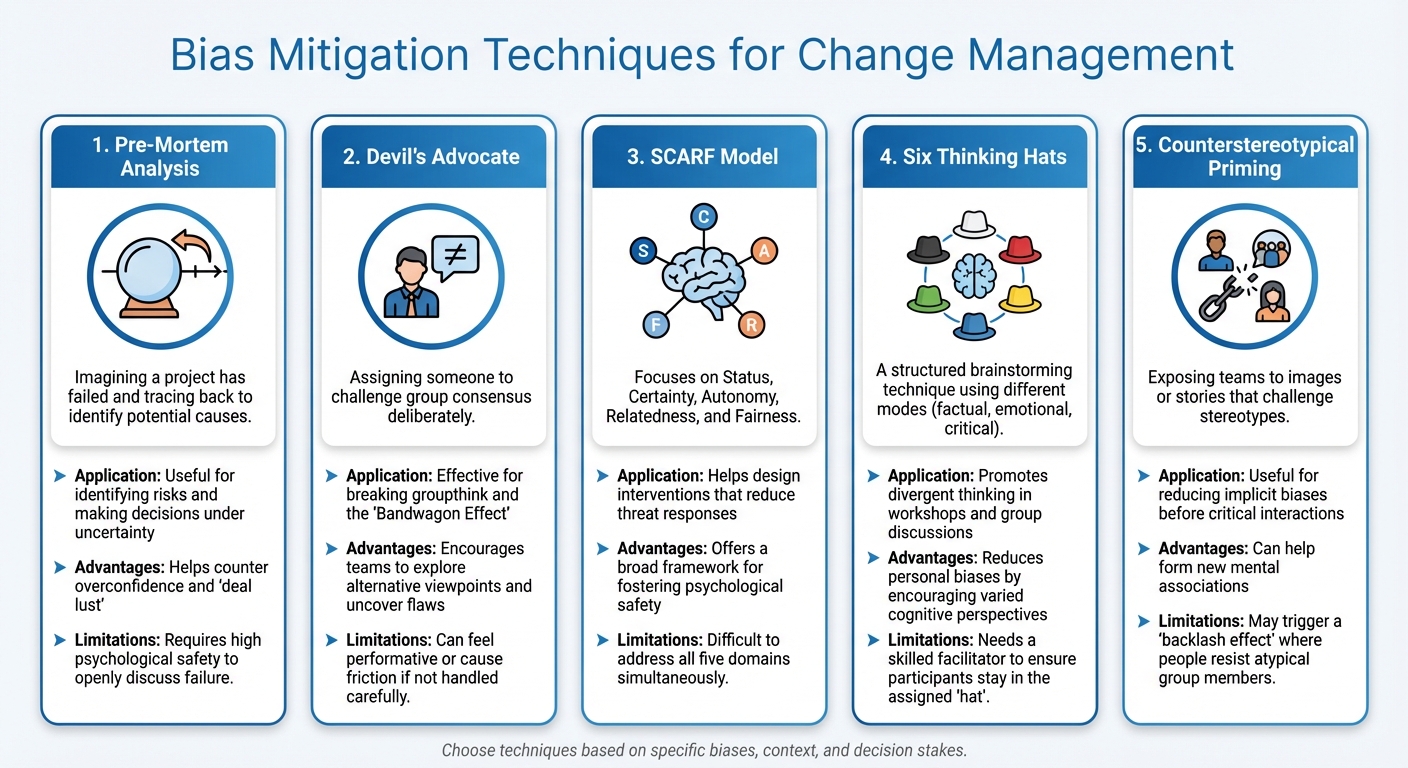
Comparison of 5 Bias Mitigation Techniques for Change Management
Building on the earlier discussion about bias awareness and management, this section dives into comparing various mitigation techniques to help navigate change management effectively. With so many strategies available, it’s crucial to choose methods that align with your team's specific biases, situational context, and the stakes of the decisions being made [15][1].
Diagnosing the bias is the first step. For instance, if your team struggles with confirmation bias - where they only seek out evidence supporting preexisting beliefs - you’ll need strategies that introduce opposing viewpoints and encourage diverse perspectives. On the other hand, if groupthink is the issue, where individuals conform to the majority to avoid conflict, assigning a devil’s advocate can be more effective.
Context is equally important. For decisions with significant consequences, pre-mortem analysis stands out as an effective tool. It forces teams to confront potential failure scenarios, which helps counter overconfidence [2]. Meanwhile, for tightly-knit teams prone to groupthink, methods like assigning devil’s advocates or using the Six Thinking Hats approach can disrupt the tendency to align too quickly by encouraging varied cognitive perspectives [14].
Timing matters too. Our brains naturally rely on shortcuts and heuristics, especially when we’re tired [2]. Bias mitigation techniques are less effective when fatigue sets in, so it’s best to schedule these sessions early in the week. Keeping meetings short can also prevent a slide into instinctive, rushed judgments [3]. With this foundation, let’s examine how each technique addresses specific biases in change management.
Comparison Table: Bias Mitigation Techniques
Here’s a comparison table summarizing the application, benefits, and challenges of various bias mitigation techniques:
| Technique | Description | Application in Change Management | Advantages | Limitations |
|---|---|---|---|---|
| Pre-Mortem Analysis | Imagining a project has failed and tracing back to identify potential causes [2]. | Useful for identifying risks and making decisions under uncertainty. | Helps counter overconfidence and "deal lust" [2]. | Requires a high level of psychological safety to openly discuss failure. |
| Devil's Advocate | Assigning someone to challenge group consensus deliberately [2]. | Effective for breaking groupthink and the "Bandwagon Effect" [1]. | Encourages teams to explore alternative viewpoints and uncover flaws [2]. | Can feel performative or cause friction if not handled carefully. |
| SCARF Model | Focuses on Status, Certainty, Autonomy, Relatedness, and Fairness [3]. | Helps design interventions that reduce threat responses. | Offers a broad framework for fostering psychological safety [3]. | Difficult to address all five domains simultaneously. |
| Six Thinking Hats | A structured brainstorming technique that uses different "modes" (e.g., factual, emotional, critical) [14]. | Promotes divergent thinking in workshops and group discussions. | Reduces personal biases by encouraging varied cognitive perspectives [14]. | Needs a skilled facilitator to ensure participants stay in the assigned "hat." |
| Counterstereotypical Priming | Exposing teams to images or stories that challenge stereotypes [3]. | Useful for reducing implicit biases before critical interactions. | Can help form new mental associations [3]. | May trigger a "backlash effect" where people resist or undermine atypical group members [3]. |
This comparison highlights how different techniques can be tailored to address specific challenges in decision-making and team dynamics. By understanding the strengths and constraints of each method, teams can better navigate the complexities of bias in change management.
Measuring Success and Continuous Improvement
After putting bias mitigation strategies into action, the next step is to evaluate their effectiveness and refine them for ongoing improvement. This process ensures that efforts to reduce bias are more than just well-meaning intentions - they translate into measurable progress. Here’s how to track outcomes and foster continuous improvement.
Tracking Decision Outcomes
Start by keeping detailed records of decision-making processes and results. For every major decision, document the alternatives considered, the evaluation criteria applied, the people consulted, and the key factors that influenced the final choice [12]. These records can reveal patterns, such as consistently favoring or overlooking certain ideas, which may point to underlying biases.
In addition to decision logs, conduct regular bias audits - quarterly reviews of organizational outcomes like promotions, raises, and assignments to high-profile projects. Look for demographic trends that might signal systemic bias [12]. Metrics like meeting participation rates and how assignments are distributed can also provide valuable insights [12]. According to Deloitte, 68% of employees reported that bias negatively impacted their productivity, while 84% said it harmed their happiness, confidence, and well-being [13]. These figures emphasize the importance of tracking and addressing bias.
"The goal isn't perfection - it's building systems that make bias visible and correctible." - Arthur C. Codex, Reintech [12]
Another useful metric is time-to-value for projects, which helps counteract the tendency to overestimate long-term benefits [4]. Keep in mind that real change takes time - typically 21 to 90 days of consistent effort to form new habits and challenge ingrained cognitive shortcuts [4]. These findings can guide future training initiatives and process updates.
Continuous Learning for Tech Leaders
Measuring outcomes is just the beginning. For change to stick, continuous learning is essential. Research indicates that 97% of implicit bias studies rely on single-session experiments, which are insufficient for lasting impact [3]. Instead, adopt a daily routine that focuses on eliminating mental shortcuts and fostering accountability [4]. As Dan French, CEO of Consider Solutions, explains:
"Self-discipline bridges the gap between goal and accomplishment, anchoring daily efforts to overcome cognitive shortcuts." [4]
Programs like those offered by Tech Leaders are designed to help engineering leaders develop a blend of technical expertise and non-technical skills, such as leadership and AI business strategy. These programs equip leaders with the self-awareness and strategic mindset needed to identify and address biases as they arise. By doing so, they shift from reactive management to proactive leadership, creating environments where biases are less likely to take root [3].
Conclusion
Cognitive biases, which once helped our ancestors survive, now often skew decision-making in today’s world. While it’s impossible to fully eliminate these biases, leaders can create systems and processes to minimize their negative effects. As Rich Lauria from Columbia University explains:
You can't eliminate bias - you can only design processes that help counteract it [2].
Leaders need to shift their focus from trying to eradicate biases to reducing their influence. Awareness alone isn’t enough to change behavior. A systematic review of 494 studies found little evidence that reducing implicit biases directly leads to behavioral changes [3]. Instead, effective leaders rely on structured tools and ongoing feedback to monitor and improve decision outcomes.
Making progress requires commitment and consistency. Research suggests that forming new habits to counteract cognitive shortcuts takes anywhere from 21 to 90 days of sustained effort [4]. Dan French, CEO of Consider Solutions, emphasizes this point:
There are no quick fixes or easy hacks, but this measured approach yields superior decisions, success, and teamwork [4].
To apply these principles, leaders can strengthen both technical and interpersonal skills - such as leadership development and AI business strategy - through programs like Tech Leaders. The aim isn’t perfection but creating an environment where biases are identified and addressed. This empowers teams to make better decisions and adapt to change more effectively. By committing to this disciplined approach, leaders can complete the cycle of recognizing, addressing, and learning from bias, which is essential for driving meaningful change.
FAQs
How do I spot my own bias during a change effort?
Recognizing biases during a change effort begins with acknowledging that they often operate beneath the surface, shaping decisions in ways you might not even notice. To counter this, take time to regularly examine and question your assumptions, particularly those tied to the change process. Be aware of common tendencies, such as overconfidence or an instinctive resistance to new ideas. Practicing self-reflection and actively seeking feedback from others can shine a light on these hidden influences, helping you make more balanced and informed decisions.
When should I run a pre-mortem vs. use a devil’s advocate?
Running a pre-mortem is a proactive way to spot potential pitfalls before putting a plan into action. By envisioning worst-case scenarios, teams can identify weak points and address them early, reducing the risk of failure.
On the other hand, employing a devil’s advocate during decision-making pushes the team to question assumptions and think critically. This approach ensures that ideas are thoroughly evaluated from all angles.
While both methods aim to reduce bias, they serve different purposes: the pre-mortem is best during the planning phase, while the devil's advocate is more suited for assessing ideas. Together, they create a more thoughtful and resilient decision-making process.
What metrics show our decisions are becoming less biased?
Metrics such as using premortems, appointing devil's advocates, and conducting scenario analysis are great tools for spotting and reducing bias. These methods work by uncovering cognitive biases that might creep into decision-making, ensuring decisions are more balanced and objective.