
Networking ROI: How to Measure Success
Networking can often feel ambiguous, but measuring its ROI (Return on Investment) turns it into a clear, results-driven activity. Here’s the key takeaway: Networking ROI is the measurable return on the time and money you spend building professional relationships. It’s calculated using a simple formula:
ROI (%) = [(Value Generated − Cost of Investment) ÷ Cost of Investment] × 100
To make networking effective, you need clear goals, measurable metrics, and a system to track both financial and non-financial outcomes. For example:
- Costs: Event tickets, travel, time spent, and tools like CRMs.
- Returns: New clients, referrals, career opportunities, or saved time.
By tracking these, you can identify which activities drive results (e.g., conferences, LinkedIn outreach) and cut those that don’t. Over time, this data helps you refine your strategy and focus on high-impact efforts.
The bottom line? Networking is a business investment. Treat it like one by measuring costs, tracking results, and ensuring each effort aligns with your professional goals.
How to Calculate Conference ROI: A Framework for Measuring Event Success
sbb-itb-8feac72
Setting Clear Networking Goals and Metrics
When it comes to networking, having well-defined goals is crucial for ensuring your efforts lead to meaningful results. By setting clear objectives, you can focus on connecting with the right people and achieving measurable outcomes.
Define Your Networking Objectives
Break your networking goals into three main categories:
- Tangible goals: These are directly tied to measurable outcomes, like generating leads, securing referrals, or forming partnerships that contribute to your bottom line.
- Intangible goals: These focus on gaining knowledge, such as industry insights or strategic advice that can help you avoid costly mistakes.
- Long-term goals: These involve building your reputation, increasing visibility, and developing social capital over time [4].
Clear objectives replace vague aspirations. For instance, instead of saying, "I want to meet more people", aim for something specific like, "Schedule three follow-up meetings with fintech decision-makers this quarter."
Choose the Right Success Metrics
Every goal should have a measurable indicator to track progress. Focus on both leading indicators (actions you control now) and lagging indicators (results of those actions) [2].
- Leading indicators: Examples include the number of meetings booked, LinkedIn connections made, or referrals given.
- Lagging indicators: These measure outcomes, such as referrals received, deals closed, or revenue generated.
| Metric Type | Example | Benchmark |
|---|---|---|
| Quantitative (Activity) | New connections per month | 100/month [3] |
| Quantitative (Outcome) | Conversion rate (contacts → leads) | 10%–15% [3] |
| Quantitative (Outcome) | Cost per lead | Under $50 [3] |
| Qualitative | Net Promoter Score (NPS) | Above 50 [3] |
To prioritize follow-ups, consider rating each new relationship on a 1–10 scale in your CRM.
Set Short-Term and Long-Term Networking Goals
Networking success often takes time, so it’s important to set goals based on different time horizons. What you track in the first few months will differ significantly from what you monitor over a year or more.
| Goal Horizon | Focus | Key Metrics |
|---|---|---|
| Short-term (0–3 months) | Activity & visibility | New connections, meetings booked, LinkedIn engagement |
| Medium-term (6–12 months) | Trust & referrals | Inbound introductions, referral revenue, partnership discussions |
| Long-term (1–2+ years) | Career and revenue growth | Closed deals, salary increases, lifetime relationship value |
Keep in mind that most relationships take 3–6 months to start producing referrals. Reviewing your progress quarterly often provides a clearer picture of your ROI than frequent, short-term assessments [2][1].
"The ROI on networking is measured in years, not weeks." – Full Stack Living [8]
Short-term goals help you stay consistent with your daily and weekly efforts, while long-term goals ensure those efforts align with your larger career ambitions.
Calculating the Cost of Your Networking Efforts
To measure the ROI of networking, you first need a clear understanding of its total cost. Many people overlook key expenses, focusing only on the obvious ones, which can lead to an incomplete picture.
Track Direct Financial Costs
Start with the direct financial costs - these are the out-of-pocket expenses tied to networking. For example:
- Conference registrations: These can range from $200 to over $1,000.
- Membership fees: Joining local business networks typically costs around $500 annually.
- Travel expenses: Flights, hotels, parking, and rideshares can add up to $300–$800 per trip.
- Miscellaneous costs: Meals, drinks, and business cards might tack on another $100–$200 per event[3][6].
Don’t forget the tools you use to manage and support your networking efforts. A CRM like Salesforce costs about $25 per user/month, while Pipedrive is around $14/month. Scheduling tools like Calendly start at $8/month, and accounting software such as QuickBooks or Expensify can help you keep these expenses organized. If you plan to deduct these costs on your taxes, ensure your records meet IRS Publication 463 guidelines[3].
Once you’ve tallied these direct expenses, it’s time to factor in the value of your time.
Put a Dollar Value on Your Time
Networking isn’t just about money - it’s also about time, which is a valuable resource. To calculate this, use the formula:
Total Cost = Direct Costs + (Time Invested × Hourly Rate)[3].
Your hourly rate should reflect your current salary or consulting fee, which often falls between $50 and $200 per hour[3]. For a more forward-looking approach, you might base this rate on your target earnings, ensuring your networking aligns with your career goals[7].
Time spent on networking goes beyond the event itself. For instance, a one-hour coffee meeting might actually take 1.5 hours when you include preparation and follow-up. Similarly, attending an industry conference could consume 8 to 16 hours. At $100 per hour, that’s $800 to $1,600 in time costs alone, even before adding registration fees.
"If you are spending three hours to make zero sales, you are paying for a hobby, not a business strategy." - Long Island Business Network[5]
Lastly, you’ll need to evaluate the opportunity costs of networking.
Account for Opportunity Costs
Opportunity costs represent the income you forgo while networking[3][5]. Even a "free" event has a hidden price if it takes time away from billable work. For example, attending an evening mixer might mean giving up two billable hours at $150 per hour, costing you $300 in lost income, not including other expenses like parking or gas.
As Long Island Business Network points out:
"Many entrepreneurs realize that free networking event options are actually expensive when you consider the lost opportunity cost."[5]
Before committing to any networking event, calculate the total cost by adding direct expenses, time costs, and lost income. If a specific event consistently results in a negative return, it might be time to cut it from your schedule[7]. Understanding these costs is essential for accurately calculating your networking ROI later.
Measuring the Returns From Networking
Once you've calculated your networking costs, the next step is to figure out what you're gaining from those efforts. Networking brings returns in two main forms: financial and non-financial - and both are equally important.
Identify Financial Returns
To measure financial returns, track both direct and indirect benefits. This includes revenue from referrals, discounted vendor fees, or waived integration costs. Because financial gains are not always straightforward, attribution models can help clarify where credit is due:
- First-touch attribution gives credit to the initial networking event that introduced the lead.
- Last-touch attribution assigns credit to the final interaction that closed the deal.
- Linear/weighted attribution splits credit across multiple interactions, such as giving 40% to the original networking event and distributing the rest among follow-up actions.
Pursue Networking estimates that the average professional relationship generates about $12,000 in lifetime value through referrals and direct opportunities [1]. To estimate the value of pending deals, you can use expected value modeling - multiply the probability of closing a deal by your average deal value and gross margin. This provides a realistic pipeline estimate even before any revenue comes in [7].
But financial returns are only part of the story. Let’s dive into the less tangible, yet equally valuable, benefits.
Measure Non-Financial Benefits
Not all networking returns show up as dollar signs. Speaking invitations, introductions to key decision-makers, and increased visibility in your industry are just a few examples of the non-financial gains that can come from networking. These outcomes, while harder to quantify, play a critical role in career growth and professional reputation.
One method to track these benefits is relationship strength scoring. Rate your key connections on a scale of 1 to 10 based on trust and rapport, and review these scores quarterly. You can also calculate a Net Promoter Score (NPS) for your network by running short post-meeting surveys. An NPS above 50 suggests strong referral potential, while scores over 70 indicate deep loyalty [3].
For non-financial gains that can be quantified, consider assigning a dollar value to saved time. For instance, if a contact's advice saves you five hours of research and your hourly rate is $150, that's $750 in saved time - a real benefit, even if it doesn't show up in your CRM [1][9].
"Relationship ROI is absolutely measurable. You just need the right framework - and the right tools to track it." - Kolin Simon, Founder & CEO, Pursue Networking [1]
Tools for Tracking Networking Returns
Once you've quantified both financial and non-financial returns, the next step is to track them efficiently. The tools you choose will depend on the scale of your networking efforts and how detailed you want to get.
| Tool | Monthly Cost | Best For |
|---|---|---|
| HubSpot CRM | Free (basic tier) | Logging contacts, tracking deal pipelines |
| Pipedrive | ~$14/month | Syncing analytics to specific deals |
| Flourish Networking | $7.99/month | Tracking introductions and network health metrics |
| Dashboard Local | $7.99/month (Starter) | Revenue attribution and referral source tagging |
| EVENT.AI | Free 14-day trial | Lead scoring and CRM syncing for conferences |
To maximize tracking, log interactions within 24–48 hours of an event. Teams that follow this habit achieve a 90% follow-up rate [3]. If you’re sharing links during networking, use UTM parameters (e.g., ?utm_source=event_name) so tools like Google Analytics can pinpoint which events are driving digital conversions [3].
Once you’ve measured your returns, you’ll be ready to calculate the precise ROI of your networking efforts and compare the performance of different channels.
How to Calculate and Use the Networking ROI Formula
Networking ROI by Channel: Investment vs. Returns
Once you've tracked your networking costs and returns, it's time to calculate your overall ROI. Here's how to do it.
The Networking ROI Formula
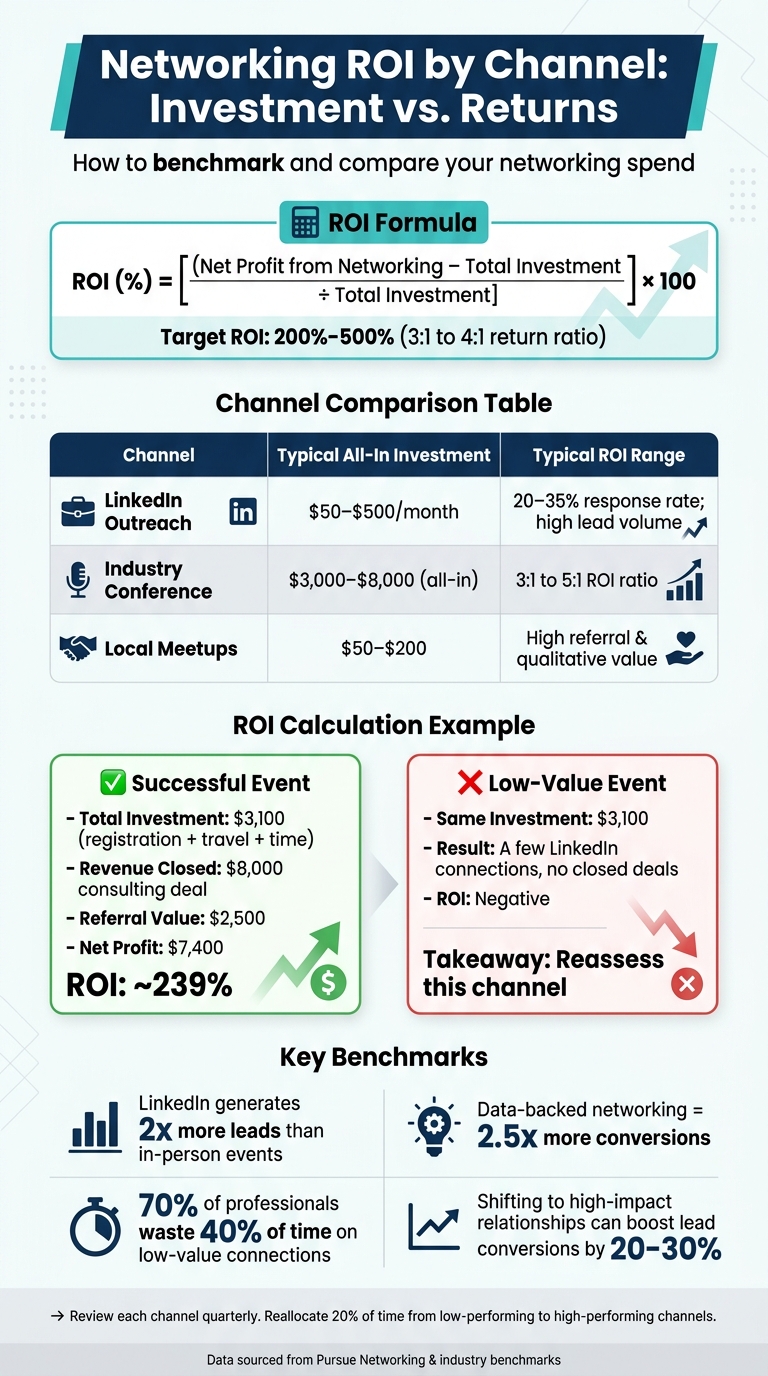
ROI (%) = [(Net Profit from Networking − Total Investment) ÷ Total Investment] × 100
The tricky part is plugging in accurate numbers. Net Profit includes things like revenue from closed deals, referral value, and even time saved - like when a connection saves you from needing to hire outside help. Total Investment combines direct costs (registration fees, travel, meals) and the value of your time. For example, if you spend 10 hours at a conference and value your time at $150 per hour, that's $1,500 added to your expenses, on top of tickets or travel costs [3][1].
The goal for consistent networkers is a 200%–500% ROI, which translates to a 3:1 to 4:1 return ratio [3][1]. If a networking channel doesn’t hit at least a 3:1 ratio, it might be time to reconsider your approach.
ROI Calculation Examples
Let’s break it down with an example. Say your total investment in an event is $3,100, which includes registration, travel, and time costs. If you close a consulting deal worth $8,000 and receive a $2,500 referral, your net profit is $7,400. Using the formula: ($7,400 ÷ $3,100) × 100 ≈ 239% ROI.
Now, imagine the same event only results in a few LinkedIn connections without any closed deals. Your ROI would be negative. This doesn’t mean networking is a failure - it might just mean this specific event didn’t deliver enough value to justify the cost [3][1].
"If you can't measure it, you can't improve it." - Kolin Simon, Founder & CEO, Pursue Networking [1]
This highlights how precise calculations help you assess the effectiveness of different networking opportunities.
Compare ROI Across Networking Channels
Once you’ve calculated ROI, you can compare the performance of various networking channels. For instance, LinkedIn is often reported to generate twice as many leads as in-person events [3], but traditional events might build deeper trust and lead to higher-value deals.
Here’s a comparison of typical investments and returns across different channels:
| Channel | Typical All-In Investment | Typical ROI Range |
|---|---|---|
| LinkedIn Outreach | $50–$500/month (tools + time) | High lead volume; 20–35% response rate [10] |
| Industry Conference | $3,000–$8,000 (all-in) | 3:1 to 5:1 ROI ratio [3][11] |
| Local Meetups | $50–$200 (meals + time) | High referral and qualitative value [4] |
Standardizing your ROI formula lets you make direct comparisons. For example, if LinkedIn outreach costs you $300 per month in tools and 8 hours of your time (valued at $150/hour, totaling $1,200), your total monthly investment is $1,500. If that effort brings in two clients worth $5,000 each, your ROI is approximately 567% - a standout compared to a conference delivering 239%.
To get the most out of your efforts, review each channel’s performance quarterly. Consider reallocating at least 20% of your time and resources from low-performing activities to those with better returns [3]. If you’re seeing strong response rates but not closing deals, the issue could be in your qualification process or follow-up [10]. Use these calculations to fine-tune your networking strategy and boost your results.
Building a Repeatable Networking ROI Process
Consistently tracking your networking ROI can reshape your career by making measurement an ongoing habit.
Build a Simple Networking ROI Dashboard
Using calculated costs and returns, you can create a straightforward dashboard to keep your networking data actionable. You don't need fancy tools - something as simple as Google Sheets can work if you consistently log the right information for each new connection. Organize your dashboard into these four key categories:
| Dashboard Category | What to Track |
|---|---|
| Contact Basics | Date, name, company, channel (LinkedIn, event, intro), role (customer, partner, mentor) |
| Qualitative Scores | Fit (0–5), Trust (0–5), Timing (0–5), Access (0–5) |
| Financials | Estimated deal value, referral multiplier, cash costs (tickets, travel) |
| Workflow | Next action, due date, status (lead, nurturing, won/lost) |
For those looking to automate, tools like HubSpot CRM or Pipedrive can sync contacts, deals, and follow-ups seamlessly [7]. The trick is to log your data consistently.
Create Standard Workflows for Networking
Inconsistent tracking can throw off your ROI calculations. A simple three-phase workflow can help you stay on track.
Before any event, set a clear, measurable goal. For example, instead of just aiming to "meet new people", try something specific like "connect with five potential consulting clients." Research the attendee list ahead of time and identify two or three key people to prioritize [4].
After the event, apply the 24/48 Rule: log all details into your CRM or dashboard within 24 hours, and send a personalized follow-up within 48 hours [3]. A thoughtful follow-up - like sharing a relevant article, a referral, or a useful insight - can be much more impactful than a generic "great to meet you" message. Dedicate 15 minutes every Friday to review your dashboard, sort opportunities by "Net Expected Profit", and plan follow-ups for your top 10 prospects for the upcoming week [7].
"Small talk is not a strategy. If you want networking to pay, you need a simple model that turns conversations into pipeline." - PlotPath [7]
Every quarter, analyze your data to pinpoint high-performing channels. If a particular event or group consistently fails to yield valuable connections, stop attending and focus your energy elsewhere [7][2]. This structured approach ensures your tracking aligns with your long-term networking goals.
Connect Networking ROI to Your Professional Development
As discussed earlier, precise tracking drives growth. When you link ROI data to your professional development, every networking effort becomes more impactful. ROI isn't just about revenue - it can also highlight areas where you might need to improve. For instance, if you're meeting the right people but struggling to convert those connections, the issue might lie in how you’re presenting your expertise rather than the number of connections you're making.
Programs like Tech Leaders are designed to address these gaps, particularly for technical professionals. By combining leadership training with entrepreneurship strategies, they help you refine how you position and articulate your skills. When you can clearly communicate your value, you increase the chance of turning conversations into meaningful opportunities.
"If you can't measure it, you can't improve it. And if you can't prove it delivers value, you'll always struggle to justify the time you spend on it." - Kolin Simon, Founder & CEO, Pursue Networking [1]
The most successful networkers aren’t always the most outgoing - they’re the most deliberate. A well-organized dashboard keeps you accountable, a repeatable workflow ensures consistency, and connecting your data to your broader career goals turns networking into a measurable, career-boosting asset.
Conclusion: Using Networking ROI to Advance Your Career
Networking often gets dismissed as an informal, instinctive activity. But the numbers tell a different story. Data-backed networking efforts are shown to deliver 2.5 times more conversions than approaches that aren’t tracked [3]. These measurable results turn what’s often seen as a soft skill into a concrete business tool.
The framework outlined here helps you approach every conversation, event, and follow-up as a valuable data point. By setting clear objectives, accounting for costs (including your time), and tracking both financial and non-financial outcomes, you can focus on strategies that deliver results. Over time, this approach transforms networking from a vague activity into a reliable system. It also allows professionals to refine their methods based on evidence, not guesswork.
For technical professionals, this approach is especially critical. Studies reveal that 70% of professionals spend 40% of their networking time on low-value connections [3]. Shifting that effort toward high-impact relationships has the potential to increase lead conversions by 20–30% [3].
"This formula quantifies networking's impact... This methodology transforms networking from soft skill to strategic investment." - Kolin Simon, Founder & CEO, Pursue Networking [1]
FAQs
How do I value my time for networking ROI?
To gauge the return on investment (ROI) for your networking efforts, start by assigning an hourly rate that represents the opportunity cost of your time. Networking should be approached as a professional investment, not merely a pastime.
Determine your total investment by multiplying the hours spent - whether it's preparing, attending events, or following up - by your assigned hourly rate. Then, subtract this cost from the value you’ve gained, such as new deals or referrals, to calculate your net return. Be sure to adjust your hourly rate as your income or efficiency evolves over time.
How can I measure networking ROI before a deal closes?
To gauge networking ROI before closing a deal, hone in on leading indicators that signal potential revenue. Start by tracking your contact-to-meeting conversion rate, which usually falls between 15-25% for B2B teams. Make sure your follow-up completion rate is above 90% within 48 hours, and keep an eye on the number of discovery calls being booked. Use your CRM to tag leads and stay on top of their progress through the pipeline.
If you're looking to turn technical expertise into a source of income, Tech Leaders provides programs designed to help professionals transition into independent consulting businesses.
How can I easily track non-financial networking wins?
Tracking non-financial achievements can give you insights into the health of your professional relationships. To do this effectively, consider using tools like a spreadsheet, journal, or CRM to keep track of key indicators:
- Relationship Strength: Evaluate the trust and rapport you share with your connections on a 1-10 scale.
- Reciprocity: Record instances where contacts reach out voluntarily or offer support without being prompted.
- Opportunities: Keep track of any unsolicited leads, referrals, or invitations that come your way.
By consistently recording these details, you can transform your networking efforts into a measurable and strategic approach to personal and professional growth.