
Top Tools for Omnichannel Personalization
Omnichannel personalization is about creating consistent, tailored experiences across all customer touchpoints - websites, apps, stores, emails, and more. With over 70% of U.S. consumers using multiple channels before purchasing, businesses that personalize see 91% higher retention rates and 80% of customers more likely to buy. To achieve this, tools that integrate real-time data, AI, and cross-channel orchestration are essential.
Here are the top tools for omnichannel personalization:
- Braze: Excels in real-time data updates and cross-channel orchestration for enterprise-level campaigns.
- Insider: AI-driven personalization and journey automation for ecommerce and retail.
- MoEngage: Mobile-first platform with strong behavioral analytics and journey optimization.
- Klaviyo: Best for small-to-medium ecommerce businesses with email and SMS automation.
- Segment: Focuses on unifying customer data for seamless integration across tools.
- Optimizely: Ideal for businesses prioritizing testing and real-time optimization.
- Tech Leaders: A training program for professionals to build custom omnichannel strategies.
Quick Comparison
| Tool | Key Features | Best For | Starting Price |
|---|---|---|---|
| Braze | Real-time data, cross-channel | Enterprise mobile campaigns | Custom pricing |
| Insider | AI personalization, journey builder | Mid-market ecommerce brands | ~$300+/month |
| MoEngage | Mobile-first, behavioral analytics | Large mobile app user bases | $999+/month |
| Klaviyo | Email/SMS automation, predictive | Small-to-medium ecommerce brands | $45/month |
| Segment | Data unification, integrations | Data infrastructure foundation | $120/month |
| Optimizely | Testing, real-time optimization | Testing-driven organizations | $50/month (basic) |
| Tech Leaders | Leadership training, AI strategy | Technical teams | Program-based pricing |
These tools cater to different needs, from small businesses to large enterprises, ensuring tailored customer experiences across multiple channels. The right choice depends on your business size, focus, and technical capabilities.
7 Omnichannel & Cross Channel Marketing Tools [Automation, SEO, Social Media, eCommerce & More
What to Look for in Omnichannel Personalization Tools
Selecting the right omnichannel personalization tool is a critical step in shaping your customer experience strategy. With countless options on the market, it’s essential to zero in on the features that truly enhance personalized interactions across all customer touchpoints. Here’s what to prioritize.
Real-time data integration is a non-negotiable feature. This ensures that every interaction - whether online or in-store - relies on the most up-to-date customer information. For example, if someone abandons their shopping cart, the system should immediately update their profile to trigger relevant follow-ups. Tools like MoEngage excel in this area, and businesses using real-time personalization report up to a 20% boost in sales conversions compared to static campaigns[2].
AI-driven personalization features take raw data and transform it into tailored experiences at scale. Advanced tools, such as Klaviyo’s predictive analytics and Insider’s automated customer journeys, can significantly reduce churn - by as much as 15% - while driving higher conversions[1][2][3].
Cross-channel orchestration is key to maintaining a consistent experience, whether your customer is browsing your website, checking emails, or visiting a physical store. The best tools synchronize interactions across email, SMS, mobile apps, websites, and even in-person locations - all from a single platform. Insider, for instance, offers a user-friendly journey builder that ensures smooth coordination across channels. This matters because 80% of consumers are more likely to buy from brands delivering personalized experiences across multiple platforms[4].
Scalability is vital for businesses planning to grow. Your platform should handle increasing data volumes, user numbers, and interactions without sacrificing performance or personalization quality. Look for solutions with flexible pricing, robust infrastructure, and features that cater to both small teams and larger enterprises. Whether you’re managing hundreds or millions of customer interactions, the system should remain efficient.
Ease of integration with existing tools - like CRMs, e-commerce platforms, and analytics software - can make or break your implementation timeline. Complicated setups can lead to delays and require extensive technical resources. Opt for tools with pre-built connectors and straightforward installation processes to get up and running quickly.
Support and onboarding quality are often overlooked but can be game-changers, especially for teams new to omnichannel strategies. Responsive customer service and comprehensive onboarding resources can help you see results faster while minimizing roadblocks during implementation.
1. Braze
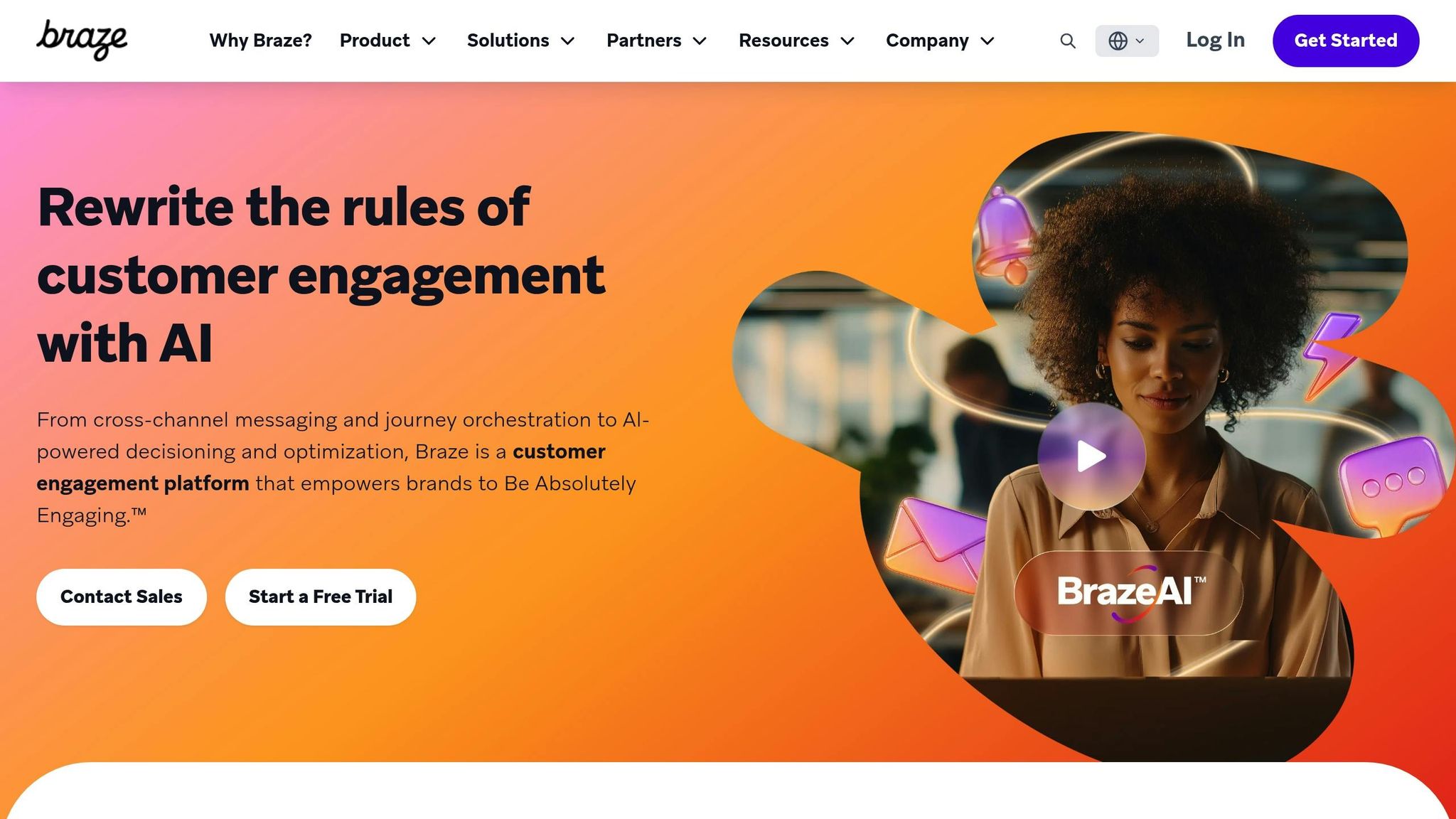
Braze connects digital and physical customer interactions for over 1,500 brands, helping them create personalized experiences at scale. Here's a closer look at what makes Braze a go-to platform for seamless omnichannel personalization[7].
Real-time Data Integration Across Channels
One standout feature of Braze is its ability to sync customer data instantly across websites, mobile apps, and offline systems using APIs and native connectors. This means that whenever a customer abandons a cart online, visits a store, or interacts with an app, their profile is updated immediately. These real-time updates allow businesses to take action right away - like sending a push notification when a customer is near a store[7].
AI-driven Personalization and Predictive Insights
Braze leverages machine learning to power predictive segmentation, optimize send times, and recommend tailored content. This helps brands pinpoint opportunities, such as reducing churn or boosting conversions. For instance, companies using Braze have seen customer retention rates improve by as much as 27% after implementing its cross-channel personalization tools[7].
Orchestrating Cross-channel Customer Journeys
With its visual journey builder, Braze makes it easy to automate complex, multi-channel customer journeys. Imagine a retailer in the U.S.: they could set up a workflow where a customer gets a push notification about a sale, followed by a personalized email if they don’t engage within 24 hours, and later an SMS reminder when they’re near a store. This ensures consistent messaging and maximizes the impact of every interaction[7].
Smooth Integration with Existing Tools
Braze integrates effortlessly with widely used tools like Shopify, Salesforce, Segment, and Google Analytics through its extensive API library and pre-built connectors. This compatibility minimizes IT headaches and speeds up implementation, allowing businesses to sync data, trigger campaigns, and measure outcomes with ease. The platform is also known for its reliability and scalability, with average ratings of around 4.5 out of 5 on popular review sites[7].
Braze uses a custom pricing model, starting in the low five-figure range for mid-sized U.S. businesses. It also offers a user-friendly campaign builder and strong customer support to help brands get the most out of the platform[7].
2. Insider
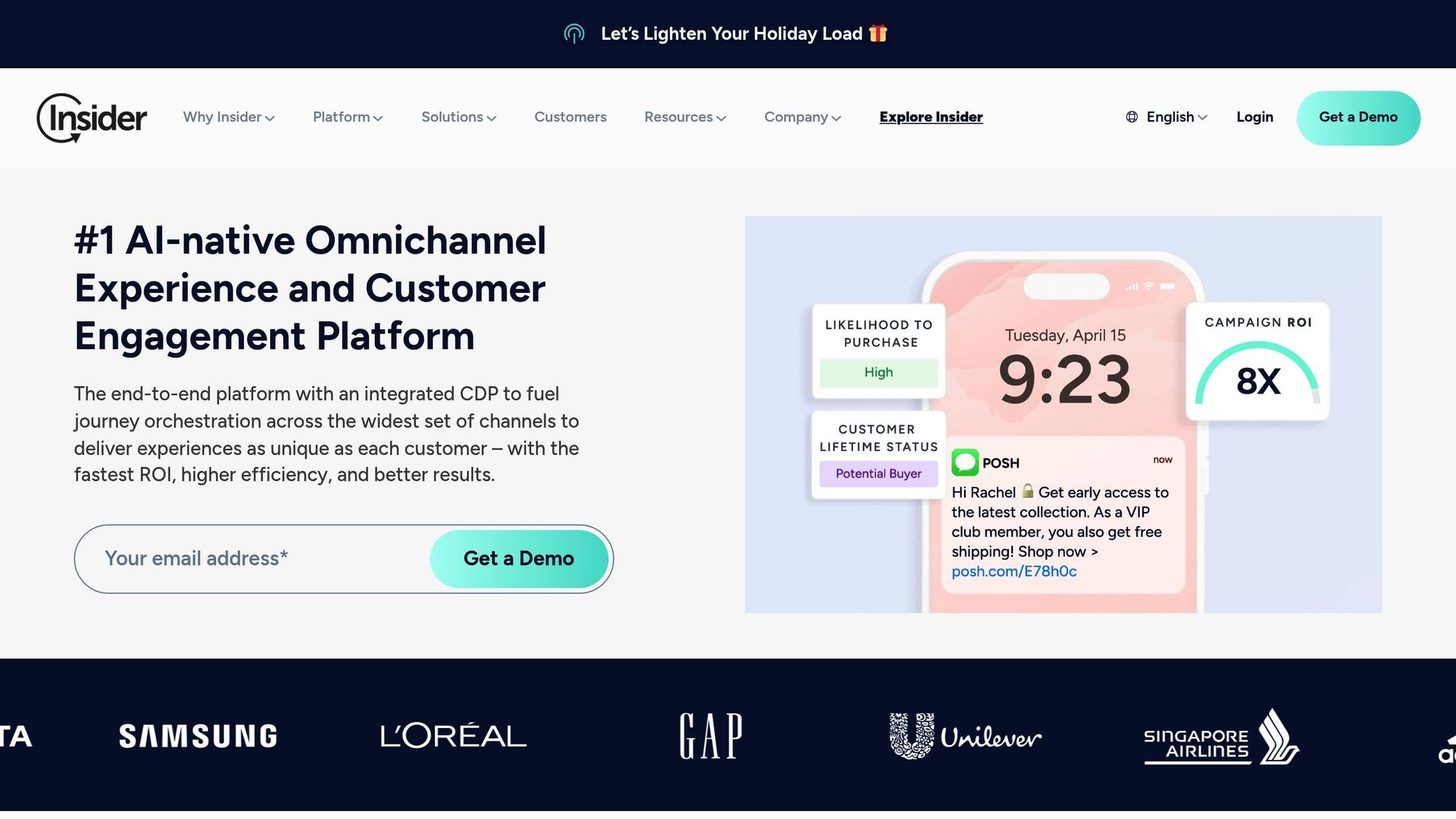
Insider is an AI-driven platform designed to deliver personalized experiences across web, mobile, and messaging channels. It’s particularly effective for consumer-focused industries like retail, ecommerce, and hospitality - businesses that rely on real-time personalization to engage large, active user bases [3].
Real-time Data Integration Across Channels
Insider brings together data from web, mobile, email, SMS, WhatsApp, and push notifications into a single, unified customer view. This integration allows marketers to deliver personalized offers and content based on live user behavior and intent. For instance, a retailer can instantly update product recommendations on their website and in-store kiosks based on what a customer recently browsed online [3].
AI-Powered Personalization and Predictive Analytics
The platform utilizes advanced AI features, such as Send-Time Optimization, Next-Best Channel predictions, and predictive personalization, through its Sirius AI technology. These tools automate customer journeys, create campaign content, optimize conversion strategies, and even identify customers at risk of leaving. Insider can trigger retention campaigns automatically and provide intent-based product recommendations alongside tailored messaging [3].
Cross-Channel Journey Orchestration
Insider’s Architect tool - a drag-and-drop journey builder - simplifies the process of managing customer interactions across multiple channels like web, mobile, email, SMS, and messaging apps. Marketers can design complex, automated journeys that adjust in real time. For example, a customer might browse products online, receive a personalized push notification about those items, get a follow-up email with a special offer, and later receive a WhatsApp message with a time-sensitive discount - all within a seamless flow [3].
Easy Integration with Existing Systems
The platform is designed to integrate smoothly with existing marketing systems. Insider simplifies data consolidation, segmentation, and campaign setup, offering responsive onboarding to get businesses up and running quickly. A G2 sales specialist noted that Insider enables efficient data consolidation, easy segmentation, and stable automated campaigns, which helps drive engagement through precise web push notifications [3].
Insider also provides strong customer support, including detailed documentation, instructional videos, and live assistance. While some users have mentioned difficulties with importing custom web designs, the support team actively helps troubleshoot issues to ensure a smooth adoption process. Overall, its support services are rated above the industry standard [3].
Pricing is customized based on business needs, and US-based companies can request tailored quotes in US dollars [3].
3. MoEngage
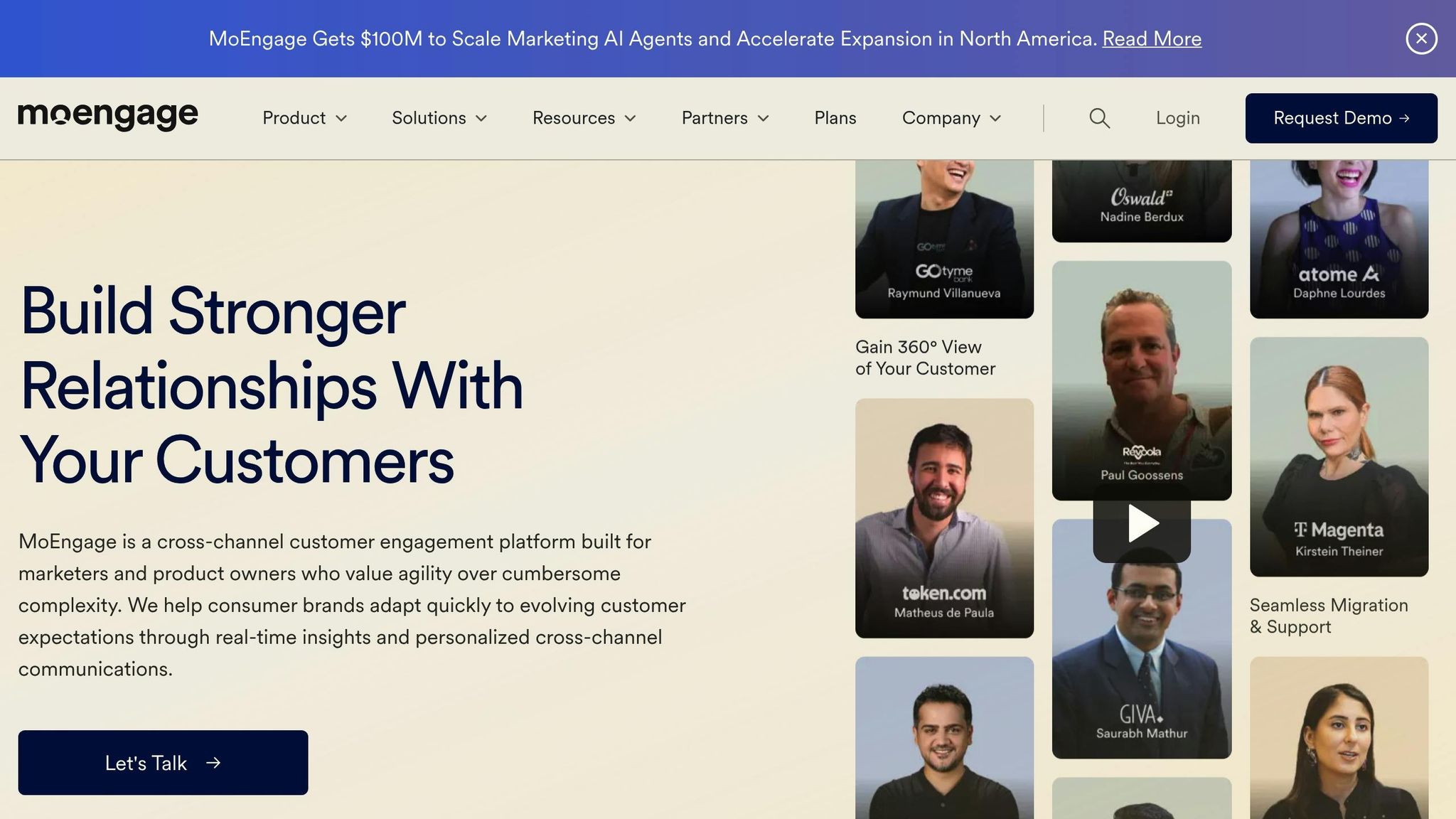
MoEngage specializes in delivering personalized, data-driven customer experiences across multiple channels, ensuring a seamless connection between physical and digital touchpoints [2].
Real-Time Data Integration Across Channels
MoEngage tailors content based on real-time user behavior, offering instant product and content recommendations on web and mobile platforms. By leveraging behavioral analytics, it continuously updates customer interactions, creating a unified and responsive experience. This approach ensures that users receive relevant suggestions, whether they're engaging online or in a physical setting [2].
AI-Powered Personalization and Predictive Analytics
The platform uses AI to adapt and personalize user experiences dynamically as actions unfold. It fine-tunes triggers and optimizes journey flows automatically based on user engagement. MoEngage also identifies and selects the most effective customer journey flows to enhance future interactions. Predictive segmentation works particularly well for businesses with larger user bases, making it a powerful tool for scaling personalization efforts [2].
Cross-Channel Journey Orchestration
MoEngage includes a visual journey builder that empowers marketers to design and automate customer interactions across platforms like web, mobile, email, and push notifications. This tool also tracks performance in real time, enabling brands to measure campaign success and refine their strategies on the go. For technical teams, the platform offers integrated onboarding and support, ensuring smoother implementation [2].
Integration with Existing Systems
While the initial setup may pose challenges for smaller teams, MoEngage provides onboarding assistance and responsive support to ease the process. Advanced customizations, however, may require technical expertise. The platform is particularly effective for brands with a large active user base and a mobile-first approach, though additional frontend support might be needed for web personalization. Pricing is tailored to individual business needs and is available through custom quotes [2].
4. Klaviyo
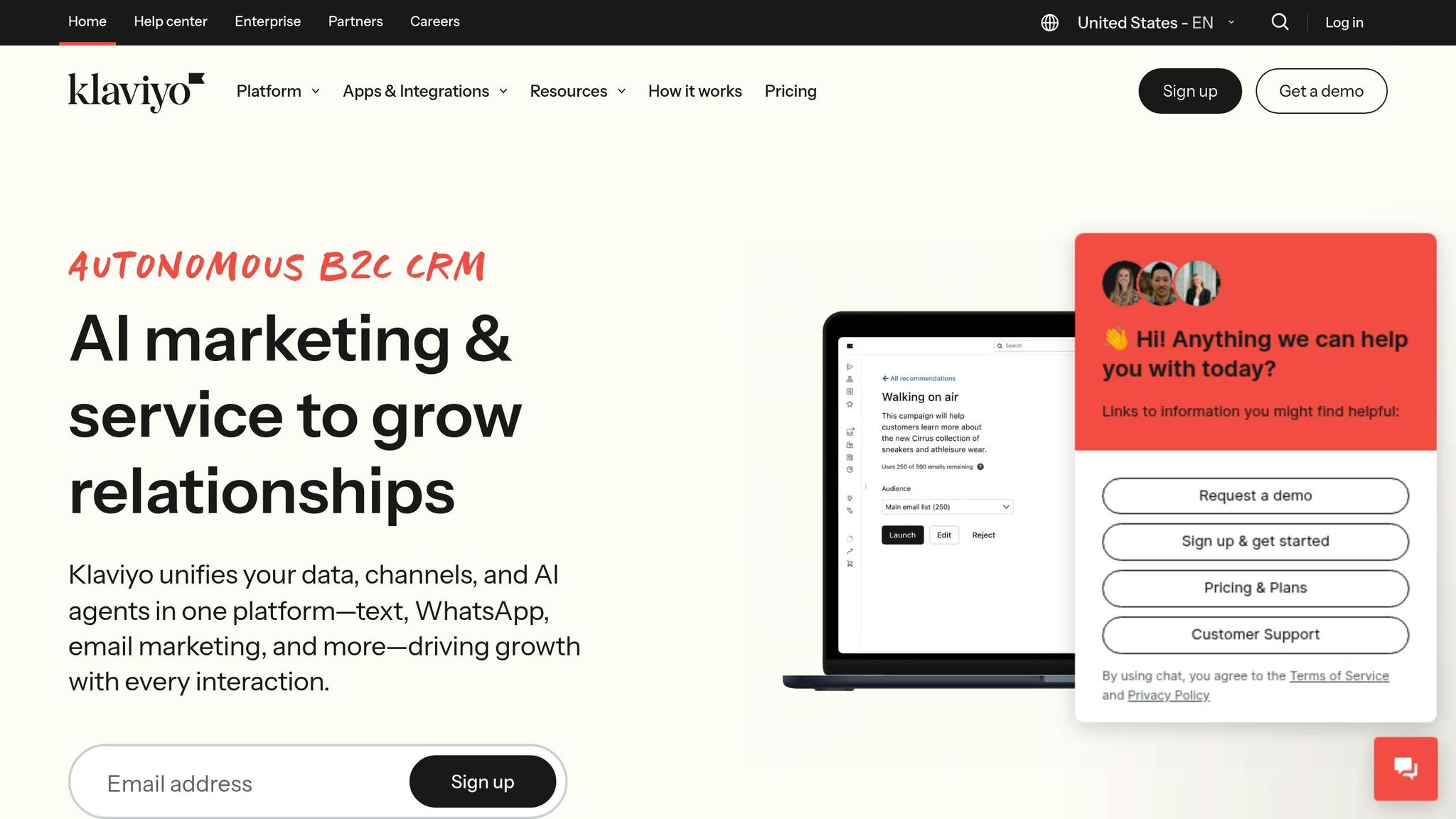
Klaviyo is trusted by over 100,000 businesses worldwide as a go-to platform for cross-channel personalization. It's especially popular among brands looking to take their email marketing efforts to the next level by integrating them into broader, personalized cross-channel strategies [8].
Real-Time Data Integration Across Channels
Klaviyo excels at bringing customer data together in real time. It integrates seamlessly with platforms like Shopify and BigCommerce, as well as POS systems and mobile apps. This means businesses can instantly update customer profiles and send personalized follow-ups whenever someone interacts with their brand. Specifically designed with the U.S. e-commerce market in mind, Klaviyo's native compatibility with major platforms ensures smooth operations [5][7].
For U.S. businesses, this real-time responsiveness is a game-changer. It allows brands to act on customer behavior immediately, boosting engagement and conversion rates. This continuous data flow also feeds into Klaviyo’s advanced AI analytics, making its recommendations even more precise [5][7].
AI-Powered Personalization and Predictive Analytics
Klaviyo uses AI and machine learning to anticipate customer behavior, such as predicting when a customer might make their next purchase or identifying those at risk of churning. These insights let brands send messages that feel personal and timely. Designed with U.S. market dynamics in mind, the platform’s predictive tools help optimize send times and improve results.
On average, businesses using Klaviyo report a 29% increase in revenue, along with higher open and click-through rates for their campaigns [5][7][8]. These tools enable marketers to create seamless, personalized experiences across multiple channels [8].
Cross-Channel Journey Orchestration
With Klaviyo’s visual journey builder, marketers can craft automated workflows that connect email, SMS, and web push notifications. For instance, a customer might receive a personalized email after browsing, followed by an SMS reminder the next day, and finally, a web push notification if their cart remains abandoned [5][7].
To make things easier, the platform provides ready-to-use templates for common scenarios like recovering abandoned carts, following up after purchases, and winning back lapsed customers. These templates help businesses quickly set up effective omnichannel campaigns without starting from scratch [8].
Seamless Integration with Existing Systems
Klaviyo stands out when it comes to integrating with other tools. It offers native, no-code or low-code integrations with popular platforms like Shopify, Magento, WooCommerce, and Salesforce. This makes it easy for U.S. businesses to connect their systems and start syncing data in just minutes - no heavy IT lifting required [5][7].
The platform’s pricing is straightforward and tailored to different needs. It offers a free tier for up to 500 contacts, with paid plans starting at $20/month for email and $5/month for SMS. Klaviyo consistently receives high marks from users, with an average rating of 4.7/5 on G2 and 4.6/5 on Capterra. Customers often highlight its user-friendly interface, powerful segmentation tools, and seamless e-commerce integrations as standout features [8].
sbb-itb-8feac72
5. Segment
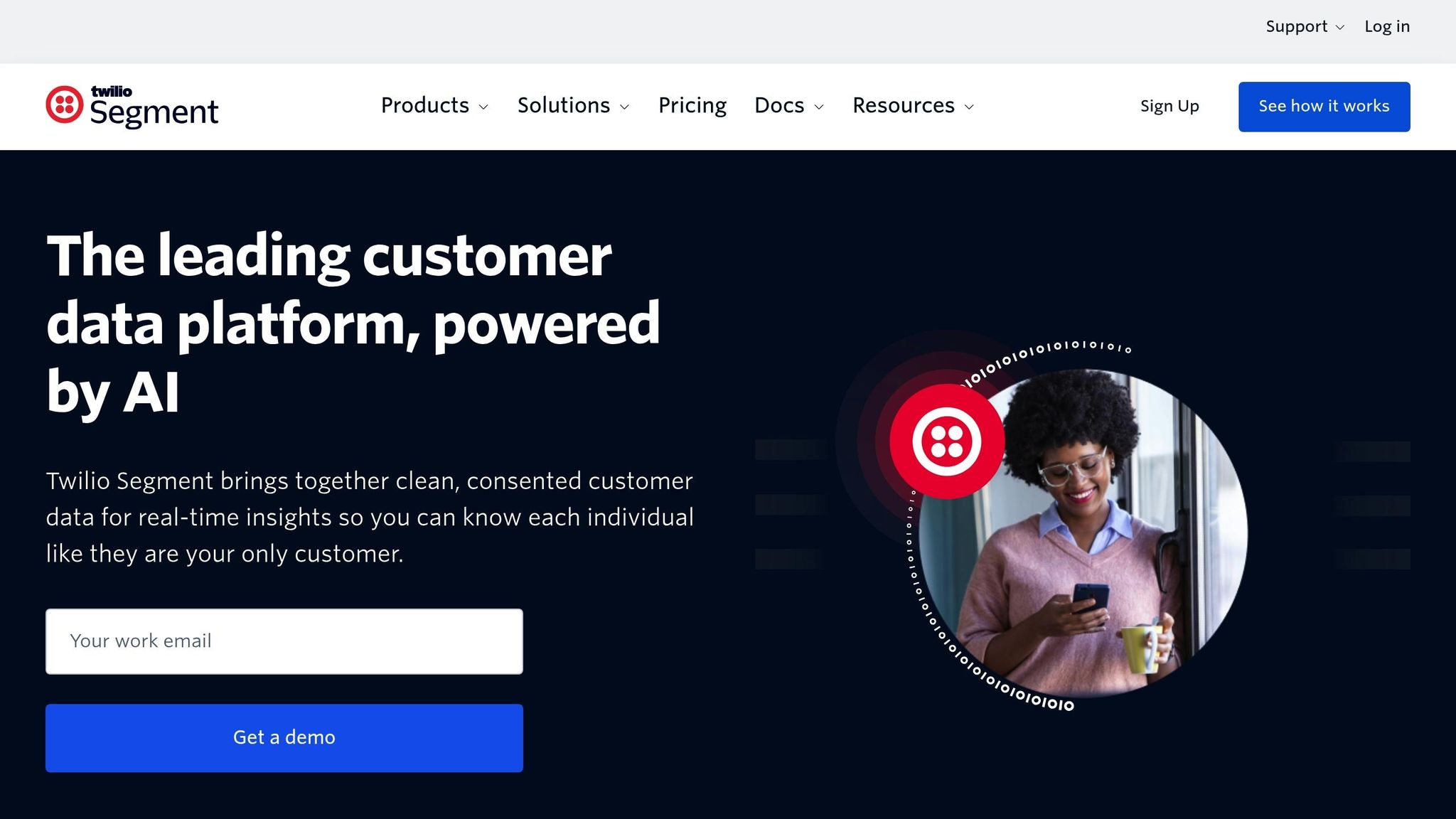
Segment has made its name by simplifying how businesses manage customer data. It pulls together scattered data from multiple sources into a single, up-to-date profile, creating a solid foundation for personalized marketing. This ensures every customer interaction feels relevant and informed by the latest information [5].
Real-Time Data Integration Across Channels
One of Segment's standout features is its ability to gather, organize, and distribute customer data instantly. Whether the data comes from website visits, mobile app usage, in-store transactions, or IoT devices, Segment creates unified customer profiles that stay updated across all channels [6]. For businesses in the U.S., this means actionable insights are available immediately. For instance, if a customer abandons their cart online, that information can be shared instantly across email, SMS, and customer service systems. This ensures every team has access to the same real-time data, formatted for U.S. standards, to take timely action.
By eliminating data silos, Segment empowers businesses to respond quickly, improving both conversion rates and customer satisfaction.
Ease of Integration with Existing Systems
Segment’s strength lies in its ability to integrate seamlessly with existing tools. It offers a vast library of pre-built connectors and APIs, making it compatible with hundreds of popular U.S. marketing, analytics, and CRM platforms [5]. For most businesses, this means they can get their systems synced without needing heavy technical resources. The platform’s developer-friendly documentation and ready-made connectors simplify the process, though custom development might still be required for older, more complex setups.
Experts advise starting with a clear data governance plan and focusing on integrations that will have the biggest impact on business outcomes [6]. Once integrated, Segment provides a centralized data hub that sets the stage for advanced customer engagement strategies.
Cross-Channel Journey Orchestration
Segment doesn’t directly create marketing campaigns, but it plays a critical role in ensuring they run smoothly. By providing unified, real-time customer data, Segment allows marketing tools like automation platforms, email services, and mobile apps to work together seamlessly. This unified data enables businesses to design customer journeys that adapt dynamically based on real-time user behavior.
For example, if a customer clicks on an email link and visits your website, that action is instantly added to their profile. This updated information allows subsequent interactions - whether through ads, messages, or customer service - to feel consistent and informed by their complete history. This level of synchronization helps marketers deliver a smoother, more personalized experience across all channels.
6. Optimizely
Optimizely stands out from tools that merely aggregate data by emphasizing continuous experimentation and real-time optimization. Originally known for its A/B testing capabilities, Optimizely has grown into a robust platform designed to deliver AI-powered customer experiences. Its core strength lies in enabling data-driven decision-making across digital channels, making it a go-to choice for U.S. businesses aiming to create more engaging and relevant customer interactions [5].
AI-Powered Personalization and Predictive Analytics
Optimizely harnesses machine learning to analyze user behavior, preferences, and history, generating predictive insights that automatically refine content and recommendations. This approach has been shown to boost conversion rates by 10-20% [3].
The platform's experimentation framework allows businesses to test various personalization strategies in real time. By leveraging machine learning, Optimizely identifies the most effective experiences for specific customer segments, eliminating the need for guesswork [5]. This ensures that customer interactions are consistently informed by the latest data.
Real-Time Data Integration Across Channels
Optimizely integrates real-time updates from a variety of sources, including in-store systems, websites, mobile apps, and third-party platforms. It also complies with U.S. privacy regulations, ensuring businesses can manage customer data responsibly [3].
The platform processes a wide range of first-party data, such as purchase history, browsing habits, location details, and engagement metrics. This real-time data integration ensures every interaction reflects the most current customer information [3].
Cross-Channel Journey Orchestration
With its journey orchestration tools, Optimizely enables marketers to create automated experiences that seamlessly span email, web, mobile, and even offline channels. Businesses can set up rules and triggers that respond instantly to customer actions, ensuring consistent and relevant messaging across touchpoints [3]. This is particularly useful for U.S. retailers managing both digital and physical store experiences.
What sets Optimizely apart is its ability to continuously refine these customer journeys. Instead of relying on static pathways, businesses can experiment with different journey variations. Optimizely’s AI then determines which strategies yield the best results for specific customer groups.
Seamless Integration with Existing Systems
Optimizely provides pre-built connectors for widely used tools like Salesforce and Shopify, making it easier to integrate with existing CRM, e-commerce, and marketing automation platforms [3]. For businesses with more specific needs, custom integrations are supported through RESTful APIs, offering flexibility to adapt to unique technology stacks.
While Optimizely excels in digital personalization, implementing its tools for e-commerce may require additional technical resources [5]. However, its focus on testing and optimization makes it a strong choice for businesses that value experimentation-driven personalization strategies.
7. Tech Leaders
Strategic leadership plays a crucial role in shaping omnichannel initiatives that align with specific business goals. While many software platforms offer ready-made solutions, Tech Leaders takes a different path. This program equips technical professionals with the leadership and strategic skills needed to design custom omnichannel strategies. Instead of relying on one-size-fits-all tools, Tech Leaders focuses on empowering professionals to address unique organizational challenges with tailored solutions.
Blending Technical Expertise with Leadership
The program's curriculum is a thoughtful mix of technical training, leadership development, AI strategy, and data-driven decision-making. Graduates are prepared to lead digital transformation projects that form the backbone of personalized omnichannel strategies. By fostering cross-functional collaboration, the program ensures that personalization efforts align seamlessly with overarching business goals. This training equips participants to create solutions that adapt and grow alongside their organizations.
Real-World Success Stories
The program doesn’t stop at theory - it dives into practical applications through case studies. For example, a graduate from Tech Leaders working at a mid-sized U.S. retailer successfully integrated in-store data with e-commerce operations. Using the strategic principles learned in the program, they boosted cross-channel conversion rates by 18% in just six months[7]. This real-world success shows how combining technical know-how with strategic leadership can yield measurable results.
Driving Innovation from Within
Tech Leaders also emphasizes the importance of leveraging modern tools like AI and data analytics to maximize productivity and make smarter decisions. The program promotes continuous learning, agile management, and proactive improvements, encouraging participants to drive innovation within their organizations. By focusing on in-house capabilities, Tech Leaders helps businesses create sustainable, personalized customer experiences that evolve over time. This approach ensures organizations remain competitive while meeting the ever-changing demands of their customers.
Tool Comparison Chart
Here's a detailed comparison of seven omnichannel personalization tools:
| Tool | Key Features | Supported Channels | AI Capabilities | Starting Price | Best For |
|---|---|---|---|---|---|
| Braze | Cross-channel orchestration, real-time personalization, mobile push | Email, SMS, push, in-app, web | Predictive segmentation, message optimization | Custom pricing | Enterprise mobile-first campaigns |
| Insider | Ecommerce personalization, journey builder, dynamic triggers | Web, mobile, messaging, WhatsApp | AI journey optimization, real-time recommendations | Custom (typically $300+/month) | Mid-market ecommerce brands |
| MoEngage | Data-driven journeys, behavioral analytics, mobile-first | Mobile, web, email, push | AI journey optimization, smart triggers | $999+/month | Mobile app engagement |
| Klaviyo | Email/SMS automation, predictive analytics, ecommerce focus | Email, SMS | Predictive analytics, dynamic recommendations | $45/month (1,500 contacts) | Ecommerce businesses |
| Segment | Customer data unification, integration hub | All (via integrations) | AI via connected tools | $120/month (advanced features) | Data infrastructure foundation |
| Optimizely | A/B testing, experimentation, content optimization | Web, mobile, CMS | Machine learning optimization | $50/month (basic) | Testing-driven organizations |
| Tech Leaders | Leadership training, AI strategy education | N/A (training program) | Strategic AI implementation | Program-based pricing | Technical teams needing leadership skills |
Below, we break down key factors to help you decide which tool fits your needs.
Channel Coverage Analysis
Each tool offers varying levels of channel support. Insider stands out with broad coverage, including web, mobile apps, email, SMS, WhatsApp, push notifications, and chatbots. For mobile-first strategies, MoEngage is a strong contender, with additional support for web and email. Klaviyo specializes in email and SMS, making it a go-to for ecommerce brands.
Braze delivers robust cross-channel capabilities, excelling in mobile push notifications and in-app messaging. Segment takes a different approach by acting as a data unification layer, enabling personalization across virtually any channel through its extensive integrations. Meanwhile, Optimizely focuses on web and mobile app personalization, ideal for organizations prioritizing experimentation.
AI and Automation Capabilities
Automation is essential for modern personalization. Insider offers advanced behavioral targeting and predictive personalization, even suggesting the next-best channel for engagement. Klaviyo uses predictive analytics to forecast order timing, churn risk, and purchase likelihood. MoEngage optimizes customer journeys with real-time recommendations, while Braze focuses on predictive segmentation and send-time optimization.
Optimizely leverages machine learning for content recommendations and experimentation, while Segment unifies customer data, enabling AI-driven personalization through connected tools.
Integration and Implementation Considerations
Integration capabilities can make or break an omnichannel strategy. Klaviyo shines with over 350 ecommerce integrations, including seamless connections to Shopify and WooCommerce. Braze, Insider, and MoEngage also offer strong integrations with platforms like Salesforce, though setup complexity varies.
Pricing and Value Considerations
Pricing structures differ significantly. Klaviyo provides transparent tiered pricing, starting at $45/month for 1,500 contacts. MoEngage, Braze, Insider, and Optimizely usually operate on custom quotes. Segment offers a free tier, with advanced features available in paid plans. Tech Leaders, on the other hand, uses program-based pricing tailored to its training focus.
Strengths and Limitations
- Klaviyo: A top choice for ecommerce, with clear pricing but limited to email and SMS.
- Insider: Offers real-time personalization and responsive support but may require technical expertise for setup.
- MoEngage: Best suited for handling large data volumes in mobile-first scenarios.
- Braze: Strong in mobile capabilities, particularly for enterprise clients.
- Optimizely: Excels in experimentation but lacks deep ecommerce functionality.
- Segment: A powerful tool for unifying customer data, though its AI capabilities depend on external integrations.
Making the Right Choice
Your decision should align with your business needs, channel priorities, and technical resources. For ecommerce brands, Klaviyo is a natural fit. If mobile-centric campaigns are your focus, consider MoEngage or Braze. Teams looking for robust data infrastructure will benefit most from Segment, while Tech Leaders is ideal for building internal skills. This breakdown should help you identify the best tool to unify and enhance your customer engagement efforts.
Conclusion
Selecting the right omnichannel personalization tools can redefine how your business interacts with customers. Each platform we've discussed brings something distinct to the table - whether it's Klaviyo's ecommerce-centric automation or Segment's robust data unification. The key is choosing a solution that aligns with your business model, technical capabilities, and channel priorities.
The potential impact of personalization is hard to ignore. It can drive revenue growth by up to 40% and boost engagement rates from 5.4% to 18.96% [5][10]. However, these numbers underscore an important truth: technology alone isn't enough. Success depends on how well these tools are implemented and integrated into your overall strategy.
Even the most advanced platforms require skilled execution. Upskilling your team is essential as AI and automation continue to evolve. Often, the difference between success and failure in omnichannel personalization lies in bridging the gap between technical implementation and strategic business outcomes.
This is where initiatives like Tech Leaders become game-changers. These programs are designed to merge technical expertise with leadership and AI-driven business strategies, addressing the skills gap that many organizations face when deploying complex personalization platforms.
"We believe the world needs technical experts with strong leadership and business skills. Our programs bridge the gap between technical expertise and business outcomes." [9]
Ultimately, success in omnichannel personalization hinges on a combination of the right tools and strong leadership. Whether you opt for Braze to power enterprise mobile campaigns, Insider for ecommerce personalization, or another platform from our comparison, investing in your team's growth will amplify your results.
With 71% of consumers expecting personalized experiences and 76% feeling frustrated when they don't get them, the stakes are high [5]. By pairing advanced technology with continuous learning, you lay the groundwork for an omnichannel strategy that evolves alongside your business and meets customer expectations head-on.
FAQs
What should I consider when selecting an omnichannel personalization tool for my business?
Choosing an omnichannel personalization tool starts with understanding your business needs and goals. Begin by pinpointing the channels you want to connect - whether that's your physical store, website, mobile app, or social media platforms. Once you have that clarity, focus on tools that can unify customer data, deliver personalization in real-time, and offer insights you can act on.
You’ll also want to prioritize platforms that integrate smoothly with your current systems and can scale as your business grows. Features like an intuitive interface, strong analytics capabilities, and AI-powered personalization are key to staying ahead in a competitive landscape.
What are the main advantages of using AI-powered personalization tools?
AI-powered personalization tools bring a lot to the table for omnichannel strategies. They enable businesses to craft tailored customer experiences by analyzing data from various touchpoints - whether online or offline. The result? Better customer engagement, higher conversion rates, and a deeper connection to the brand.
On top of that, these tools take care of time-consuming tasks like analyzing customer behavior and offering predictive recommendations. This not only saves valuable time and resources but also ensures consistent messaging across all channels. With AI insights, companies can get to know their audience on a deeper level and adjust to their preferences in real-time, delivering a smooth and personalized experience at every step.
Why is it important to integrate omnichannel personalization tools with systems like CRMs and e-commerce platforms?
Integrating omnichannel personalization tools with systems like CRMs and e-commerce platforms is key to delivering a smooth and connected customer experience. These integrations make sure customer data flows consistently across all channels, enabling more precise personalization while keeping marketing, sales, and support efforts in sync.
When these tools work together, businesses can uncover deeper insights into customer behavior, simplify processes, and provide customized experiences across both online and offline interactions. This approach boosts customer satisfaction, increases engagement, and strengthens loyalty.