

Organizational Alignment Framework Explained
Organizational alignment ensures that a company’s vision, strategy, structure, systems, and culture work together to achieve business goals. For technical leaders, alignment means connecting product roadmaps, team structures, and engineering priorities to broader company objectives. Misalignment leads to slow decision-making, duplicated efforts, and poor outcomes.
This guide covers actionable frameworks like the McKinsey 7-S Model (analyzing gaps in strategy, structure, and culture) and Galbraith's Star Model (designing structure, processes, and rewards to match goals). It also explains how tools like OKRs align daily tasks with company strategy. Leaders can measure alignment through progress tracking, team feedback, and performance metrics.
Key takeaways:
- Vertical alignment connects leadership goals to team execution.
- Horizontal alignment ensures teams collaborate effectively across functions.
- Use frameworks to diagnose and fix misalignment.
- Combine clear goals, decision-making authority, and shared metrics for better results.
Alignment isn’t a one-time fix - it requires regular reviews, adjustments, and strong leadership to maintain focus as organizations grow. Programs like Tech Leaders can help leaders develop skills to bridge strategy and execution effectively.
Organizational Alignment [The 7-S] Overview
Core Principles of Organizational Alignment
Organizational alignment brings together strategy, structure, and culture to ensure smoother execution, encourage innovation, and minimize unnecessary conflicts. When these elements are misaligned, even the most dedicated teams can struggle to achieve their goals.
Strategy-Structure Fit
The idea of strategy-structure fit revolves around designing an organization's structure, decision-making processes, and reporting lines to serve its strategic goals - not simply sticking to outdated systems or convenient setups. Research highlights that aligning structure with strategy, such as adopting flat, cross-functional teams for quick experimentation, can lead to better outcomes [2][3].
For instance, a strategy centered on rapid product experimentation thrives with flat, cross-functional teams that have the authority to make local decisions about features and A/B tests. These teams need streamlined approval processes and clear metrics to operate efficiently without constant delays. On the other hand, a cost-leadership or reliability-focused strategy - common in industries like critical infrastructure or regulated sectors - often requires standardized workflows, specialized roles, and centralized governance to address architecture, security, and compliance needs [2][5].
Misalignment is often easy to spot. For example, a company might claim to embrace a platform strategy but still rely on siloed teams with no shared responsibility for core services. Leadership may demand "move fast" results while approvals, budgets, and compliance decisions remain bogged down in multiple committees. These contradictions slow decision-making, create inconsistent priorities, and hinder collaboration, especially in areas like product development and customer experience [4][6][7].
Technical leaders can identify misalignment by mapping strategic priorities - like speed to market, reliability, or customer focus - to structural elements such as centralization levels, team configurations (e.g., platform vs. stream-aligned teams), and dependency management. If execution consistently stalls at specific points, it’s often a sign that the structure needs adjustment to better support the strategy [4][5].
Hard vs. Soft Alignment Elements
Alignment depends on both hard and soft elements working together. Frameworks like the McKinsey 7-S model differentiate hard elements - strategy, structure, and systems - from soft elements - culture, leadership, skills, and shared values. Hard elements are concrete and easier to document or change. For example, you can redesign an org chart, introduce new processes, or adjust KPIs relatively quickly. Soft elements, however, are rooted in behaviors and beliefs, making them slower to evolve. They influence how people interpret strategy and whether they act in ways that align with it [2][3].
Many technical leaders tend to focus too heavily on hard elements, such as reorganizing teams, rolling out new tools, or tweaking KPIs, while neglecting soft elements like leadership behaviors, psychological safety, and unwritten norms. This often results in "paper alignment", where formal documents and processes say one thing, but day-to-day actions tell a different story, eroding trust and undermining execution [2][3][6].
| Aspect | Hard Elements | Soft Elements |
|---|---|---|
| Nature | Tangible, formal, easier to change | Intangible, behavior- and belief-driven |
| Examples | Org charts, processes, IT systems, KPIs | Leadership style, norms, shared values |
| Primary Role | Enable clear roles and efficient workflows | Shape interpretation of strategy and behavior |
| Risk of Neglect | Coordination failures, bottlenecks | Cynicism, resistance, and lack of innovation |
Leaders can diagnose misalignment by combining structured assessments with behavioral observations. Warning signs include strategy documents that emphasize innovation while performance reviews reward only short-term results, or stated values promoting collaboration while incentives and promotions focus solely on individual achievements. Agile processes implemented in a rigid, command-and-control culture are another common red flag [2][3][6].
The best interventions address both hard and soft elements. For example, update performance management and rewards systems (hard) to recognize cross-team achievements while also investing in leadership training to encourage facilitative and empowering management styles (soft). Similarly, redesign team structures and interfaces (hard) to minimize dependencies while fostering shared rituals like joint demos and incident reviews to strengthen collaboration (soft) [2][4][5].
For U.S.-based tech leaders, aligning compensation, career progression, and promotion criteria with desired cultural outcomes can bridge the gap between organizational values and business performance [6].
Vertical and Horizontal Alignment
Beyond balancing hard and soft elements, alignment must flow effectively both vertically (from leadership to individual contributors) and horizontally (across teams and functions). This dual approach ensures smoother execution without bottlenecks or conflicting priorities.
Vertical alignment ensures that strategy, goals, and priorities are clearly communicated and translated across all levels - from corporate strategy to team objectives and individual goals. Horizontal alignment, on the other hand, focuses on how different functions and teams collaborate to achieve shared outcomes, ensuring that groups like product, engineering, and sales work together rather than pursuing siloed metrics [2][4][5].
In technical organizations, strong vertical alignment without horizontal collaboration can lead to bottlenecks, while strong horizontal collaboration without clear vertical alignment can result in highly cooperative efforts that fail to drive key business metrics [4][6].
To strengthen vertical alignment without stifling innovation, leaders can:
- Use company-wide OKRs to define measurable outcomes, while empowering teams to set their own aligned objectives.
- Conduct regular strategy reviews to clarify priorities and constraints.
- Tie performance management and promotions to contributions toward strategic outcomes, not just local metrics [2][4].
Encouraging bottom-up proposals can also foster innovation. Teams can present data-driven ideas that support broader strategic goals, with leadership allocating resources for exploratory work tied to these themes. Bidirectional goal setting, where leadership defines the "what" (outcomes) and teams propose the "how" (initiatives), can further align efforts. Transparent decision-making forums, like technical review boards, provide an avenue for ideas from all levels, evaluated against clear strategic criteria [2][4][5].
For horizontal alignment, both structural and behavioral practices are key. Structurally, cross-functional product teams with shared outcomes - rather than just deliverables - help reduce miscommunication and handoffs. Practices like quarterly integrated planning, where product, engineering, and go-to-market teams align priorities, prevent conflicts later on. Behaviorally, shared metrics and dashboards that track end-to-end outcomes, such as customer satisfaction or time-to-value, ensure all teams focus on the same goals. Joint rituals like cross-functional standups, demos, and incident reviews further enhance collaboration [4][5][6].
For technical leaders managing complex setups like squads, tribes, or platform teams, both vertical and horizontal alignment are non-negotiable. Clear goals, delegated decision-making, and well-defined team interfaces are essential for maintaining momentum and engagement. Programs like those from Tech Leaders can help bridge the gap between technical expertise and the leadership skills required to align strategy and execution in complex organizations.
Key Frameworks for Organizational Alignment
Technical leaders often rely on well-established frameworks to diagnose misalignment and redesign their organizations. These frameworks help map the connections between strategy, structure, culture, and execution. Two prominent models - the McKinsey 7-S Model and Galbraith's Star Model - offer complementary approaches for ensuring that all organizational elements work together to achieve strategic goals. Both serve as diagnostic tools and blueprints for design, linking strategy to daily operations.
McKinsey 7-S Model
The McKinsey 7-S Model identifies seven interconnected elements that must align for an organization to perform effectively. These elements are divided into two categories:
-
Hard elements: These include Strategy, Structure, and Systems, which are tangible and easier to document or adjust. For example:
- Strategy defines how the organization plans to gain a competitive edge, such as a SaaS company in the U.S. focusing on AI-driven features and rapid iteration.
- Structure outlines the organization of teams and reporting lines, like cross-functional product pods versus function-based engineering teams.
- Systems cover daily processes and tools, such as automation platforms, incident response workflows, and performance cycles.
-
Soft elements: These include Shared Values, Style, Staff, and Skills, which are more about behaviors and beliefs and evolve gradually. For instance:
- Shared Values form the organization's core principles, like "customer obsession" or "security first."
- Style reflects leadership and management approaches, such as command-and-control versus servant leadership.
- Staff refers to workforce composition and capabilities.
- Skills highlight the organization's distinct strengths, such as expertise in reliability engineering or machine learning operations.
Alignment across all seven components ensures smooth functioning. For example, an agile product strategy should be supported by a flat organizational structure, streamlined systems, experimental shared values, collaborative leadership, a skilled team, and strong execution capabilities.
Leaders can use the 7-S Model to quickly identify misalignments by comparing the current state with the desired state. Tools like interviews, surveys, and data reviews (e.g., sprint metrics or attrition reports) help pinpoint gaps. For instance, if the strategy emphasizes platform reliability but the team is focused on feature delivery, leaders can address these inconsistencies to prioritize the right changes.
Next, Galbraith's Star Model provides a structured approach to implementing these changes.
Galbraith's Star Model
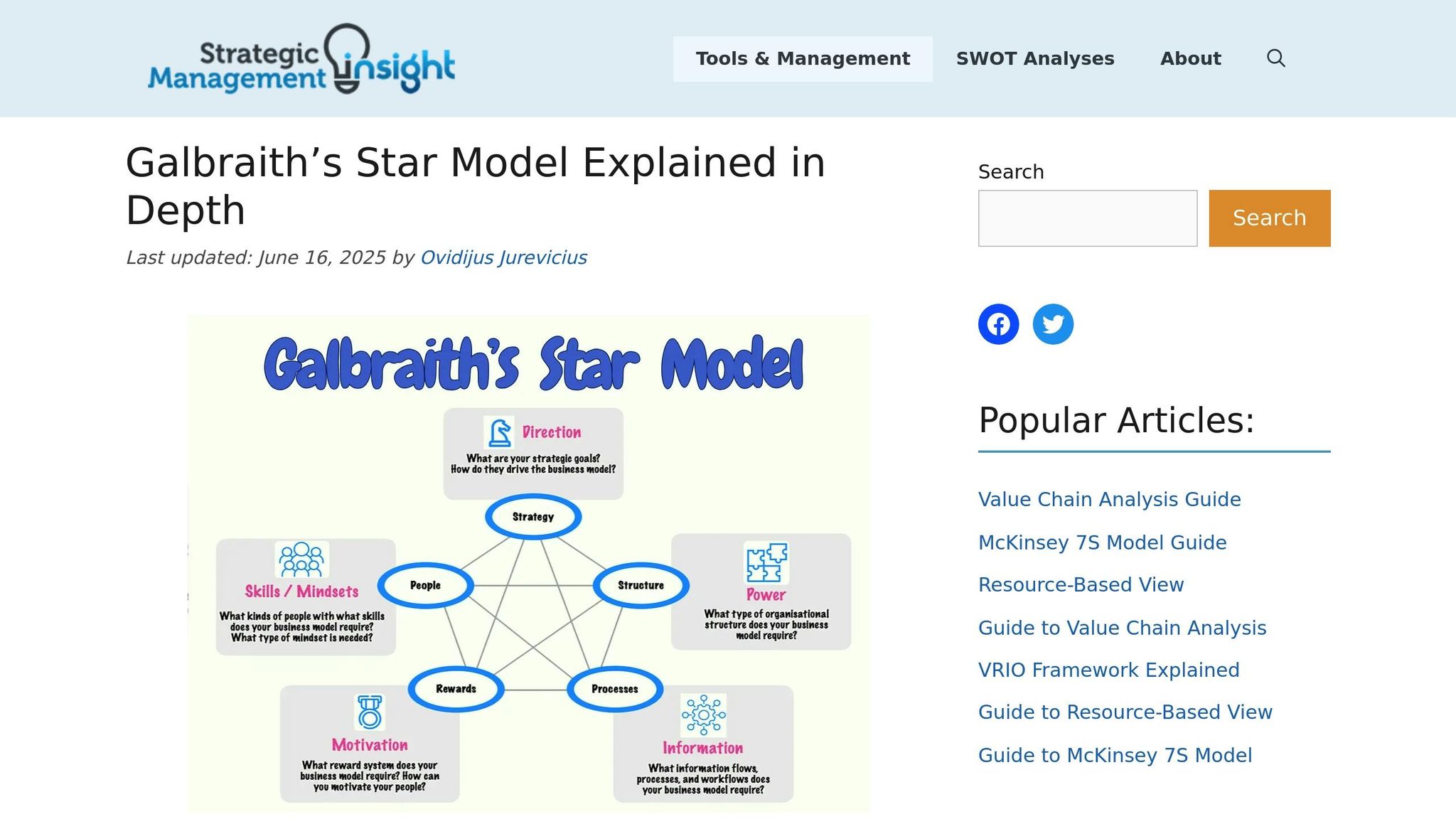
Galbraith's Star Model takes a more prescriptive approach to organizational design, focusing on five key elements: Strategy, Structure, Processes, Rewards, and People. The framework begins with Strategy, which defines the organization's direction, target markets, value propositions, and trade-off criteria. The other components are then configured to support this strategy:
- Structure: Defines how the organization is arranged, whether by function, product, geography, customer segment, or platform. Factors include specialization, hierarchy (flat vs. tall), and centralization versus decentralization.
- Processes: Focus on cross-functional coordination, such as product discovery, release management, and portfolio planning.
- Rewards: Cover incentive systems, including salaries (in USD), bonuses, equity, and promotion criteria. These systems can emphasize collaboration or individual achievements.
- People: Encompass talent profiles, recruitment, training, succession planning, and overall workforce alignment with strategic goals.
The Star Model emphasizes that structure alone isn't enough for alignment. Decision-making, cross-functional processes, incentives, and people practices must also align with the strategy. For example, a cloud platform strategy targeting enterprise customers would require a customer-centric structure, cross-functional teams, performance-based incentives, and a focus on hiring consultative experts.
Leaders can use the Star Model step by step to realign their organization around a new strategy. This might involve defining clear target segments and success metrics (like annual recurring revenue in USD), restructuring teams, establishing critical processes, and aligning rewards and talent development programs. Programs like Tech Leaders can support leaders in integrating technical expertise with strategic goals.
Comparison of Frameworks
Both frameworks complement the principles of organizational alignment, offering distinct but interconnected approaches:
| Dimension | McKinsey 7-S Model | Galbraith's Star Model |
|---|---|---|
| Primary Focus | Holistic alignment, including culture and leadership | Organizational design and execution through structural and people-focused levers |
| Core Elements | Strategy, Structure, Systems, Shared Values, Style, Staff, Skills | Strategy, Structure, Processes, Rewards, People |
| Hard vs. Soft | Explicit split between hard (e.g., Strategy) and soft (e.g., Shared Values) elements | Covers both formal design levers and people practices |
| Central Element | Shared Values as the anchor | Strategy as the foundation |
| Use Cases | Diagnosing misalignments and guiding change | Designing or redesigning organizations to align with new priorities |
| Orientation | Analytical: maps current vs. desired states | Prescriptive: focuses on actionable design choices |
| Strengths | Highlights interdependence of culture, skills, and leadership | Practical guidance for workflows, incentives, and structure |
| Limitations | May require additional steps to translate into design actions | Less emphasis on cultural and leadership aspects |
Leaders can combine these models for optimal results. For instance, the McKinsey 7-S Model is ideal for diagnosing misalignments, while the Star Model provides actionable steps to address them. Together, they ensure that strategy translates effectively into execution.
For U.S.-based technical organizations undergoing transformations - whether shifting to cloud-native SaaS, scaling from startup to growth, or adopting AI strategies - these frameworks offer structured approaches to ensure all organizational elements align. Programs like Tech Leaders can help translate these frameworks into actionable plans, bridging technical leadership with strategic execution.
sbb-itb-8feac72
Aligning Strategy to Execution with Goal Frameworks
Turning strategy into actionable, day-to-day tasks is a critical part of organizational success. Goal frameworks, like OKRs and cascading goals, serve as bridges between high-level objectives and measurable outcomes. They give every employee a clear sense of direction while enabling leaders to track progress. By connecting strategic vision to everyday work, these methods ensure alignment across teams and individuals.
Studies show that organizations with strong alignment are 67% more effective at executing their strategies compared to those with weak alignment [4]. Goal frameworks operationalize this alignment by defining success at every level and establishing regular review cycles.
Objectives and Key Results (OKRs)
OKRs align teams by starting with a small set of company-wide Objectives that reflect strategic priorities. Each Objective is paired with measurable Key Results that define what success looks like. For example, a company might set an Objective like "Improve developer productivity to accelerate feature delivery", with a Key Result such as "Reduce average lead time from code commit to production by 30% in Q3" [2].
These company-level OKRs act as a guiding star for team-level OKRs. Teams then create their own measurable Key Results that directly support the broader objectives. This mix of top-down direction and bottom-up input is typically developed during cross-functional planning sessions.
The OKR framework, originally popularized at Intel in the 1970s and later adopted by Google [2], thrives on visibility. Most U.S. organizations integrate OKRs into quarterly cycles, syncing them with established practices like sprint reviews and quarterly business reviews. This ensures individual tasks align with strategic goals.
Effective OKRs focus on outcomes, not just activities. They should have clear ownership, ambitious but achievable targets (with a 60–80% completion rate as a benchmark), and regular check-ins [2]. Key Results should measure real business or user impact - think metrics like "Increase API uptime to 99.9%" or "Boost Net Promoter Score from 40 to 55" - instead of simply tracking completed tasks.
For companies new to OKRs, here’s how to get started:
- Leadership defines annual company Objectives and drafts Key Results.
- Pilot the process with one to three cross-functional teams.
- Use existing agile rituals for OKR check-ins.
- Teams propose OKRs linked to company Objectives, with leadership ensuring alignment.
- Tie each Key Result to measurable data and track progress on shared dashboards.
- Hold weekly or biweekly check-ins to assess progress and make adjustments.
- Review and refine OKRs at the end of each quarter [2].
Programs like Tech Leaders can support this rollout by helping engineering managers craft OKRs that align technical execution with broader product strategies in the AI era.
Cascading Goals and Performance Management
While OKRs are great for agile execution, cascading goals offer a more structured, top-down approach suited to stable environments. This method starts at the top - CEO, VPs, Directors, Managers - and translates each layer’s objectives into more detailed goals. It’s particularly effective in highly regulated industries or operational functions where predictability is key [9].
However, a rigid top-down approach can stifle agility. Many modern organizations blend methods: they use cascading goals for high-level guardrails, such as reliability targets or cost budgets, while relying on OKRs to drive innovation and product development [9].
To balance autonomy with alignment, cascading goals should focus on intent and boundaries rather than prescribing specific tasks. Leadership might set a goal like "Reduce customer churn by 3 percentage points" and let teams figure out the best way to achieve it. Instead of micromanaging, they provide broader constraints, like error budgets or cost ceilings, to guide decision-making [9].
For cross-functional teams, alignment often happens at the "mission level." For example, a product team might be tasked with owning the onboarding experience, measured by metrics like time-to-first-value and activation rate. These missions are typically timeboxed to quarters and reassessed based on results [9].
Modern performance management systems can reinforce alignment without turning goals into rigid bonus targets. Using OKRs as tools for improvement rather than just metrics for rewards prevents behaviors like sandbagging or gaming the system. Reviews can factor in diverse signals, such as goal contributions, code quality, incident handling, collaboration, mentorship, and customer impact [9]. Frequent feedback cycles - monthly or quarterly - enable teams to adjust goals as priorities evolve.
Calibration sessions also help ensure consistent evaluation across teams, particularly for high-risk or experimental initiatives where not all Key Results may be met. When strategic shifts involve adopting AI or modernizing platforms, development plans can include learning objectives, such as hands-on projects or courses. Programs like Tech Leaders help managers connect technical growth with strategic goals in these scenarios.
Risks and Best Practices
Both OKRs and cascading goals come with challenges. A common issue is setting too many goals and Key Results, which can overwhelm teams and dilute focus [2]. Limiting top-level objectives to three to five OKRs per quarter helps maintain clarity.
Over-cascading is another risk. Breaking down every corporate metric into individual Key Results can reduce autonomy and encourage teams to focus on local optimizations rather than broader outcomes. Similarly, tracking activities (e.g., "Launch feature X") instead of outcomes (e.g., "Increase active usage of feature X by 25%") can obscure whether the strategy is truly advancing [2][9].
Misalignment across functions can also lead to conflicts. For instance, engineering teams might prioritize platform stability while other departments focus on different metrics. Without transparent data and shared dashboards, spotting and resolving these misalignments becomes harder.
To avoid these pitfalls, keep OKRs outcome-focused and measurable, avoid listing projects as Key Results, and review OKRs mid-cycle if circumstances change. Alignment maps - often available in OKR software - can visualize connections between team goals and company objectives, helping identify any "orphan goals" that don’t fit into the larger strategy.
Ultimately, both OKRs and cascading goals play a role in ensuring alignment from strategy to execution. For technical leaders, the key is integration. Incorporating OKR discussions into sprint planning, roadmap reviews, and architecture meetings ensures alignment remains dynamic and responsive to change. This approach keeps strategy connected to execution at every level.
Leadership Insights for Technical Organizations
Effective leadership in technical organizations thrives on alignment - between leadership style, team structure, and metrics. For engineering and product leaders, this means ensuring that strategy and execution are tightly connected through thoughtful organizational design.
Adapting Leadership Style to Organizational Design
Your leadership approach should reflect your organization's structure. Studies on contingency and situational leadership highlight that leaders are most effective when they tailor their communication, decision-making, and coaching to fit the organization's strategy, structure, and culture [3][8]. What works well in a functional hierarchy often falls short in a product-focused setup, and vice versa.
In a functional structure, where departments like engineering, product, and marketing operate independently, leaders must prioritize defining clear interfaces and service-level agreements (SLAs) between teams. Without these, priorities can clash, and teams may focus on their own objectives instead of broader business goals [2][4]. Leaders in this setup act as translators, bridging the gap between technical priorities and business goals [1]. Vertical goal alignment, such as linking department-level OKRs to company-wide OKRs, ensures that efforts stay unified.
When organizations adopt a product or business-unit structure, leadership demands shift. Here, teams are given ownership of end-to-end outcomes, combining product, engineering, and design with local autonomy over their roadmaps and execution. Leaders in this setting take on the role of portfolio managers, ensuring that each product's OKRs align with corporate strategy while avoiding conflicts between different products [2]. The focus changes from managing handoffs to maintaining cross-product architecture standards to prevent fragmentation [5].
In matrix structures, where teams report to both a product leader and a technical standards group, leaders need to clarify decision-making authority to avoid confusion [4][5]. This requires nurturing collaboration through practices like joint backlog grooming and quarterly planning. Leaders in these structures often act as mediators, modeling collaborative conflict resolution to navigate competing priorities across products, platforms, and regions.
Leadership misalignment can derail strategy. For instance, if rapid experimentation is a priority, but leaders demand exhaustive business cases for every feature, the leadership style is at odds with the organization's goals. Leaders should regularly reflect: "Are my decisions, communication, and escalation methods supporting our strategy and structure - or hindering them?" [3]
For new technical leaders, programs like Tech Leaders provide essential training in leadership, communication, and AI-business strategy, helping bridge the gap between technical expertise and organizational leadership.
Designing Roles and Collaboration Mechanisms
Clear role definitions are vital for ensuring ownership and accountability. Ambiguity around responsibilities and decision-making can lead to duplicated efforts and stalled progress [1][4][5].
Start by anchoring roles to strategic outcomes. Assign each team one to three measurable outcomes - like API reliability, onboarding conversion, or infrastructure cost per request - and make ownership explicit [1]. These outcomes should directly connect to company-level goals through OKRs [2][4]. When roles are tied to business impact rather than just technical tasks, alignment becomes more tangible.
Decision rights must also be well-defined. Document these in team charters and onboarding materials. In matrix and product organizations, more than half of leaders report that unclear decision rights slow down execution and create conflicting priorities [4][5].
Cross-functional collaboration thrives on intentional design. Cross-functional pods - comprising product managers, engineering managers, engineers, designers, and data analysts - should own specific parts of the product or customer journey from start to finish [5][6]. Shared OKRs tied to company strategy help prevent teams from optimizing for their own function at the expense of the broader goal.
Regular operating rhythms are essential for alignment. Quarterly planning translates company strategy into team-level OKRs, while biweekly rituals like backlog refinement, design reviews, and experiment readouts keep teams aligned as new information arises [2][4]. Shared metrics and dashboards ensure that everyone - engineering, product, and go-to-market teams - works from the same data [2][4]. For example, a growth team might track metrics like activation rate, time-to-value, and churn reduction using shared analytics tools.
Interface agreements - such as APIs, data schemas, SLAs, and incident escalation procedures - reduce negotiation overhead and prevent misalignment. These agreements turn alignment into a repeatable process, especially for distributed U.S.-based teams working across time zones.
Role clarity also extends to career growth. Distinguish between technical leadership roles (like Staff Engineer) and people management roles (like Engineering Manager), aligning expectations with frameworks like the 7-S model [3]. For organizations emphasizing AI and machine learning, create specialized roles - such as ML Platform Engineer or MLOps Lead - with well-defined mandates and compensation structures that reward strategic contributions, not just seniority.
Measuring and Diagnosing Alignment
To ensure alignment, leaders should measure both quantitative and qualitative indicators [1][2][4].
Quantitative metrics include tracking strategy-execution fit, such as the percentage of team OKRs linked to company OKRs and the time it takes to implement strategic decisions into production [1][4]. Monitoring cross-team efficiency metrics - like the number of dependencies per initiative or the percentage of delayed initiatives due to unclear ownership - can reveal structural issues.
People metrics provide additional insight. Employees who understand how their work connects to company strategy report engagement scores up to 30% higher than those in misaligned organizations [1][6]. High voluntary attrition, especially among top performers, often signals alignment problems. Aligned organizations are up to 2.2 times more likely to outperform their peers in profitability and growth [1][4].
Qualitative feedback is just as important. Conduct organizational alignment surveys annually to assess strategy clarity, role understanding, psychological safety, and cross-team collaboration quality [1][6]. Use retrospectives and post-incident reviews to identify alignment issues, such as unclear ownership or conflicting priorities, and incorporate these insights into organizational adjustments [4][6].
Dashboards that integrate business KPIs, OKR progress, engineering productivity, and people metrics provide a comprehensive view of alignment [1][4][6]. For example, if a team consistently misses OKRs despite strong execution metrics, the issue might lie in unclear incentives or decision rights rather than poor performance.
Regular review cycles - such as quarterly OKR reviews, monthly business updates, and weekly team check-ins - create structured opportunities to identify and address misalignment [1][2][4]. Transparent, frequently updated OKR dashboards ensure everyone remains focused on shared goals and can quickly identify blockers.
Frameworks like McKinsey 7-S and Galbraith's Star Model can act as leadership tools for diagnosing and addressing alignment challenges. Leaders who view alignment as a system-wide issue, rather than just a people problem, are better equipped to maintain high performance as their organizations grow. Programs like Tech Leaders help technical leaders develop the systems thinking, design, and decision-making skills needed to bridge the gap between technical expertise and organizational leadership in today's AI-driven world.
Conclusion
Organizational alignment is all about ensuring that strategy, structure, systems, people, and culture work together seamlessly. When these pieces are in sync, technical teams can move faster, avoid unnecessary friction, and tie engineering efforts directly to business results. But when alignment falters, teams risk duplicating efforts, clashing priorities, and falling short despite hard work.
The frameworks discussed in this article offer actionable ways to create and maintain alignment. The McKinsey 7-S Model helps pinpoint misalignments, the Galbraith Star Model provides a blueprint for redesigning organizational structures, and goal-setting frameworks like OKRs turn priorities into measurable outcomes. Together, these tools create a clear process: use the 7-S Model to diagnose issues, apply the Star Model to redesign, and execute with OKRs. By iterating through these steps, leaders can build a more cohesive organization.
However, frameworks alone aren’t enough - strong leadership is essential. Effective technical leaders regularly communicate a clear strategic vision, define roles and responsibilities thoughtfully, and embrace evidence-based goal-setting. When teams see how their work connects to broader company objectives, research shows engagement and performance improve dramatically. Organizations with aligned goals are also more likely to exceed performance targets [1][4]. Leaders who establish clear decision-making processes, encourage cross-functional planning, and foster a feedback-driven culture can cut down on confusion and duplicated efforts, helping teams deliver consistently.
Alignment isn’t a one-and-done effort - it’s an ongoing process. Regular surveys, OKR reviews, and checks for inconsistencies between strategy and structure are essential. For technical leaders juggling the demands of shipping features quickly while maintaining long-term architectural stability - or managing dependencies across product, platform, and security teams - these frameworks help make trade-offs transparent and shared across the organization.
Bridging the leadership skills gap is also critical. Many technical leaders are experts in coding or architecture but lack formal training in organizational design. Programs like Tech Leaders address this gap, offering training in areas like strategic communication, organizational design, and business modeling tailored for engineers stepping into leadership roles. These programs help leaders run alignment workshops, design effective OKR cycles, and advise on tech-specific organizational challenges.
To get started on improving alignment, take small but meaningful steps. Begin with a one-page alignment assessment using the 7-S or Star Model. Then, adjust your next quarter’s OKRs and refine collaboration processes. Focus on one vertical improvement, such as linking company goals directly to team backlogs, and one horizontal improvement, like introducing quarterly cross-functional planning sessions. Measure success by tracking clearer priorities, fewer escalations, and more predictable delivery outcomes. Treat alignment as an ongoing, system-wide effort, and you’ll be better equipped to lead high-performing teams as your organization scales.
FAQs
How can technical leaders use the McKinsey 7-S Model and Galbraith's Star Model to identify and resolve organizational misalignment?
Technical leaders can use the McKinsey 7-S Model and Galbraith's Star Model to pinpoint and resolve organizational misalignment by focusing on key interconnected elements. The McKinsey 7-S Model centers on aligning seven core components: strategy, structure, systems, shared values, style, staff, and skills. By examining each of these areas, leaders can uncover gaps or inconsistencies that may be holding the organization back.
On the other hand, Galbraith's Star Model focuses on five essential design elements: strategy, structure, processes, rewards, and people. Aligning these elements provides a strong foundation for achieving business goals and building a high-performing team. When technical leaders combine the insights from both models, they gain a well-rounded perspective, addressing both technical and operational challenges to drive alignment across the organization.
What is the difference between vertical and horizontal alignment in organizations, and how can both be achieved?
Vertical alignment ensures that an organization’s goals, strategies, and operations flow seamlessly from top leadership down to individual team members. It’s about making sure everyone is working toward the same overarching objectives. Meanwhile, horizontal alignment focuses on collaboration and coordination between different departments or teams, ensuring they work together effectively to achieve shared goals.
To accomplish both, organizations need to clearly communicate their vision and objectives, align team-level goals with the bigger picture, and encourage teamwork across departments. Regular check-ins, open lines of communication, and proactive leadership that connects teams and levels are key to keeping everything aligned.
What’s the difference between OKRs and cascading goals, and how do you decide which to use for aligning strategy and execution?
OKRs (Objectives and Key Results) and cascading goals both aim to connect strategy with execution, but they go about it in different ways. OKRs are all about setting bold, measurable objectives paired with key results to track progress. They’re designed to encourage innovation, promote flexibility, and align teams without micromanaging how goals are achieved. On the other hand, cascading goals take a more traditional, top-down approach. High-level goals are broken down into smaller, actionable tasks for teams or individuals, creating clear accountability and a structured path to execution.
If your priority is to inspire creativity, adaptability, and collaboration across teams, OKRs are a great fit. But if you need a more hierarchical and structured system to ensure precise execution of detailed strategies, cascading goals might be the better choice.