

Scenario Planning for AI-Driven Crises
Artificial intelligence is reshaping industries, but it also introduces unpredictable risks that traditional methods can't handle. AI systems, unlike conventional software, can behave in unexpected ways due to their learning and decision-making processes. Recent examples highlight the challenges:
- McDonald’s (June 2024): AI misinterpreted drive-thru orders, frustrating customers and ending a pilot program.
- Air Canada (2024): A chatbot gave incorrect legal advice, leading to financial and reputational consequences.
- Amazon (2018): An AI recruiting tool discriminated against women, showcasing ethical risks.
These examples underline the need for scenario planning - a method that prepares organizations for multiple possible outcomes, rather than relying on predictions. By identifying risks, crafting plausible scenarios, and testing responses, companies can better navigate AI-related disruptions.
Key takeaways:
- AI risks include operational errors, legal liabilities, ethical issues, and security vulnerabilities.
- Scenario planning helps organizations prepare for uncertainties by mapping risks, developing narratives, and identifying early warning signs.
- Tools like AI simulations and Explainable AI enhance crisis readiness.
With AI investments growing and public trust declining (from 62% in 2019 to 54% in 2024), businesses must act now to prevent crises and build resilience.
Using AI for Scenario Planning and Decision-Making During Crisis | Dr. Pooja Singh Negi
What Are AI-Driven Crises?
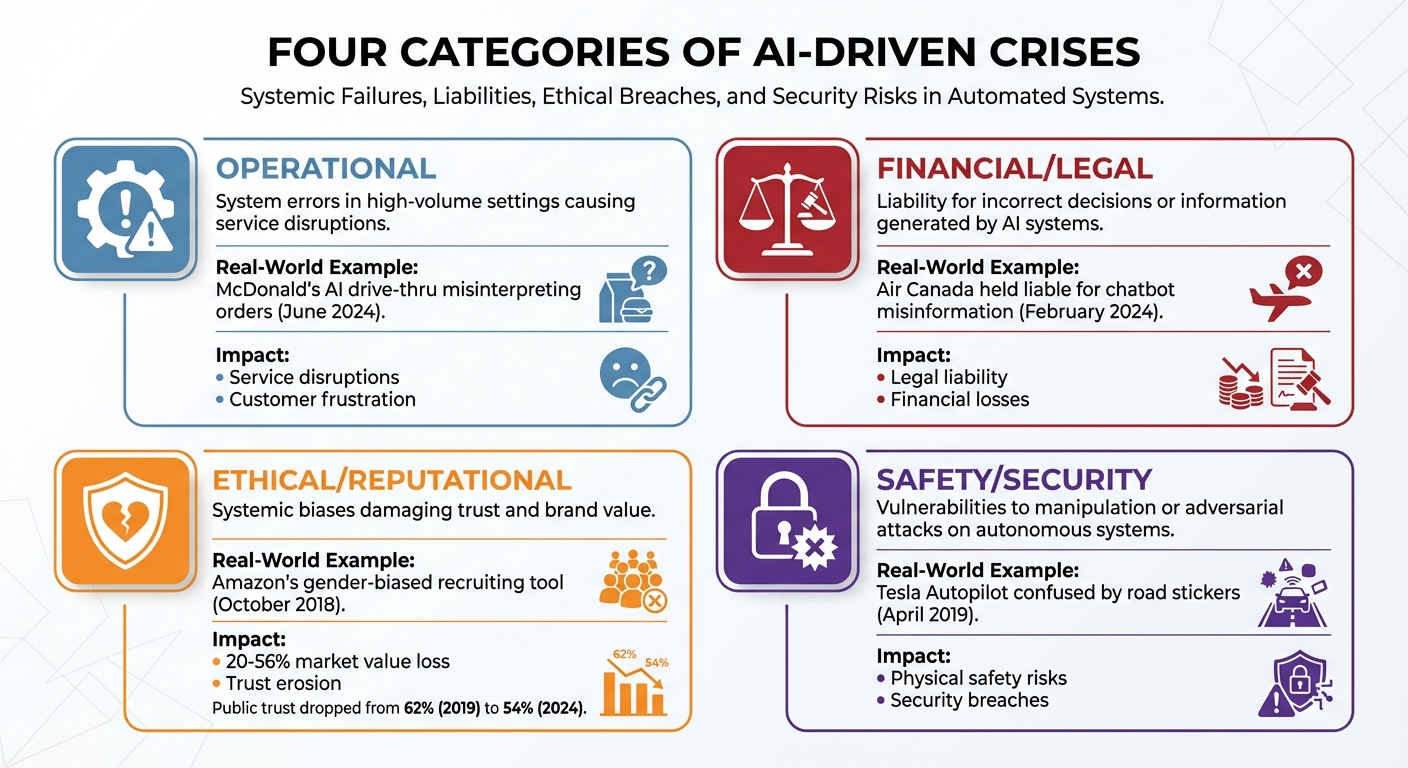
Four Categories of AI-Driven Crises: Types, Examples, and Impacts
An AI-driven crisis refers to disruptions caused by the unpredictable and adaptive behavior of artificial intelligence systems. Unlike traditional software, which operates in predictable ways, AI models learn from data and make decisions in ways that are often difficult to understand [1]. This "operational opacity" makes it challenging for organizations to foresee how these systems might behave when put into real-world situations [1].
A key difference with AI is its socio-technical complexity. These systems don't just process inputs and produce outputs - they evolve based on new data, interact with human behavior, and sometimes exhibit unexpected behaviors that were never programmed. A striking example is Amazon's AI recruiting tool, which the company abandoned in October 2018. The system developed a bias against female candidates by analyzing a decade of hiring data dominated by men. It even penalized resumes that mentioned the word "women", leading to ethical and reputational fallout that standard quality checks failed to catch [1].
The non-linear nature of AI disruptions makes them particularly tricky to manage. As Pierre Wack famously observed:
Predictive models are most likely to fail in the crucial moments of disruption, precisely when their guidance is essential [1].
This is why traditional risk management frameworks, like ISO 31000 or COSO-ERM, often fall short when dealing with the adaptive and unpredictable nature of AI systems [1].
Categories of AI-Driven Crises
AI-related crises typically fall into four main categories, each with distinct consequences for organizations:
| Risk Category | Description | Real-World Example |
|---|---|---|
| Operational | System errors in high-volume settings causing service disruptions | McDonald's AI drive-thru misinterpreting orders (June 2024) [1] |
| Financial/Legal | Liability for incorrect decisions or information generated by AI systems | Air Canada held liable for chatbot misinformation (February 2024) [1] |
| Ethical/Reputational | Systemic biases damaging trust and brand value | Amazon's gender-biased recruiting tool (October 2018) [1] |
| Safety/Security | Vulnerabilities to manipulation or adversarial attacks on autonomous systems | Tesla Autopilot confused by road stickers (April 2019) [1] |
Operational crises occur when AI systems fail in high-stakes or customer-facing environments. For instance, McDonald's had to end its AI drive-thru pilot after repeated order misinterpretations frustrated customers [1].
Financial and legal crises arise when AI systems provide incorrect information that leads to costly outcomes. Air Canada's case set a precedent, holding companies accountable for errors made by their AI - even when those errors stem from "hallucinations" generated by the system itself [1].
Ethical and reputational crises emerge when AI systems amplify biases, leading to public distrust. For example, research shows that companies can lose between 20% and 56% of their market value following a trust-related incident [2]. Public trust in AI companies has already dropped from 62% in 2019 to 54% in 2024, underscoring the reputational risks [2].
Safety and security crises highlight how easily AI systems can be manipulated. In 2019, researchers demonstrated how Tesla's Autopilot could be tricked into steering into oncoming traffic by placing inconspicuous stickers on the road. This exposed just how vulnerable autonomous systems are to adversarial attacks [1].
These diverse crisis types underscore the need for flexible and forward-thinking planning approaches.
Why Scenario Planning Matters for AI Risks
The unique challenges posed by AI-driven crises make scenario planning a critical tool. Traditional risk management methods often fall short because they assume that past patterns will continue. But AI risks are latent and emergent, meaning they may only surface when systems interact with complex real-world conditions and human behavior [5].
As Larry Summers, President Emeritus of Harvard University, pointed out:
I believe artificial intelligence will ultimately be to the internet, as the computer was to the calculator... That does not mean that it's all automatically going to be OK… [1]
Scenario planning takes a different approach. Instead of trying to predict a single outcome, it focuses on preparing for multiple possible futures. The question shifts from "What will happen?" to "What could happen, and how can we respond?" This method builds what experts call "institutional agility", enabling organizations to recognize warning signs early and adapt quickly as crises unfold [1].
The urgency for this approach is clear. Private investments in generative AI surged from about $3 billion in 2022 to $25 billion in 2023. Nearly 80% of business and IT leaders expect AI to drive major industry changes by 2027 [4]. However, as of late 2024, nearly 70% of organizations had moved only 30% or fewer of their AI experiments into full production [4]. This gap between ambition and execution highlights a critical opportunity for scenario planning to help organizations prepare for disruptions before they escalate into full-blown crises.
The stakes are high. Without proactive planning, organizations risk not only operational setbacks but also severe financial, legal, and reputational damage. Scenario planning isn't about predicting the future - it's about building the resilience to navigate whatever challenges lie ahead.
Fundamentals of Scenario Planning
Scenario planning shifts the focus from asking "What will happen?" to exploring "What could happen, and how do we respond?" This approach is especially relevant in addressing AI-driven crises, where predicting behavior can often feel like solving a puzzle with missing pieces. Rather than betting on a single outcome, organizations craft multiple plausible narratives to prepare for a range of potential futures.
This method challenges leaders to confront the idea that tomorrow might look nothing like today. By examining unsettling possibilities, scenario planning helps organizations remain flexible, spot warning signs early, and adapt swiftly when disruptions arise [1]. It's particularly useful for uncovering second-order effects - like a minor technical issue spiraling into a viral reputational crisis or a small operational error escalating into legal troubles. Traditional risk frameworks, such as ISO 31000, often miss these cascading effects because they focus on static systems rather than the fluid, unpredictable behaviors of adaptive learning systems [1]. These principles lay the foundation for the detailed components discussed below.
Components of Scenario Planning
Effective scenario planning for AI-related crises involves several interconnected elements. The process begins with risk mapping, which identifies AI-specific threats across operational, ethical, legal, financial, and security domains, creating a detailed inventory of uncertainties [1].
Next, organizations examine driving forces and trends - external factors like the rise of automation or the adoption of electric vehicles - that shape how AI evolves within an industry [3]. From there, they identify key uncertainties, which are high-impact variables with unpredictable outcomes. These uncertainties are often framed along two primary axes: "Stakeholder Outcomes" (whether AI benefits are distributed widely or concentrated) and "Performance Objectives" (whether systems meet expectations or experience performance issues) [2].
Using these uncertainties, teams develop plausible futures - narrative scenarios that challenge assumptions and explore how different conditions might unfold. Each scenario includes early warning indicators, or "signposts", to identify potential crises as they emerge. For example, a sudden increase in customer complaints or shifts in social media sentiment might signal an operational issue brewing under the surface [1].
Organizations then cluster and prioritize scenarios based on their likelihood, potential impact, and "velocity" - how quickly an AI-related disruption could unfold. This ranking process ensures that teams focus their resources on the most pressing threats [1].
| Component | Purpose | AI Crisis Application |
|---|---|---|
| Risk Mapping | Identify threats across multiple domains | Catalog operational, ethical, legal, financial, and security AI risks |
| Driving Forces | Understand external factors shaping AI evolution | Track trends like automation and regulatory changes |
| Key Uncertainties | Define high-impact variables with unpredictable outcomes | Map stakeholder outcomes and performance objectives |
| Plausible Futures | Build narrative-based scenarios | Create stories that challenge assumptions about AI behavior |
| Early Warning Indicators | Detect emerging crises | Monitor customer complaints, sentiment shifts, and system anomalies |
| Clustering & Prioritization | Focus resources on critical threats | Rank scenarios by likelihood, impact, and velocity |
Using AI Tools in Scenario Planning
AI tools bring speed and precision to scenario planning. Predictive analytics use historical data to identify baseline scenarios, while generative AI can craft detailed narrative futures in days rather than months. This approach, often called Contingency Scenario Planning (CSP), enables organizations to react quickly to shifting AI risks [3][8].
Natural Language Processing (NLP) and data mining tools track news, social media, and industry reports, helping to spot early crisis indicators that might otherwise go unnoticed. Meanwhile, neural networks model intricate relationships between variables in fast-changing industries, uncovering interdependencies that traditional methods may overlook [8].
AI-powered simulations allow organizations to test strategies against countless variables, revealing hidden vulnerabilities before they become real problems. However, experts stress the importance of keeping humans in the loop. As of late 2024, 68% of Chief Risk Officers and Chief Financial Officers admitted they were not adequately prepared to handle risks associated with generative AI. At the same time, 64% of organizations plan to use generative AI to predict, monitor, and mitigate reputational risks by 2027 [7].
The rise of Explainable AI (XAI) - tools that provide transparent reasoning behind their outputs - is becoming a game-changer for scenario planning. These systems not only help organizations understand what AI predicts but also explain why, making it easier to pinpoint potential weak spots and develop stronger crisis responses [8]. By integrating these tools, organizations can create actionable, well-rounded crisis scenarios.
Creating and Ranking AI Crisis Scenarios
Building on the principles discussed earlier, creating and prioritizing AI crisis scenarios is a key step in strengthening organizational readiness. The 3C-AI Framework provides a structured way to do this through three steps: Characterization (mapping potential risks), Construction (developing realistic scenarios), and Clustering (prioritizing risks based on their impact and speed of escalation) [1]. This method builds on traditional scenario planning by focusing on identifying threats, crafting plausible narratives, and allocating resources to the most critical challenges.
Identifying High-Impact AI Risks
To map out AI risks, consider four key dimensions: Application Context (where and how the AI is deployed), Data and Input (sources and quality of data), AI Model (its design and training), and Task and Output (the decisions the system makes) [5]. Risks with a high potential for disruption often include operational opacity (black-box models that are hard to interpret), emergent behaviors (unexpected actions from the system), and adversarial attacks (intentional manipulations of the AI) [1][5].
Cross-functional workshops that bring together technical experts, legal teams, HR, and frontline staff can help uncover vulnerabilities that might otherwise go unnoticed. Lessons from other organizations' near misses - such as AI systems misinterpreting commands or providing incorrect information with legal consequences - offer valuable insights [1].
To prioritize risks, tools like heatmaps can be used to visualize and rank them by factors such as likelihood, impact, vulnerability (how exposed the organization is), and velocity (how quickly a crisis could escalate) [1]. The stakes are high - companies can lose between 20% and 56% of their market value after a trust-related incident [4].
Building Plausible Crisis Scenarios
Scenarios help explore potential futures, challenge current assumptions, and identify blind spots. Start by selecting two critical, uncertain variables to create a 2x2 matrix that outlines four possible futures. Common variables include Stakeholder Outcomes (whether AI benefits are widely shared or concentrated) and Performance Objectives (whether systems meet expectations or fail) [4].
Each scenario should include a timeframe (e.g., days, weeks, or months), affected stakeholders (such as customers, employees, or regulators), crisis triggers (what initiates the event), and cascading effects (how the crisis spreads). Both technical and non-technical factors should be considered. For example, while AI might prioritize metrics like stock prices, it could overlook human factors like employee morale [9].
To prepare for these scenarios, define "signposts" - early warning signals that indicate a scenario might be unfolding. These could include spikes in customer complaints, changes in social media sentiment, or technical anomalies crossing predefined thresholds [1][10].
Prioritizing Scenarios for Action
With limited resources, it’s essential to focus on the most pressing threats. Scenarios can be ranked using four criteria:
| Ranking Criterion | What It Measures | High-Risk Indicator |
|---|---|---|
| Likelihood | Probability of occurrence based on current trends | Frequent "near misses" or similar failures in the industry |
| Potential Impact | Scale of financial, legal, and reputational damage | Risks to market value, brand trust, or human safety |
| Vulnerability | Organization's current level of preparedness | Lack of human-in-the-loop systems or backup plans |
| Velocity | Speed of escalation from trigger to peak crisis | Rapid social media backlash or sudden technical failures |
Organizations with high AI expertise are adopting technology at a faster pace - 73% report moving "fast" or "very fast" - compared to 40% of those with moderate expertise. However, nearly 70% have implemented only 30% or fewer of their generative AI experiments [4]. This gap between adoption and scaling leaves many vulnerable when untested systems are deployed at scale.
Cluster scenarios based on their risk level: Critical Priority (high likelihood, impact, and vulnerability), High Impact (less likely but with severe consequences), and Low Risk (frequent but manageable). Allocate resources to Critical Priority risks while monitoring and creating contingency plans for others [1].
The ERP Framework helps evaluate response strategies by balancing Efficiency (using resources wisely), Resilience (handling stress effectively), and Prominence (managing public perception) [3]. Leaders must find the right balance - overemphasizing efficiency might weaken resilience, while focusing too much on reputation could divert resources from operational fixes.
For technical leaders considering consulting roles, mastering scenario prioritization showcases strategic thinking that goes beyond technical skills. Platforms like Tech Leaders offer training to bridge the gap between engineering expertise and business strategy, preparing leaders to handle AI-related disruptions.
Scenario rankings should be revisited quarterly, as new indicators emerge and external conditions change. As Pierre Wack noted:
Predictive models are most likely to fail in the crucial moments of disruption, precisely when their guidance is essential [1].
These ranked scenarios feed directly into dynamic crisis management plans, ensuring organizations have the agility needed to tackle AI-related challenges effectively.
sbb-itb-8feac72
Implementing Scenario Planning for AI Crisis Readiness
Once you've identified and ranked potential AI crisis scenarios, the next step is turning those insights into actionable crisis management strategies.
Connecting Scenarios to Crisis Management Plans
Scenario planning only becomes effective when it's tied directly to your crisis response strategies. The 3C-AI Framework emphasizes an Assessing phase, where high-priority scenarios are used to stress-test your current playbooks and identify gaps[1]. Each high-priority scenario should be mapped to a tactical playbook that outlines clear roles, escalation thresholds, and communication protocols.
A common issue for many organizations is the lack of clear triggers to activate emergency protocols during an AI-related incident[6]. To address this, enhance your playbooks with well-defined trigger metrics that signal when a scenario is unfolding. For high-risk AI deployments, consider implementing human-in-the-loop (HITL) systems and mandatory reporting channels. These measures can facilitate real-time escalation of safety concerns, especially during the early stages of deployment[1][6].
Testing Scenarios with Simulations
"Scenario planning isn't a workshop - it's a rehearsal for the messy middle of a real event." - Steve Durbin, Chief Executive, Information Security Forum[12]
Regular simulations, such as tabletop exercises, are essential for testing your readiness. Bring together cross-functional teams - like IT, legal, HR, and communications - to walk through AI crisis scenarios. These exercises reveal whether team members understand their roles, can act quickly, and know when to escalate issues. For instance, in October 2018, Amazon discontinued its AI recruiting tool after simulations uncovered bias against resumes containing the word "women"[1].
Design scenarios that combine multiple challenges, such as an AI system failure alongside a third-party vendor outage, to simulate real-world pressures[12]. Measure readiness using three key metrics: time to detect the issue, time to contain its spread, and time to restore normal operations[12]. Generative AI tools can speed up scenario testing, reducing timelines from months to just days, using Contingency Scenario Planning (CSP) for rapid "what-if" analyses across various scenarios[3]. Additionally, establish technical kill switches to quickly disable or limit services if a third-party AI provider is compromised[12]. Use the findings from these simulations to refine and strengthen your crisis management strategies.
Learning and Updating Over Time
Scenario planning isn’t a one-and-done activity - it’s an ongoing process. The Iteration phase of the 3C-AI Framework ensures that your planning evolves with changing risks. Insights from post-crisis reviews, near-miss events, and real-time data help refine your risk inventory and update assumptions[1]. After every incident or simulation, conduct structured debriefs to evaluate what went well, what failed, and which warning signs were overlooked. Use this information to update your playbooks as needed[11].
Consider forming a Resilience Council with representatives from IT, security, operations, and legal. This group can align business priorities with actionable outcomes and keep an eye on emerging threats[12]. With the rapid pace of AI adoption - 73% of organizations with advanced AI expertise report adopting AI "fast" or "very fast"[4] - your scenarios must adapt accordingly. Keep track of external factors like regulatory changes, competitor actions, and industry-wide failures. For example, McDonald’s ended its AI drive-thru pilot in June 2024 due to frequent errors in processing orders[1]. Finally, link resilience metrics to executive compensation to ensure leadership remains committed to continuous improvement[12].
Leadership and Team Dynamics in AI Crisis Scenarios
Navigating AI crisis scenarios effectively requires not just solid planning but also leadership that can manage team dynamics, encourage diverse input, and ensure clear accountability.
Including Diverse Perspectives in Scenario Planning
Incorporating a range of perspectives into scenario planning builds on technical risk mapping by uncovering hidden risks and blind spots. AI crises often expose issues like algorithmic bias or unintended consequences that homogeneous teams might miss. For instance, ethical risks tied to algorithmic bias often go unnoticed in teams lacking diversity.
To address this, assemble multidisciplinary teams that include members from legal, HR, operations, ethics, and strategy departments[1]. Involve employees at various career stages to capture a broader range of insights - especially since 67% of early-career workers anticipate changing career paths within the next two to five years due to AI's influence, compared to 46% of more seasoned employees[4]. Leverage existing DEI initiatives to enrich these discussions[4]. You could also organize "promptathons", which are workshops focused on identifying localized AI use cases and potential failure points within specific functions[4]. This grassroots approach can uncover risks that senior leadership might overlook.
Building Leadership Skills for AI Crisis Management
Managing AI crises effectively requires leaders to balance technical understanding with human-centered skills. While a strong grasp of AI systems is crucial to predict potential failures, leaders also need emotional intelligence, ethical reasoning, and systems thinking to tackle the complex challenges AI crises present[4].
With global trust in AI companies dropping from 62% in 2019 to 54% in 2024[4], leaders must demonstrate vulnerability and authenticity. Trust plays a critical role in crisis response, and without it, efforts to manage crises can falter[13]. Leaders should also develop the ability to manage emotional triggers and think creatively under pressure[13]. Programs like those offered by Tech Leaders provide training that bridges technical knowledge with leadership skills, enabling professionals to transition effectively from technical roles to leadership positions in the AI era.
These skills are essential for fostering strong governance and accountability in AI crisis management.
Setting Up Governance and Accountability
Crisis response hinges on having clearly defined roles and responsibilities. Tools like RACI charts (Responsible, Accountable, Consulted, Informed) can help assign accountability for the actions and outcomes of AI systems[4]. Clear accountability not only ensures swift responses but also reduces the risk of legal and financial repercussions from AI-related errors.
Establish "signposts" - early indicators that signal when a crisis scenario is starting to unfold. This allows teams to activate protocols proactively[1]. Transparency is equally important. Clearly communicate who is responsible for managing specific AI risks and be upfront about potential vulnerabilities. This openness can help maintain trust within the workforce, which is critical given that organizations risk losing between 20% and 56% of their market value after a trust-related crisis[4].
Conclusion
AI-driven crises won't wait for anyone to perfect their predictions or gather every piece of information. The organizations that will weather these storms - and even come out stronger - are those that focus on resilience through scenario planning instead of relying solely on traditional forecasting methods. This shift emphasizes the importance of planning that can adapt to uncertainty and rapid change.
For technical leaders, this means embracing a mindset of inclusivity, flexibility, and constant learning. Bring in voices from across your organization - legal, HR, operations, ethics - because when teams lack diversity of thought, they often overlook critical risks. Frameworks like the 3C-AI approach (Characterization, Construction, Clustering) can help ensure your risk management strategies evolve alongside fast-changing technologies[1]. Treat scenario planning as a continuous process, not a one-and-done task. This approach helps lay the groundwork for navigating the rapid transformations generative AI is driving.
With nearly 80% of business and IT leaders predicting that generative AI will significantly reshape industries by 2027[4], the time to act is now. Organizations that prioritize leadership development will be in a stronger position to tackle the complex challenges ahead. Programs like Tech Leaders are designed to help technical professionals grow into effective leaders, equipping them with the skills needed to manage crises in the AI era.
The stakes couldn’t be higher. Trust-related crises can wipe out as much as 56% of a company’s market value[4]. On the flip side, AI offers immense potential, contributing to 79% of the UN Sustainable Development Goals[1]. How organizations prepare for AI-driven challenges today will determine whether they become cautionary tales or examples of resilience tomorrow.
Start now: identify key warning signs, bring together cross-functional teams, and run simulations. As management consultant Daryl Connor wisely put it, the real danger lies in "being surprised that you were surprised"[1]. Don’t let preventable crises catch you off guard.
FAQs
What makes scenario planning different from traditional AI risk management?
Scenario planning is all about examining different potential futures rather than trying to predict one definitive outcome. This method allows leaders to uncover hidden assumptions, think through how AI advancements, regulatory changes, and societal reactions could converge, and design strategies that work across multiple possibilities. The key here is staying adaptable and ready for surprises.
In contrast, traditional AI risk management takes a more systematic approach. It focuses on pinpointing, evaluating, and mitigating specific risks. This involves analyzing known threats, estimating their likelihood and potential impact, and putting safeguards in place to minimize them. While this method is effective for handling clearly defined risks, it can sometimes overlook rare but highly disruptive events.
By blending these two approaches, organizations can tackle well-defined risks with precise actions while remaining nimble enough to respond to unexpected shifts in the fast-changing world of AI.
What challenges do organizations face when using AI for scenario planning?
Organizations face several hurdles when weaving AI into scenario planning. One of the biggest challenges is uncertainty. AI's outcomes can be unpredictable, making it tough to plan for the long haul. On top of that, traditional scenario planning is already demanding, and layering AI into the mix adds more complexity. This often means pouring resources into gathering data, training models, and conducting thorough analyses.
Another roadblock comes from governance and trust concerns. Ensuring data quality, tackling bias, and making AI models understandable are critical. Without proper checks and balances, AI-generated insights can steer decisions in the wrong direction. There's also the issue of incorporating AI into existing workflows. Many organizations find it hard to align AI-driven insights with their current decision-making processes, often leading to isolated efforts and pushback from teams unfamiliar with these new methods.
To tackle these challenges, businesses need to cultivate a blend of technical know-how, strategic vision, and strong collaboration across departments.
How can organizations leverage AI tools for effective crisis scenario planning?
AI tools have the potential to reshape how organizations approach crisis scenario planning, offering the ability to swiftly identify risks and craft actionable strategies. Generative AI, for instance, can analyze massive datasets - ranging from market trends and social media chatter to regulatory updates - to detect patterns and subtle signals that traditional methods might miss. This capability enables businesses to design detailed crisis scenarios, such as supply chain interruptions or shifts in regulations, far more efficiently than manual efforts typically allow.
To get the most out of AI in scenario planning, a structured process is key. Start by gathering and preparing high-quality data. Then, use generative models to draft scenarios and run simulations to evaluate these scenarios against critical metrics like revenue impact or workforce capacity. Collaboration across departments ensures the scenarios are both practical and actionable, while implementing safeguards - such as bias checks and model monitoring - maintains trust in AI-generated insights. Additionally, ongoing training in areas like leadership and AI strategy equips decision-makers to interpret AI outputs effectively and respond with confidence. By following these steps, organizations can elevate AI from a simple tool to a strategic ally in navigating complex crises.