

How to Use Scenarios for Cross-Cultural Leadership Training
Scenario-based learning helps leaders practice decision-making in diverse settings without real-world risks. It builds the skills needed to manage global teams effectively. Here's how it works:
- Cross-Cultural Competence: Leaders learn to interpret behaviors through different cultural perspectives, avoiding costly missteps. For example, a company lost $1M in China by ignoring local norms.
- Why Scenarios Work: They provide safe, interactive spaces to test solutions and improve performance by up to 70%.
- Steps to Success:
- Design Realistic Scenarios: Base them on real challenges like communication styles or hierarchy differences.
- Choose Formats & Tools: Options include branching scenarios, VR, or AI-powered platforms.
- Run & Debrief: Facilitate discussions to connect lessons to workplace realities.
- Measure & Scale: Track improvements and integrate scenarios into broader training programs.
This method prepares leaders to handle complex global challenges, improving team dynamics and decision-making.
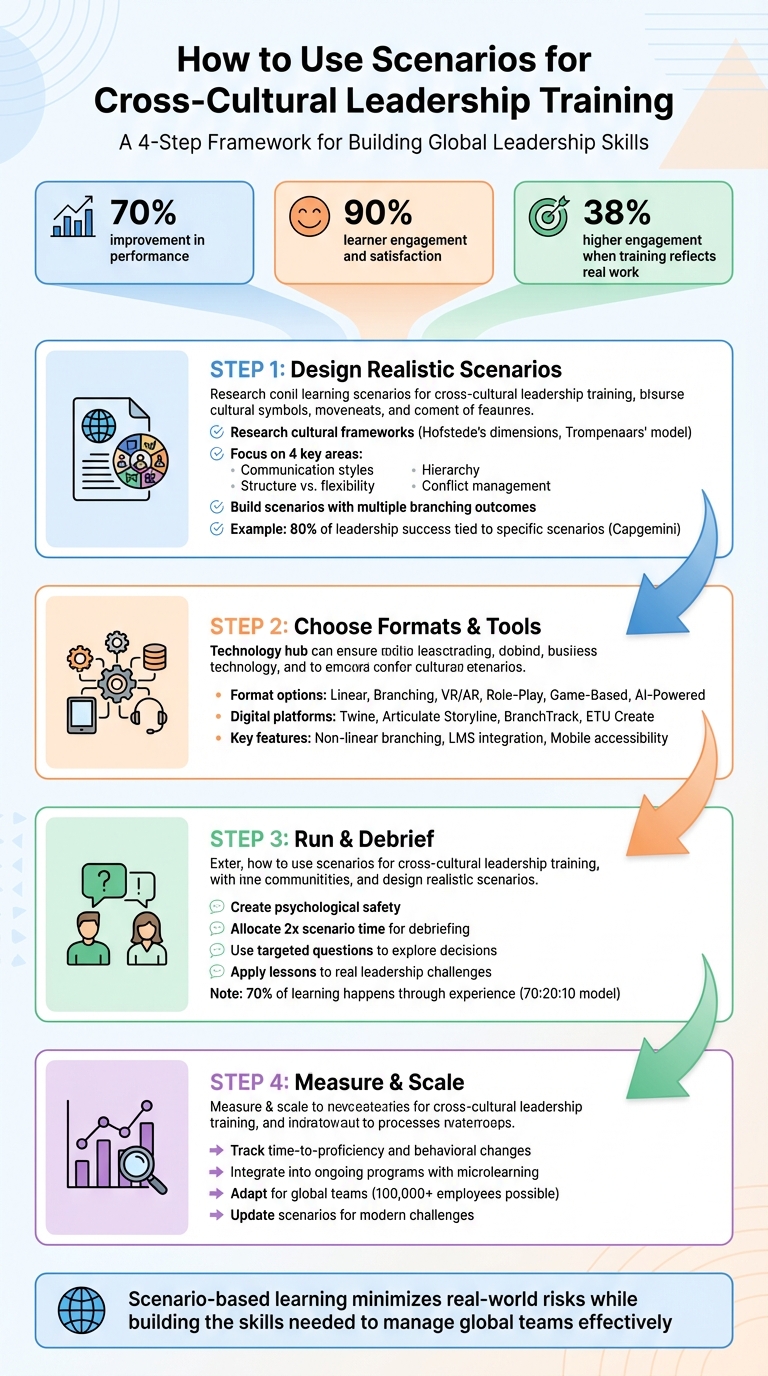
4-Step Process for Implementing Cross-Cultural Leadership Scenario Training
Developing Cross Culturally Competent Leaders and Managers
sbb-itb-8feac72
Step 1: Design Scenarios That Reflect Real Situations
Creating effective scenarios starts with realistic situations that leaders actually encounter. The aim is to replicate the complexity of real-world cross-cultural interactions rather than presenting oversimplified "right or wrong" choices. To achieve this, you'll need to research how different cultures approach communication, hierarchy, and conflict. This research becomes the foundation for scenarios that challenge leaders and refine their cross-cultural decision-making skills.
Research Key Themes and Norms
To design meaningful scenarios, it's essential to explore cultural frameworks like Hofstede's dimensions or Trompenaars' model. Hofstede's dimensions categorize national tendencies across six areas: Power Distance, Individualism vs. Collectivism, Uncertainty Avoidance, Masculinity vs. Femininity, Long-term Orientation, and Indulgence vs. Restraint [5][7][9]. Trompenaars' model adds depth by examining cultural priorities, such as rules versus relationships (Universalism vs. Particularism) or emotional expression in professional settings (Neutral vs. Affective) [5][7].
When addressing leadership challenges, focus on four key areas: communication styles (direct vs. indirect), perspectives on hierarchy, preferences for structure versus flexibility, and approaches to conflict management [6][8]. Use both qualitative methods (like interviews and field observations) and quantitative surveys to uncover underlying beliefs and patterns [7]. For global teams, pay close attention to visual and symbolic cues - colors, icons, and imagery carry different meanings across cultures and can significantly impact the scenario's credibility [5][7][9].
A creative research method is the "Bollywood Technique", particularly useful in collectivist cultures where direct feedback might be uncomfortable. This approach uses hypothetical, fantasy-based narratives to encourage open and honest input without fear of judgment [9]. Additionally, open-ended cultural probes - such as written, drawn, or photographed responses - can reveal deeper motivations and everyday realities [9].
Build Scenarios With Multiple Outcomes
Use your research to design decision points with realistic and varied outcomes. Scenarios should include branching logic that reflects the complexity of real-world decisions, offering outcomes that range from effective to less effective, rather than labeling choices as simply "right" or "wrong" [10]. For example, if a leader publicly addresses a missed deadline in a high-context culture, the scenario could show the team member losing face and disengaging, rather than just displaying a generic "incorrect" message [11].
To avoid obvious answers, create decision structures that challenge learners. Collaborate with subject matter experts to identify common leadership missteps and incorporate these as tempting but flawed options [10]. Before diving into complex branching paths, test a single decision point with stakeholders to ensure the tone and difficulty are appropriate [10]. Use flowcharts to map out narrative paths, which helps keep the branching manageable [10][11]. Include recovery paths so learners can recognize poor choices and adjust their approach, ultimately achieving better outcomes [10].
Examples of Scenarios That Work
Focus on "moments that matter" - situations where leadership behavior directly impacts business outcomes. At Capgemini, research found that 80% of leadership success or failure could be tied to specific scenarios [2]. Common examples include mediating creative conflicts (e.g., balancing differing cultural attitudes toward risk-taking and brand alignment), addressing performance issues (e.g., handling missed deadlines while respecting cultural norms around directness), and celebrating success (e.g., tailoring recognition to cultural preferences, such as private versus public acknowledgment) [4].
One example could involve crafting a scenario where a leader provides feedback in France versus Japan. In France, direct and critical feedback delivered in a one-on-one setting might be effective, whereas in Japan, feedback framed with indirect language and a focus on group harmony is more appropriate. Each path should show realistic consequences: the French team member values the clarity and improves quickly, while the Japanese team member responds better when the feedback is framed as a collective goal. To make the scenarios even more realistic, include constraints like time pressure, budget limitations, or incomplete information [2][1]. These strategies ensure scenarios simulate real-world challenges while building the leadership skills necessary for managing global teams effectively.
Step 2: Choose Scenario Formats and Tools
Once you've crafted realistic scenarios, the next step is deciding how to deliver them. The format you choose will influence how well your scenarios teach concepts or simulate high-pressure decision-making. This decision builds on your work in Step 1, helping you determine the best way to replicate the complexity of cross-cultural decision-making.
Comparing Scenario Formats
Different formats offer unique advantages depending on your goals. Here's a closer look:
- Linear Scenarios follow a single path where decisions lead to immediate feedback. They're great for onboarding and reinforcing basic cross-cultural concepts but lack the depth to explore complex leadership challenges [11][13].
- Branching Scenarios provide a more nuanced experience by offering multiple paths based on decisions. These are perfect for practicing ambiguous, "no right answer" situations - exactly the kind of challenges leaders face when navigating cultural differences [10][11][13].
- VR/AR Simulations are ideal for safely recreating high-pressure environments. Companies like IBM and Merck use these tools to train leaders in areas like providing feedback and managing conflict in diverse teams [2].
- Role-Play Formats, whether live or digital, shine when it comes to developing empathy and soft skills through dialogue [12][1].
- Game-Based Learning adds points, levels, and timers to boost engagement. It's particularly effective in competitive environments but can sometimes shift focus from learning to "winning" [1][11].
- AI-Powered Scenarios adapt dynamically to individual performance using synthetic avatars and scripts. In 2024, Capgemini implemented an emerging leaders program with ETU's immersive simulation platform, focusing on critical decision points that accounted for 80% of leadership success or failure. This approach improved leaders' proficiency by providing repeatable, focused practice [2]. Research shows that when scenarios reflect real workplace situations, 38% of learners report higher engagement [11].
| Format | Best For | Pros | Cons |
|---|---|---|---|
| Linear Scenarios | Basic comprehension | Easy to create, clear structure | Less effective for complex situations |
| Branching Scenarios | Decision-making practice | Engaging, shows consequences | Can be complex to design |
| Immersive (VR/AR) | High-pressure situations | Highly realistic, safe environment | Costly and requires technical resources |
| Role-Play (Digital) | Soft skills development | Great for empathy and dialogue training | May lack immersive realism |
| Game-Based Learning | Motivation, engagement | Fun and engaging mechanics | Risk of prioritizing "winning" over learning |
| AI-Powered | Scalability | Dynamic and customizable | Requires advanced tools |
Leveraging Digital Tools for Delivery
Choosing the right platform is essential for making your scenarios scalable and accessible to global teams. Once you've selected your format, pick a tool that supports your vision and accommodates distributed learners.
- Twine is a free, open-source tool ideal for sketching and testing complex branching scenarios [10][15].
- For polished, professional delivery, tools like Articulate Storyline, Adobe Captivate, and Lectora offer non-linear navigation and decision-based learning [15].
- Platforms like BranchTrack and iSpring Talkmaster are specifically designed for interactive branching scenarios [15].
- ETU Create simplifies the production of AI-driven simulations with realistic scripts, decision points, and synthetic avatars [2].
- Tools like Scenario.com ensure consistency by generating on-brand visuals and characters for your training [14].
When selecting a platform, prioritize features like non-linear branching capabilities, LMS integration for tracking learner decisions, multimedia support for realistic scenarios, and mobile accessibility for global participation [1][15].
"Make it real. And by that, I mean something that would really happen in the real world... This level of authenticity will ensure your scenarios help people connect back to their own tasks and context." - Cammy Bean, Author and eLearning Expert [15]
Start small by writing and testing a single decision point with stakeholders to ensure the challenge level feels right [10]. Look for tools that encourage learners to interact with the scenario, like clicking on virtual files or engaging with characters, instead of passively reading bullet points [15]. Platforms that provide "intrinsic feedback" - where learners see the consequences of their choices play out rather than receiving simple "Correct/Incorrect" messages - are especially effective [1][10]. By using these tools, you can prepare leaders to tackle cross-cultural challenges with practical, real-world skills.
Step 3: Run and Debrief Scenarios
Now that you’ve crafted your scenarios and chosen the right tools, it’s time to bring them to life. This step is where theory meets practice, helping leaders develop real-world skills. Running cross-cultural scenarios isn’t just about hitting "play" on a simulation - it’s about creating an environment that encourages reflection and connects the experience to workplace realities.
How to Facilitate Scenarios
Start by clearly briefing participants on the scenario, the tools being used, and the purpose of the session. Whether the goal is skill-building or performance evaluation, setting expectations upfront ensures participants know how to approach the exercise.
Creating psychological safety is non-negotiable. Participants should feel free to explore different viewpoints and even make mistakes without fear of judgment. Confidentiality is key to fostering this openness.
Set the scene by providing context - what’s the team dynamic? What’s the business challenge or stakeholder concern? If you’re using digital tools like VR, ensure everyone is comfortable with the technology to avoid unnecessary distractions. Structure the session thoughtfully, allowing time for both small-group discussions (about 5–8 minutes) and larger group reflections. A dry run can help iron out any logistical wrinkles.
Once the scenario concludes, shift gears to the debrief. This is where the real learning happens, as participants analyze their experiences and translate them into actionable leadership insights.
Lead Debriefing Sessions
Allocate at least twice the scenario time for debriefing. Use this time to unpack the decisions made, examine cultural assumptions, and explore the lessons learned.
"The debrief creates an opportunity for learners to explore their emotions and perspectives while considering the implications of their learning to practical situations." - INACSL Standards Committee [17]
Encourage participants to focus on what they observed rather than jumping to personal judgments. As noted by Greater Good in Education:
"Evaluative statements are inherently interpretative", which underscores the importance of recognizing how cultural perspectives shape interpretations [16].
Use targeted questions to spark discussion. For example: What made this scenario particularly challenging? How did individual perspectives shape the outcome? What actions could better align with organizational values? The aim isn’t to identify a single "correct" answer but to explore the thought processes and cultural frameworks behind the decisions.
Encourage participants to view the scenario from multiple angles. How might team members, senior leaders, or customers interpret the same interaction differently? This broadens their understanding of stakeholder dynamics.
Apply Lessons to Leadership Challenges
After debriefing, focus on applying the takeaways to real-world leadership situations. Wrap up by identifying actionable steps that connect the scenario’s insights to core leadership skills and organizational values, ensuring the lessons remain relevant to daily work.
"The feedback mechanism is where learning really happens. Effective feedback should... explain the thinking: Help learners understand why certain approaches work better in specific contexts." - ETU [2]
Reinforce these lessons with follow-up activities like journaling or coaching sessions to help participants internalize what they’ve learned. A Critical Action Checklist can be a useful tool to pinpoint areas for improvement. Keep in mind the 70:20:10 learning model, which emphasizes that 70% of learning comes through experience. Well-designed scenarios allow participants to practice decision-making, experience outcomes, and adapt - all in a risk-free environment [18].
Step 4: Measure Results and Scale Training
Track Competence Improvements
To gauge the effectiveness of your training, focus on measurable outcomes like time-to-proficiency and visible leadership behaviors after training. For instance, observe how leaders manage team conflicts or adjust their communication styles when working across different cultures after completing the scenarios [10].
Digital tools can play a key role here, helping track decision-making patterns and identifying consistent strengths and areas for improvement. Some platforms even use systems like Experience Points (XP) and Levels to provide ongoing feedback on learner progress [1]. Pre- and post-training assessments are particularly useful for spotting shifts in competence, while participant feedback can reveal which scenarios had the greatest impact. Ultimately, the real success lies in how well leadership behaviors in these scenarios translate into actual business outcomes - like improved team performance or quicker conflict resolution [2].
The insights gained from these measurements can then guide how scenarios are incorporated into broader leadership development programs.
Add Scenarios to Ongoing Programs
Rather than treating scenarios as isolated exercises, weave them into continuous leadership development efforts. This approach reinforces cross-cultural leadership skills over time. For example, you can connect scenarios through a master narrative featuring recurring characters and evolving challenges [13]. This not only creates continuity but also allows leaders to see how their decisions play out over the long term.
Scenarios can also be integrated into microlearning modules and gamified learning paths. These methods encourage discussion and practice, ensuring the training addresses real-world challenges faced by technical leaders. Video-based scenarios can be paired with quizzes or assessments, where learner responses guide the next piece of personalized content [1].
To make training more relevant, consider using a "role selector" at the start of the program. This feature tailors scenarios based on factors like department or region, which is especially useful for large, global organizations where a one-size-fits-all approach doesn’t work. Research shows that 38% of learners are more engaged when the training reflects their actual work environment [11].
Adapt for Global Teams
Scaling scenario-based learning for global teams requires a balance between consistency and local relevance. Digital platforms can help maintain uniformity while allowing for regional adaptations. AI-powered tools, for example, can create realistic scripts and use synthetic media avatars to deliver training to teams of 100,000+ employees without the logistical challenges of flying trainers around the world [2]. Boeing, which supports 330,000 employees across 28 countries, used a combination of online cultural orientation resources, employee rotation programs, and structured classroom sessions for leaders to achieve this [3].
To ensure cultural relevance and usability, pilot the training with a diverse group [11]. Collaborate with existing employee networks, like regional groups or cultural affinity organizations, to tailor content to local nuances [3]. SAP successfully used 30 employee networks representing 89 nationalities to customize their training based on specific regional needs [3].
Keep scenarios updated to address modern challenges like remote work dynamics or shifting market conditions [2]. Digital delivery through Learning Management Systems can track learner progress across time zones while allowing for regional customization [1]. The aim isn’t just to teach cultural etiquette but to develop "global dexterity" - the ability to navigate and lead effectively even in unfamiliar situations [3].
Conclusion
Scenario-based learning takes cross-cultural leadership training from mere theory to real, hands-on practice. By implementing the four steps outlined here - crafting realistic scenarios, selecting appropriate formats and tools, conducting meaningful debriefing sessions, and evaluating results - you create a safe space for technical leaders to rehearse high-stakes cultural interactions. This approach minimizes the risk of damaging relationships or business outcomes while offering practical experience.
The impact of scenario-based training is clear: it drives 90% learner engagement and satisfaction [18] and boosts individual performance by 70% [4]. Beyond the numbers, these programs prepare technical leaders to handle global challenges with the agility required in today’s interconnected world [3].
What makes this method so effective? Scenarios seamlessly integrate technical knowledge with essential soft skills like empathy, conflict resolution, and clear communication. This is especially critical when managing remote global teams or balancing diverse stakeholder needs across regions. The experiential nature of this training aligns with the 70:20:10 learning model, where 70% of learning happens through experience [18]. Unlike passive lectures, scenario-based learning ensures lessons stick.
The secret to success lies in designing scenarios that mirror real workplace challenges, providing immediate feedback, and encouraging reflection through debriefing sessions. This equips technical leaders to face unfamiliar situations with confidence, ultimately improving team dynamics and delivering better business results.
Tech Leaders supports engineering professionals in blending technical expertise with leadership skills, enabling them to tackle cross-cultural and AI-driven challenges effectively.
FAQs
How can scenario-based training enhance cross-cultural leadership skills?
Scenario-based training takes cross-cultural leadership to the next level by placing leaders in realistic, diverse situations where they can actively put their knowledge into practice. Rather than simply learning about cultural differences in theory, participants engage in simulated interactions - like working with an international team - where they encounter subtle but important cultural dynamics. These might include variations in communication styles, decision-making processes, or attitudes toward hierarchy. This immersive, hands-on approach allows leaders to develop empathy, refine their leadership strategies, and truly grasp cultural nuances for practical use.
One of the biggest advantages of this method is that it offers a safe space to experiment. Leaders can test their approaches, make mistakes, and learn from them without facing real-world consequences. This not only makes the experience more engaging but also encourages deeper reflection on their own cultural assumptions. For instance, a scenario might reveal why a French team member and an American manager interpret the same behavior in completely different ways. By working through these differences, leaders learn how to bridge communication gaps and align expectations effectively.
Tech Leaders integrates these scenario-based exercises into its engineering leadership programs. By doing so, it prepares technical professionals to navigate cross-cultural challenges while also honing their leadership and AI strategy skills.
What are some effective scenario formats for cross-cultural leadership training?
Effective approaches to cross-cultural leadership training often include role-play simulations, where participants practice handling cultural differences during conversations or negotiations. Case studies are another powerful tool, allowing learners to analyze real-world challenges faced by diverse teams. Additionally, branching scenarios provide an interactive element, letting participants make decisions at critical moments and observe how their choices influence outcomes. This helps them better understand and respond to cultural nuances.
For a more immersive experience, formats like interactive videos or simulation games can be highly effective. These methods place participants in realistic situations, such as managing virtual international projects or interpreting non-verbal cues from different cultures. By weaving cultural dynamics into these exercises, leaders can sharpen their ability to empathize and adapt in diverse environments.
At Tech Leaders, we incorporate these techniques into our engineering leadership programs, giving professionals the chance to practice and enhance their cross-cultural leadership skills through engaging, hands-on experiences.
How can I evaluate the effectiveness of scenario-based cross-cultural leadership training?
To evaluate the success of scenario-based cross-cultural leadership training, start by defining specific, measurable goals. These might include improving cultural awareness, refining decision-making skills, or enhancing conflict resolution abilities. Begin with pre-training assessments or surveys to gauge participants' initial skill levels. After the training, use the same tools to measure progress and identify learning gains.
Beyond assessments, keep an eye on practical outcomes. For example, look for higher success rates in multicultural projects, fewer misunderstandings among diverse teams, or increased engagement across different groups. Collecting qualitative feedback from participants and their colleagues can also shed light on any noticeable shifts in behavior or team dynamics.
To gauge long-term impact, track metrics like retention of key concepts through follow-up quizzes, how well participants apply their training to real-world decisions, or even calculate ROI by comparing training costs to benefits like reduced employee turnover or quicker project completions. These strategies provide a thorough evaluation of the training's effectiveness and highlight its value to the organization.