
Why Silos Hurt Teams and How to Fix Them
Silos slow teams down, waste resources, and damage morale. They form when teams work in isolation, use disconnected tools, or lack shared goals. This leads to miscommunication, duplicated efforts, and delays. Fixing silos requires improving data sharing, aligning team incentives, and training leaders to encourage collaboration.
Key Takeaways:
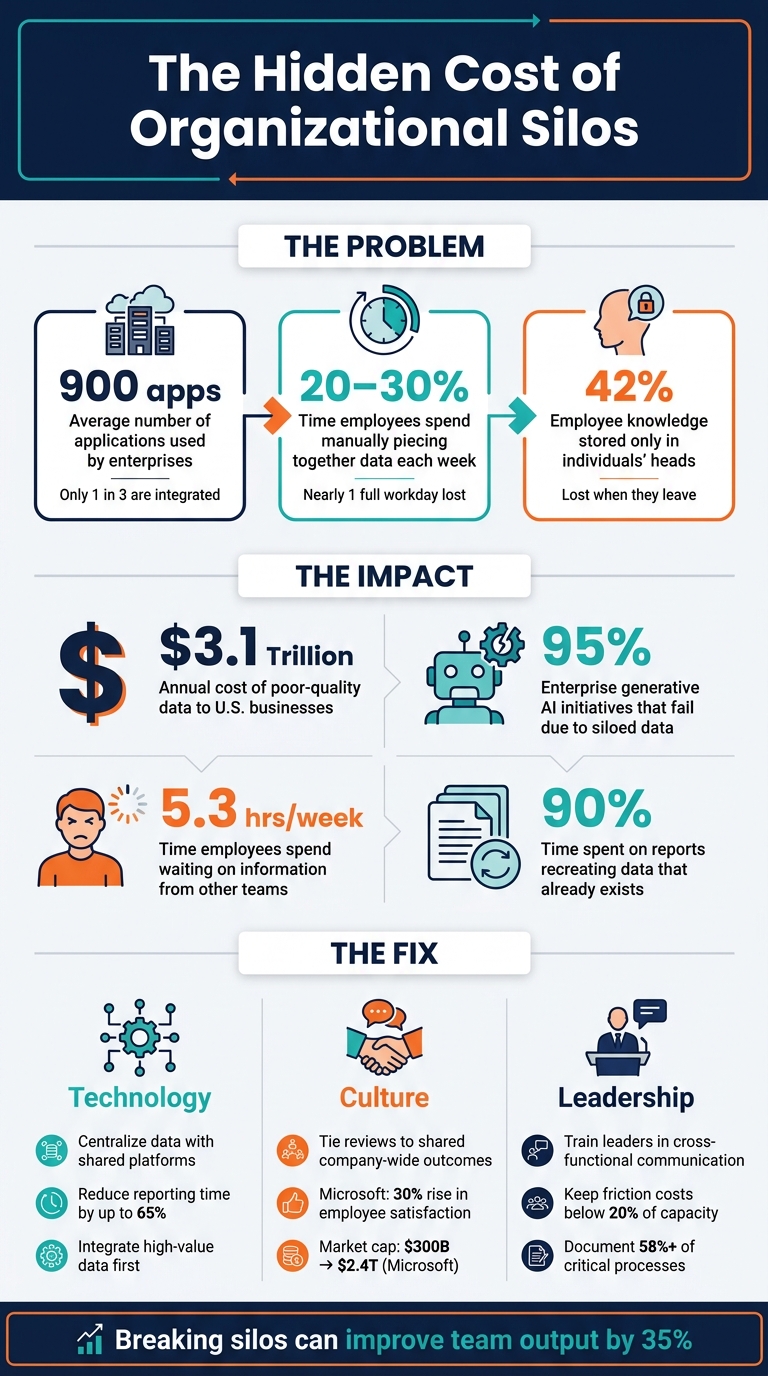
- Silos cost organizations millions: Employees spend 20% of their week searching for information, and poor data costs U.S. businesses $3.1 trillion annually.
- Disconnected tools are a major issue: The average enterprise uses 900 apps, but only a third are integrated.
- Collaboration boosts productivity: Breaking silos can improve team output by 35%.
- Leadership matters: Leaders must model and reward teamwork to break down silos.
Solution Highlights:
- Use shared platforms to centralize data and streamline workflows.
- Align team goals and incentives to prioritize organizational success.
- Train leaders to communicate effectively and bridge team gaps.
Silos won’t disappear overnight, but with the right tools, mindset, and leadership, teams can work together more efficiently.
The Hidden Cost of Organizational Silos: Key Stats & Fixes
Cross-Functional Teams Explained: Breaking Silos for Agile Success
sbb-itb-8feac72
Why Silos Form in the First Place
Silos don't just appear out of nowhere - they emerge over time due to structural issues, fragmented tools, and communication breakdowns. Pinpointing these causes is the first step toward breaking them down and fostering better collaboration.
Structural and Incentive Misalignments
Many tech organizations are structured around distinct functions - Engineering, Marketing, Product, and Sales - each with its own goals, budgets, and performance metrics. Here's where the problem lies: these metrics often reward individual team success rather than shared outcomes. For example, Engineering might focus on feature delivery speed, while Sales prioritizes closing deals. With no built-in incentive to coordinate, teams naturally operate in isolation.
"Silos are rational... They form because the incentive structures, performance metrics, and cultural norms of most organizations make local optimization... more reliably rewarded than organizational optimization." - Jacob Goldstein, Executive Director, The Leadership Laboratory [2]
This issue is amplified when senior leaders compete for resources or headcount instead of working together. Their behavior sets the tone for the rest of the organization, creating leadership silos that trickle down and reinforce division at all levels. [2]
Tool Fragmentation and Data Incompatibility
The average enterprise uses about 900 different applications, but only a third of them are integrated. [5] This means teams rely on disconnected systems: Sales uses a CRM, Engineering uses a ticketing tool, and Support logs issues elsewhere. These tools don't "talk" to each other.
The result? Employees spend 20–30% of their time manually piecing together data. [6] This isn't a people problem - it's a design flaw.
"You are forcing your colleagues and worse, your customers to serve as the integration layer between your own systems. That is an organizational design failure, not a people problem." - Patrick van de Werken, Head of EMEA, DevRev [6]
The costs of this fragmentation are staggering. Poor-quality data costs U.S. companies an estimated $3.1 trillion annually. [1] And with 60% of AI projects expected to fail by 2026 due to disorganized or incomplete data, [8] the lack of unified tools isn't just a productivity issue - it's a major strategic risk.
Cultural and Communication Barriers
Even with better structures and tools, silos can persist due to cultural challenges. Teams often focus on their own success rather than the company's overall goals. Sometimes, individuals intentionally withhold information to protect their job security, knowing that being the only one with certain knowledge or skills makes them harder to replace. [9]
"Many organizations work in silos because, frankly, working in silos is more natural than working collaboratively - it's a tribal mentality." - Ron Ashkenas, Senior Partner, McKinsey [9]
A powerful example of cultural transformation comes from Microsoft. When Satya Nadella became CEO in 2014, he replaced the company's competitive "stack ranking" system with a "growth mindset" culture that emphasized collaboration and transparency. By 2024, this shift led to a 30% rise in employee satisfaction and helped grow Microsoft's market value from $300 billion to over $2.4 trillion. [9]
Language barriers also quietly contribute to silos. For instance, Marketing and Engineering might use the same term but mean completely different things - or they might use entirely different terms for the same concept. Without a shared language, collaboration falters before it even begins. Building this common vocabulary isn't just a "nice-to-have" - it's essential for effective teamwork. [2] Addressing these cultural and communication gaps is key to breaking down silos and creating a more unified organization.
How Silos Hurt Team Performance
When silos take hold - whether through conflicting goals, disjointed tools, or internal divisions - they quietly undermine how teams operate. The damage becomes evident in slower decisions, wasted effort, and a decline in trust among team members.
Slower Decisions and Poor Data Quality
Silos make it harder for teams to share information, leading to decisions based on incomplete or outdated data. For example, a support team might address a customer complaint without realizing that a recent update from Engineering caused the issue. This disconnect results in temporary fixes that fail to address the root cause.
Siloed systems also create conflicting data definitions. Sales might classify a "qualified lead" differently than Marketing, while Engineering and Operations might use different metrics to measure uptime. These inconsistencies slow decision-making. On average, workers spend nearly 20% of their week - about one full day - just tracking down internal information[4][10]. That’s time that could be spent solving problems or driving progress.
This challenge becomes even more critical with AI investments. As SAP CEO Christian Klein explains:
"Every company you walk into has their data siloes... and when it doesn't fit, AI can't do magic immediately to say, 'I 100% understand how this data fits together.'"[8]
In fact, 95% of enterprise generative AI initiatives fail to deliver measurable results because they rely on siloed data environments[8]. These delays ripple through organizations, creating further inefficiencies.
Misaligned Work and Increased Rework
Silos don’t just slow decisions - they also lead to duplicated efforts. Studies show employees spend 90% of their time on reports recreating data that already exists[4]. The situation worsens during handoffs between teams. For instance, when Support escalates an issue to Engineering, the lack of shared context forces the receiving team to piece together the details. This often reveals hidden dependencies, but only after problems escalate.
Patrick van de Werken, Head of EMEA at DevRev, highlights this issue:
"The paradox is this: your teams are working harder, but your organization is moving slower. And that gap keeps widening."[6]
Declining Morale and Breakdown of Collaboration
Beyond inefficiencies, silos take a toll on team morale. When departments don’t share visibility into each other’s work or goals, frustration grows. Blame becomes the default response - Sales might fault Marketing for poor leads, while Engineering criticizes Product for unclear requirements[1]. Instead of working together to solve problems, teams focus on protecting their own interests.
This blame culture erodes trust and stifles collaboration. When leaders prioritize their own team’s resources over the organization’s broader goals, it sends a clear message: self-interest comes first.
The result? A disengaged workforce. Employees aren’t burned out because they’re overworked - they’re frustrated by the constant struggle to navigate disconnected systems and duplicate efforts. As Waal et al. put it:
"At worst, they create a silo mentality where departments do not want to exchange knowledge or information, hindering internal collaboration and organizational learning..."[7]
This breakdown in morale underscores the urgent need for open data sharing and collaborative workflows to restore trust and efficiency.
How to Break Down Silos with Cross-Functional Collaboration
The last section highlighted how silos can drain team morale, inflate costs, and delay decisions. Fixing this issue requires action on three fronts: technology, culture, and leadership skills. Let’s dive into how each can help dismantle silos.
Using Cross-Functional Data Sharing Platforms
Centralizing data is a critical first step. Cross-functional data-sharing platforms act as a "data spine", connecting all departmental tools. This ensures that when data updates in one system, it automatically syncs across the board, keeping everyone on the same page.
The results? They’re undeniable. Companies like CLIF Bar and The Washington Companies have shown that centralized platforms can reduce reporting time by up to 65% and uncover multimillion-dollar revenue opportunities [12].
Here’s why this matters:
"When every department has a different version of reality, strategic discussions become debates about data accuracy." - QuickLaunch Analytics [12]
To get started, audit your data flow. Identify where data is stored, who uses it, and where bottlenecks occur. Focus on integrating high-value data points first - like customer interaction history - before scaling across the organization [5][11]. While technology lays the groundwork, it’s the cultural shift that truly breaks down silos.
Building a Culture of Collaborative Problem-Solving
Technology alone won’t solve the problem. As Jacob Goldstein, Executive Director of The Leadership Laboratory, explains:
"You cannot restructure your way out of silos that were created by how leaders behave. You can only lead your way out." [2]
Leaders need to actively promote cross-department collaboration. One effective approach is to tie performance reviews to shared, company-wide outcomes. For example, instead of evaluating teams on isolated metrics, focus on goals like user retention. This removes the incentive for knowledge hoarding and encourages teamwork [14].
Microsoft’s transformation under Satya Nadella is a powerful example. In 2014, Nadella replaced the company’s competitive "stack ranking" system with a "growth mindset" culture centered on transparency and shared accountability. Over the next decade, this shift boosted employee satisfaction by 30% and helped drive Microsoft’s market valuation from $300 billion to over $2.4 trillion [9].
Giving Leaders the Cross-Functional Skills They Need
Even with the right culture in place, leaders must develop the skills to sustain collaboration. Many leaders, especially those with technical backgrounds, are promoted for their expertise in specific areas - not for their ability to align teams, communicate across departments, or connect technical work to broader business goals.
This is where leadership training becomes crucial. Programs like those offered by Tech Leaders' focus on building skills like effective communication, AI business strategy, and bridging the gap between technical and organizational priorities. For leaders moving from technical roles to broader strategic ones, this type of training isn’t a luxury - it’s a necessity.
"Structure creates behavior. Slogans don't override structure. Ever." - Gordon Klein, Founder, Reflect Excellence LLC [13]
Breaking silos requires all three elements working together. A centralized data platform removes technical barriers. A culture of shared accountability tackles behavioral challenges. And well-trained leaders ensure these changes are sustainable over the long term.
Tracking Progress and Keeping Collaboration Going
Once strategies for integrating technology and improving team dynamics are in place, the next step is making sure they deliver results. Tracking progress is essential because breaking down silos isn’t a one-and-done effort. Without measurable goals and accountability, teams can easily slip back into old patterns.
Key Metrics to Watch
To truly measure collaboration, shift your attention from traditional output metrics to ones that highlight teamwork. For example, consider how much time employees spend waiting for information from other teams. In siloed organizations, this averages 5.3 hours per week [9]. Another critical area is "friction costs" - the resources consumed by redundant meetings, duplicate tasks, and excessive oversight. For a well-functioning organization, these costs should stay below 20% of total capacity [9].
Other overlooked but revealing metrics include knowledge retention and cross-functional decision speed. Knowledge retention looks at how much of your team's critical processes are documented versus being stored in someone’s head. Alarmingly, 42% of employee knowledge currently resides solely with individuals and leaves the organization when they do [9]. As for decision speed, slow approvals across departments indicate lingering structural issues.
| Metric | What to Measure | Healthy Target |
|---|---|---|
| Information wait time | Hours/week spent waiting on other teams | Below 5.3 hrs/week [9] |
| Friction costs | % of capacity lost to redundant work | Below 20% [9] |
| Knowledge documentation | % of processes formally documented | Above 58% [9] |
| Employee satisfaction | Cross-functional trust via surveys | 30%+ improvement [9] |
Regularly reviewing these metrics ensures progress doesn’t stall and helps maintain momentum.
How to Keep Improving Over Time
Collaboration isn’t something you can "fix" once and forget about - it needs ongoing care. One effective way to stay on top of this is by conducting an annual silo audit. This helps identify isolated teams and redundant work before they become entrenched [15].
Another crucial step? Make knowledge documentation a non-negotiable part of every project. This ensures critical information is shared, not hoarded. Pair this with team rotation programs to broaden skills and reduce the risk of single points of failure [3].
"Knowledge sharing is an investment in future velocity." - Engineering Manager Tools [3]
The Leader's Role in Making Change Last
Metrics and processes are helpful, but they’re not enough on their own. Leaders play a pivotal role in reinforcing new behaviors. Silos often stem from leadership issues, and it’s up to leaders to set the tone [2]. This means modeling the collaboration they expect - crediting colleagues publicly, seeking input from other teams, and addressing resource conflicts as shared challenges rather than turf wars.
Incentives also play a big part. As Jonathan M. Pham of ITD World puts it:
"For people to work together, leaders cannot pay them to work apart." [14]
Tying bonuses and promotions to activities like mentoring, documentation, and cross-team collaboration - not just individual achievements - sends a powerful message about what the organization truly values. Leaders who invest in their own cross-functional skills, such as communication and strategic alignment, are better equipped to make these changes stick. Programs like those from Tech Leaders are designed to help leaders build these critical capabilities.
FAQs
How can I tell if my team has silos?
Spotting silos in your organization often comes down to recognizing inefficiencies and breakdowns in communication. Here are some key indicators to watch for:
- Duplicated efforts: When different teams or individuals unknowingly work on the same tasks or projects.
- Restricted access to data: Information is hoarded or not easily shared across departments.
- Overly complicated communication: When simple messages require navigating through multiple layers or channels.
Another red flag is when specific tasks are repeatedly assigned to the same person, creating a single point of failure. To dig deeper into potential knowledge bottlenecks, try asking team members: "If you were unavailable for a month, what would fall apart?" This question often highlights areas overly dependent on individual expertise.
What should we integrate first to reduce tool and data fragmentation?
To streamline operations, begin by integrating key data into a unified platform through automated connectors or workflows. This setup enables real-time or near-real-time updates, cutting out the need for tedious manual transfers between tools. Simultaneously, put consistent definitions and governance standards in place from the outset. This helps avoid the confusion and inefficiencies that arise when teams work with conflicting "versions of the truth" as data moves across different systems.
How do leaders keep collaboration from slipping back into silos?
Leaders can avoid silos by weaving connectivity into the very fabric of their organization. Start by setting shared, measurable goals that encourage collaboration across teams. When these goals are tied to incentives, it shifts the focus from individual achievements to collective success.
To further strengthen connections, implement centralized systems for sharing information and standardize communication methods across teams. Another key step is identifying "knowledge brokers" - individuals who can act as bridges between departments - to ensure smooth coordination and maintain a unified flow of information.