

Stages of Change: Insights for Tech Leaders
Leading change in tech is about structure, strategy, and communication. Without a clear plan, even the best initiatives can fail. Here’s what you need to know to guide your team through transitions effectively:
- Why change management matters: Nearly 50% of change efforts fail due to poor communication. Structured approaches, like Lewin's 3-Stage Model and Kotter's 8-Step Process, help avoid this by breaking changes into manageable steps.
- Frameworks for success: Use Lewin’s model for straightforward changes (e.g., adopting a new tool) and Kotter’s for large-scale transformations (e.g., enterprise-wide AI integration). Combining both can address group dynamics and execution challenges.
- Execution tips: Start with a pilot, focus on clear communication, and embed changes into daily routines. Resistance often stems from unclear goals or job security concerns, so address these early.
- Leadership’s role: Effective leaders prepare their teams by focusing on what they can control, minimizing inefficiencies, and leveraging external support networks like coaching or peer groups.
Key takeaway: Treat change like a core project. Use structured frameworks, prioritize communication, and ensure leadership models the behavior they want to see. This approach boosts team alignment and long-term success.
Top Organizational Change Management Strategies for 2024
sbb-itb-8feac72
Core Change Management Models for Tech Leaders
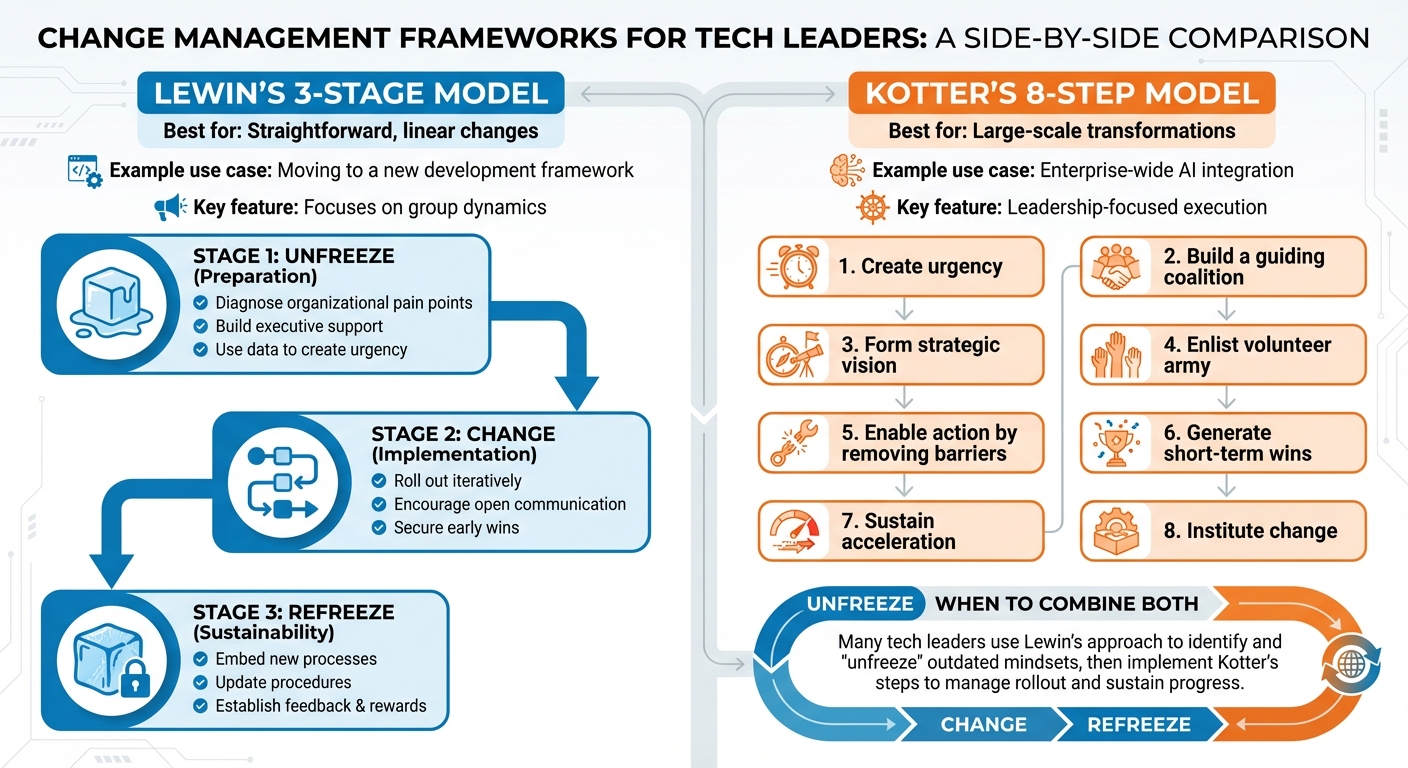
Lewin's 3-Stage Model vs Kotter's 8-Step Process for Tech Change Management
Two well-known frameworks - Lewin's 3-Stage Model and Kotter's 8-Step Process - offer structured approaches to navigating change effectively.
Deciding which model to use depends heavily on your specific situation. Lewin's model is ideal for straightforward, linear changes - like moving a team to a new development framework - where clear start and end points exist. On the other hand, Kotter's framework shines in large-scale transformations, such as enterprise-wide digital initiatives, where aligning leadership and team culture is critical. Interestingly, many tech leaders combine these models: using Lewin's approach to identify and "unfreeze" outdated mindsets, then implementing Kotter's steps to manage the rollout and sustain progress. Together, these models provide a strong mix of theory and practical tools for tech-driven changes.
Why does this matter now? By 2026, 71% of organizations expect to increase investments in AI technology. Yet, research shows that two-thirds of companies only achieve lasting productivity gains when pairing new technologies with structured change management strategies [5]. The pace of change is accelerating, making these frameworks more relevant than ever.
Lewin's 3-Stage Model: Unfreeze, Change, Refreeze
Kurt Lewin's model simplifies change into three phases: Unfreeze, Change, and Refreeze. This method is particularly helpful in tech projects, as it identifies forces that push change forward and those that resist it.
A standout feature of Lewin's approach is its emphasis on group dynamics. As Lewin famously stated, "the behavior of any individual in response to a proposed change is a function of group behavior" [3]. In other words, you won’t succeed by convincing individuals alone - you need to address the norms and dynamics of the entire team.
- Stage 1: Unfreeze (Preparation) – Start by diagnosing organizational pain points and building executive support. Use data to frame the change as a strategic necessity, creating a sense of urgency.
- Stage 2: Change (Implementation) – Roll out the change iteratively. Encourage open communication and leadership at all levels to address challenges quickly and secure early wins that build momentum.
- Stage 3: Refreeze (Sustainability) – Embed new processes into the organization through updated procedures, regular feedback, and reward systems. In fast-moving tech environments, think of "Refreeze" as a foundation for ongoing improvement rather than a fixed endpoint.
While Lewin's model helps identify what needs to change, Kotter's framework focuses on how to execute that change effectively.
Kotter's 8-Step Model for Tech Environments
John Kotter's model provides a leadership-focused strategy for managing large-scale transformations. It emphasizes urgency, coalition-building, and short-term wins to maintain momentum. As Kotter himself pointed out, "One person cannot drive organisational change alone" [4].
In modern tech settings, Kotter's framework operates as eight interconnected "Accelerators", supported by both traditional hierarchies and networked teams. Urgency is often created by framing complex challenges - like AI disruption or platform shifts - as existential threats, using data to highlight gaps between current capabilities and market needs. Building a coalition of technical leaders and influential team members is another key step to driving adoption across departments.
Short-term wins are particularly useful in tech projects. For example, demonstrating early success in a software rollout can validate the new system and build trust. However, Kotter's model sometimes overlooks the psychological experiences of individuals. Many tech changes struggle when leaders rely on one-off training sessions instead of providing continuous support. To address this, complement Kotter's steps with ongoing resources like embedded coaches, real-time documentation, and peer mentoring networks.
Implementing Change Stages in Tech Projects
When it comes to tech initiatives, the way you implement change can make or break your success. Whether you're introducing AI tools, transitioning to cloud systems, or expanding agile methods, execution is everything. Studies reveal that only 32% of leaders worldwide manage to get employees to embrace change in a productive way [8]. Success lies in moving through each stage with intention and care.
Organizations with higher rates of change adoption report revenue growth that's twice as high as those with lower adoption rates [8]. For tech leaders, treating change as a structured process - not just a one-time announcement - is critical to staying competitive.
Stage 1: Building Awareness and Readiness
Before diving into change, ask yourself: What’s changing? Why now? How will it impact everyone involved?
Start with a baseline assessment. Clearly define the scope of the change, identify the gap between your current setup and your goals, and pinpoint the purpose behind the initiative [6]. For example, if you're rolling out AI development tools, check whether your team has the necessary infrastructure - like IDE integrations and security frameworks - to support the shift [7]. Skipping this step can lead to resistance, especially among teams already feeling stretched thin [6].
Bring key stakeholders on board, particularly those with both organizational and technical expertise [7]. Pay close attention to middle managers - their attitude often determines whether the change gains traction or stalls [6].
Interestingly, the focus is shifting from trying to "inspire" change to embedding it into daily routines. Carolina Valencia from Gartner explains:
Establishing change as a routine is three times more effective than the inspirational approach [8].
Rather than aiming for big, sweeping visions, prioritize steady and measurable progress. Once awareness is built and readiness assessed, the next step is seamless execution.
Stage 2: Executing the Change
In tech environments, execution requires frameworks that respect existing workflows and developer autonomy. ADKAR is a solid choice for teams needing targeted skill development, while Prosci Agile Change Management works well for integrating change into sprint cycles and retrospectives [9]. The goal is to avoid creating unnecessary processes that slow teams down.
Start with a controlled pilot lasting 5–12 weeks to test technical integration, security compliance, and productivity impact [9]. Choose pilot teams with strong technical skills and influence to set a transparent example [9]. When leaders openly acknowledge they’re still learning, it builds trust rather than undermining confidence.
An 85% failure rate in AI adoption among engineering teams highlights how business frameworks often overlook technical workflows [9]. To address this, align change efforts with existing agile cadences like sprint planning and retrospectives [9]. For instance, instead of scheduling separate training sessions, embed learning opportunities into the professional development systems teams already use.
Resistance is inevitable, but it can be minimized by framing new technology as "skill augmentation" rather than a replacement for jobs. Many tech changes falter because they spark job security concerns or skepticism around overhyped promises [9]. Offer evidence-based demonstrations and create an environment of psychological safety where mistakes - like errors in AI-generated code - are treated as learning moments [9]. Once the change is successfully executed, the next step is ensuring it becomes permanent.
Stage 3: Making Change Permanent
Half of all change initiatives fail [10], often because leaders assume the job is done once the new system is live. Without a proper plan, employees tend to revert to old habits, especially during transitional periods [10].
To avoid this, embed the changes into your organization’s structures and reward systems. Update policies to align with the new approach, making it harder for teams to slip back into previous routines [10]. For instance, if new development tools are introduced, integrate their usage metrics into dashboards and performance tracking systems [9]. Track KPIs like improvements in code quality, faster development cycles, and team satisfaction - not just usage stats.
Provide visual reference materials like screen captures, video tutorials, and annotated screenshots for quick and easy access to documentation [11]. Establish feedback loops to continuously gather input from stakeholders, addressing any issues and refining processes as needed [11]. In Agile environments, this isn’t a one-time effort - it’s iterative, revisiting all phases in 2–4 week cycles to ensure ongoing improvement [12].
Highlight success stories and share performance data to demonstrate the benefits of the change [11]. This kind of reinforcement helps solidify the change within the organization and prevents backsliding [11]. In tech, making a change "permanent" means creating a foundation that supports ongoing adaptation and growth.
Leading Teams Through Change as a Tech Leader
Preparing Your Team for Change
The success of any team during a period of change often depends on how well leaders prepare and create an environment that encourages adaptability.
One practical starting point is to guide your team to focus on what they can control. During organizational changes, it's easy for engineers to get caught up in external factors like market trends or decisions made by executives. Instead, redirect their attention toward areas they can influence - like improving code quality, honing their skills, or collaborating effectively with teammates. This shift not only helps reduce anxiety but also keeps the team moving forward, even when the broader situation feels unpredictable.
When dealing with reorganizations or staffing changes, it's important to prioritize the human aspect first. Laurie Barth of Netflix emphasizes this point:
If you jump straight to problem-solving the Rubik's cube of work to be done [during personnel changes], then you've already made a crucial mistake. Start by recognizing the impact on the rest of the team [14].
Take time to hold brief, one-on-one check-ins to address how these changes are affecting your team emotionally before diving into workload adjustments.
Another key consideration is how time is spent. Andrew Boyagi, Customer CTO at Atlassian, points out:
The bottleneck is almost always in the other 84% of [a developer's] week [13].
This refers to time lost in meetings, hunting for information, waiting for approvals, and managing documentation. To reduce these inefficiencies, audit these friction points and explore tools like asynchronous video updates and shared documentation. For example, in early 2026, Boyagi managed a 20-person, multi-country project entirely without real-time meetings. Instead, he relied on video updates and detailed documentation to keep everyone aligned across time zones.
Jack Franklin of Google advises focusing on building teams centered around people rather than rigid processes [15]. Processes will inevitably evolve, but teams with strong collaborative cultures adapt more quickly because their foundation is built on trust and teamwork - not inflexible workflows.
Once your team is aligned and focused on what they can control, the next step is to strengthen your own leadership by tapping into external networks and support systems.
Using Leadership Networks and Support Systems
Tech leaders often face the challenge of navigating uncertainty and making high-stakes decisions on their own. Peer networks and structured support systems can help lighten this load.
After preparing your team, it’s crucial to bolster your leadership by engaging with trusted networks. These networks provide a space to process changes and decisions before presenting them to your team. Leaders who participate in peer masterminds or coaching programs often find they can think more clearly and achieve better outcomes [15]. The goal isn’t to have all the answers - it’s to reduce mental strain so you can lead effectively.
Programs like those from Tech Leaders offer engineering-specific leadership training that balances technical expertise with essential leadership skills. These frameworks are designed to help leaders guide their teams through organizational transitions without burning out.
The impact of modeling change as a leader is supported by data. Leaders who encourage their teams to experiment with new tools and workflows report saving 55% more time per day compared to those who don’t [13]. To create this kind of environment, you need to embrace change yourself. Leaders who process their uncertainties through coaching, peer groups, or leadership networks can approach challenges with clarity instead of stress.
For example, when Atlassian tackled long pull request cycle times in early 2026, their leaders demonstrated the use of new tools during their own technical reviews. This approach led to a 45% reduction in cycle times [13]. Leaders who have already worked through their own learning curves with the help of peers or coaches are better equipped to guide their teams through similar transitions.
Before communicating the reasons behind any change to your team, it’s essential to understand them thoroughly yourself. This is where external support systems prove invaluable. By combining these leadership practices with a clear strategy, you can ensure that your team is supported while navigating technical transformations with confidence and purpose.
Conclusion: Change Management Principles for Tech Leaders
Having a structured approach to change management is essential, especially when considering that nearly 50% of organizational change efforts fail due to poor communication [10][1]. By leveraging frameworks like Lewin's 3-Stage Model or Kotter's 8-Step Process, tech leaders can clearly articulate the "why" behind changes. This clarity helps reduce resistance and keeps teams aligned, even during uncertain times. These frameworks provide tech leaders with tools to guide their teams through complex transitions effectively.
In 2026, the nature of change management has evolved. It’s no longer just about adopting new tools - it’s about addressing the role of judgment when AI and automated systems influence decisions [2]. As Monserrat Raya of Scio puts it:
Change management... is about how organizations absorb uncertainty when judgment is partially delegated to systems that don't own outcomes [2].
This highlights a crucial responsibility for leaders: defining who owns the outcomes. Without clear accountability, there’s a risk of diffusing responsibility. Interestingly, research shows that AI adoption often increases the amount of review and validation work - not due to a lack of trust, but because the "decision surface" has expanded [2].
Another key challenge for leaders is finding the right balance between speed and stability. It’s not just about moving faster - it’s about achieving stability under acceleration [2]. While AI systems can speed up execution, building trust and confidence in these systems takes time. Leaders who proactively redesign responsibility models and communicate expectations early can avoid becoming bottlenecks in the process.
Resilient organizations recognize that uncertainty can’t always be eliminated. Instead, they learn to manage it wisely [2]. Leaders who recalibrate trust, align distributed teams around shared values, and focus on containment rather than micromanagement create environments where teams can adapt quickly without risking burnout.
FAQs
How do I pick Lewin vs Kotter for my change?
Lewin’s model is ideal for simpler, step-by-step changes where maintaining stability afterward is crucial. It breaks the process into three straightforward stages: unfreezing, changing, and refreezing. This approach works well when the goal is to implement changes gradually and solidify them over time.
On the other hand, if you’re tackling a more extensive and intricate transformation, Kotter’s eight-step model offers a more detailed roadmap. It emphasizes creating a sense of urgency, fostering collaboration, and integrating the changes into the organizational culture. This structured method is better suited for complex initiatives that require widespread involvement and long-term adoption.
To ensure success, choose the model that best matches the complexity and goals of your change initiative.
What KPIs prove a tech change is working?
When evaluating the success of a tech change, there are several key performance indicators (KPIs) to keep an eye on. These metrics help track both the technical and organizational effects of the change, giving leaders a clear picture of progress and results. Here’s a breakdown of the most important ones:
- Business value delivered: Does the change contribute to measurable business outcomes like revenue growth, cost savings, or improved efficiency?
- Rate of change: How quickly are updates and improvements being implemented without sacrificing quality or stability?
- Application delivery success: Are new applications or updates being delivered on time and meeting their intended goals?
- End-user satisfaction: How do users feel about the change? Are their needs being met, and is their experience improving?
- Technical debt index: Is the change reducing long-term technical debt, or is it adding complexity that might cause issues down the road?
- Stakeholder perception: How do stakeholders view the change? Are they aligned with its goals and satisfied with the outcomes?
- Productivity: Has the change made teams more efficient or streamlined workflows?
- Strategic risk reduction: Does the change mitigate risks tied to outdated systems, security vulnerabilities, or compliance issues?
By focusing on these KPIs, organizations can better understand how a tech change is impacting both their operations and their broader goals.
How do I reduce resistance to AI tools?
To make AI tools more acceptable within an organization, it's essential to focus on strategies that address both human behavior and workplace dynamics. This means prioritizing leadership involvement, ensuring open and honest communication, and encouraging employees to actively participate in shaping AI solutions.
Change can be challenging, but guiding teams through the emotional and psychological stages - like those outlined in the Kübler-Ross Change Curve - can help. By acknowledging phases such as denial and eventual acceptance, organizations can build trust, encourage collaboration, and make the shift to AI tools smoother for everyone involved.