

4 Stages of Principled Negotiation Explained
Principled negotiation is a structured approach to resolving conflicts by focusing on collaboration rather than confrontation. It consists of four main stages:
- Separate the People from the Problem: Address emotions and communication issues to focus on solving the actual problem, not personal differences.
- Focus on Interests, Not Positions: Understand the underlying needs driving each party’s demands to find common ground.
- Invent Options for Mutual Gain: Brainstorm multiple solutions to meet the needs of all parties involved.
- Insist on Objective Criteria: Use impartial, measurable standards (like market data or legal precedents) to ensure outcomes are fair and acceptable.
This method, introduced in the book Getting to Yes, helps negotiators avoid common pitfalls like emotional conflicts and positional standoffs. By focusing on shared goals and measurable standards, it creates solutions that strengthen relationships and achieve better outcomes.
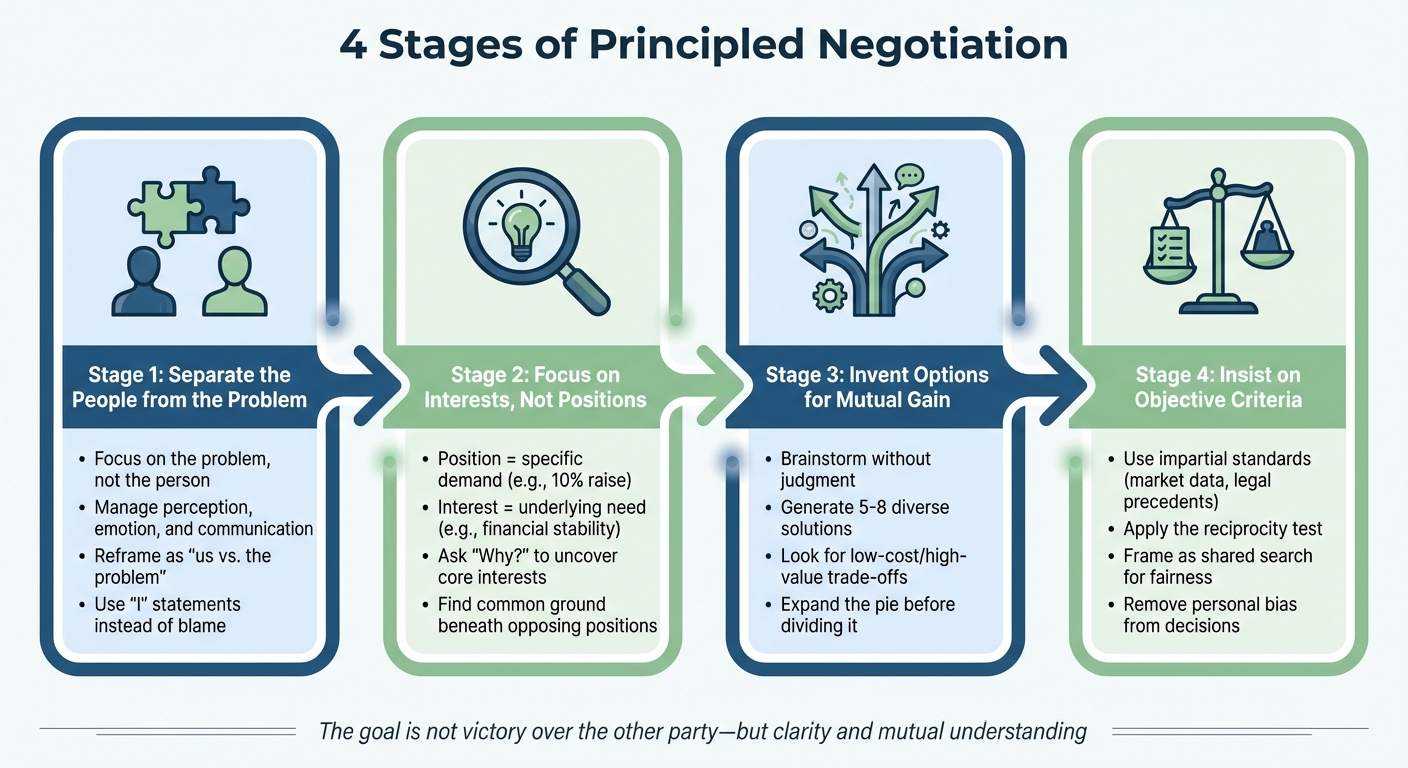
4 Stages of Principled Negotiation Framework
Master the 4 Harvard Negotiation Principles for Effective Conflict Resolution
sbb-itb-8feac72
Stage 1: Separate the People from the Problem
Negotiations often fall apart not because the numbers don’t add up, but because emotions take over and people feel personally attacked [6]. Picture this: a technical lead misinterprets a resource debate as a personal critique. Suddenly, the focus shifts from solving the issue to defending personal pride, and finding a rational solution becomes nearly impossible.
The key takeaway? Focus on the problem, not the person [6]. It’s crucial to separate interpersonal dynamics from the actual issues at hand. As Ashish Mendiratta, Founder of Negotiation Academy, wisely states:
"The person across the table is not the problem. The problem is the problem." [6]
This separation hinges on managing three areas: perception (how each side interprets the situation), emotion (how they feel about it), and communication (how they exchange information). Avoid assuming the other side has bad intentions. Instead, focus on what’s observable - like delays caused by tight deadlines - without assigning blame.
Try reframing the negotiation as a shared challenge: “us vs. the problem.” Imagine everyone sitting on the same side of the table, working together to tackle the real issue. This mindset helps bypass emotional roadblocks and keeps the conversation productive.
Identifying and Managing Emotional Triggers
Once you’ve separated people from the problem, managing emotions becomes critical. When someone feels attacked or ignored, they stop listening. This can trigger an “emotional hijack,” leading to rash actions like making threats or saying things they later regret [8]. Virtual negotiations make this even trickier, as emotions are harder to read. Acknowledging feelings can make all the difference. For example, calmly saying, “I sense some frustration here” or “I hear the pressure you’re under” can defuse tension and stabilize the conversation.
Sometimes, letting the other side vent their feelings can clear the air and prevent emotions from escalating further. If things heat up, take a moment to pause and refocus on your shared goals.
Using “I” statements is another effective tool. For instance, instead of blaming, you could say, “I feel we’re misaligned on timelines.” This approach shifts the conversation toward solving the issue rather than pointing fingers.
Active Listening and Clear Communication
Miscommunication is one of the quickest ways to derail a negotiation [7]. That’s why active listening is so important. Paraphrasing what the other party says not only ensures you understand their point but also shows that you’re genuinely engaged. For example, you might say, “If I understand correctly, your main concern is that the Q2 deadline conflicts with the infrastructure upgrade - am I right?” This technique helps uncover hidden concerns and reduces tension.
Asking thoughtful, open-ended questions can also foster collaboration. For example, questions like, “What constraints should we consider on your side?” or “What’s creating challenges for your team?” invite constructive dialogue. Similarly, using “we” statements - like, “We seem misaligned on timelines; let’s figure out where the breakdown is” - reinforces a sense of partnership.
When communication is clear and emotions are managed, both sides are better positioned to shift their focus to the next step: uncovering the interests that drive each party’s position.
Stage 2: Focus on Interests, Not Positions
After addressing the human element in negotiations, the next step is to uncover what truly drives each side. A position is a specific demand - like asking for a 10% pay raise - while an interest reflects the deeper need behind that demand, such as financial stability or recognition [9]. Positions often lead to rigid standoffs, but focusing on interests opens up possibilities for collaboration and creative problem-solving.
It's easy to assume that opposing positions mean conflicting interests, but that's rarely the case. Beneath the surface, parties often share common goals. For example, a landlord might push for strict lease terms to protect their property, while a tenant wants a fair price. At their core, both parties likely value a stable, long-term arrangement. Shifting the discussion from demands to motivations creates opportunities to find solutions that work for everyone [9].
Take the 1978 Camp David negotiations as an example. By examining the underlying interests, Egypt and Israel reached an agreement: Egypt regained sovereignty over Sinai, while Israel ensured its security through a demilitarized zone [10][3]. This focus on interests rather than positions turned a potential deadlock into a workable solution.
How to Identify Core Interests
The key to uncovering interests is asking "Why?" when a position is presented. Instead of challenging the other side's stance, show curiosity about the reasons behind it. For instance, if someone insists on a tight deadline, you might say, "Can you explain why that timeline is so important?" Similarly, if a proposal is rejected, asking "Why not?" can reveal hidden concerns or external pressures [9].
Core interests often tie back to basic needs like security, financial stability, recognition, belonging, or autonomy [9][11]. For example, a developer advocating for remote work might be prioritizing work–life balance. Acknowledging these needs can go a long way. Saying something like, "I see how flexibility helps you spend more time with your family", builds trust and reduces tension.
It's also helpful to share your own interests before jumping to solutions. By explaining the "why" behind your position, you give the other side a chance to understand your perspective. Keeping the conversation forward-looking and focused on shared goals - rather than dwelling on past disagreements - creates a more productive atmosphere [10].
Why Positional Bargaining Fails
Relying on positional bargaining - where each side digs in with fixed demands and negotiates through small compromises - often leads to frustration. This approach wastes time, strains relationships, and usually results in less-than-ideal outcomes. Instead of solving the problem, both parties become fixated on "winning" or saving face [9].
When negotiators focus only on defending their positions, they miss opportunities for creative solutions. The common "split the difference" approach may seem fair, but it often leaves both sides unsatisfied because it doesn't address the root issues [9].
| Dimension | Positional Bargaining | Interest-Based Negotiation |
|---|---|---|
| Core Focus | Fixed demands (Positions) | Underlying needs (Interests) |
| Approach | Adversarial and rigid | Collaborative and flexible |
| Process | Gradual concessions | Creative problem-solving |
| Outcome | Often mediocre; compromises | Solutions that benefit both sides |
| Relationship | Risk of long-term damage | Builds and strengthens ties |
| Mindset | Zero-sum; fixed "pie" | Expands the "pie" for mutual gain |
Interest-based negotiation shifts the dynamic entirely. Instead of treating the process as a zero-sum game where one side's win equals the other's loss, it asks: How can we meet the needs of both parties? This shift in perspective opens the door to solutions that create value for everyone involved.
Stage 3: Invent Options for Mutual Gain
Once you’ve identified the interests of all parties, the next step is to generate a wide range of solutions - without rushing to judgment. This approach helps avoid limiting creativity and encourages thinking beyond the assumption that one party’s gain must mean another’s loss. The aim here is to expand the available value before deciding how to divide it [12]. By coming up with multiple options, you increase the chances of finding solutions that address the priorities of everyone involved.
"The key to wise decision making lies in selecting from a great number and variety of options" [13].
Brainstorming Techniques for Building Solutions Together
To make brainstorming effective, consider gathering 5–8 people in a relaxed, informal setting, preferably outside the usual meeting space [12]. Arrange seating side-by-side instead of face-to-face to emphasize collaboration rather than opposition. Assign a facilitator to guide the session, ensuring it stays productive and adheres to agreed-upon ground rules.
The primary rule? No criticism during brainstorming. Judgments and evaluations should wait until every idea is on the table [12]. Some groups even adopt a "no-blame, no-credit" policy to encourage open, uninhibited thinking [12]. The goal is to focus on quantity over quality - throw out as many ideas as possible, even unconventional ones, to increase the odds of finding a workable solution [14].
Look for opportunities where one party’s high-value need is a low-cost concession for the other. This dovetailing approach can lead to creative solutions that meet core interests. For instance, one side might emphasize short-term results, while the other places greater value on long-term outcomes. Similarly, one party might prioritize financial considerations, while the other cares more about political factors [12].
| One Party Cares More About | Other Party Cares More About |
|---|---|
| Form | Substance |
| Economic Considerations | Political Considerations |
| Immediate Future | Distant Future |
| Practical Considerations | Symbolic Considerations |
Another strategy is the “multiple options” technique. Develop several equally acceptable solutions and present them to the other party, asking which they prefer [12]. This approach not only reveals their priorities but also avoids putting pressure on them to commit right away. If reaching a full agreement seems difficult, you could propose interim solutions - such as temporary agreements or procedural frameworks for future negotiations - rather than insisting on a permanent resolution [12].
Once a variety of ideas are on the table, the next step is to evaluate their feasibility.
Evaluating Options for Feasibility
Now it’s time to assess how practical the brainstormed options are. Start by ranking the ideas and identifying potential obstacles for the most promising ones [12]. This process helps uncover any challenges before moving forward.
The best solutions will address the underlying interests of both parties, not just their stated positions. Revisit the interests identified earlier and evaluate how well each option aligns with them. Use objective standards - like market value, industry benchmarks, or past precedents - to assess the options rather than relying on personal preferences [4]. For example, if the other party has previously resolved a similar issue in a particular way, referencing that precedent can make the solution easier for them to accept.
If a comprehensive agreement still feels out of reach, don’t give up. Partial wins, such as agreeing on a specific geographic area, a limited timeframe, or a procedural plan for future talks, can keep the negotiation process moving forward [12]. Even small steps can build trust and lay the groundwork for more significant agreements down the road.
For technical professionals, mastering these negotiation strategies is especially important. At Tech Leaders, these approaches are emphasized as a critical part of transitioning from technical expertise to leadership, where bridging technical skills with effective negotiation can make all the difference.
Stage 4: Insist on Objective Criteria
At this stage, the focus shifts to ensuring that any agreement reached is grounded in fairness and impartiality, relying on objective standards to guide the decision-making process.
The goal here is to find a solution that both sides see as fair. Using objective criteria - such as market values, legal precedents, or expert opinions - removes personal bias from the equation. Instead of turning the negotiation into a clash of opinions, this approach transforms it into a collaborative effort to identify a reasonable and principled outcome.
Fairness plays a huge role in human interactions. For example, the ultimatum game reveals that offers below 30% of the total are often rejected, even if it means walking away empty-handed. This underscores the importance of using objective standards to ensure that both parties perceive the final agreement as legitimate and unbiased[15].
What Are Objective Criteria?
Objective criteria are independent benchmarks that both sides can agree on. They’re impartial, credible, and applicable to the situation at hand. These criteria can fall into several categories, including fair standards - like market values or professional norms - or fair procedures, such as flipping a coin or involving a neutral third party. The most effective criteria are up-to-date, easy to verify, and straightforward to understand.
| Category | Examples of Objective Criteria |
|---|---|
| Market-Based | Market value, Blue Book values, comparable home prices, average salary ranges |
| Legal/Regulatory | Legal precedent, court rulings, industry regulations, Uniform Commercial Code (UCC) |
| Professional/Scientific | Scientific merit, expert opinions, professional standards, trade journals |
| Internal/Organizational | Precedent, tradition, corporate mission/values, cost of living, raw material costs |
| Procedural | "One cuts, the other chooses", drawing lots, flipping a coin, third-party arbitration |
"The more you bring standards of fairness, efficiency, or scientific merit to bear on your particular problem, the more likely you are to produce a final package that is wise and fair."
- Roger Fisher, William Ury, and Bruce Patton[4]
Applying Standards in Negotiations
Objective criteria do more than just guide the final decision - they can shape the entire negotiation process.
Start by framing the discussion as a shared effort to find a fair outcome. Instead of making demands, ask questions like, "What evidence supports this price?" or "What’s the fairest way to divide this?" This collaborative tone can help prevent defensive reactions and foster mutual problem-solving.
Before presenting an offer, consider the test of reciprocity: would you accept this deal if the roles were reversed? If not, it’s a sign that the offer might not be fair.
While it’s important to stand firm on the need for objective standards, remain open to different types of criteria. For instance, if one party favors market value and the other leans toward depreciated cost, it might make sense to find a middle ground. Avoid giving in to pressure tactics like threats or bribes. If someone insists on "company policy" as their justification, ask them to explain the reasoning behind it to assess its fairness and validity.
For professionals stepping into leadership roles, understanding and applying objective criteria is a key skill. At Tech Leaders, we emphasize these strategies in our training, helping technical experts navigate decision-making with fairness and precision.
Conclusion
Principled negotiation offers a way to lead where collaboration takes priority over ego. Instead of letting conflicts escalate, this approach transforms disagreements into opportunities for teamwork. It’s a critical skill, especially when your role shifts from defending technical accuracy to fostering agreements that protect relationships and ensure project success.
The final stage of this method focuses on cementing fairness within complex negotiations. For technical professionals moving into leadership roles, this structured approach eliminates the need for power struggles, replacing them with decisions rooted in objective standards. In fact, organizations that adopt principled negotiation strategies often see outcomes that are 30% stronger compared to those relying solely on positional tactics[2]. The reason is simple: it moves the focus from personal victories to achieving balanced, fair solutions.
A key element of this strategy is understanding your BATNA - your Best Alternative to a Negotiated Agreement. Knowing your options if discussions fail gives you the confidence to stand firm without being confrontational. This clarity is especially useful in cross-functional settings, where overlapping roles and tight deadlines can complicate negotiations.
At Tech Leaders, we integrate these principles into our leadership training programs, helping technical professionals develop the soft skills needed to handle high-stakes negotiations with fairness and accuracy. As the Program on Negotiation at Harvard Law School explains:
"The goal [of negotiation] is not victory over the other party - but clarity and mutual understanding"[1].
Mastering the four stages of principled negotiation doesn’t just resolve conflicts - it builds agreements that endure.
To make this approach practical, apply the 5 C’s in your next negotiation: Clarify your objectives, Connect with the other party to establish trust, Create options that benefit both sides, Commit to clear terms, and Confirm the agreement in writing[5]. This framework bridges theory and practice, helping you approach negotiations with confidence. By embracing these steps, you’ll not only negotiate more effectively but also strengthen your leadership abilities.
FAQs
How do I keep emotions from derailing a negotiation?
In negotiations, emotions can easily take over and derail progress. The key to avoiding this is to separate the people from the problem. Stay logical, focus on the issue at hand, and avoid letting personal feelings or attacks get in the way.
When emotions like fear, anger, or distrust arise, deal with them as distinct from the main negotiation points. Acknowledging these feelings without letting them dominate the discussion helps keep things productive.
Above all, maintain respect and concentrate on shared goals rather than personal differences. This approach fosters a more constructive conversation and minimizes the risk of emotional outbursts disrupting the process.
How can I uncover the other side’s real interests fast?
To better understand the other side's true priorities during principled negotiation, steer the conversation away from rigid demands and toward their deeper needs. Use open-ended questions to uncover what genuinely matters to them. Highlight areas of common interest, work together on creative solutions, and remember to distinguish the people from the problem itself. Relying on objective standards can also foster open dialogue, making it easier to pinpoint their key motivations.
What objective criteria should I use if we disagree on “fair”?
If people can’t agree on what’s “fair,” turn to objective criteria that both sides consider trustworthy and impartial. These might include things like industry standards, legal regulations, expert advice, or verified data. Using these benchmarks keeps the focus on facts instead of personal opinions or biases.