

Ultimate Guide to Stakeholder Expectation Management
Managing stakeholder expectations is critical for project success. Here's why:
- 57% of projects fail due to poor communication, often tied to unclear stakeholder expectations.
- Misaligned expectations lead to scope creep, budget overruns, and missed deadlines.
- Defining success criteria early prevents 25% of planning-phase issues (KPMG study).
To manage expectations effectively:
- Identify stakeholders through brainstorming, interviews, and documentation reviews.
- Categorize and prioritize using tools like the Power/Interest Grid.
- Understand needs through interviews, surveys, workshops, and document analysis.
- Translate expectations into SMART objectives and define constraints (time, cost, scope).
- Maintain alignment with regular updates, feedback loops, and clear communication plans.
Mastering these practices builds trust, ensures project alignment, and strengthens leadership skills. Stakeholder management isn’t just about meeting deadlines - it’s about ensuring everyone feels heard and invested in the process.
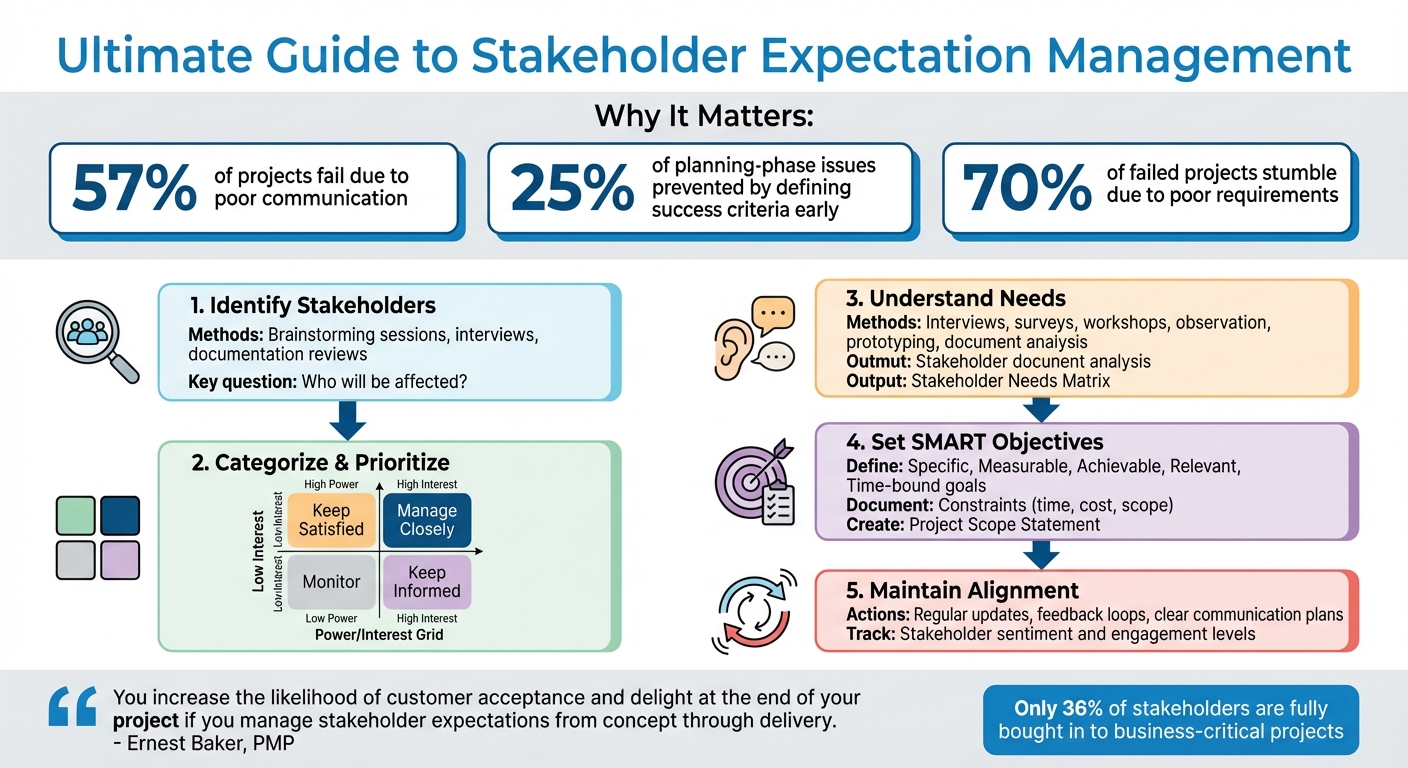
5-Step Stakeholder Expectation Management Framework
What Is Proactive Stakeholder Expectation Management?
How to Identify and Categorize Stakeholders
The first step in managing expectations is identifying stakeholders. Taking a structured approach to this ensures that no key individuals or groups are overlooked, which can help avoid complications down the road. Begin by assembling your project team and relevant experts for brainstorming sessions to create a comprehensive list of stakeholders [7][5]. Additionally, review project documentation to identify groups such as end-users, suppliers, and regulators who might be impacted by or involved in the project [6][7][1].
Structured interviews can also be incredibly helpful. Ask questions like, "Who else should we include?" and focus on departments that might not be immediately obvious, such as purchasing, legal, audit, IT, marketing, governance, and human resources. This approach can reveal stakeholders that might otherwise be missed [6][5]. Other useful questions include: Who will be affected? Who needs to approve decisions? Whose work will change as a result of this project? [5].
Once stakeholders are identified, the next step is categorizing them to guide how you’ll engage with each group. Start by logging essential details - names, roles, and interests - in a stakeholder register [2]. Tools like RACI charts (Responsible, Accountable, Consulted, Informed) can further clarify roles, ensuring everyone knows who should be informed and involved [5][1].
These steps lay the groundwork for categorization and engagement strategies.
Stakeholder Mapping and Prioritization
Stakeholder mapping is a powerful way to visualize motivations and prioritize engagement strategies. One widely used tool for this is the Power/Interest Grid. This matrix helps you plot stakeholders based on two key factors: their level of authority (power) and their level of concern (interest) regarding project outcomes [9][7].
The Power/Interest Grid defines four categories of stakeholders, each requiring a different approach:
- Manage Closely (High Power/High Interest): These are your key players. They need to be deeply involved and regularly updated.
- Keep Satisfied (High Power/Low Interest): Address their needs carefully but avoid overwhelming them with unnecessary details.
- Keep Informed (Low Power/High Interest): Provide regular updates and leverage their support for advocacy when needed.
- Monitor (Low Power/Low Interest): Maintain minimal communication, such as periodic newsletters, while keeping an eye on any changes in their involvement [6][4][7].
It’s important to remember that stakeholder influence and interest can shift as the project progresses. Regularly revisit and update your stakeholder map at key phases or milestones. For instance, someone initially categorized as "Monitor" could transition to "Manage Closely" if the project starts to significantly affect their department [9][10]. Keeping the map current ensures your engagement strategies remain effective.
Methods for Understanding Stakeholder Expectations
Once stakeholders are categorized, the next step is understanding their expectations using methods tailored to your project's needs. The goal is to gather honest and detailed input while staying within your timeline and resource constraints.
A variety of techniques can help achieve this:
- Interviews: Ideal for in-depth insights, one-on-one interviews allow you to uncover specific goals and concerns. Prepare key topics in advance, ask open-ended questions, and paraphrase responses to ensure clarity [11].
- Surveys and Questionnaires: These are effective for collecting data from large groups, especially when stakeholders are spread across different time zones [11][12].
- Workshops: Collaborative sessions, such as Joint Application Development (JAD) workshops, encourage group discussions and problem-solving [11].
- Observation: Watching stakeholders in their natural work environment often reveals unspoken or implicit requirements [11][12].
- Prototyping: Mock-ups and early models provide a way to gather feedback on potential solutions.
- Document Analysis: Reviewing existing business plans, policies, or process flows can uncover documented but overlooked requirements [11].
Why does this matter? 70% of failed projects stumble due to poor requirements, and up to 50% of rework stems from issues in this area [11]. Using these methods ensures you engage stakeholders effectively and align their expectations with project goals.
"You increase the likelihood of customer acceptance and delight at the end of your project if you manage stakeholder expectations from concept through delivery." - Ernest Baker, Project Management Consultant [1]
As you gather expectations, transform them into SMART objectives. For instance, instead of a vague goal like "improve sales performance", work with stakeholders to refine it into something measurable, such as "conduct sales skills workshops with performance tracking over the next quarter" [12]. Additionally, pinpoint the critical constraint - whether it’s cost, time, or scope - that stakeholders consider non-negotiable [1].
Another helpful technique is the "Let's Pretend" approach, where you ask stakeholders to imagine a risk scenario and describe how they would respond [1]. This process provides a clearer understanding of expectations and prepares you to address potential challenges. Once gathered, these insights can be organized into a Stakeholder Needs Matrix for better clarity and comparison.
Creating a Stakeholder Needs Matrix
A Stakeholder Needs Matrix simplifies complex projects by mapping out expectations, success metrics, and risks in an easy-to-read format. This tool not only highlights priorities for each stakeholder group but also helps identify potential conflicts early on.
| Stakeholder | Core Needs/Expectations | Success Metrics | Potential Risks |
|---|---|---|---|
| Executives | ROI and alignment with strategy | Key Results (KRs), ROI percentage | Budget overruns, strategic misalignment |
| Managers | Team performance and skill growth | Milestone completion, productivity | Resource constraints, conflicting goals |
| Employees | Flexible and relevant training | Learner satisfaction, skill mastery | Low engagement, time limitations |
| Customers | Solutions that solve key problems | Product adoption, Net Promoter Score | Misunderstood needs, technical barriers |
| Compliance | Adherence to regulations | Certification, audit success | Regulatory updates, missed deadlines |
This matrix should be updated regularly as new information is gathered through interviews, workshops, and other methods. Its visual layout makes it easier to spot potential conflicts, such as when executives prioritize speed while compliance teams require thorough documentation. Addressing these tensions early allows for productive discussions and consensus before the project moves forward.
Creating and Maintaining a Stakeholder Engagement Plan
Once you've identified your stakeholders and analyzed their expectations, the next step is to craft a formal engagement plan. This plan is your blueprint for clear communication, decision-making, and accountability throughout the project. It builds on the groundwork of stakeholder identification, ensuring that everyone stays aligned as the project progresses.
Your engagement plan should include several key components: a stakeholder register, a communication strategy, a responsibility framework, and an engagement assessment matrix.
- Stakeholder Register: This lists everyone impacted by the project, categorized into groups such as internal, external, upwards (owners or funders), downwards (team members or suppliers), outwards (customers or regulators), and sideways (competitors for resources).
- Communication Strategy: This outlines the "who, what, when, and how" of information sharing, specifying details like frequency and channels.
- Responsibility Framework: Frameworks like RACI (Responsible, Accountable, Consulted, Informed) or DACI (Driver, Approver, Contributor, Informed) clarify roles, ensuring everyone knows who is responsible for tasks, who has decision-making authority, and who needs to stay informed.
- Engagement Assessment Matrix: This tracks how engaged stakeholders are, comparing their current level of buy-in to the desired level. For instance, it might aim to shift a resistant stakeholder to a more neutral or supportive stance.
Why is this so critical? A survey revealed that while 50% of respondents lead business-critical projects, only 36% feel that stakeholders are fully "bought in" to the project's goals [13]. Without a clear engagement plan, you risk the biggest threat to project success: stakeholders who lack ownership or investment in the process.
"The project manager is responsible for stakeholder expectations management." - Project Management Institute [13]
Setting Clear Goals and Boundaries
At the start of your project, take time to define deliverables, deadlines, and exclusions. This initial clarity is essential, as nearly one-quarter of struggling projects run into trouble due to poor planning and unclear success criteria [1].
Use your project kickoff meeting wisely. Instead of just presenting information, use this opportunity to establish communication rhythms, decision-making protocols, and success metrics with all key stakeholders. Then, document these agreements in a Project Scope Statement. This statement should clearly define what is within scope and what is not, protecting you from scope creep and misunderstandings later on.
Be sure to document assumptions and constraints right from the beginning. For example, if your budget relies on a specific funding assumption, note it. Similarly, if there's a fixed timeline or budget, acknowledge this tension early to avoid surprises during critical moments.
Centralize all this information in a shared repository. This transparency ensures stakeholders have easy access to goals, scope, and milestones, reducing unnecessary meetings and building trust. Keep in mind that stakeholders often view their expectations as non-negotiable. Even if the final deliverable meets the project goals, failing to follow agreed-upon processes - like providing regular updates - can lead to dissatisfaction or rejection.
Regular Check-Ins and Feedback Loops
Once you've set clear goals, the next step is to maintain alignment through regular updates and feedback. The frequency of communication should depend on each stakeholder's level of influence and interest. For example:
- High-power, high-interest stakeholders (e.g., steering committees) typically need weekly or bi-weekly updates via face-to-face meetings or direct consultations.
- High-power, low-interest stakeholders (e.g., executives) prefer monthly reports with high-level overviews.
- Low-power, high-interest stakeholders (e.g., team members or customers) benefit from frequent updates via newsletters or a project website.
- Low-power, low-interest stakeholders (e.g., peripheral groups) usually only require milestone-based announcements.
| Stakeholder Group | Engagement Strategy | Recommended Frequency | Preferred Channels |
|---|---|---|---|
| High Power / High Interest | Manage Closely | Weekly/Bi-weekly | Face-to-face meetings, steering meetings |
| High Power / Low Interest | Keep Satisfied | Monthly | Formal reports, high-level briefings |
| Low Power / High Interest | Keep Informed | Weekly/As-needed | Newsletters, project website |
| Low Power / Low Interest | Monitor | Milestone-based | General announcements |
Feedback loops are equally important. Use your RACI chart to identify who needs to be actively consulted and who just needs updates. Regularly addressing concerns can prevent small issues from escalating into major obstacles.
"You increase the likelihood of customer acceptance and delight at the end of your project if you manage stakeholder expectations from concept through delivery." - Ernest Baker, PMP [1]
To stay consistent, automate reminders for updates using scheduling tools. Additionally, track stakeholder sentiment over time. If you notice attitudes shifting from supportive to resistant, address the concerns early to keep the project on track. Treat your engagement plan as a living document, adapting it as stakeholder dynamics evolve throughout the project lifecycle.
sbb-itb-8feac72
How to Adjust Stakeholder Expectations During the Project
Even the most meticulously planned projects can hit unexpected roadblocks, making it crucial to adjust stakeholder expectations quickly and effectively. Keeping a close eye on progress and addressing deviations early can prevent small issues from snowballing into larger conflicts.
To stay on top of things, track key metrics like milestones, scope changes, timeline risks, and resource usage. Variance reports are especially useful for spotting deviations from the baseline promptly [8][2]. Tools like Kanban boards and Gantt charts can help illustrate these adjustments visually, making it easier for stakeholders to grasp why changes are necessary [5].
A practical way to prepare for potential changes is through what’s called a "Let's Pretend" session. For instance, ask stakeholders, "If we miss this milestone by two weeks, what adjustments would you expect?" This kind of proactive discussion sets the stage for smoother decision-making later on [1]. Similarly, clarify which of the triple constraints - Time, Cost, or Quality - is non-negotiable. Knowing this helps prioritize trade-offs when adjustments are unavoidable [1].
When resistance arises, remember that stakeholders value fairness in the process. People are more likely to accept changes if they feel their voices are heard, even if they don’t fully agree with the final decision. Address concerns as soon as they come up. During regular check-ins, ask questions like, "Is the project meeting your expectations?" This can help uncover hidden issues before they grow into bigger problems [2].
"Actively managing stakeholders increases the likelihood that the project will not veer off track due to unresolved stakeholder issues, enhances the ability of persons to operate synergistically, and limits disruptions during the project."
- Project Management Institute [1]
This approach builds on earlier stakeholder engagement strategies by ensuring that adjustments are driven by data and managed collaboratively, keeping everyone aligned throughout the process.
Using Feedback to Maintain Alignment
Once adjustments are in motion, feedback loops become essential for maintaining alignment. Two-way communication allows stakeholders to actively influence outcomes [3][15]. AI-powered sentiment analysis can even help identify emotional shifts or early signs of resistance before they escalate into vocal complaints [3].
Shared digital platforms like Confluence or Mural can serve as a central hub for information, while tools like Atlas can automate weekly updates. This keeps everyone informed without the need for constant meetings [8][5]. When stakeholders have access to real-time data, misunderstandings about project status are less likely to occur.
When stakeholders request changes, try the "It Depends" strategy. Instead of giving a simple yes or no, open a discussion about trade-offs: "We can add that feature, but it depends - are you willing to extend the timeline by three weeks or reduce another deliverable?" This approach keeps expectations grounded in the realities of project constraints [1]. You can also involve stakeholders in prioritization using techniques like "Visualize the Vote" or "Buy a Feature", which encourage real-time feedback on what matters most [8].
Document every interaction in issue and change logs, and follow up with post-meeting summaries to confirm decisions and timelines [14][8]. Regular, fact-based updates help dispel rumors and maintain trust [2].
| Monitoring Method | Frequency | Purpose |
|---|---|---|
| Status Updates | Weekly / Bi-weekly | Track task-level progress and address immediate blockers [8] |
| Steering Meetings | Monthly | Align on strategic goals and address major shifts [8] |
| Sentiment Analysis | Continuous | Detect emotional shifts or resistance using AI [3] |
| Variance Reports | Milestone-based | Measure deviations in budget, schedule, or scope [2] |
| Post-Meeting Summaries | After key sessions | Confirm decisions, responsibilities, and updated timelines [8] |
Building Long-Term Stakeholder Relationships
Building lasting relationships with stakeholders goes beyond individual projects - it's an investment that pays off throughout your career. At the heart of these relationships lies trust. As the Harvard Business Review aptly states:
Trust is the social glue that holds business relationships together [16].
Earning trust requires consistent actions: delivering on promises, being transparent, and holding yourself accountable.
One way to foster trust is by creating a centralized hub for all project-related information. A digital hub ensures everyone has access to accurate, up-to-date details without relying on constant update meetings [5][8]. When stakeholders see that they can depend on this system, they’re more likely to trust your processes. Pair this with steady communication - using the same tools, formats, and schedules - to reinforce your reliability over time.
Transparency becomes even more critical when things go wrong. Sharing bad news openly, rather than hiding it, can actually strengthen relationships during challenging times [16]. Taking ownership of both successes and setbacks sends a powerful message. As project management consultant Ernest Baker explains:
Everything you do, or don't do, sets an expectation for future behavior [1].
For example, allowing missed deadlines to slide without consequences signals that timeliness isn't a priority.
Post-project reviews are another excellent opportunity to build relationships. Use these sessions to assess whether the project delivered the benefits stakeholders expected [14]. Share measurable outcomes, like completed milestones and resource allocation, to demonstrate tangible results [8]. Most importantly, show stakeholders that their feedback matters. When people see their input shaping future decisions, they remain engaged and supportive [16]. These practices not only enhance project outcomes but also lay the groundwork for stepping into advanced leadership roles.
Applying These Skills in Leadership Roles
As technical professionals advance into leadership positions, their focus must evolve. Managing stakeholder expectations becomes a critical skill. Unlike individual contributors, leaders shift from "doing the work" themselves to "creating options" that allow stakeholders to make informed decisions [1]. The communication and accountability habits built during projects form the foundation for effective leadership.
Consider this: CEOs spend about 30% of their time engaging with external stakeholders, and 70% of employees say their sense of purpose is tied to their work [17]. This underscores the importance of clear and meaningful communication.
Scott Herren, CFO at Cisco, underscores the value of a skill that many technical professionals overlook:
Focus on communications, and in particular storytelling with data... [It's] something that I significantly underappreciated before I got in this seat [17].
The ability to transform complex technical details into compelling narratives that resonate emotionally sets exceptional leaders apart.
To bridge the gap between technical expertise and leadership capabilities, organizations like Tech Leaders offer specialized training. Their programs help technical professionals develop essential skills like stakeholder management, effective communication, and AI business strategy - tools that become increasingly vital as you transition from individual contributor roles to leadership positions. For more information, visit Tech Leaders.
Conclusion
Managing stakeholder expectations effectively is a cornerstone of successful technical leadership. As Ernest Baker aptly said, "Expectation Management is job #1 for a Project Manager" [1]. Without clear communication and thoughtful planning, even the most well-intentioned projects can falter.
To excel in this area, focus on three key practices. First, identify and prioritize stakeholders early on. Tools like the Power/Interest Grid or DACI model can help you determine which stakeholders require close involvement and which only need occasional updates. Second, maintain transparency by centralizing documentation and establishing consistent communication channels. This approach fosters trust and transforms you from a potential target for frustrations into a reliable partner. Finally, adopt a flexible mindset. Instead of rigidly agreeing or rejecting every request, offer informed trade-offs that balance project needs with stakeholder expectations. These practices not only align projects with broader goals but also strengthen your technical leadership.
Success in project management goes beyond meeting time, budget, and scope goals. A project can achieve all its technical objectives yet still fail if it doesn't resonate with stakeholders' visions. The ultimate measure of success lies in stakeholder satisfaction, which stems from fair and inclusive processes - even if the final outcome isn't exactly what everyone envisioned.
For technical professionals stepping into leadership roles, mastering these skills is essential. The ability to simplify complex technical concepts, juggle competing priorities, and nurture strong relationships distinguishes effective leaders from outstanding ones. Organizations like Tech Leaders are dedicated to helping technical experts develop these crucial capabilities, bridging the gap between technical knowledge and leadership excellence in today’s fast-paced, AI-driven world.
FAQs
What’s the best way to identify and prioritize stakeholders for my project?
Getting a handle on stakeholders early in a project can make all the difference. Start by examining your project scope or brief to pinpoint key individuals or groups already mentioned - like end-users, sponsors, or regulatory bodies. Then, broaden your perspective by identifying departments or external parties that might feel the ripple effects of your project. During discussions, don’t hesitate to ask, “Is there anyone else we should involve?” This simple question can reveal stakeholders you might have overlooked and help you avoid surprises down the road. Keep everything organized by documenting each stakeholder’s role, interests, authority, and preferences in a digital tool or spreadsheet - it’ll save you a lot of headaches later.
When it’s time to prioritize, the power/interest matrix is your go-to tool. It helps you map stakeholders based on their influence (power) and their level of engagement (interest). Here’s how it works:
- High power, high interest: These are your VIPs - think sponsors or executives. Keep them closely engaged with regular updates and detailed communication.
- High power, low interest: They might not be deeply involved day-to-day, but they hold sway over decisions. Keep them informed at key milestones; legal or finance teams often fall into this category.
- Low power, high interest: These individuals care deeply about the project but don’t have much influence. Regular updates will keep them in the loop; end-users are a common example.
- Low power, low interest: While they don’t require much attention, don’t ignore them entirely. Monitor their needs with minimal communication.
This strategy ensures your energy is directed where it counts, amplifying the voices that align with your project’s objectives. If you’re looking to sharpen your skills in stakeholder management, communication, or strategic planning, programs like those offered by Tech Leaders can be a valuable resource.
What tools can help turn stakeholder expectations into actionable goals?
To turn stakeholder expectations into clear, actionable goals, teams often turn to a mix of project management tools, collaboration platforms, and ready-to-use templates. Project management software like ProjectManager or Atlassian’s tools (Jira, Confluence) helps break down broad expectations into specific, measurable tasks. These platforms also make it easier to track progress, stick to deadlines, manage budgets, and maintain quality standards.
Collaboration tools that include template libraries, such as Mural, provide pre-made frameworks like requirement traceability matrices and OKR worksheets. These templates simplify the process of organizing stakeholder input and ensure that expectations are connected to well-defined, time-sensitive objectives.
For engineering leaders, platforms like Tech Leaders offer training programs focused on converting stakeholder insights into strategic plans, product roadmaps, and AI-driven business strategies. By pairing the right tools with structured approaches, you can consistently meet stakeholder demands while keeping projects on schedule.
What should I do to reset stakeholder expectations when project conditions change?
When project circumstances shift - whether it's due to changes in scope, limited resources, or unexpected risks - resetting stakeholder expectations calls for clear and honest communication. Start by evaluating how these changes will impact the timeline, budget, and deliverables, and share the details in a way that's easy to understand. Highlight what remains consistent and outline what adjustments are necessary.
To keep expectations aligned, offer data-backed updates like revised schedules or detailed reports that explain the reasoning behind the adjustments. Encourage stakeholders to voice their concerns and contribute their ideas to the updated plan. This kind of collaboration not only builds trust but also ensures everyone feels included in the decision-making process.
For engineering leaders, these skills are crucial when managing complex, AI-driven projects. Programs like those from Tech Leaders can help bridge the gap between technical know-how and essential soft skills, such as effective communication and leadership.