

Structured Ideation for AI Projects: Guide
95% of AI projects fail to deliver business value, often due to poorly defined problems. Structured ideation offers a solution by focusing on problem-first thinking, rigorous validation, and aligning ideas with business goals and technical feasibility before implementation.
Key takeaways from this guide include:
- Start with the problem, not the technology: Define clear goals, user needs, and data readiness.
- Use structured frameworks: Methods like Design Thinking, mind mapping, and SCAMPER help refine ideas into actionable plans.
- Evaluate ideas systematically: Assess impact, feasibility, data quality, and risks to prioritize high-value opportunities.
- Pilot with clear scope: Test ideas with minimal resources to validate their potential before scaling.
Design Thinking Ideation | How to Ideate to Innovate with AI and ChatGPT
sbb-itb-8feac72
What Is Structured Ideation
Structured ideation takes abstract ideas and turns them into well-defined, actionable plans [7]. Instead of starting with a blank slate, it uses specific frameworks to break down complex challenges into smaller, more manageable parts - covering context, pain points, and success metrics. This method is especially important for AI projects because poorly defined ideas can lead to much bigger problems compared to traditional software development.
"AI transforms brainstorming from 'blue-sky ideation' into what my Innovation Mode methodology calls a 'synthesis session.'" - George Krasadakis, Author of The Innovation Mode [3]
In practice, structured ideation pushes teams to refine their ideas while considering real-world constraints like data availability, business goals, and technical feasibility.
Key Inputs Before You Start Ideating
Before diving into an ideation session, it's essential to establish a strong foundation. Skipping this step is one of the main reasons AI projects fail to move forward. Below is a breakdown of the five key areas teams need to define ahead of time:
| Prerequisite Category | Key Elements to Define |
|---|---|
| Strategic Context | Vision, business goals, and product metrics [8] |
| Problem Definition | Context, symptoms, root causes, and quantified impact [2] |
| Data Landscape | Availability, data quality, and ethical/privacy constraints [2] |
| User Profile | Ideal Customer Profile (ICP), pains, and desired gains [1][8] |
| Operational Limits | Budget, timeline, and technical feasibility [10] |
The data landscape is particularly critical. Data-related issues derail 80% of AI projects, so asking early questions like "Where is the data, and is it reliable?" can eliminate nearly 40% of unworkable ideas before resources are spent [2]. Teams should also define failure criteria, such as whether the system can degrade gracefully or risks catastrophic failure, to set oversight expectations [2].
Once these inputs are in place, it's helpful to compare structured ideation with open-ended brainstorming to understand their differences.
Structured Ideation vs. Open-Ended Brainstorming
Open-ended brainstorming emphasizes generating as many ideas as possible, assuming that more options increase the likelihood of success. However, for AI projects, this often results in what George Krasadakis refers to as "innovation theater" - flashy demos that fail in real-world applications because they lack grounding in actual data or business needs [2].
Structured ideation, on the other hand, focuses on producing high-quality ideas.
"Structured creativity does not reduce originality. It increases the chance that originality will be relevant, usable, and aligned with the work." - WorkWithAI.expert [4]
Here’s a side-by-side comparison of the two approaches:
| Feature | Open-Ended Brainstorming | Structured AI Ideation |
|---|---|---|
| Starting Point | Technology or "blue-sky" [2][3] | Defined business problem with measurable impact [2] |
| Participant Role | Idea generator [3] | Idea synthesizer and evaluator [3] |
| Focus | Quantity of ideas | Feasibility, data readiness, and business impact [2] |
| Output | Raw sticky notes | Structured concepts tied to measurable criteria [3] |
| Primary Risk | "Innovation theater" and wasted pilots [2] | High upfront effort in framing and context [2][8] |
While structured ideation demands more effort upfront, it saves time and resources in the long run by filtering out ideas that would inevitably fail - just at a much higher cost later.
Frameworks for AI Ideation
When it comes to AI projects, there's no one-size-fits-all framework. The right approach depends on your current phase - whether you're defining the problem, aligning your team, or working toward a technical solution. Below, we’ll explore practical methods that can help channel creativity effectively in AI initiatives.
Brainstorming, Mind Mapping, and Design Thinking
Brainstorming is ideal for generating a large number of ideas in a short time. To make it work, teams need to follow clear rules: delay judgment, encourage bold ideas, and build on each other's contributions [15]. Without structure, brainstorming sessions can fall prey to groupthink or be dominated by a few voices.
Mind mapping comes in handy when dealing with complex problems where understanding the relationships between ideas is key. Start with a central challenge and branch out, linking concepts, constraints, and opportunities. This method is especially valuable for AI projects, where understanding interactions between data sources, user needs, and system components is crucial.
Design Thinking takes a user-first approach, focusing on empathy to uncover real challenges before diving into solutions. A key tool here is the "How Might We" (HMW) framework, which reframes problems as opportunities. For instance, instead of asking, "Why do users abandon the product before seeing its value?" you might ask, "How might we show value before the trial ends?" [11][14]. This shift encourages open-ended, collaborative problem-solving without locking into a single solution too early.
"Ideation is the mode of the design process in which you concentrate on idea generation. Mentally it represents a process of 'going wide' in terms of concepts and outcomes." - d.school [14]
While Design Thinking requires more time and user research than the other methods, it’s especially effective for AI products where trust and usability are critical. This approach helps blend human and AI strengths in later stages.
Combining Human Creativity with AI-Assisted Tools
Once you've chosen your core ideation method, you can amplify creativity by combining human insights with AI tools. AI can accelerate early idea generation, but its value depends on how it’s used. The most effective approach is a hybrid model, where AI generates ideas and humans refine them, ensuring ethical considerations and strategic alignment [16][18].
Avoid treating AI as a simple answer generator. Generic prompts lead to generic results. For example, asking an AI to "suggest AI use cases for our business" will likely produce a list that’s too broad to be useful. Instead, provide specific constraints, unique contexts, and a defined persona to guide the AI toward more relevant outputs [13].
A helpful technique is iterative feedback prompting. Start by asking for a few options, review them, and then provide detailed feedback before requesting another round. For instance: "Option B relies on labeled data; suggest three alternatives for scenarios with unlabeled data." This process yields more targeted and practical results than a single large prompt.
"Allocate divergent exploration primarily to AI while retaining human judgment for convergent selection and ethical decision-making." - Cambridge Core [16]
Progressive prompting helps overcome AI's tendency to recycle initial ideas [17]. Without deliberate effort to refine and push beyond the first wave of suggestions, teams risk ending up with a list of ideas that seem diverse but are actually quite similar. Each new prompt should build on and expand from earlier outputs.
Framework Comparison Table
Below is a summary of the frameworks discussed, outlining their best use cases, strengths, and limitations:
| Framework | Best Use Case | Key Strengths | Primary Limitations |
|---|---|---|---|
| Brainstorming | Early-stage, high-volume idea generation | Quick and leverages collective thinking [15] | Vulnerable to groupthink without facilitation [15] |
| Mind Mapping | Visualizing complex problem relationships | Highlights connections between constraints and opportunities [15] | Less effective for generating entirely new ideas |
| Design Thinking | User-centric product development | Builds empathy; HMW framing ensures relevance [14] | Time-intensive; requires real user research [11] |
| IDEA Framework | AI-assisted creative problem-solving | Structured for AI collaboration; moves quickly from context to action [12] | Quality depends on a well-defined "Define" stage [12] |
| Product Trio | Cross-functional product teams | Balances business value, UX, and technical feasibility [11] | Risk of bias if one perspective dominates [11] |
Each of these frameworks plays a role in turning raw ideas into actionable steps for AI projects, depending on the specific challenges and goals at hand.
A Step-by-Step Workflow for AI Ideation
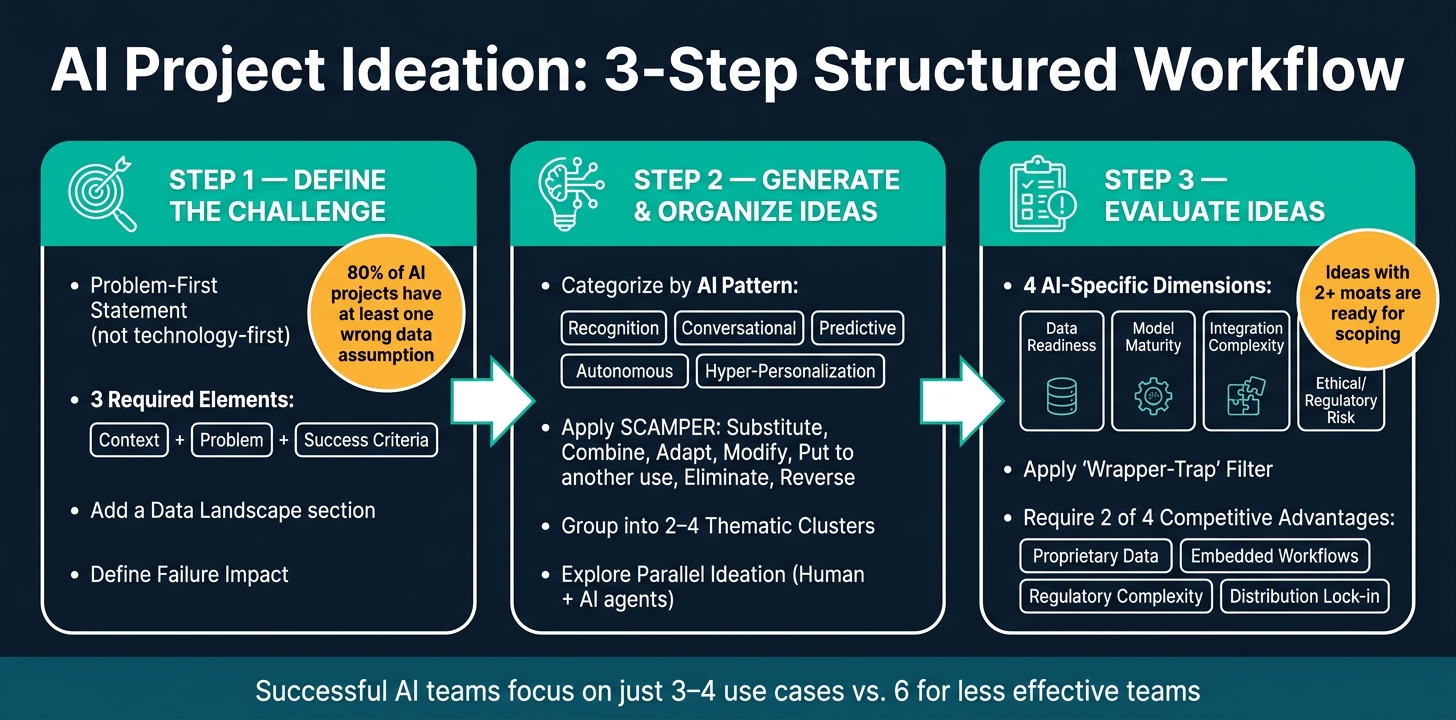
AI Project Ideation: 3-Step Structured Workflow
Having a solid framework is just the starting point. The real magic happens when you combine those frameworks with a clear, repeatable process that takes you from the initial brainstorming session to a shortlist of actionable ideas. Here’s a three-step process to guide you.
Step 1: Define the Challenge
Before you dive into brainstorming, start with a clear, problem-first statement - not a technology-first one. Here’s a quick litmus test:
"If you removed the AI from your project description and the problem statement still makes sense, you are problem-first. If removing the AI leaves you with nothing to say, you are technology-first." [2]
A strong problem statement includes three key elements: context, problem, and success criteria. Context sets the stage - what’s happening and why it matters. The problem itself should be concise, and success criteria should define what a successful outcome looks like, such as a measurable result or proof-of-concept.
For AI projects, add a Data Landscape section. This should outline the availability, quality, and access to data. This step is critical because 80% of AI projects encounter at least one incorrect assumption about data [2].
Don’t skip defining the Failure Impact either. AI systems are probabilistic, meaning errors are inevitable. But the consequences of those errors vary widely - missteps in fraud detection, for example, carry very different risks than errors in recommending content. Identifying these risks early on will shape your decisions moving forward.
With a well-defined challenge, you’re ready to dive into idea generation.
Step 2: Generate and Organize Ideas
Now that you’ve defined the challenge, focus on structured ideation. Start by categorizing ideas based on common AI patterns, such as Recognition, Conversational, Predictive, Autonomous, or Hyper-Personalization. This approach helps you spot potential pitfalls early [1].
Use the SCAMPER method to push beyond incremental thinking. SCAMPER stands for: Substitute, Combine, Adapt, Modify, Put to another use, Eliminate, and Reverse. These prompts encourage you to think more creatively about your problem space [20].
Once you’ve brainstormed, don’t rush to evaluate ideas immediately. Instead, group them into 2–4 thematic clusters based on shared product logic rather than the techniques used to generate them [20]. This makes the evaluation process smoother and more focused.
You can also explore parallel ideation by involving both human teams and AI agents. Siemens Foundational Technologies, for example, used this approach to develop ideas for its Industrial Metaverse use cases [19].
Step 3: Evaluate Ideas Against Key Criteria
After organizing your ideas, it’s time to evaluate them. Assess each idea using standard business metrics alongside four AI-specific dimensions:
| AI-Specific Dimension | What to Assess |
|---|---|
| Data Readiness | Is the necessary data available, clean, and ethically sourced? |
| Model Maturity | Can an off-the-shelf model be used, or will it require custom research? |
| Integration Complexity | How difficult will it be to integrate into existing workflows? |
| Ethical/Regulatory Risk | Are there concerns around bias, liability, or compliance (e.g., HIPAA)? [2] |
Additionally, apply a "wrapper-trap" filter. Ask yourself: Could a major provider like OpenAI, Google, or Anthropic turn this idea into a standard feature within six months? If the answer is yes, the idea may lack long-term competitive potential [5].
As entrepreneur Ayush Chaturvedi explains:
"If you can only justify one moat, your idea is a feature, not a company." [5]
To move forward, an idea should demonstrate at least two of these four competitive advantages: proprietary data, embedded workflows, regulatory complexity, or distribution lock-in [5]. Ideas that meet these criteria are ready for the next stage - scoping and prioritization.
How to Prioritize and Select AI Opportunities
Once you've brainstormed potential AI projects using structured frameworks, the next step is to prioritize them with clear business and feasibility metrics. Research indicates that successful AI teams tend to focus on just 3–4 use cases, compared to 6 for less effective teams [22]. This focus on fewer, well-chosen projects often determines whether a team achieves meaningful results or spreads its resources too thin.
Impact vs. Feasibility Matrix
A great way to narrow down your options is by using a 2×2 matrix that evaluates ideas based on business value and implementation feasibility. This approach forces you to realistically assess both the potential impact and the effort required.
| Quadrant | Value | Feasibility | Action |
|---|---|---|---|
| Quick Wins | High | High | Pilot now; build momentum and credibility |
| Strategic Bets | High | Low | Plan and invest in prerequisites first |
| Fill-Ins | Low | High | Pursue only if resources are idle |
| Avoid | Low | Low | Deprioritize or eliminate entirely |
Start with Quick Wins. These smaller, impactful projects can help build trust, refine your processes, and strengthen your team's capabilities. Rajesh Pentakota from Dyyota emphasizes this approach:
"Start with your highest-scoring use case, not your highest-impact one. A successful small project builds the credibility, infrastructure, and organizational muscle you need to tackle the bigger opportunities later." [25]
For example, in April 2026, a Fortune 200 manufacturer identified automating RFP responses as a Quick Win through a scoring exercise. After implementation, they cut response times by 60–80% and produced more proposals in 24 hours than they had in the previous three years combined [23].
This matrix lays the groundwork for a structured scoring process to further validate and refine your ideas.
Criteria for Selecting Viable Ideas
To score ideas consistently, you need clear, objective benchmarks. For instance, a project might score 5/5 for Business Impact if it directly reduces costs by over 10% or generates measurable revenue [21][22].
Key scoring dimensions include:
- Business Impact: How much revenue or cost savings does the project deliver?
- Technical Feasibility: Can your team realistically implement this with available skills and tools?
- Data Readiness: Do you already have the necessary data, or will significant preparation be required?
- Strategic Alignment: Does this project align with your company’s broader goals?
- Speed to Value: How quickly can you achieve measurable results?
Adjust the weight of these criteria based on your situation. For example, if cost reduction is a priority, you might allocate 35% of the weight to Business Impact. On the other hand, an early-stage AI initiative might emphasize Feasibility and Data Readiness equally at 25% each [22].
Involve a cross-functional team - Finance, IT, Operations, and others - to validate scores and minimize bias [21][22]. As John Byron Hanby IV, CEO of Iternal Technologies, explains:
"The solution is not generating more ideas. It is developing a rigorous methodology for discovering the right ideas, evaluating them against consistent criteria, and prioritizing them based on genuine business impact." [23]
Candidate Idea Ranking Table
Here’s how a cross-functional team might score a shortlist of AI use cases. Note that risk is scored inversely (1 = low risk), which positively affects the total score [23][24].
| Candidate Idea | Impact (1–5) | Effort (1–5) | Data Readiness (1–5) | Risk (1–5) | Total Score |
|---|---|---|---|---|---|
| B2B Sales Proposal Drafting | 5 | 2 | 5 | 2 | 24/25 |
| Meeting Recap Automation | 5 | 1 | 4 | 1 | 23/25 |
| Contract Clause Extraction | 4 | 4 | 5 | 3 | 18/25 |
| Outbound Email Scaling | 3 | 3 | 2 | 4 | 14/25 |
Take Meeting Recap Automation as an example. Although its impact is slightly lower than Sales Proposal Drafting, it scores high overall because it requires minimal effort and carries very little risk. This makes it a perfect Quick Win - ideal for building confidence before tackling more complex projects like contract clause extraction.
Moving from Ideas to Project Scope
Once you've ranked your top ideas and selected the best one, the real challenge begins: turning that concept into a workable project. Many AI initiatives stumble here - not because the idea was flawed, but because the project scope was never properly defined.
How to Define the Project Scope
To move from idea to execution, you need to set clear boundaries for your project. Start by crafting a measurable problem statement. As Andrew Ng, Founder of DeepLearning.AI, aptly says:
"I don't want to hear about your AI problems. I want to hear about your business problems. And then it's my job to work with you to see if there is an AI solution." [26]
Begin by mapping out the existing workflow to identify bottlenecks. Is there a manual step slowing things down? A lengthy approval process? Or maybe inefficient data lookups? Then, apply the No-AI test: if a non-AI solution can solve 80% of the problem, skip the AI approach altogether [27].
If AI is indeed the right tool, the next step is to create an output contract - a detailed specification of what the AI system needs to deliver. For example, a contract review tool might need to generate outputs like draft_reply, a list of citations with document IDs and quotes, policy_flags, and a needs_human_review boolean [27]. This kind of specificity helps avoid confusion during development and gives engineers a clear benchmark for testing.
It's also crucial to clearly define what the project's initial phase (Phase 1) will cover. For instance, if you're building a tool to summarize support tickets, explicitly state that "auto-resolving tickets without human review" is out of scope. This helps prevent scope creep - one of the leading causes of AI project failures, accounting for 35% of them [30]. A helpful way to align stakeholders is with a one-sentence project definition, such as: "Build an AI capability that does X for Y users in Z workflow, using A inputs, producing B outputs, with C constraints." [29]
Finally, quantify the cost of the current manual process. Without a clear understanding of the costs you're trying to offset, the project isn't ready to move forward [28].
Once the scope is nailed down, the next step is to test the concept with a pilot program.
Taking a Concept to Pilot
With the scope in place, it's time to test your idea in the real world. A pilot program allows you to validate the concept quickly without committing excessive resources. To avoid endless testing cycles, set a fixed timeline, define a minimum sample size, and establish clear go/no-go criteria upfront. Without these, pilots often drag on without a clear outcome [27].
A popular approach is the 90-day pilot cycle [31]:
- Weeks 1–2: Finalize one feature based on user impact and technical feasibility. During this phase, ensure you have access to the necessary data and meet compliance requirements (e.g., PII, HIPAA).
- Weeks 3–8: Build and test the core system architecture - whether it's an API wrapper, retrieval-augmented generation (RAG), or agent-based model. Define "done" as successfully passing 95% of pre-written test cases.
- Weeks 9–12: Deploy the system to a small group of users, gather feedback, and measure performance against your pre-set North Star KPI.
Before diving into full-scale production, run a 14-day validation sprint. The goal? Confirm demand. Secure 20 sign-ups or conduct 15 customer interviews to ensure there's genuine interest. If you can't generate that interest within two weeks, the project may need to pivot [5]. You can even manually produce the AI output during this phase to see if users find it valuable. If they don't, automating the process won't fix the issue [1].
Best Practices and Pitfalls to Avoid
Guardrails for Better Ideation
The most critical factor for a successful ideation session isn't the framework you choose - it's psychological safety. Google's Project Aristotle highlighted this as the top trait of high-performing teams [32]. When team members fear judgment, they self-censor, which stifles unconventional but valuable ideas.
In addition to fostering a safe environment, two structural habits can significantly improve outcomes. First, start with the problem, not the technology. For instance, a question like "How might we reduce customer support response times from 72 hours to under 4?" is far more effective than simply asking, "How can we use GPT-4?" Tackling a specific challenge keeps the session grounded and focused. Second, incorporate asynchronous contribution time before live discussions. Using tools like a shared digital whiteboard allows everyone, including introverts, to contribute without the pressure of groupthink [9].
On the data front, don’t let ideation outpace reality. Evaluate your data based on Availability, Quality, Accessibility, and Volume. If your total score is below 12 out of 20, it’s a sign that your data foundation needs work [33].
Common Ideation Mistakes
Even with strong guardrails in place, certain pitfalls can derail the ideation process.
One of the most frequent mistakes is starting with technology instead of a well-defined problem. This approach often results in flashy demos rather than meaningful solutions. Another issue is over-reliance on AI tools during brainstorming. Large language models can reinforce your ideas without truly challenging them, creating a false sense of validation [8][34]. As product discovery coach Else van der Berg advises, "The core principle: solo first, AI second." Generate your ideas independently, then use AI to refine or stress-test them.
A less obvious but equally damaging misstep is assuming your data is ready to go. Studies reveal that in 80% of AI projects, at least one assumption about data - whether it exists, is clean, accessible, or representative - is incorrect [2]. Asking early questions like "Where is the data, and is it good enough?" can eliminate nearly 40% of unrealistic ideas before they drain resources [2].
Lastly, beware of the wrapper trap - creating superficial AI solutions that can be easily replicated by major providers [5]. By 2026, venture capital has shifted almost entirely toward vertical AI solutions that integrate deeply into specific industry workflows, leaving generic AI wrappers largely unfundable [5].
Connecting Ideation to Leadership and Business Strategy
By following these guardrails and avoiding common errors, leaders can align ideation processes with broader business goals.
Structured ideation isn’t just about generating ideas - it’s a leadership skill. When prioritization is guided by data-driven scoring models rather than office politics, it prevents the "loudest voice in the room" from dictating direction [2]. This is especially crucial as organizations scale their AI initiatives. Teams with formal AI governance frameworks report 40% better project outcomes and reduce AI-related risks by 50% [33].
The statistics around failed AI projects tell a compelling story. According to BCG research cited by Nick Skillicorn, Founder of AI Hub Landau, "70% of AI challenges stem from people and process, not technology" [33]. This is where the 10/20/70 rule becomes a valuable guide for leaders: dedicate 10% of your focus to algorithms, 20% to technology infrastructure, and 70% to people and process change management [33].
For technical professionals stepping into leadership or consulting roles, mastering structured ideation is a game-changer. The ability to translate a business problem into a clear AI opportunity - using tools like scoring models, Technical Design Documents (TDDs), or Requests for Comments (RFCs) - bridges the gap between technical expertise and strategic decision-making [6]. Programs like Tech Leaders offer training to help engineers integrate AI strategies into business goals, turning ideation into tangible organizational outcomes.
Conclusion
Structured ideation plays a crucial role in the success of AI projects. It’s often the line between creating scalable solutions and contributing to the 80% of AI projects that never make it to production [33]. By using frameworks, workflows, and scoring models, teams can replace guesswork with a reliable, evidence-driven process.
George Krasadakis, author of The Innovation Mode, captures this idea perfectly:
"The fix is not more AI expertise. It is better innovation methodology applied to AI decisions." [2]
Start with a pressing business problem, and treat every AI capability as a hypothesis to be tested. Validate your data assumptions early on, and evaluate ideas using clear, objective criteria - not group consensus. Before writing a single line of code, ensure your concept has at least two strong competitive advantages, such as proprietary data, integrated workflows, or regulatory barriers [5]. Following these steps can help turn an AI concept into a scalable, impactful solution.
James Croft, Senior Software Engineer at Microsoft, emphasizes this mindset:
"Every AI capability you want to build can be encapsulated into a bunch of hypotheses. As you internalize that, it becomes much faster to ship things that matter." [1]
The tools and frameworks are already available. The challenge now is to apply them effectively. By incorporating these proven methods and maintaining a disciplined approach to evaluation, your AI projects can deliver meaningful business results.
FAQs
How do I know if my AI idea is problem-first or tech-first?
Here’s a simple way to figure it out: Take AI out of your project description.
- If the problem still makes sense and is actionable, congratulations - you’re working on a problem-first project. These kinds of ideas aim to solve real challenges or address specific pain points.
- If removing AI leaves you with nothing to solve, you’re dealing with a tech-first project. These often focus on showcasing AI’s capabilities rather than solving meaningful problems, which can lead to what’s sometimes called “innovation theater.”
The key is to focus on delivering real value rather than just flashy AI demonstrations.
What should we verify about data before committing to an AI pilot?
Before kicking off an AI pilot, it's important to evaluate whether your data is ready by focusing on four main areas:
- Availability: Make sure the data you need actually exists, is easy to access, and covers at least 12 months if you're working with supervised learning models.
- Quality: Review the data for completeness, consistency, and accurate labeling. Be mindful of any potential biases that could skew results.
- Accessibility: Ensure your team can access the data without significant obstacles while staying compliant with privacy and regulatory standards.
- Volume: Check that there's enough labeled data to support reliable model training and performance.
Properly assessing these factors upfront can save time and prevent setbacks later in the process.
How can we avoid creating an AI 'wrapper' that lacks defensibility?
To steer clear of creating an AI wrapper that's easily outmatched, center your efforts on addressing specific, high-stakes problems in areas where you possess deep expertise. Make sure your solution integrates seamlessly into workflows, especially with read/write access to internal systems.
To make your product harder to replicate, focus on at least two of these areas: proprietary data, specialized workflows, or regulatory barriers. These factors can give your solution a competitive edge.
Finally, validate your idea by securing tangible commitments, such as pre-orders. This ensures your users find enough value in the solution to justify paying for it.