
Top 7 CQ Assessment Tools for Teams
Cultural intelligence (CQ) is critical for working effectively in diverse teams. It helps in understanding and navigating different norms, communication styles, and behaviors. Here’s a quick look at seven tools to evaluate and improve CQ for individuals and teams:
- CQ 360° Assessment: Measures CQ across four areas (Drive, Knowledge, Strategy, Action) with personalized feedback and 360° reviews.
- CulturalQ Assessments: Offers tools like CQ Pro and Behavioral Preferences Profile to evaluate team dynamics and communication styles.
- GlobeSmart Profile: Focuses on work style preferences across five dimensions, such as communication and decision-making.
- TMC Cultural Orientations Indicator (COI): Maps team cultural preferences to improve collaboration.
- Intercultural Development Inventory (IDI): Tracks progress along a continuum from monocultural to intercultural mindsets.
- Hofstede's Cultural Dimensions Survey: Examines workplace behavior through six cultural dimensions like Power Distance and Individualism.
- Cultural Competence Assessment (CCA): Evaluates CQ dimensions with actionable steps for improvement.
These tools vary in scope, cost, and feedback style, making it crucial to select one based on your team's specific needs. Below is a summary table for quick comparison.
Quick Comparison
| Tool | CQ Dimensions Covered | Format | Feedback | Cost Range | Best For |
|---|---|---|---|---|---|
| CQ 360° Assessment | Drive, Knowledge, Strategy, Action | Online survey + 360° feedback | Personalized reports + plans | $150-$300/person | Peer feedback for global teams |
| CulturalQ Assessments | Drive, Knowledge, Strategy, Action | Interactive platform | Real-time dashboards + team insights | $100-$200/person | Agile, cross-time-zone teams |
| GlobeSmart Profile | Work style preferences | Quick online questionnaire | Cultural comparison charts | $50-$100/person | Remote teams with diverse backgrounds |
| TMC Cultural Orientations Indicator | 10 orientations + communication styles | Online assessment | Team profiles + gap analysis | $80-$150/person | Multicultural project management |
| Intercultural Development Inventory | Intercultural competence continuum | Questionnaire + interview | Professional interpretation | $200-$400/person | Senior leaders in global roles |
| Hofstede's Cultural Dimensions Survey | 6 cultural dimensions | Traditional survey | Country-level comparisons | $30-$75/person | Teams expanding internationally |
| Cultural Competence Assessment | Drive, Knowledge, Strategy, Action | Scenario-based assessment | Targeted development recommendations | $75-$125/person | Teams implementing DEI initiatives |
Each tool supports better teamwork by highlighting communication gaps and cultural differences. Select the one that aligns with your team's goals, budget, and timeline for the most impact.
Cultural Intelligence CQ - The Code for Team Success
1. Cultural Intelligence Center's CQ 360° Assessment
The Cultural Intelligence Center's CQ 360° Assessment is a detailed tool designed to measure cultural intelligence at both individual and team levels. It’s especially useful for technical leaders managing diverse, global teams, offering insights into how effectively they can navigate cultural differences.
Four Key Dimensions: Drive, Knowledge, Strategy, and Action
The CQ 360° Assessment evaluates four core areas of cultural intelligence:
- CQ Drive: This measures your motivation to engage in multicultural interactions, including your interest, persistence, and confidence when navigating cultural differences.
- CQ Knowledge: This assesses your understanding of cultural similarities and differences, focusing on aspects like communication styles, values, and business practices.
- CQ Strategy: This dimension looks at your ability to plan and prepare for cross-cultural interactions, helping you anticipate and navigate cultural differences effectively.
- CQ Action: This evaluates your adaptability in multicultural settings, including how well you adjust verbal and non-verbal behaviors.
The assessment provides a breakdown of these four capabilities across 13 sub-dimensions, offering a detailed profile of your cultural intelligence. It combines self-ratings with feedback from observers, benchmarking your results against global norms for a comprehensive view.
Backed by Scientific Research
The CQ Scale is rooted in rigorous academic research. Developed by David Livermore’s collaborators Soon Ang, Linn Van Dyne, and Christine Koh, it draws on Sternberg's theory of intelligence and has been validated across diverse groups, including executives, expatriates, professionals, and students [1].
"There's rigorous evidence to demonstrate the reliability and validity of both the self and 360° versions of the assessment." – David Livermore [1]
Studies show that the CQ 360° Assessment reliably predicts outcomes such as effective cross-cultural negotiations, better decision-making, and smoother cultural adaptation [2]. A review by intercultural psychologists David Matsumoto and Hyisung C. Hwang, published in the Journal of Cross-Cultural Psychology, further supports its validity across various cultural contexts [2].
Personalized Feedback and Development Plans
One of the standout features of this assessment is the actionable feedback it provides. After completing the evaluation, participants receive personalized reports and development plans tailored to their specific needs [3][4][6].
The tool offers two versions:
- Standard 360° Assessment: You choose your observers, who provide feedback on your cultural intelligence.
- Team 360° Assessment: Team members evaluate each other’s cultural capabilities, fostering collective growth.
This feedback often highlights blind spots - areas where your self-perception may differ from how others see you - helping you refine your leadership approach in multicultural settings.
Ideal for Technical and Global Teams
For technical leaders managing international teams, this assessment is a game-changer. Its focus on both self-awareness and external feedback makes it invaluable in environments where cultural misunderstandings can disrupt projects or harm client relationships. The Team 360° version, in particular, helps entire teams build a shared understanding of cultural dynamics, boosting collaboration and overall productivity.
2. CulturalQ's CQ Assessments
CulturalQ offers tools designed to measure how effectively team members navigate diverse cultural environments. These assessments focus on cultural intelligence in various organizational settings, making them particularly useful for teams working across multicultural landscapes [9].
Coverage of CQ Dimensions (Drive, Knowledge, Strategy, Action)
CulturalQ integrates the four key CQ dimensions - Drive, Knowledge, Strategy, and Action - into its specialized tools. Their offerings, including the CQ Pro Assessment and the Behavioral Preferences Profile, evaluate areas like motivation, cultural awareness, strategic thinking, and behavioral flexibility. This approach provides a detailed look at how cultural intelligence plays out in professional scenarios.
Actionable Feedback and Development Planning
CulturalQ provides detailed reports with clear, actionable feedback that highlights both individual and team strengths, as well as areas for improvement [7]. These reports go beyond basic scores, offering practical advice and tailored development plans to encourage growth [7]. For teams, optional group reports highlight collective strengths and challenges, sparking meaningful discussions and collaborative planning [7]. Additionally, the CQ 360° Assessment for Teams delivers personalized feedback by comparing individual and team scores to global benchmarks, alongside a custom development plan [8].
Ideal for Technical and Multicultural Teams
These assessments are particularly helpful for teams that need precise insights into cross-cultural dynamics. Managers can use the data to identify patterns in how team members interact across cultures, enabling discussions on work styles, communication preferences, and decision-making approaches. By blending individual and group insights, CulturalQ helps teams improve collaboration and tackle cultural challenges with confidence. This makes it an invaluable resource for enhancing cultural intelligence in diverse team settings.
3. GlobeSmart Profile
The GlobeSmart Profile takes a fresh approach to understanding cultural differences by zeroing in on work style preferences rather than the more conventional cultural intelligence categories. With a user base exceeding 800,000 globally, this tool has become a go-to resource for teams navigating the complexities of international business interactions [11]. Its focus on work styles highlights how these differences shape team dynamics and collaboration.
Key Work Style Dimensions
Instead of measuring the standard four dimensions of cultural intelligence, the GlobeSmart Profile examines five specific cultural dimensions that shed light on how individuals prefer to work:
- Independent vs. Interdependent: Looks at whether people define themselves through personal achievements or group harmony.
- Egalitarianism vs. Status: Explores preferences for challenging authority versus respecting hierarchical structures.
- Risk vs. Certainty: Reflects decision-making tendencies, from quick, bold choices to careful, research-driven processes.
- Direct vs. Indirect: Highlights communication styles, whether someone appreciates direct feedback or prefers a more nuanced, contextual approach.
- Task vs. Relationship: Examines whether individuals focus more on achieving goals or building relationships when starting a project.
This framework provides a clear understanding of how team members naturally approach tasks, communication, and problem-solving, especially in culturally diverse settings.
Personalized Insights and Practical Guidance
The GlobeSmart Profile delivers tailored recommendations based on each user’s unique work style preferences. It offers actionable tips for bridging gaps and finding common ground with colleagues who may approach work differently. Users can compare their profiles with data from over 95 countries and their peers, helping them spot potential challenges and opportunities for smoother collaboration early on.
Ideal for Technical and Global Teams
For technical teams working across international borders, the GlobeSmart Profile is a practical tool for addressing common workplace challenges. It tackles issues like varying attitudes toward risk, communication styles, and decision-making processes - areas that frequently come up in engineering and tech environments. With 98% of users reporting improved team collaboration after using the tool [10], it’s no surprise that it’s widely adopted by global teams. The assessment is also available in 13 languages, including Arabic, Chinese, German, Japanese, Korean, and Spanish [11], making it accessible to teams around the world.
4. TMC Cultural Orientations Indicator (COI)
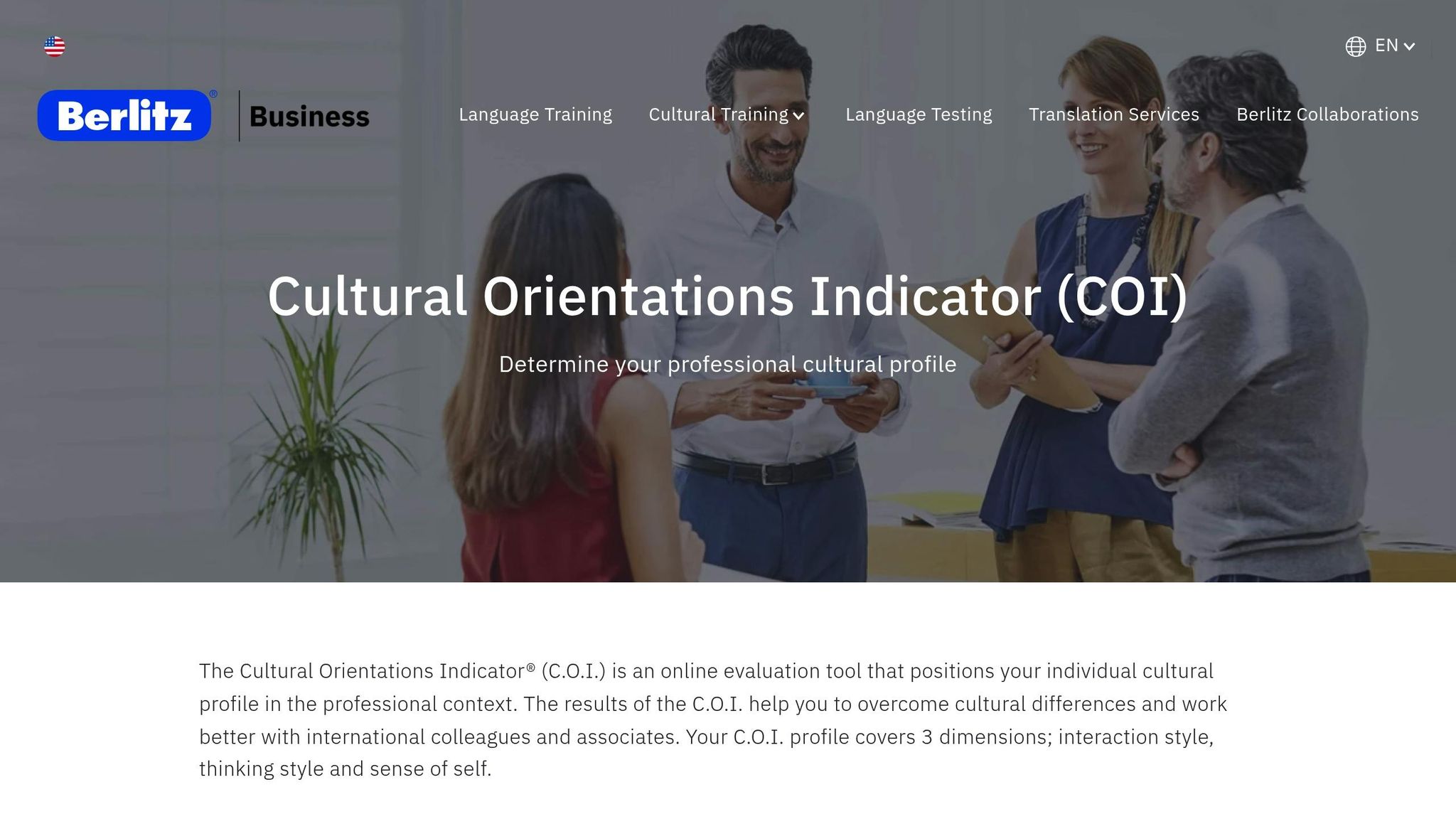
The TMC Cultural Orientations Indicator (COI) is a psychometric tool designed to explore and map cultural preferences within teams. By pinpointing cultural strengths and challenges, it provides organizations with valuable insights to improve cross-cultural collaboration and team dynamics [12]. This assessment lays a foundation for understanding how cultural differences influence team interactions.
Coverage of CQ Dimensions (Drive, Knowledge, Strategy, Action)
While the COI doesn't directly align with the traditional Cultural Intelligence (CQ) framework, it examines cultural preferences in areas such as communication style, decision-making, and leadership approaches. For example, it explores contrasts like hierarchy versus egalitarianism and direct versus indirect communication, shedding light on how these factors shape team dynamics. These insights help teams navigate cultural differences in areas like meeting participation and conflict resolution [12].
Actionable Feedback and Development Planning
The COI provides detailed reports that map both individual and team cultural profiles. These reports include visual representations of team diversity and gap analyses, offering clear data to address cultural differences. Teams can use this information to improve communication and develop tailored action plans. The tool also suggests specific strategies for enhancing cultural competence based on the team’s unique cultural makeup and areas for improvement [12].
Validity and Reliability
Grounded in established cross-cultural research, the COI has undergone rigorous psychometric validation to ensure its reliability and consistency. Its structured methodology and widespread adoption by global organizations highlight its credibility as a measurement tool [12]. However, its effectiveness depends on honest self-assessment and a commitment to applying the feedback provided. These validated insights empower teams to refine their cross-cultural strategies with confidence.
Suitability for Technical and Multicultural Teams
The COI is particularly useful for technical and multicultural teams, such as those in engineering and technology fields. For instance, a multinational engineering team used the COI to uncover communication and decision-making gaps between U.S. and Asian team members. By addressing these gaps with new protocols, the team achieved faster project delivery [12]. The COI helps create environments where diverse perspectives are acknowledged and leveraged, leading to stronger collaboration and outcomes.
sbb-itb-8feac72
5. Intercultural Development Inventory (IDI)
The Intercultural Development Inventory (IDI) is a tool designed to measure intercultural competence, validated across various cultural contexts. Rather than focusing on isolated skills, the IDI evaluates progress along a spectrum, moving from a monocultural to an intercultural mindset [13][14].
This tool examines both mindset and skillset in cross-cultural interactions, offering a broad perspective on where teams stand in their journey toward cultural understanding and collaboration [14].
Coverage of CQ Dimensions (Drive, Knowledge, Strategy, Action)
The IDI takes a developmental approach to cultural intelligence, viewing it as an evolving process. Traditional CQ assessments focus on four areas: Drive, Knowledge, Strategy, and Action. In contrast, the IDI measures progress along the Intercultural Development Continuum (IDC). This continuum captures the shift from monocultural mindsets - marked by stages like Denial and Polarization - to transitional phases such as Minimization, and finally to intercultural mindsets like Acceptance and Adaptation [13][5][15].
While it doesn’t directly align with the four CQ capabilities, the IDI provides a deeper understanding of the developmental groundwork that supports effective cross-cultural behavior.
Validity and Reliability of Measurement
The IDI stands out for its strong scientific foundation, having undergone extensive validation across different cultural environments [13][14]. Unlike tools that simply assess knowledge or preferences, the IDI focuses on developmental capacity, offering practical insights into how individuals and teams are likely to perform in intercultural settings. Its research-backed framework ensures reliable results, making it a trusted choice for organizations seeking actionable insights into cross-cultural competence.
Actionable Feedback and Development Planning
One of the IDI’s strengths lies in its ability to provide detailed feedback. It identifies specific developmental stages and offers tailored recommendations to help individuals and teams advance their intercultural competence [14]. Almendra Staffa-Healey, Co-Founder and Director of Intercultural Understanding, highlights its value:
"The IDI provides a base framework from which to developmentally understand one's relationship with difference and the strategies we use to navigate them. It's so sound and clear when used as part of a coaching or intercultural competency growth program that I really don't use other options." – Almendra Staffa-Healey [13]
This level of guidance makes the IDI a practical tool for fostering long-term growth in intercultural skills.
Suitability for Diverse Teams
The IDI’s developmental focus makes it particularly useful for teams aiming to improve cross-cultural collaboration. It helps organizations assess whether their members have transitioned from a monocultural perspective to an intercultural mindset. This shift is essential for effective communication and teamwork in diverse environments. For more insights on integrating cultural intelligence into team leadership, visit Tech Leaders.
6. Hofstede's Cultural Dimensions Survey
Hofstede's Cultural Dimensions Survey provides a structured way to understand cultural differences, particularly in workplace environments. Created by Geert Hofstede based on research conducted with IBM employees across various countries, this framework examines how national cultures shape communication styles and team dynamics.
The survey evaluates cultural values across six key dimensions: Power Distance, Individualism vs. Collectivism, Masculinity vs. Femininity, Uncertainty Avoidance, Long-term vs. Short-term Orientation, and Indulgence vs. Restraint. These dimensions offer insights into how people from different backgrounds approach hierarchy, collaboration, decision-making, and risk.
Coverage of Cultural Intelligence (CQ) Dimensions
Hofstede's survey primarily enhances the Knowledge (Cognition) aspect of Cultural Intelligence by quantifying national cultural traits. While it indirectly supports Strategy and Action through better-informed cross-cultural planning, it does not delve deeply into motivational factors. By focusing on measurable cultural differences, the framework equips teams with the knowledge needed for thoughtful, research-based cross-cultural interactions.
Validity and Reliability
The reliability of Hofstede's framework is backed by decades of data and extensive validation. With input from over 100,000 IBM employees across more than 50 countries, the survey offers a robust foundation for comparing cultural tendencies at the national level. Its strength lies in its focus on quantifiable cultural traits rather than subjective opinions, making it applicable across various organizational contexts. However, it’s important to note that the results reflect general national patterns, not individual behaviors.
Suitability for Technical and Multicultural Teams
For technical teams working in global markets, Hofstede's framework is a practical tool for understanding client needs and communication styles. For instance, the Uncertainty Avoidance dimension can help engineering teams recognize why clients from certain cultures may prefer detailed project plans or thorough documentation. Similarly, the Individualism vs. Collectivism dimension can guide leaders in finding the right balance between individual recognition and team-oriented goals.
For leaders managing multicultural teams, this framework offers actionable insights to create culturally aware leadership strategies. By identifying potential areas of friction based on cultural dimension scores, teams can address communication challenges early, ensuring smoother collaboration and project success. To further develop leadership skills that combine cultural awareness with technical expertise, platforms like Tech Leaders provide specialized training programs tailored for engineering professionals stepping into leadership roles.
7. Cultural Competence Assessment (CCA)
The Cultural Competence Assessment (CCA) stands out among CQ assessment tools for its practical and hands-on approach. Designed to evaluate how effectively individuals and teams operate in culturally diverse environments, the CCA is especially useful for organizations seeking immediate insights into their team’s ability to navigate cross-cultural challenges.
This tool provides a starting point by identifying strengths and gaps in cultural competence. It’s often used as both a pre- and post-assessment, offering measurable data to track improvements after diversity, equity, and inclusion (DEI) initiatives. This makes it an invaluable resource for teams aiming to enhance their cross-cultural effectiveness.
Coverage of CQ Dimensions (Drive, Knowledge, Strategy, Action)
The CCA thoroughly examines all four core CQ dimensions:
- Drive: Measures motivation for engaging across cultures.
- Knowledge: Assesses understanding of cultural differences.
- Strategy: Evaluates planning for cross-cultural interactions.
- Action: Focuses on adapting behaviors in diverse settings.
This comprehensive focus is particularly beneficial for technical teams working on high-stakes projects where cultural differences can significantly impact outcomes.
Actionable Feedback and Development Planning
One of the CCA’s key strengths is its ability to turn results into actionable steps. By pinpointing specific areas for improvement, it supports targeted DEI strategies. Teams can use the insights to create development plans that address gaps in cultural awareness, knowledge, or skills. For example, a 2023 survey found that organizations using structured cultural competence assessments saw a 17% boost in team collaboration and a 12% decline in cross-cultural misunderstandings within six months of implementing targeted interventions [12]. These kinds of results are crucial for teams tackling complex, diverse challenges.
Tailored for Technical and Multicultural Teams
The CCA is particularly well-suited for technical and engineering teams working in global markets or with diverse team compositions. For instance, software development teams collaborating across time zones and cultural backgrounds can use the CCA to identify potential communication barriers early on, preventing delays in project timelines. Engineering managers can leverage the results to better understand how cultural differences influence communication styles and decision-making processes.
For technical professionals aiming to enhance leadership skills that blend cultural awareness with technical expertise, platforms like Tech Leaders offer specialized programs. These programs build on CCA insights, helping engineers become more effective leaders in multicultural environments.
Tool Comparison Table
Choosing the right CQ tool depends on your team's specific needs and available budget. Below is a table highlighting the key features, costs, and suitability of various tools to help you make an informed decision.
| Tool | CQ Dimensions Covered | Assessment Format | Feedback Type | Typical Cost Range | Best For Technical Teams |
|---|---|---|---|---|---|
| CQ 360° Assessment | All 4 dimensions (Drive, Knowledge, Strategy, Action) | Online survey + 360° feedback | Comprehensive reports with development plans | $150-$300 per person | Global software teams seeking peer feedback |
| CulturalQ Assessments | All 4 dimensions with cultural context mapping | Interactive online platform | Real-time dashboards with team analytics | $100-$200 per person | Agile teams working across time zones |
| GlobeSmart Profile | Cultural values + behavioral adaptations | Quick online questionnaire (15-20 minutes) | Instant cultural comparison charts | $50-$100 per person | Remote engineering teams with diverse backgrounds |
| TMC Cultural Orientations Indicator | 10 cultural orientations + communication styles | Comprehensive online assessment | Detailed personal and team profiles | $80-$150 per person | Technical project managers leading multicultural teams |
| Intercultural Development Inventory | Intercultural competence continuum | Structured questionnaire + follow-up interview | Professional interpretation required | $200-$400 per person | Senior technical leaders in global organizations |
| Hofstede's Cultural Dimensions Survey | 6 cultural dimensions (Power Distance, Individualism, etc.) | Traditional survey format | Country-level cultural comparisons | $30-$75 per person | Startups expanding to international markets |
| Cultural Competence Assessment | All 4 CQ dimensions + practical application | Scenario-based online assessment | Targeted development recommendations | $75-$125 per person | Technical teams implementing DEI initiatives |
Key Insights for Budgeting and Timing
When selecting a tool, it's important to balance cost and implementation speed with the depth of insights required. For example, GlobeSmart Profile and CulturalQ Assessments provide quick results, making them ideal for teams that need immediate feedback. On the other hand, tools like the Intercultural Development Inventory (IDI) are more expensive and time-intensive but offer deeper, long-term insights.
For engineering teams, the CQ 360° Assessment is particularly effective for analyzing how cultural intelligence impacts processes like code reviews. Meanwhile, the GlobeSmart Profile is a great choice for teams needing fast cultural insights to address immediate communication challenges.
Budget planning becomes especially critical when rolling out these tools across entire departments. Consider both the financial investment and the time required to implement and interpret the results.
For those looking to further enhance multicultural leadership skills, check out Tech Leaders' specialized training programs, which are designed to complement these assessment tools and drive better collaboration in diverse technical environments.
Conclusion
Understanding and embracing cultural intelligence is a key strength for technical teams operating in today’s interconnected world. The seven assessment tools discussed above provide structured ways to evaluate and improve how teams handle cultural differences.
Choosing the right tool makes all the difference. Every team has unique needs, so it’s important to align the tool’s features with your team’s goals and resources.
The real impact comes when technical professionals grow into leaders who are culturally aware. Platforms like Tech Leaders offer training programs designed to help engineers build leadership skills alongside their technical expertise. This combination lays a strong foundation for managing diverse, global teams effectively.
Beyond assessments, incorporating customized leadership training can further boost team performance. By investing in cultural intelligence tools and leadership development, organizations demonstrate their dedication to diversity and innovation. As remote work continues to shape the tech industry, teams that apply these insights are better positioned to thrive in today’s competitive, multicultural markets.
FAQs
How can I choose the right cultural intelligence (CQ) assessment tool for my team?
To find the right CQ assessment tool for your team, start by pinpointing the specific areas of cultural intelligence your organization values most - whether it’s motivation, knowledge, strategy, or behavior. Think about your team’s unique goals, challenges, and dynamics to make sure the tool aligns with what you’re aiming to achieve.
Choose tools that deliver practical insights tailored to your team’s cultural environment and provide feedback that encourages real growth. It’s also smart to prioritize tools that are easy to use and support focused development efforts, making them a natural fit for your day-to-day operations. Keeping these factors in mind will help you pick a tool that genuinely boosts cultural intelligence within your team.
How do the CQ 360° Assessment and the Intercultural Development Inventory (IDI) differ in terms of feedback and practical use?
The CQ 360° Assessment gathers feedback from various sources like colleagues, supervisors, and team members, giving a comprehensive picture of an individual's cultural intelligence. It also identifies preferences across 10 cultural values, making it a practical tool for team building and personal development.
Meanwhile, the Intercultural Development Inventory (IDI) evaluates intercultural competence using the Intercultural Development Continuum. Through a confidential 50-item questionnaire, it establishes a starting point for understanding cultural awareness and sensitivity. This tool is often used in larger organizational or educational settings.
The CQ 360° shines in team and leadership development with its detailed, multi-source feedback, while the IDI focuses on fostering long-term intercultural awareness and growth.
How do cultural intelligence assessments enhance teamwork and productivity in diverse teams?
Cultural intelligence assessments play a crucial role in helping teams succeed in diverse settings. They improve understanding, encourage respect, and strengthen communication among team members. By highlighting cultural strengths and pinpointing areas that need improvement, these tools give leaders the insights they need to develop strategies that boost collaboration, minimize misunderstandings, and elevate team performance.
These assessments also promote inclusive leadership by equipping managers with the skills to guide diverse teams effectively. The result? A workplace that's not only more cohesive but also more innovative and productive.