

Ultimate Guide to 360-Degree Feedback for Leaders
360-degree feedback is a tool that helps leaders understand how they are perceived by others. Unlike traditional performance reviews, it gathers anonymous input from managers, peers, direct reports, and sometimes external stakeholders. This feedback focuses on leadership skills like communication, emotional intelligence, decision-making, and teamwork. The goal? To identify blind spots and align leadership intentions with actual impact.
Key Takeaways:
- What it is: A multi-rater assessment for leadership growth, not tied to promotions or pay.
- Why it matters: Boosts self-awareness, highlights strengths, and addresses perception gaps.
- How it works: Anonymous surveys with 30–40 questions covering 8–10 leadership competencies.
- Challenges: Requires effort, anonymity, and proper follow-up to avoid bias or overwhelm.
- Best practices: Use trained coaches, focus on actionable goals, and allow time for growth.
The process is developmental, not evaluative, and works best when paired with coaching and clear improvement plans. Leaders using this method often see improvements in team dynamics, employee retention, and customer loyalty.
What Is 360-Degree Feedback
Definition and Key Features
360-degree feedback, also known as multi-rater assessment, is a tool designed to help leaders grow by collecting anonymous feedback from their professional network. This network typically includes managers, peers, direct reports, and sometimes external stakeholders like customers or vendors [1]. Instead of focusing on measurable outcomes like sales or productivity, this process evaluates leadership qualities such as communication, decision-making, empathy, and teamwork [4].
A critical part of this process is the self-assessment. Leaders assess themselves on the same skills and traits their colleagues evaluate. By comparing these self-ratings with input from others, leaders can identify blind spots - areas where their self-perception doesn’t align with how others see them [9]. This comparison provides a clear picture of where intentions might not match actual impact, offering a foundation for meaningful growth.
Typically, an effective 360-degree feedback process includes 30 to 40 questions that cover eight to 10 key competencies. To ensure anonymity and reduce bias, each group of raters (managers, peers, direct reports) should include at least three participants [1]. This setup helps maintain confidentiality while delivering actionable insights without overwhelming participants.
Pros and Cons for Leaders
360-degree feedback comes with both clear benefits and potential challenges.
One of its standout advantages is the boost in self-awareness it provides. Dana Washington from DDI highlights this by saying:
The greatest value of 360-degree feedback is that it helps leaders see the gap between their intentions and how they actually show up [9].
This process not only uncovers blind spots but also brings hidden strengths to light - qualities that might go unnoticed in traditional top-down evaluations.
That said, the process isn’t without its hurdles. Gathering feedback from multiple sources takes time and effort, and if too many people are involved, rater fatigue can become a problem. Feedback may then feel rushed or incomplete. Additionally, receiving critical input from various sources can be overwhelming for leaders without proper guidance. Marie Krebs from People Stories points out:
360-degree reviews communicate to people that the value of their work is based not only on their managers' assessment but also on how helpful they are to their peers [10].
This benefit, however, hinges on maintaining strict anonymity. Without it, participants might hesitate to provide honest feedback out of fear of repercussions [1].
| Advantages | Challenges |
|---|---|
| Identifies blind spots between intentions and actual impact | Can overwhelm leaders without proper guidance |
| Reduces bias by including multiple perspectives | Requires significant time and effort to implement |
| Encourages open communication and accountability | Risk of rater fatigue if too many participants are involved |
| Creates a clear path for leadership growth | Fear of retribution if anonymity isn’t upheld |
| Helps improve team dynamics by clarifying interpersonal effects | Can lose effectiveness without follow-up action plans |
Unlike traditional performance reviews, which often focus on task completion and tie directly to promotions or pay raises, 360-degree feedback is strictly for development. It should never be used to make decisions about compensation or performance ratings. Instead, it’s a tool for growth, helping leaders understand how they are perceived and where they can improve.
Leadership Competencies to Assess
Core Competencies for Leadership Growth
360-degree feedback is a powerful tool for evaluating the behavioral skills that define leadership success, especially for technical professionals stepping into management roles. While technical expertise might land you the position, it's your ability to communicate, empathize, and make sound decisions that will truly determine your effectiveness as a leader.
To make feedback actionable, focus on 8 to 10 specific competencies. These should be framed around observable behaviors rather than vague descriptors. For instance, instead of simply measuring "communication", a well-designed survey might assess whether you "adjust messages to suit the audience" or "foster open and honest dialogue" [5][4].
Key competencies often fall into these categories:
- Communication: How effectively do you convey ideas and encourage meaningful dialogue?
- Emotional intelligence and empathy: Do you understand others' perspectives, build trust, and treat colleagues with respect?
- Decision-making and problem-solving: Can you make confident decisions with limited information and empower others to do the same?
- Teamwork and collaboration: Are you recognizing contributions, sharing credit, and working cohesively with others?
- Strategic alignment: Do you focus on long-term goals, approach challenges strategically, and advocate for necessary changes?
- Developing others: Are you committed to fostering team members' growth and learning?
- Accountability: Do you take responsibility for results and ensure tasks are completed effectively? [4]
These competencies provide a clear framework for meaningful feedback and improvement. For example, in December 2020, an HR team at a high-tech company carried out a 360-degree feedback survey for their CEO and executive team. While scores were generally high, the team received poor marks for "removing barriers to effective teamwork." Follow-up interviews revealed that a preferred billing system was causing inefficiencies, leading to extended client calls that disrupted core responsibilities. This feedback enabled the team to address the issue promptly, demonstrating the value of actionable insights [11].
It's easy to assume you're communicating clearly when, in reality, your team might find your instructions unclear. This highlights the shift from relying on technical skills to mastering people leadership. Programs like Tech Leaders' engineering leadership training are designed to help bridge this gap, ensuring managers develop the non-technical skills they need to succeed in leadership roles.
Comprehensive Guide to 360 degree feedback
sbb-itb-8feac72
How to Implement 360-Degree Feedback
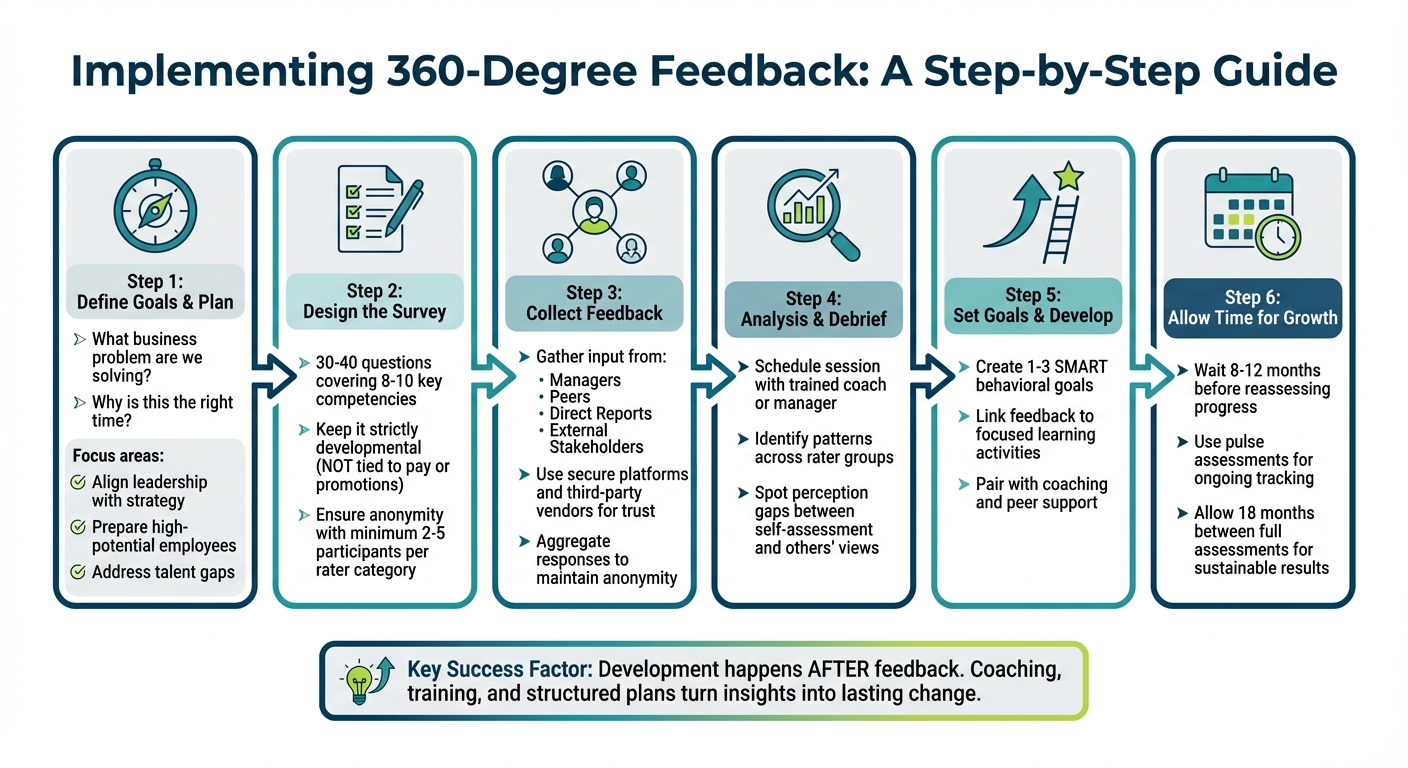
How to Implement 360-Degree Feedback: A Step-by-Step Process
Implementing a 360-degree feedback process successfully requires more than just distributing surveys. According to the Center for Creative Leadership, when these initiatives fail, it's usually due to poor execution rather than issues with the tool itself [7].
Start by defining your goals and planning each phase carefully. Ask yourself: What business problem are we solving? and Why is this the right time? [7]. Your focus might be aligning leadership with a new strategy, preparing high-potential employees for larger roles, or addressing specific talent gaps holding back your organization [7][14]. Without clear objectives, the process can backfire, leading to survey fatigue and skepticism instead of meaningful improvements.
To keep the process efficient, limit surveys to 30–40 items covering 8–10 key competencies [1]. This approach avoids overwhelming participants while focusing on what’s most important. Also, keep the feedback strictly developmental. Linking it to pay or promotions can lead to biased responses, as people may avoid sharing honest, constructive feedback if they think it could impact someone's salary or career progression [1].
Ensure anonymity by aggregating responses and using secure platforms. Only display results when a minimum of 2 to 5 participants are in each rater category [14][2]. Partnering with third-party vendors can further enhance trust in the process.
Once the feedback is collected, the next step is analysis and goal-setting. Schedule a debrief session with a trained coach or manager to review the results [7][14]. These discussions should focus on patterns across rater groups and identifying perception gaps - areas where others see weaknesses that the leader may not recognize. Use these insights to create 1–3 SMART behavioral goals [13][14]. Allow 8 to 12 months for leaders to work on these goals before reassessing progress, ensuring there’s enough time for meaningful and lasting changes [12].
Best Practices for Using 360-Degree Feedback
Make Feedback Part of Continuous Development
Getting a 360-degree feedback report is just the beginning. The real value lies in what you do next - linking that feedback to focused learning and development activities [7]. For instance, if the report highlights issues with communication or delegation, consider signing up for leadership training that targets those specific areas. Instead of limiting yourself to annual reviews, try pulse assessments - short, frequent check-ins that track progress on specific behaviors [8]. This method provides a more dynamic way to measure improvement.
It’s also important to focus on your strengths, not just areas for improvement. Studies suggest that honing your natural talents can lead to greater growth than solely working on weaknesses [1][3]. For example, if your feedback shows strong strategic thinking but room for improvement in empowering your team, think about how you can use your strategic skills to gradually enhance your coaching abilities.
To take this further, structured peer groups and coaching can help turn feedback into meaningful growth.
Use Peer Groups and Coaching
Interpreting feedback on your own can be tough. That’s where coaching and peer support come in. Work with a trained facilitator or coach who can help you analyze your feedback and create an actionable development plan [7][5]. A one-on-one session can uncover patterns in the feedback from various groups and help you identify which behaviors to prioritize. Dana Washington, Managing Consultant at DDI, explains:
A 360 is only valuable if leaders act on it. Provide coaching to help them interpret their report and build a development plan [5].
This is especially crucial for technical leaders moving into management roles. While you may excel at technical skills, 360-degree feedback often focuses on softer skills like empathy, communication, and conflict resolution - areas that are harder to measure and develop [4]. Platforms like Tech Leaders offer coaching and peer groups specifically designed for leaders in this transition. These peer groups provide a supportive environment where you can share feedback insights with others navigating similar challenges, making the process feel less isolating and more collaborative [4].
Conclusion
360-degree feedback sheds light on the difference between how you aim to lead and how others perceive your leadership style [5]. By collecting input from supervisors, peers, and direct reports, it provides a well-rounded perspective that highlights behaviors limiting your effectiveness and encourages meaningful change [3][4][5].
But feedback alone isn’t enough. As the Center for Creative Leadership explains:
Receiving, evaluating, and discussing a 360 feedback report is assessment. But development is what happens afterward - and development is what matters most to organizations [7].
The true value lies in turning feedback into action. This happens through coaching, training, and well-structured development plans. Without follow-up, the impact of feedback diminishes significantly [6].
Use these insights to amplify your natural strengths while addressing critical areas for improvement. Studies suggest that focusing on your strengths often leads to greater growth than solely working on weaknesses [1][6]. Pairing feedback with coaching can help you create clear, actionable steps [7][5]. To ensure sustainable progress, allow at least 18 months between assessments for reflection, action, and measurable results [5].
FAQs
How does 360-degree feedback help leaders grow?
360-degree feedback provides leaders with a comprehensive look at their strengths and areas where they could improve. By gathering input from colleagues, team members, and other stakeholders, this process ensures a mix of perspectives that helps minimize bias and highlights blind spots that might otherwise go unnoticed.
The key benefit? It boosts self-awareness. Leaders gain a clearer understanding of how their actions and behaviors affect those around them. This improved awareness can lead to better communication, sharper decision-making, and stronger emotional intelligence. When integrated into a development plan, 360-degree feedback becomes a practical tool for honing leadership abilities and driving organizational success.
What are the biggest challenges leaders face when implementing 360-degree feedback?
Introducing 360-degree feedback can be tricky for leaders, primarily because of a few key obstacles. One of the most significant is defining clear objectives. If the purpose of the feedback process isn’t well-defined or aligned with the organization’s goals, it risks becoming a pointless exercise that doesn’t lead to meaningful change.
Another big issue is building trust and ensuring confidentiality. If participants worry that their feedback won’t remain anonymous or could backfire on them, they’re less likely to be honest. On top of that, survey fatigue can set in, especially if employees feel the feedback is overly critical instead of constructive. This can lead to pushback or even disengagement.
To navigate these challenges, leaders need to plan carefully, prioritize anonymity, and foster a workplace culture that encourages growth and learning. Transparent communication and strong support from leadership are essential to ensure the process is both effective and well-received.
How can I effectively use 360-degree feedback to grow as a leader?
To grow as a leader using 360-degree feedback, start by approaching the feedback with an open mind. Look for recurring themes or patterns that highlight areas for improvement or strengths you can further develop. Resist the urge to dismiss critical comments - they often provide valuable insights that can help you grow.
Once you’ve identified key takeaways, create a clear action plan. Focus on setting specific, measurable goals to address the feedback you’ve received. Break these goals into smaller, manageable steps, and prioritize the areas that will have the most significant impact on your leadership. Consider seeking guidance from mentors, coaches, or trusted peers who can offer support and hold you accountable as you work toward your goals.
Finally, make it a habit to track your progress regularly and adjust your plan as needed. Treat feedback as a tool for ongoing growth rather than criticism. This mindset can help you boost self-awareness, refine your leadership skills, and inspire a culture of development and improvement within your team.