

Ultimate Guide to Navigating Workplace Polarization
Workplace polarization is a growing challenge, especially for technical teams. It goes beyond simple disagreements, affecting communication, collaboration, and team performance. Leaders must address this issue to maintain productivity and innovation. Here's what you need to know:
- 89% of U.S. employees experience workplace conflict, losing 3.5 hours weekly to disputes.
- Key causes include moral divides (absolutists vs. relativists), political differences, and remote work dynamics.
- Polarization impacts creativity, psychological safety, and retention, with 36% of workers avoiding colleagues due to political differences.
- Remote work amplifies these issues by reducing in-person interactions and increasing misunderstandings.
Solutions for Leaders:
- Encourage Open Communication: Create safe spaces for dialogue and use anonymous feedback tools.
- Build Emotional Intelligence: Train teams in active listening and empathy.
- Implement Conflict Resolution Protocols: Use structured steps or mediators when necessary.
- Equip Leaders with Training: Provide tools for managing emotions and fostering respectful dialogue.
Polarization won't disappear overnight, but leaders who prioritize these strategies can turn conflicts into opportunities for better teamwork and problem-solving.
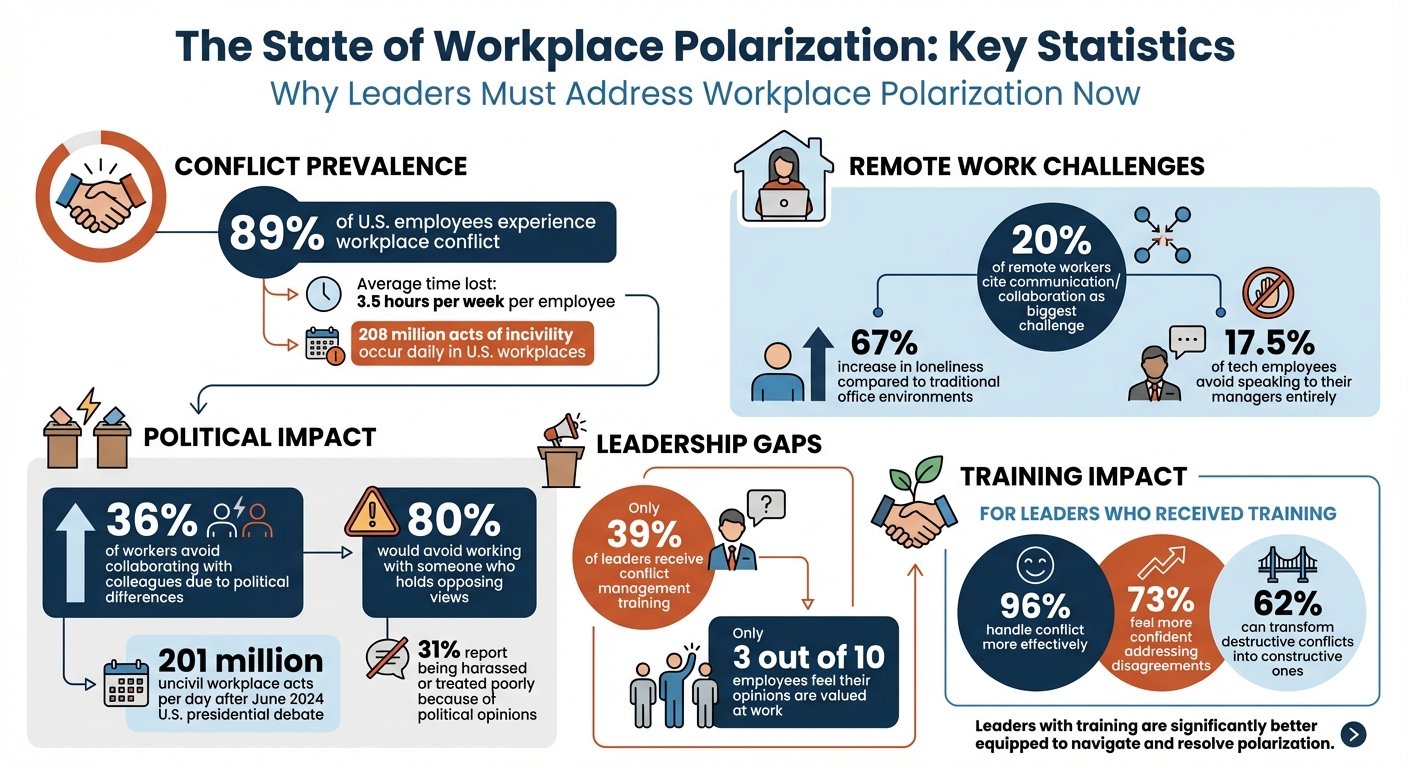
Workplace Polarization Statistics and Impact on Teams
Root Causes of Workplace Polarization
Cultural and Value-Based Conflicts
Workplace polarization often arises from differences in moral reasoning rather than straightforward political ideologies. In technical teams, this divide is most noticeable between moral absolutists, who see issues in black-and-white terms, and moral relativists, who prefer a nuanced approach [2]. Studies reveal that moral philosophy often shapes policy positions more strongly than political leanings [2].
This moral divide can lead to identity narrowing, where individuals reduce colleagues to simplistic political labels. When personal beliefs become moral identities, employees form "moral tribes" - groups that seek validation from those who share their views while dismissing others as immoral [6]. Social psychologist Jonathan Haidt captures this mindset:
"I am right (that is, moral), and anyone who disagrees with me is wrong (that is, immoral)" [6].
The impact of this polarization is staggering. After the June 2024 U.S. presidential debate, uncivil workplace acts in the U.S. surged to 201 million per day [6]. Surveys show 36% of workers avoid collaborating with colleagues due to political differences, and 31% report being harassed or treated poorly because of their political opinions [10]. In technical fields, these value-based conflicts frequently spill into task-related disputes, such as disagreements over ethical standards, data interpretation, or strategic decisions - turning everyday work into a battleground for broader cultural values [9][11].
These deep-seated conflicts are further complicated by the communication challenges brought on by remote work.
Impact of Remote Work and Global Teams
Remote work has fundamentally changed how polarization manifests in the workplace. With physical boundaries erased, "porous boundaries" now allow personal political opinions to seep into professional spaces [6]. Social media amplifies this effect, making colleagues' political views more visible than ever before. A single LinkedIn post or a viral tweet can reshape how team members perceive one another.
The shift to text-based, asynchronous communication adds another layer of complexity. Without nonverbal cues, misunderstandings become more common, deepening divisions [13][14][15]. In fact, 20% of remote workers cite communication and collaboration as their biggest challenges [12][14]. Remote setups also eliminate casual, in-person interactions - those spontaneous "water cooler" moments that help build trust and ease tensions [13][15].
The consequences are significant. Remote work has increased loneliness by 67% compared to traditional office environments [14]. Additionally, proximity bias - where in-office employees receive more attention and opportunities - creates a "two-tier" workforce, further fueling resentment [15]. For technical leaders, this means shifting away from visual supervision toward outcome-based metrics, which requires a level of trust that’s much harder to maintain in remote or hybrid settings [12][16].
These challenges underscore the need for leaders to rethink their strategies in a polarized and remote work environment.
Leadership's Role in Addressing Polarization
Leaders play a critical role in either reducing or exacerbating workplace polarization. Instead of trying to "win" moral arguments, effective leaders focus on creating fair decision-making processes [6][2]. Attempts to silence political discussions or counter employees' beliefs with overwhelming amounts of data often backfire, hardening resistance and increasing turnover - especially among younger workers [6][2].
An executive from Intuit highlighted a different approach:
"Focus on how you're feeling and how things are affecting you as a person, and less on using our internal channels as a platform for your political views" [6].
This strategy allows for emotional acknowledgment without turning the workplace into a political arena. Leaders can also create "red line lists" - clear, non-negotiable principles such as refusing to work with suppliers who violate labor standards. This approach satisfies absolutists while giving relativists room to explore compromises outside those boundaries [2].
Corporate activism adds another layer of complexity. Companies face growing pressure to take public stances on issues like AI ethics, climate change, and reproductive rights. While these actions may align with some employees' values, they risk alienating others [8][10]. To navigate this, leaders should establish anonymous reporting channels, enabling employees to report disrespect or harassment without fear of retaliation from colleagues in opposing "moral tribes" [7]. Research also suggests that when leaders embrace the ambiguity of contentious issues, employees are less likely to adopt polarized positions [6].
These leadership strategies are essential for fostering a more balanced and collaborative workplace environment amidst growing divides.
Political Polarization in the Workplace with Arthur Brooks | Tomorrowist
Promoting Open and Effective Communication
Workplace conflict is more common than you might think. A staggering 89% of U.S. employees deal with it, dedicating an average of 3.5 hours per week to resolving disputes [1]. On top of that, 208 million acts of incivility occur daily across U.S. workplaces [7]. For technical leaders, the challenge lies in creating strategies that open communication channels and prevent these tensions from derailing team performance.
Creating Safe Spaces for Dialogue
At the heart of effective communication is psychological safety. Teams that feel safe to share ideas and concerns without fear of judgment or punishment tend to perform better and experience fewer interpersonal conflicts. A study spanning 2.5 years and nearly 300 leaders revealed that teams with high psychological safety achieved higher performance and lower conflict levels [17]. Yet, only 3 out of 10 employees feel their opinions are valued at work [17].
"Psychological safety is the belief that you won't be punished or humiliated for speaking up with ideas, questions, concerns, or mistakes." - Center for Creative Leadership [17]
To build this foundation, focus on the four stages of psychological safety:
- Inclusion Safety: Ensures everyone feels accepted for who they are.
- Learner Safety: Encourages questions and tolerates mistakes without judgment.
- Contributor Safety: Empowers individuals to apply their skills meaningfully.
- Challenger Safety: Allows team members to question norms without fear of retaliation [17].
In meetings, guide discussions toward tasks and strategies rather than personal attributes [7]. For remote teams, video calls can help leaders pick up on emotional cues, while chat functions provide a space for those who prefer typing over speaking [17]. Once these safe spaces are established, anonymous tools can further ease communication barriers.
Using Anonymous Feedback Tools
Anonymous feedback tools are a game-changer, especially in situations where employees feel uncomfortable addressing issues directly with supervisors [7][5]. A survey of 6,000 tech employees revealed that 17.5% avoid speaking to their managers entirely [19], underscoring the need for alternative communication channels.
Consider implementing digital tools like Mentimeter, Slido, or EasyRetro to gather unfiltered feedback. These platforms allow team members to express concerns without fear of reprisal, particularly during interim check-ins or brainstorming sessions [19][7]. Anonymous systems can act as a stepping stone, helping employees feel heard until open dialogue becomes the norm.
When feedback is shared anonymously, acknowledge the input publicly (without exposing identities). This reinforces the message that honesty and vulnerability are valued [17]. Over time, these tools can build trust, paving the way for more transparent communication in team meetings.
Conducting Regular Team Meetings
Proactive team meetings are a simple yet effective way to prevent conflicts from escalating [20]. These gatherings provide a platform for addressing issues early and reinforcing communication protocols. Start each meeting with personal check-ins - celebrating milestones or simply asking how everyone is feeling can strengthen the human connection needed to navigate tough conversations [7].
Use these sessions to normalize brainstorming and encourage sharing of incomplete ideas. Many conflicts arise from confusion over decision-making authority, so be clear about who has the final say on key issues [7]. Additionally, provide feedback throughout the year, not just during annual reviews. This helps resolve misunderstandings before they snowball into larger disputes [7].
Dr. Amy Dufrane, CEO of HRCI, emphasizes the importance of authenticity in workplace communication:
"Our goal should be a culture that allows individuals to express themselves authentically - and diplomatically - without fear of retribution." [18]
When 80% of surveyed individuals admit they would avoid working with someone who holds opposing views [18], regular, structured meetings become essential. These discussions act as guardrails, allowing for productive disagreements while fostering collaboration. By addressing communication challenges head-on, leaders can turn potential conflicts into opportunities for stronger, more cohesive teams.
Building Empathy and Emotional Intelligence in Teams
Emotional intelligence (EI) involves using emotions as valuable data to guide decisions and avoid impulsive reactions [21]. This approach helps team members acknowledge their emotions without letting those feelings dictate their actions [21]. Strengthening empathy goes hand-in-hand with fostering open communication and psychological safety. As Robin Stern, Co-founder and Senior Adviser at the Yale Center for Emotional Intelligence, aptly puts it:
"Emotional intelligence isn't a magic solution that will resolve every divide or heal every wound, but it's a starting point." [21]
A core part of EI is perspective-taking - pausing to consider others' feelings and how one's actions shape a situation. This mindset helps counter exaggerated perceptions, where opposing views seem more extreme than they actually are [4]. Michele Gelfand, Professor of Organizational Behavior at Stanford GSB, emphasizes that cultures that encourage constructive conflict see benefits like reduced burnout and stronger team cohesion [22]. Strategies such as active listening, intentional team-building, and structured mentorship can turn empathy into practical tools for improving team dynamics.
Training on Active Listening
Active listening workshops equip employees to focus on the issue rather than attacking a colleague's character or motives [7]. This method uncovers the emotions behind disagreements, reducing personal conflicts. By considering opposing perspectives, team members can minimize exaggerated perceptions [7]. Training often includes verbal strategies, like hedging statements with phrases such as "I believe" or "it's possible that", to encourage open and respectful dialogue [3]. Leaders play a critical role here by modeling respectful communication through receptive tones and open body language during discussions [7]. Harvard Business School researchers Julia A. Minson and Francesca Gino highlight the value of these efforts:
"Honing these skills takes time and practice, but the resulting decrease in frustration and negativity is well worth the effort." [3]
The aim is to help employees see that productive disagreement is a skill to develop, not an innate ability [5]. When managers guide dissent toward tasks, strategies, and goals - avoiding personal criticism - they foster an environment where disagreements can drive innovation and lead to better decisions [7].
Team-Building Exercises
Building on active listening, team-building activities help forge deeper connections among team members. These activities are most effective when they encourage productive debates and highlight diverse perspectives [7]. Intentionally diverse teams can spark innovation, provided psychological safety is maintained. A good starting point is identifying shared values - like concerns for family or community - before diving into more polarizing topics [22]. Rituals like celebrating milestones or starting meetings with personal check-ins can strengthen bonds and create a sense of belonging [7]. These practices reinforce shared humanity through storytelling and connection [22].
Organizations are increasingly broadening their definitions of workplace diversity to include ideological and viewpoint diversity [22]. Recognizing that moral and political beliefs are often deeply ingrained rather than simple choices helps reduce discrimination and fosters empathy within teams.
Mentorship and Peer Support Programs
Mentorship programs play a pivotal role in cultivating empathy by offering personalized guidance on managing conflict. Pairing colleagues as mentors and mentees encourages emotional growth and perspective-taking. Additionally, assigning peer support specialists to mediate conflicts can prevent disagreements from escalating into formal HR issues [7]. These specialists act as neutral facilitators, fostering understanding between colleagues with differing viewpoints.
Mentorship programs can teach participants to pause before reacting, allowing time to process emotions and consider how their responses affect others [21]. Digital tools like HowWeFeel can support this process by helping employees track and reflect on their emotional states [21].
U.S. Surgeon General Vivek Murthy underscores the importance of relationships in this context:
"Our relationships are a source of healing and well-being hiding in plain sight." [21]
sbb-itb-8feac72
Implementing Conflict Resolution Protocols
Conflict is an inevitable part of any workplace, especially in environments where diverse backgrounds and perspectives intersect. In fact, 89% of employees experience conflict, with an average of 3.5 hours lost weekly due to these disputes. This makes having a formal conflict resolution process not just helpful but essential for maintaining productivity. As the Society for Human Resource Management aptly notes:
"Conflict is a natural outcome of employees with diverse backgrounds and ways of thinking working together." [7]
Beyond simply resolving disputes, effective protocols can prevent conflicts from spiraling into costly issues like litigation or employee turnover [7][5]. A well-thought-out system promotes fairness, preserves relationships, and helps teams stay focused on their goals instead of being mired in interpersonal challenges.
Standardized Steps for Conflict Resolution
A clear and structured approach is key to managing conflict consistently across an organization. A five-phase process often works best:
- Identify the problem with clear, objective facts.
- Allow emotional expression to acknowledge feelings like anger or frustration.
- Identify mutual needs to understand the underlying concerns of all parties.
- Generate solution alternatives collaboratively.
- Schedule formal follow-ups to ensure accountability and progress [23][25].
This sequence is important because emotions can block productive problem-solving. Carnegie Mellon University researchers highlight the value of listening in this context:
"Listening is the most powerful tool to resolve an issue but can also be the hardest." [23]
By focusing on the why behind someone’s position rather than just the what, teams can uncover shared needs. For instance, two colleagues arguing over project ownership might both be seeking recognition. A solution that acknowledges their contributions could resolve the dispute without forcing a win-lose outcome.
It’s also essential to conduct these discussions in neutral spaces rather than a supervisor’s office. This reduces power dynamics and fosters open communication [24]. Additionally, tracking metrics - like the average resolution time and costs associated with grievances - helps evaluate the protocol’s effectiveness [7][5]. For particularly polarized disputes, starting with agreements on smaller points can build trust and momentum toward resolving larger issues [25].
When these steps aren’t enough, external mediation may be required.
Utilizing Professional Mediators
Certain situations call for professional mediators, especially when conflicts involve senior leadership, claims of harassment or discrimination, or recurring patterns of bullying [7][5]. These neutral third parties bring an unbiased perspective and can guide discussions toward creative solutions that might not emerge internally [7].
Other triggers for external mediation include cases where HR lacks the expertise or time to manage the issue, when HR professionals report to someone involved in the conflict, or when an employee has legal representation [7][5]. Eugene Dilan, Founder and CEO of Dilan Consulting Group, emphasizes:
"The ideal resolution is one that lands on an outcome that's best for the organization." [27]
Successful mediation relies on voluntary participation and clear ground rules, such as no interruptions, maintaining a calm tone, and setting time limits [27][7]. If emotions run high, protocols should allow for a "pause" to reschedule discussions after everyone has had time to reflect [27]. Mediators do not impose solutions; instead, they facilitate dialogue, helping preserve relationships and ensuring all parties feel invested in the outcome [24].
For cases where external mediation isn’t necessary, strong internal policies provide a foundation for conflict resolution.
Establishing Internal Mediation Policies
To ensure consistency, mediation protocols should be clearly documented in employee handbooks and executive contracts. These policies must explicitly prohibit retaliation against employees who raise concerns [7]. Offering multiple reporting channels, such as anonymous digital systems or alternatives to direct supervisors, ensures employees feel safe coming forward [7][5].
A four-step grievance process can help manage disputes without unnecessary escalation:
- Open-door policy for initial discussions.
- Management review for further insights.
- HR review to provide an impartial perspective.
- Formal appeal for unresolved issues [7][5].
Customizing these policies to reflect your organization’s unique environment is crucial - generic templates often fall short [26]. Regularly monitoring metrics like the number of grievances per 1,000 employees and identifying recurring issues can help address systemic problems. Finally, accountability for resolving conflicts shouldn’t rest solely on managers; employees at all levels should be empowered to address disputes at their source [7].
Equipping Leaders with Tools and Training
Conflict resolution in the workplace is only as effective as the skills of the leaders managing it. Yet, only 39% of leaders report receiving any training or coaching in this area [29]. This lack of preparation leaves many managers ill-equipped to handle the increasing polarization seen in today’s workplaces, where an estimated 208 million acts of incivility occur daily in U.S. organizations [5]. Building these skills is essential for turning workplace divides into meaningful, productive discussions, especially within technical teams.
The impact of training is clear. Among leaders who received conflict management training, 96% reported handling conflict more effectively, 73% felt more confident addressing disagreements, and 62% believed they could transform destructive conflicts into constructive ones [29]. These skills not only improve team dynamics but also enhance performance and retention.
Leadership Development Programs
To close this skills gap, leaders need practical tools and training tailored to real-world challenges. Programs like SHRM’s People Manager Qualification (PMQ) provide managers with structured training in dispute resolution and team dynamics [5]. For technical leaders, initiatives such as those offered by Tech Leaders help bridge the gap between technical expertise and the interpersonal skills needed to manage emotionally charged situations and foster psychological safety in high-pressure environments.
One effective approach is the "HEAR" framework, which teaches leaders to:
- Hedge claims with words like "sometimes" or "often" to avoid absolutes
- Emphasize common ground before addressing disagreements
- Acknowledge other viewpoints with phrases like "I understand that you believe..."
- Reframe issues positively to encourage open dialogue
Research shows that when leaders model this approach, it sets a tone of openness that team members naturally follow [29].
Another critical skill is deep listening, which involves three steps:
- Attending: Showing engagement through nonverbal cues.
- Following: Using active silence and open-ended questions.
- Reflecting: Rephrasing what’s been said to confirm understanding.
The "Listening Triangle" technique builds on this by having leaders ask about a perspective, listen carefully, and restate it before responding. This not only clarifies misunderstandings but also encourages deeper reasoning [29]. These strategies help reduce divisiveness by ensuring all viewpoints are heard before decisions are made.
Workshops on Emotional Regulation
Emotionally charged disagreements can derail productivity if not managed well [29]. Leaders must learn to regulate their own reactions to maintain team cohesion. Mindfulness training (MT) helps leaders develop "meta-awareness", allowing them to recognize and distance themselves from emotional triggers [30]. Similarly, cognitive reappraisal (CT) teaches leaders to reframe challenging situations as opportunities for growth rather than threats [30].
Techniques from Dialectical Behavior Therapy (DBT) are also effective in workplace settings. For instance:
- Opposite Action encourages leaders to listen attentively instead of interrupting defensive urges.
- Radical Acceptance helps leaders acknowledge that they cannot control others’ beliefs, reducing the need for forced agreement [31].
Workshops should also focus on task-oriented conflict resolution, guiding leaders to keep disagreements centered on work rather than personal differences. Pixar cofounder Ed Catmull captures this idea well:
"There is no learning without debate... It is by truly embracing disagreement and differences in perspectives that we make better decisions... But to be effective, conflict needs to be about the work, not the people." [29]
When discussions veer into personal territory, leaders can redirect the conversation with phrases like, "We’re getting personal. Let’s refocus on the task" [29]. This simple intervention preserves trust and keeps the team focused on solving problems rather than defending egos.
Modeling Respectful Dialogue
Leaders play a key role in shaping team culture [10], and their behavior sets the tone for how conflicts are handled. Modeling respectful dialogue starts with intellectual humility - being open to questioning one’s own assumptions and reasoning [28]. Leaders can demonstrate this by softening their assertions with phrases like "I could be wrong, but..." and by acknowledging valid points from opposing views [29].
Establishing clear decision-making rules also helps shift the focus from "who is right" to "how we decide", reducing the perception that one side’s values are being dismissed [2].
Structured techniques like "Jazz Dialogues" encourage dynamic discussions where leaders actively listen, build on ideas, and respond thoughtfully in real time [32]. This approach moves teams away from "impression management" - staying silent to avoid looking incompetent - and toward embracing disagreement as a tool for better solutions [32].
Leaders must also address false polarization bias, where people assume opposing views are more extreme than they actually are [4][29]. By seeking to understand opposing perspectives and asking clarifying questions, leaders show that understanding doesn’t require agreement. This mindset makes even the most divisive topics a chance to innovate and strengthen team cohesion.
Conclusion
Workplace polarization is here to stay - nearly 89% of employees report experiencing conflict on the job, with the average worker dedicating 3.5 hours each week to managing disagreements [1]. The real challenge isn’t avoiding conflict but deciding how to respond when it arises. Teams that thrive under pressure often do so because of leaders who intentionally cultivate what researchers call "constructive conflict cultures" [22].
To build such a culture, leaders must go beyond technical know-how and focus on developing the interpersonal skills that help teams stay united during tough times. Tech Leaders offers tailored programs for engineering professionals, equipping them with training in conflict resolution, emotional intelligence, and team management - skills critical for navigating workplace tensions effectively.
The strategies outlined in this guide, like fostering open dialogue and implementing structured conflict protocols, only succeed when leaders consistently model these behaviors. As Michele Gelfand, Professor of Organizational Behavior at Stanford GSB, explains: "Leaders in organizations are key to promoting social norms for constructive conflict management - what we call conflict cultures. Leaders' own conflict styles trickle down to others" [22]. Simply put, your team mirrors the way you handle disagreements, setting the tone for how conflicts are managed.
Start small. Choose one strategy from this guide - whether it’s practicing deep listening or establishing clear decision-making frameworks - and put it into action this week. While the 208 million acts of incivility occurring daily in U.S. workplaces [7] won’t vanish overnight, each step you take toward redirecting conflicts from personal friction to task-focused problem-solving strengthens your team’s resilience and cohesion.
FAQs
What are the best strategies for managing workplace polarization in remote teams?
Handling workplace polarization in remote teams requires a focus on open communication and mutual understanding. Leaders should create an environment where team members feel safe sharing their perspectives, no matter how different. Encouraging respectful dialogue is key to building trust and easing tensions.
Practical steps can make a big difference. Regular virtual check-ins help keep everyone connected, while structured methods for resolving conflicts ensure issues are addressed fairly. Emphasizing shared goals reminds the team of their common purpose, fostering collaboration. Understanding what’s causing the polarization - like conflicting values or communication challenges - allows leaders to tackle problems at their core.
By showing empathy and demonstrating how to handle conflicts constructively, leaders set an example for the team. This approach helps maintain both cohesion and productivity, even when everyone is working from a distance.
How can leaders create psychological safety in a divided workplace?
Building psychological safety in a workplace that feels divided starts with establishing trust, open communication, and mutual respect. Leaders play a key role in creating an environment where team members feel comfortable sharing their ideas or concerns without worrying about judgment or backlash.
Here’s how leaders can make that happen:
- Encourage open dialogue: Set clear expectations for respectful conversations. Actively listen to different viewpoints and show empathy for others' experiences, even if they differ from your own.
- Lead by example: Transparency matters. Admit mistakes openly, seek feedback from your team, and stay consistent in your actions to build trust.
- Address conflicts constructively: Offer structured ways to resolve disagreements. This ensures everyone’s voice is heard and helps clear up misunderstandings before they escalate.
By embracing inclusivity and valuing a range of perspectives, leaders can create a culture where respectful debate is not only welcomed but thrives. The result? Less division, stronger team connections, and a workplace where collaboration feels natural.
How does emotional intelligence help resolve workplace conflicts?
Emotional intelligence plays a crucial role in handling workplace conflicts effectively. It equips individuals with the ability to not only manage their own emotions but also understand and respond to the emotions of others. This kind of awareness paves the way for empathy, patience, and active listening - all critical skills for easing tensions and fostering open, honest communication.
When leaders and employees approach disagreements with a composed and considerate mindset, they create an environment of trust and mutual understanding. Even in highly charged situations, emotional intelligence can guide discussions toward finding common ground. It transforms conflicts into chances for meaningful dialogue, teamwork, and stronger workplace connections.