

Ultimate Guide To Stakeholder Trust Building
Trust is the foundation of effective technical leadership. It impacts team efficiency, decision-making, and stakeholder collaboration. Without it, projects stall, communication breaks down, and productivity suffers. This guide explains how to build, maintain, and measure trust with actionable strategies for leaders managing complex environments.
Key Takeaways:
- Trust is built on four pillars: Competence, reliability, integrity, and transparency.
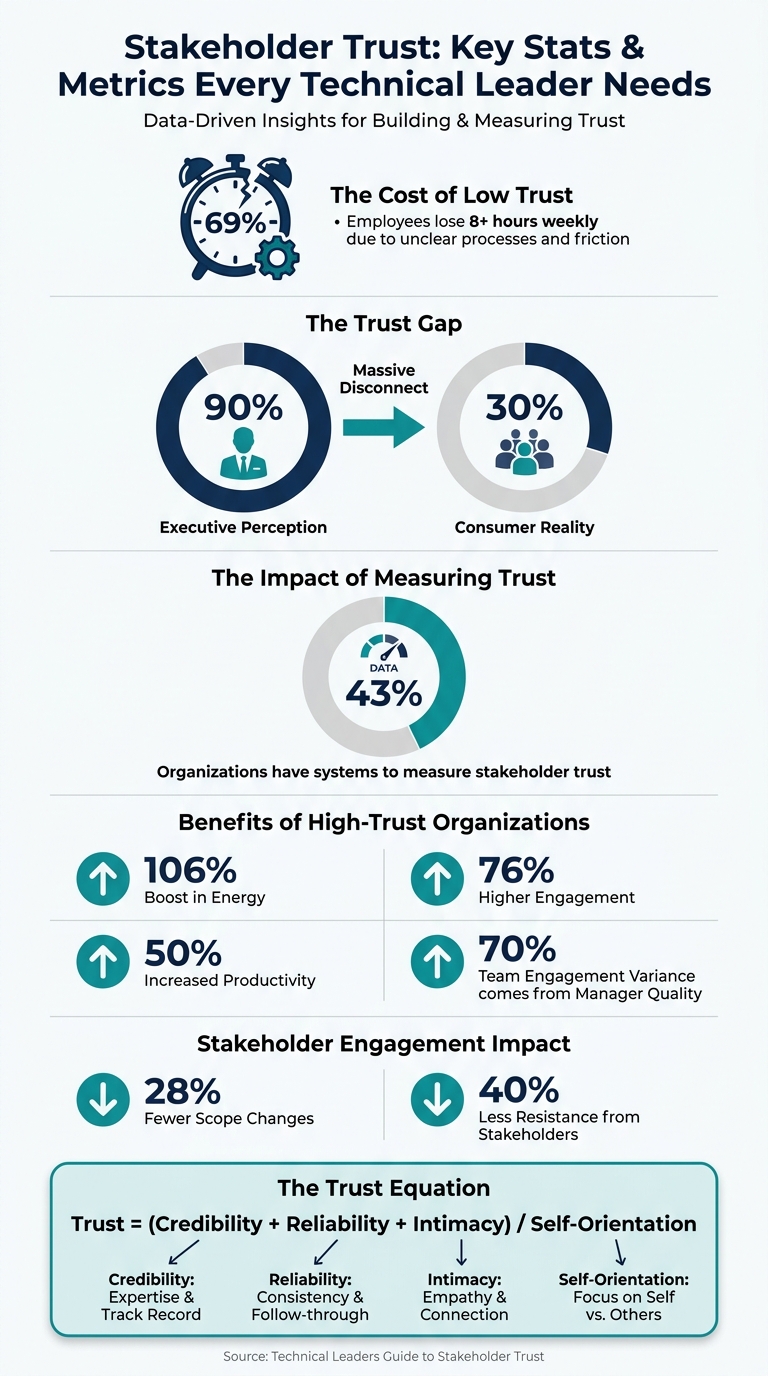
- Low trust costs time and resources: 69% of employees lose 8+ hours weekly due to unclear processes and friction.
- Practical tools help manage stakeholders: Use frameworks like the Power/Interest Grid and RACI for clarity and accountability.
- Measure and monitor trust: Track metrics like stakeholder satisfaction, decision-making efficiency, and information flow.
- Consistency matters most: Deliver on promises, communicate proactively, and involve stakeholders in decisions.
This guide provides clear steps to strengthen trust, from mapping stakeholders to repairing relationships after setbacks.
Stakeholder Trust: Key Stats & Metrics Every Technical Leader Needs
Managing Stakeholders - Building Trust for Project Success | Episode 511
sbb-itb-8feac72
Core Principles of Stakeholder Trust
Trust isn’t something that just happens - it’s built through consistent actions that reflect credibility, reliability, intimacy, and a focus on others rather than oneself. These elements are captured in the Trust Equation.
The Building Blocks of Trust
The Trust Equation - Trust = (Credibility + Reliability + Intimacy) / Self-Orientation [3] - provides a clear framework for understanding trust. Even with strong credibility, trust can crumble if stakeholders sense that a leader is more focused on personal gain than shared goals. In technical leadership, putting stakeholder outcomes first is non-negotiable.
Here’s how the components of trust translate into technical leadership:
| Trust Component | In Practice |
|---|---|
| Credibility | Providing data-driven estimates and showcasing domain expertise |
| Reliability | Consistently delivering on small commitments, not just big milestones |
| Intimacy | Creating an atmosphere where stakeholders feel safe sharing concerns |
| Self-Orientation | Focusing on team and stakeholder success over personal recognition |
Sandra Sucher, a Harvard Business School professor, emphasizes this point:
"Trust is not just a feeling - it is created through actions." [1]
The Wells Fargo scandal of 2016–2017 is a cautionary tale. Misaligned priorities and unethical leadership led to a fraudulent accounts debacle, slashing the company’s profits by half in just one quarter and severely damaging its reputation [6].
With this foundation in mind, the next step is identifying and prioritizing the stakeholders who rely on these principles.
How to Map and Prioritize Stakeholders
Not all stakeholders require the same level of engagement. The Power/Interest Grid is a practical tool for categorizing stakeholders based on their influence and interest in your work [7].
| Quadrant | Strategy | Communication Cadence |
|---|---|---|
| Manage Closely (High Power / High Interest) | Deep involvement and collaboration | Weekly 1:1s, steering committees |
| Keep Satisfied (High Power / Low Interest) | Focused, impact-driven updates | Monthly summaries, risk alerts as needed |
| Keep Informed (Low Power / High Interest) | Regular transparency and feedback | Biweekly newsletters, demos |
| Monitor (Low Power / Low Interest) | Minimal engagement, observe for changes | Quarterly updates, all-hands meetings |
For example, stakeholders in the "Keep Satisfied" quadrant, like CFOs or board members, might not engage regularly but can veto projects unexpectedly. Providing concise, business-focused updates to this group can prevent last-minute objections [10][11].
Beyond categorization, it’s essential to track each stakeholder’s stance - whether they’re a Champion, Supporter, Neutral, Skeptic, or Opponent. Stakeholder positions can shift during a project, and organizations that treat engagement as a strategic priority (rather than a formality) report 28% fewer scope changes and 40% less resistance from stakeholders [9].
Governance and Accountability
Governance ensures trust principles are applied in day-to-day operations. Without clear structures, confusion about decision-making and accountability can erode trust.
One effective tool is the RACI framework, which assigns roles for every major decision:
- Responsible: Does the work
- Accountable: Owns the outcome
- Consulted: Provides input
- Informed: Receives updates afterward
This structure avoids "consultation fatigue", where stakeholders are looped in unnecessarily or without clear purpose [7].
The concept of "minimum necessary control" is another way to balance trust and autonomy. Standardizing processes around high-risk areas - like production access, release protocols, or dependency management - provides guardrails while allowing engineers the freedom to decide how to execute [2]. When mistakes happen, blameless postmortems focus on improving systems rather than assigning blame. This encourages early reporting of risks and fosters a culture of openness [2].
"When governance structures do not clearly define who owns decisions, who is consulted, and how outcomes are traced, trust erodes at the execution layer, not just the boardroom." - The Moxo Team [13]
Practical Ways to Build and Maintain Stakeholder Trust
Turning trust-building principles into everyday habits is critical for technical leaders who want to earn and keep stakeholder confidence. At its core, trust is built through consistent actions - how you communicate, what you deliver, and how you involve others in the decision-making process.
How to Communicate with Stakeholders
Effective communication requires more than just reacting to issues as they arise. Instead, technical leaders should establish a steady, predictable rhythm. This could include weekly written updates, biweekly verbal check-ins, and monthly summaries. Such a routine not only reduces stakeholder anxiety but also minimizes the need for ad-hoc status requests [14][12].
When sharing updates, focus on framing technical progress in terms of business outcomes. For example, instead of detailing code changes, highlight measurable results like "a 40% drop in page load times." This approach makes technical work more relatable and builds credibility [14][15].
Stick to a "No Surprises" rule. If an issue arises, communicate it early and directly. Stakeholders value visibility, and addressing problems head-on helps maintain their confidence [16][4][3].
For routine updates, written communication works best. However, sensitive matters - like delivering bad news, addressing conflicts, or discussing complex trade-offs - are better handled in live conversations [16]. By consistently communicating clearly and proactively, you establish a reputation for reliability.
Delivering on Your Commitments
Clear communication is just the starting point. Following through on your promises is what truly cements trust. Whether it’s sending a status update on time, resolving a bug within the agreed timeframe, or flagging a risk before it becomes critical, these small but consistent actions build a reputation for dependability [5][19].
One effective strategy is to under-promise and over-deliver. For instance, if a project will likely take three weeks, setting a four-week timeline allows room for unforeseen delays while managing expectations [14][4]. When stakeholders push for faster timelines or additional features, rely on data - like historical team velocity, capacity, and trade-offs - to explain the impact. For example, you might say, "Adding this feature will delay the release by two weeks" [5][19].
"An engineering manager who builds excellent internal team processes but fails to maintain stakeholder trust will find their team constantly under fire, underresourced, and fighting for legitimacy."
- Engineering Manager Tools [5]
To further reinforce trust, maintain an evidence ledger with links or screenshots that document progress. A decision log, capturing outcomes and the reasoning behind them, can also prevent misunderstandings and provide clarity [18][20].
Involving Stakeholders in Decisions
When stakeholders are part of the decision-making process, they’re more likely to be invested in the results. Before making major decisions, meet individually with key stakeholders to address any concerns privately. This step reduces the likelihood of surprises during group discussions [10].
Use a clear decision-making framework, like DACI (Driver, Approver, Contributors, Informed), to clarify roles. This eliminates confusion about who holds decision-making authority versus who is simply being updated [10][9].
Be transparent about trade-offs. For instance, if approving one feature means delaying another, explain this clearly using tools like RICE or MoSCoW. This approach shows that decisions are based on thoughtful analysis rather than personal opinions [10].
As the ITU Online Editorial Team explains:
"Technical correctness does not create alignment by itself. Stakeholders usually approve what they understand, trust, and can defend to their own teams."
- ITU Online Editorial Team [17]
Lastly, consider hosting regular office hours - informal sessions where stakeholders can ask questions or share feedback. These open channels of communication reinforce transparency and foster trust [9]. By actively involving stakeholders, you not only strengthen trust but also demonstrate a commitment to shared goals and open dialogue.
How to Measure and Monitor Stakeholder Trust
Building trust is one thing, but figuring out if it’s actually working is another challenge altogether. Many leaders rely on intuition, but that’s not enough. In fact, only 43% of organizations have systems in place to measure stakeholder trust [1]. That leaves most operating without a clear picture.
Metrics for Measuring Trust
Measuring trust involves more than a simple survey. It’s about understanding how you’re performing across four key dimensions: Humanity (are you empathetic and fair?), Transparency (are you open about your reasoning?), Capability (do you deliver quality?), and Reliability (do you follow through?) [21]. By tracking these areas, you get a clearer view of where trust is strong - and where it’s slipping.
Tools like stakeholder satisfaction surveys and Net Promoter Scores (NPS) are a good starting point, but they only tell part of the story [8]. These metrics show how stakeholders feel in the moment but don’t reveal the underlying reasons. You need to dig deeper. For example, following up on low NPS scores with direct conversations can uncover the specific issues behind the numbers - and those insights are often more valuable than the score itself [1].
There’s also a major disconnect when it comes to trust: 90% of executives believe their companies are trusted, but only 30% of consumers agree [8]. This gap highlights the importance of actively measuring trust instead of assuming all is well.
Setting Up Ongoing Trust Monitoring
Measuring trust shouldn’t be a one-time event. It needs to become part of your regular operations. Michael Bondar, Enterprise Trust Leader at Deloitte Consulting LLP, emphasizes this point:
"Measuring trust is not a core competency for most organizations, but multiple approaches to trust measurement are emerging, from the very tactical to the highly strategic." [1]
Start by establishing a baseline. Conduct an initial survey with key groups - employees, partners, and executives - and document the results. From there, integrate trust-related questions into your existing processes, like quarterly reviews or biannual retrospectives. This doesn’t require reinventing the wheel; it’s about weaving trust checks into what you’re already doing.
In addition to surveys, keep an eye on operational signals - the subtle behaviors that reflect trust levels without anyone needing to say a word.
| Operational Signal | Low-Trust Indicator | High-Trust Indicator |
|---|---|---|
| Decision Making | Pushed upward to avoid liability | Made independently at the right level |
| Information Flow | Hoarded or filtered before sharing | Flows freely across teams |
| Innovation | Risk-aversion is the default | Calculated risks are encouraged |
| Execution | Excessive check-ins to verify status | Work moves fast without constant oversight |
(Source: monday.com, 2026) [22]
For example, if decision-making starts getting bogged down or you notice stakeholders seeking excessive verification, take these as early warning signs. These patterns often signal trust issues that, if addressed quickly, can prevent more serious problems.
How to Repair Trust After a Setback
When trust takes a hit, it doesn’t happen all at once. You’ll notice it in subtle ways: slower responses, more questions about your decisions, or stakeholders escalating concerns [3]. When these red flags appear, act fast.
Recovering trust involves two key steps [23]. First, demonstrate resilience. Acknowledge the issue openly, explain what went wrong, and outline your plan to fix it. Avoid vague statements like "mistakes were made." Specificity and visible action are what rebuild confidence [4]. Second, demonstrate competence. Focus on your core commitments and consistently deliver on them to prove you’re still reliable.
One helpful framework is the Trust Equation: Trust = (Credibility + Reliability + Intimacy) / Self-Orientation [25]. If stakeholders feel you’re acting in your own interest rather than theirs (high self-orientation), trust erodes quickly. Addressing this perception through open discussions and shared decision-making can often repair trust faster than anything else.
As Aida Figuerola, Neuropsychologist at Lift, puts it:
"Stakeholders don't expect you to be flawless. They expect you to be honest when you're not. Show the work, not just the wins." [24]
Conclusion: Trust as a Core Leadership Skill
Trust is the bridge that turns technical decisions into shared commitments. While authority might secure compliance, trust is what fosters genuine dedication and collaboration.
Key Takeaways
Organizations that cultivate trust see remarkable benefits: a 106% boost in energy, 76% higher engagement, and 50% increased productivity. What’s more, 70% of team engagement variance comes down to manager quality [28][4]. These figures highlight the profound influence of leadership on team dynamics.
The central message here is straightforward: trust isn’t built through flashy gestures but through consistent, everyday actions. The "Trust Stack" - which includes Clarity, Competence, Care, and Consistency [26] - offers practical ways to strengthen trust. For example, following through on small commitments, sharing difficult news promptly, owning mistakes, and closing communication loops all contribute to a reservoir of trust. These habits not only enhance credibility but also prepare you to lead effectively when challenges arise.
Next Steps for Technical Leaders
To grow as a leader, focus on honing skills like communication, accountability, and stakeholder engagement. Revisit the trust pillars - competence, reliability, intimacy, and transparency - and decide where to start improving.
Here’s a practical idea: pick one Trust Stack pillar to work on this week. For instance, if you choose Consistency, make it a point to follow up on unresolved issues. If Clarity is your focus, take time to explain the reasoning behind your decisions, not just the decisions themselves. These small, deliberate actions can lead to meaningful change over time.
If you’re eager to dive deeper into these skills, Tech Leaders offers training programs tailored to help technical professionals build leadership capabilities. Their courses, including one dedicated to trust and communication, are designed to bridge the gap between technical expertise and essential leadership skills [27].
FAQs
What’s the fastest way to rebuild trust after a missed deadline?
To regain trust after a missed deadline, start by acknowledging the situation openly. Take full responsibility without offering excuses, as accountability is key. Then, outline a clear and realistic recovery plan to address the issue.
Using the SBAR framework - Situation, Background, Assessment, Recommendation - can help you communicate effectively. This structured approach ensures you provide all the necessary details while staying concise and focused.
From there, follow through consistently. Stick to the revised timeline, meet your commitments, and provide regular updates to demonstrate reliability. Strengthening your communication and leadership skills will also play a big role in rebuilding credibility and maintaining trust in the long run.
How do I tailor updates for different stakeholder types?
The first step is to identify your stakeholders and understand what matters most to them, as well as how they prefer to communicate. A power-interest grid can help you determine the right level of engagement for each group.
Here’s a breakdown of common stakeholder priorities:
- Executives: They care about the big picture - business impact, strategy, and results. Keep your updates brief and focused on high-level outcomes.
- Product Managers: Their main concern is staying on schedule. Highlight timelines and progress to keep them aligned.
- Technical Peers: They need specifics. Share detailed information about dependencies and technical challenges.
For leaders, concise summaries work best. For collaborators, detailed data is key. When you present technical work in terms of business outcomes, it not only builds trust but also reduces the number of unexpected questions or interruptions.
Which trust metrics should I track without over-surveying people?
To prevent over-surveying, pay attention to behavioral and operational indicators that offer a real-time picture of trust. Important metrics to monitor include:
- Say/Do consistency: How often are commitments fulfilled without needing additional explanations?
- Stakeholder behaviors: Look for actions such as early sharing of concerns or providing honest feedback.
- Proactive communication frequency: How often are updates shared without being prompted?
By keeping an eye on these patterns, you can assess trust effectively while maintaining a balance of transparency, reliability, and fairness - without overwhelming people with too many surveys.